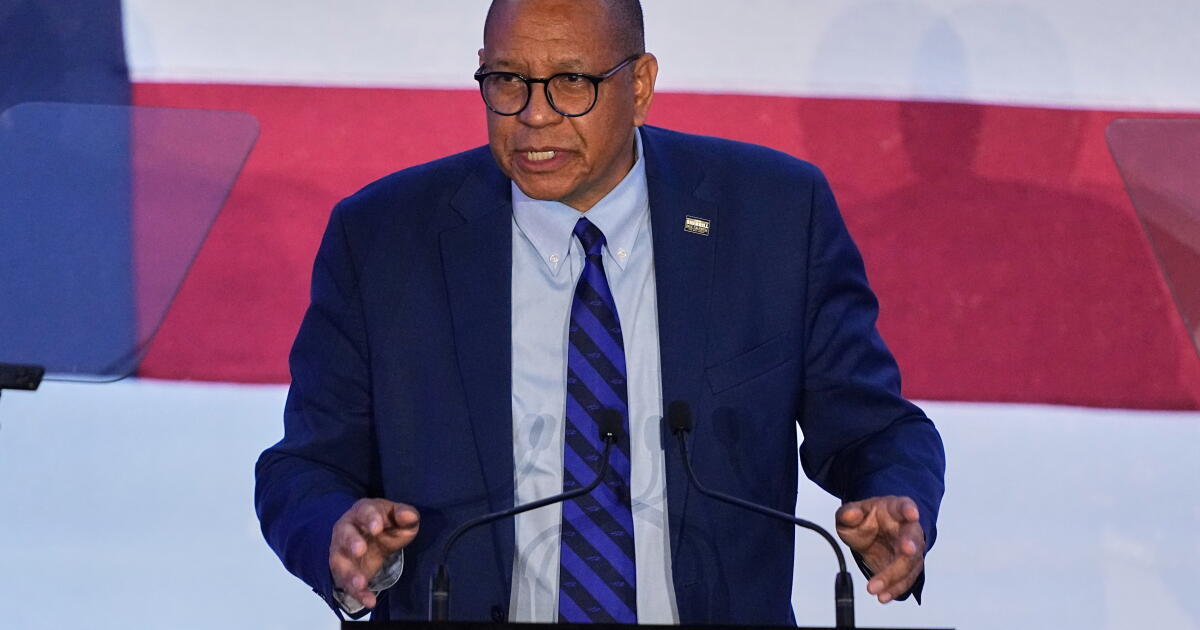
resigns

Mexico’s Sinaloa state governor resigns amid US drug trafficking charges | Crime News

Ruben Rocha Moya again denies allegations he shielded cartel, says taking ‘temporary leave’ to defend self.

The governor of Mexico’s Sinaloa state has temporarily resigned days after being charged by United States authorities in a sweeping drug trafficking indictment that has further strained relations between the two countries.

In a brief video statement posted late Friday, Ruben Rocha Moya again denied any wrongdoing, but said he was taking “temporary leave” to defend himself against the US allegations.

Recommended Stories

list of 3 itemsend of list

The indictment unsealed by US prosecutors earlier this week claimed that Rocha Moya and nine other officials directly aided the Sinaloa drug cartel in its smuggling operations in exchange for political support and bribes.

That support included members of the powerful cartel kidnapping and threatening opposition candidates in the 2021 election and stealing paper ballots cast for those running against Rocha Moya, the indictment charged.

Rocha Moya is a member of President Claudia Sheinbaum’s progressive Morena party.

“My conscience is clear,” Rocha Moya said in the video message. “To my people and to my family, I can look you in the eye because I have never betrayed you, and I never will.”

Juan de Dios Gamez Mendivil, the mayor of the Sinaloa state capital Culiacan who was among the other officials charged by the US, also announced he would step down on Saturday. He has denied the allegations.

Sheinbaum has also pushed back on charges, which come at a time when she has sought to navigate tense relations with the administration of US President Donald Trump.

On Thursday, she said her government had not been provided with any concrete evidence to back up the claims, suggesting the information laid out in the indictment was insufficient.

“My position on these events is as follows: truth, justice and the defence of sovereignty,” Sheinbaum said.

She added that if “clear and irrefutable evidence” is presented, the US still must proceed “in accordance with the law under our jurisdiction”.

Sheinbaum maintained her government will not “shield anyone who has committed a crime”.

“However, if there is no clear evidence,” she added, “it is evident that the aim of these charges by the [US] Department of Justice is political.”

Tense US-Mexico relations

Since taking office in January of last year, the Trump administration has heaped pressure on Mexico to do more to address migration and drug smuggling.

The approach has included Washington imposing a host of tariffs as leverage against Mexico’s government.

The US State Department has also labelled several Latin American drug cartels as “Foreign Terrorist Organisations”, an unorthodox move in line with the administration’s more militaristic approach to Latin America.

The administration has broadly argued that the criminal groups are driven, in part, by efforts to destabilise the US, a claim rejected by many longtime experts.

Sheinbaum has walked a careful line with Trump, increasing cooperation in countering cartels while pledging to protect Mexico’s sovereignty. Notably, she has staunchly opposed the prospect of any US military action on Mexican soil.

But experts have said charging elected officials in Mexico represents a major escalation in the Trump administration’s strategy.

Speaking to Al Jazeera this week, Vanda Felbab-Brown, an expert on non-state armed groups at the Brookings Institution think tank in Washington, DC, said the approach had “long been considered a very big step, almost a ‘nuclear option’”.

She predicted more US indictments were likely to come.

Source link

Viktor Orban resigns seat in Hungarian parliament

Former Prime Minister of Hungary Viktor Orban, pictured at a meeting at the White House in November 2025, on Saturday announced that he will step down from the Hungarian parliament to focus on rebuilding his party after its landslide defeat in recent elections. File Photo by Aaron Schwartz/UPI | License Photo

April 25 (UPI) — Former Hungarian Prime Minister Viktor Orban on Saturday said he will give up his seat in Parliament to focus on rebuilding his Fidesz-KDNP party after its election losses two weeks ago.

Orban said that he is leaving the parliament to focus on rebuilding the far-right, Russia-aligned party after it secured only 55 seats in Hungary’s parliament in elections on April 12, Politico and The New York Times reported.

Peter Magyar’s Tisza party won 138 of the parliament’s 199 seats in a landslide victory ending 16 years of Orban running the country.

“I am needed not in Parliament but in the organization of the patriotic movement,” Orban said in a video message posted on social media.

“Discussions are in full swing about renewing the patriotic camp, strengthening our parliamentary group and protecting our communities,” he said.

Magyar will take over as prime minister on May 9 and, because Tisza has more than two-thirds of the parliament’s seats, he can undue some of the actions Orban took during his rule, which included cracking down on the media and a host of democratic institutions.

Orban, who was in Hungary’s parliament since 1990 and prime minister since 2010, said he plans to remain in charge of Fidesz and will seek re-election in June to keep the job.

President Donald Trump speaks during a Health Care Affordability event in the Oval Office at the White House on Thursday. Trump announced announced a new drug price deal with Regeneron. Photo by Will Oliver/UPI | License Photo

Source link

Billy Donovan: Chicago Bulls head coach resigns after six seasons

Billy Donovan has resigned as head coach of the Chicago Bulls, ending his six-season tenure, after missing out on the play-offs.

The Bulls wanted to retain Donovan’s services despite parting company with vice president of basketball operations Arturas Karnisovas and general manager Marc Eversley on 6 April.

Donovan, 66, held an option in his contract for next season but has decided to step down to allow a new coach to rebuild.

“After a series of thoughtful and extensive discussions with ownership regarding the future of the organisation, I have decided to step away as the head coach of the Chicago Bulls, to allow the search process to unfold,” Donovan said.

“I believe it is in the best interest of the Bulls, to allow the new leader to build out the staff as they see fit.”

Source link

Democratic Rep. Sheila Cherfilus-McCormick of Florida resigns amid ethics investigation

Rep. Sheila Cherfilus-McCormick is resigning from Congress rather than be formally disciplined by the House as part of an ethics investigation into her use of campaign funds.

Explaining her decision in an extended social media statement on Tuesday, the Florida Democrat decried the internal investigation process as unfair. She said the House Committee denied her and her new attorney adequate time to prepare a defense.

“Rather than play these political games, I choose to step away,” she wrote.

Members of the House Ethics Committee on Tuesday had been set to weigh what punishment to recommend after they found she committed 25 violations of House rules and ethical standards, including breaking campaign finance laws.

Republicans had already called for the expulsion of Cherfilus-McCormick, who was in her third term and was running for reelection in a southeastern Florida district. She is also facing federal criminal charges accusing her of stealing $5 million in coronavirus disaster relief funds and using the money to buy items such as a 3-carat yellow diamond ring.

Cherfilus-McCormick has pleaded not guilty to the criminal charges and says she is not guilty of ethics violations, either.

The allegations against the congresswoman center on how she received millions of dollars from her family’s healthcare business after Florida mistakenly overpaid the business by roughly $5 million with COVID-19 disaster relief funds. She is accused of using that money to fund her 2022 congressional campaign through a network of businesses and family members.

Cherfilus-McCormick declined to testify during a previous Ethics Committee hearing, citing her Fifth Amendment right against self-incrimination. Her attorney, William Barzee, sparred with some of the lawmakers and argued that they should have allowed a thorough ethics trial, at which he could present witnesses and evidence to counter the conclusions of House investigators.

A group of supporters in Cherfilus-McCormick’s congressional district had weighed in on her behalf with the lawmakers who lead the Ethics Committee, urging committee leaders to proceed with caution.

“Our communities deserve stability. Our voices deserve to be heard. And our right to representation must be protected,” said one of the letters sent to the committee signed by about a dozen local faith leaders, union officials and others.

In all, the panel’s two-year investigation led to the issuance of 59 subpoenas, 28 witness interviews and a review of more than 33,000 pages of documents.

Rep. Greg Steube, a Florida Republican, had said he would move to expel Cherfilus-McCormick once the Ethics Committee made a determination on what punishment it would recommend.

That move could in turn prompt Democrats to seek the expulsion of Rep. Cory Mills, a Florida Republican who is the subject of a wide-ranging investigation by the Ethics Committee that includes whether he violated campaign finance laws, misused congressional resources and engaged in sexual misconduct or dating violence. That investigation is ongoing. Mills has denied any wrongdoing.

The focus on lawmaker wrongdoing comes just one week after two lawmakers resigned during ethics investigations into alleged sexual misconduct. Democratic Rep. Eric Swalwell of California and Republican Rep. Tony Gonzales of Texas headed off possible expulsion votes with their resignations.

House Democratic leaders had declined to condemn Cherfilus-McCormick, saying they wanted to see the ethics process play out. Potential punishments included a reprimand or a censure, which serve as forms of public rebuke. The committee could also have recommended a fine. The most severe form of punishment was expulsion, but the House has historically been reluctant to serve as the final arbiter of a lawmaker’s career, preferring to give that final say to the voters.

Only six members of the House have been expelled. The first three fought for the Confederacy during the Civil War and were expelled for disloyalty. The next two had been convicted of crimes. The final one was George Santos, the scandal-plagued freshman who was the subject of a blistering ethics report on his conduct as well as federal indictment. Santos, a New York Republican, served time in prison for ripping off his campaign donors before President Trump granted him clemency, and he has apologized to his former constituents.

Under the Constitution, at least two-thirds of the House has to vote for expulsion for it to occur, a high threshold that requires enormous bipartisan support.

House Speaker Mike Johnson (R-La.) told reporters last week he believes the House will move to expel Cherfilus-McCormick.

“The facts are indisputable at this point, and so I believe it’ll be the consensus of this body that she should be expelled,” Johnson said.

Freking and Groves write for the Associated Press.

Source link

Swalwell resigns seat in Congress amid rape and sexual misconduct allegations

California Rep. Eric Swalwell resigned his congressional seat on Monday under intense pressure from lawmakers of both parties after several women accused him of sexual misconduct, including a former staffer who alleged rape.

Swalwell, a Dublin Democrat who suspended his campaign for California governor on Sunday, said in a statement that he was stepping down from the House, where he has served since 2013, and planned to continue fighting what he called “serious, false” allegations made against him.

“However, I must take responsibility and ownership of the mistakes I did make,” Swalwell wrote without specifying which mistakes those were.

His resignation came hours after the House Ethics Committee opened an investigation into the sexual misconduct allegations against him and as lawmakers from both parties threatened to expel him from the House if he did not leave his post. He said he was aware of the expulsion efforts underway and said that it was “wrong” to expel a member of Congress “without due process, within days of an allegation being made.”

“But it is also wrong for my constituents to have me distracted from my duties. Therefore, I plan to resign my seat in Congress,” he said.

Asked about replacing Swalwell, Gov. Gavin Newsom’s office said in a statement that it is “reviewing the matter. Once the seat is officially vacant, our office will make an official announcement.”

The allegations, detailed in reports by the San Francisco Chronicle and CNN last week, drew swift bipartisan condemnation, with lawmakers from both parties calling the accusations “disgusting” and demanding that he either resign or be removed from office.

Rep. Anna Paulina Luna (R-Fla.) intended to lead the charge to expel Swalwell. In an interview Monday, Luna said she planned to file a motion as early as Tuesday on the grounds that he violated House rules over an alleged inappropriate sexual relationship with a subordinate. A House floor vote could have been held as early as Wednesday, she said.

Following Swalwell’s resignation, Luna said the Northern California lawmaker did “the right thing.” But she took issue with him saying that the allegations were not grounds for expulsion, noting that he was under criminal investigation.

In New York, the Manhattan district attorney’s office opened an investigation into sexual assault allegations against Swalwell by a former staffer and issued a statement over the weekend that urged “survivors and anyone with knowledge of these allegations to contact our Special Victims Division.”

After the sexual allegations came to light, Democrats called on Swalwell to resign, but when it comes to expulsion, they said they would not move against Swalwell alone. They were also pushing to expel Rep. Tony Gonzales (R-Texas), who last month admitted to a sexual relationship with a staffer who later died by suicide.

Late Monday, Gonzales said he too was stepping down. “When Congress returns tomorrow, I will file my retirement from office,” he wrote on X.

The push to get Swalwell expelled had gained traction even among his friends.

Sen. Ruben Gallego (D-Ariz.) wrote on X on Monday that Swalwell should be kicked out of Congress, saying he “trusted someone who I believed was a friend, but is now clear that he is not the person I thought I knew.” Gallego said the woman “deserves to be believed, to be supported, and to see justice served.”

Had Swalwell been expelled, it would have been the first such removal in congressional history on the grounds of sexual misconduct, and among the rare instances in the House’s 237-year history in which members ousted one of their own.

Only six members have been expelled from the House. Three were fighting for the Confederacy, two were convicted of bribery and one was the fraudster George Santos, whose sentence was later commuted by President Trump.

Now that Swalwell has resigned, he is still eligible for his pension and for a number of other perks extended to other former members, including the ability to enter the House floor and access to the congressional gym.

Swalwell said Monday that he is working with his staff to “ensure they are able, in my absence, to serve the needs of the good people of the 14th congressional district.”

While many of Swalwell’s staffers have already quit, remaining staffers not involved in constituent services would lose their jobs and receive no severance pay.

Daniel Schuman, executive director of the American Governance Institute, which is focused on congressional reform, argues that the practice is unfair.

“I think the House owes them a duty for what they’ve had to go through,” Schuman said.

Longtime ethics expert Meredith McGehee said that members have been reluctant to expel their colleagues in recent years because of the razor-thin majorities in the House, but that not doing so hurts the credibility of the institution.

“It’s really important at this moment that the House act to expel these men who have been seriously and credibly accused of wrongdoing,” said McGehee, a former executive director of the ethics watchdog Issue One. “To allow either one of them to stay in office and serve out their term would be a farce.”

The Swalwell scandal could still prompt an ever larger surge of expulsion calls. Some lawmakers called for two additional members to be swept into any expulsion vote: Rep. Cory Mills (R-Fla.), who has been accused of sexual assault, and Rep. Sheila Cherfilus-McCormick (D-Fla.), who was indicted on charges that she laundered $5 million of federal disaster money and used it to fund a political campaign.

“Reps. Swalwell, Gonzales, Cherfilus-McCormick, and Mills should resign. If they refuse, they should be expelled,” Rep. Nydia Velazquez (D-N.Y.) wrote on X on Monday. “Americans deserve better and Congress must hold our members accountable.”

Any expulsion would require a two-thirds majority vote, or 290 of 435 votes if every House member participates. The Senate would not be required to concur with the House vote to make the expulsion effective, but it remains to be seen whether the House could meet the two-thirds threshold.

Times staff writer Melody Gutierrez in Sacramento contributed to this report.

Source link

Embattled Director of State Lottery Resigns : Government: Sharon Sharp cites family reasons. She had been criticized over awarding of major contracts.

Sharon Sharp, the embattled director of the California Lottery criticized for her handling of major contracts, resigned Monday, saying that months of controversy had made her “tired and angry.”

Insisting the resignation was her idea and not that of Gov. Pete Wilson, Sharp said she was stepping down so she could spend more time with her husband, who lives in Illinois. However, a source in the Administration said she was urged to resign.

“It’s just time for me to go home,” said Sharp, who is credited with adding several lottery games, including Keno, and of helping to turn around the agency’s downward revenue slide.

“I’m grateful to the governor . . . who I’m sure wished many times that the lottery would stay out of the news and most especially that I would stay out of the news.”

Sharp’s resignation came several weeks after it was disclosed that the former lobbyist for a company that received lucrative lottery contracts described Sharp in a secretly tape-recorded conversation as “our gal.” The conversation was played during a federal court trial of lobbyist Clayton R. Jackson, who has been charged with racketeering and money laundering.

On Monday, Sharp dismissed Jackson’s comments as the idle boasting of a lobbyist who wanted to impress others with his ability to gain access to public officials. Calling Jackson’s statement “ridiculous,” she maintained that her relationship with his former client, GTECH Corp. of Rhode Island, had always been professional and that there was no conflict of interest.

“I’m Don Sharp’s gal,” she quipped, referring to her husband of 34 years.

In a short statement, Wilson praised Sharp for “innovative leadership” at the lottery, especially improvements in customer services and the addition of new games–Keno, Fantasy 5, Daily 3 and multiple Scratchers, which helped boost sales. A spokesman for the governor said Wilson’s staff would conduct a nationwide search for her replacement.

“Her job is completed,” Wilson said. “She will give her successor a more efficient and more effective lottery to support education for California’s children.”

But the tense news conference announcing Sharp’s resignation contrasted starkly with the one two years ago in which the governor proudly announced her appointment.

At the time, Wilson said Sharp was his handpicked choice to revitalize a demoralized lottery and reverse a decline in sales that had caused deep reductions in the agency’s contributions to public schools.

Sharp, 53, left office Monday having accomplished the sales turnaround but also having created so much controversy over her handling of contracts that she became a political liability for the Wilson Administration.

Sharp was director of the Illinois lottery before coming to California. She commuted to her home in Chicago throughout her tenure and said Monday that she has no job lined up after leaving.

Although the governor’s office Monday had nothing but public praise for her work, staff members privately have been expressing concern about the appearance of favoritism in the awarding of lottery contracts.

Just days before Sharp’s resignation, Wilson’s chief of staff, Bob White, spoke generally of worries about the lottery’s contracting process.

“You want to make sure that the process and every contract let, on something as major as this, is above suspicion,” he said. “Our main goal was to make the things not sole sources; to make it as competitive as could be in a not very competitive world.”

White denied that Sharp was pressured to resign, but a source familiar with the lottery said an Administration official sent to review the lottery’s operation came away “concerned at the way they conducted business.” The source said the governor’s office urged Sharp to resign.

“I think it’s a welcome step,” said Sen. Tom Hayden (D-Santa Monica), one of Sharp’s most vocal critics. “I think it has just become a tainted and unmanageable mess over there. She would have nothing to look forward to but grief.”

Hayden said he will ask the governor and attorney general to investigate the lottery’s relationship to GTECH and to work with other states where the company’s contracts are being criticized.

As one of her final acts in office, Sharp said she had asked for a state audit of the lottery’s handling of a $400-million, five-year contract awarded GTECH to operate its computerized games. “For the sake of the future of the California Lottery, this issue must be put to rest,” she said.

During Sharp’s tenure, GTECH was awarded three lottery contracts totaling nearly $500 million and was recommended for a fourth–all without competitive bids.

Sharp had been in office only a few months in 1991 when she proposed a one-year extension of GTECH’s contract to operate the computerized games.

Her recommendation came just days after former state Sen. Alan Robbins pleaded guilty to a series of charges including accepting a $13,500 bribe allegedly from Jackson, to influence legislation of interest to GTECH.

Although the company was never implicated in the charges, an embarrassed governor’s staff asked the agency to delay awarding the contract for at least a month. Before the contract extension expired, Sharp again recommended–and the Lottery Commission approved–a $25-million amendment for the purchase of 2,000 additional terminals and upgrades to the computer system. Several staff members complained internally that the purchase should have been handled by competitive bids.

A year later, she did seek competitive bids, this time for a new computer contract, but GTECH was the only company to submit a proposal.

Rival companies complained that the specifications for the contract so favored GTECH that it was useless for them to bid. Sharp insisted that the specifications were standard for the industry and again recommended that GTECH get the contract. The commission agreed.

In September, she proposed that GTECH receive another contract without competitive bid to provide an automated system that would make it easier to cash lower-prize Scratchers. She later withdrew her recommendation after the governor’s office expressed displeasure at the lack of competition. That contract is still pending.

Asked at the conclusion of proceedings Monday in his corruption trial for his opinion on Sharp’s resignation, Jackson said: “That’s too bad. . . . If this (the trial) was all over, I’d say something.”

Times staff writer Mark Gladstone contributed to this story.

Out of the Game

California State Lottery Director Sharon Sharp announced her resignation Monday, two years after she was appointed to the job by Gov. Pete Wilson. Here is a snapshot of the performance of the lottery under her tenure.

NUMBER OF PLAYERS: 8 million a month

GAMES INTRODUCED

* Dec. 1991: SuperLotto

* Feb. 1992: Fantasy 5

* April, 1992: Daily 3

* Nov. 1992: Keno

ANNUAL LOTTERY REVENUE (In billions of dollars) ‘85-’86: $1.8 ‘86-’87: $1.4 ‘87-’88: $2.1 ‘88-’89: $2.6 ‘89-’90: $2.5 ‘90-’91: $2.1 Sharp’s term: (Sept. 1991 to Nov. 1993) ‘91-’92: $1.4 ‘92-’93: $1.8

Source link

Italy 2026 World Cup: Gabriele Gravina resigns as head of the Italian Football Federation

Gabriele Gravina has resigned as the head of Italy’s football association (FIGC) following their failure to qualify for a third consecutive World Cup.

The four-time world champions suffered another play-off final defeat when they were beaten 4-1 on penalties by Bosnia-Herzegovina on Tuesday.

No previous winner of the tournament has missed three World Cups in a row, which Italy now have after missing out on Russia in 2018 and Qatar 2022.

Also on Thursday, former goalkeeper Gianluigi Buffon, who was working closely with the men’s national team, resigned as delegation head via Instagram., external

Buffon, who was part of Italy’s 2006 World Cup-winning side, wrote that with Gravina’s decision to go, he felt, “as an act of responsibility”, he should do the same.

“The main objective was to bring Italy back to the World Cup. And we didn’t succeed,” Buffon, 48, added.

“It’s fair to leave it to those who will come after the freedom to choose the figure they think is best to play my role.”

Gravina, 72, who is the Uefa first vice-president, announced his resignation following a meeting held at the FIGC’s headquarters in Rome.

He took the job in October 2018, with his predecessor Carlo Tavecchio having stepped down following Italy’s failure to beat Sweden in a World Cup play-off the previous year.


Source link