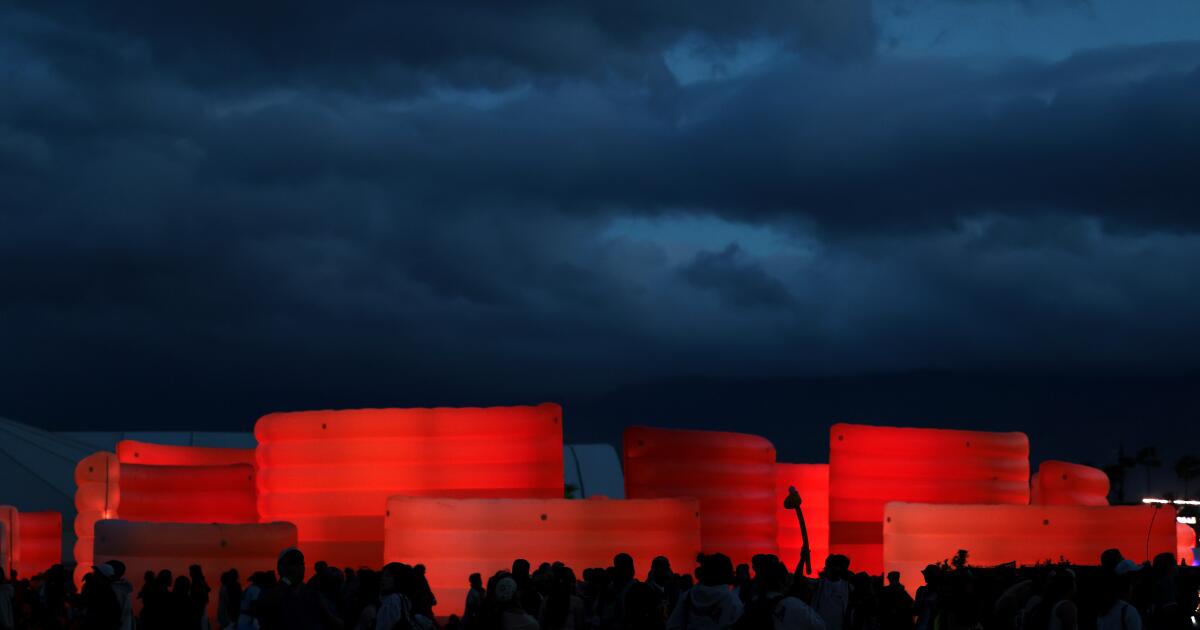
Dust storms have overtaken Coachella. Researchers say it’s a sign of what’s to come
A powerful dust storm disrupted the first weekend of the Coachella music festival as blustery winds swept over the sprawling grounds and enveloped concertgoers in a whirlwind of desert sand.
Several social media videos from last Friday night showed attendees navigating the festival grounds amid wind-tossed tents and wearing face masks to guard against the airborne dust.
The weather conditions prompted the South Coast Air District to issue dust advisories for parts of the Coachella Valley, warning that strong winds could expose people to unhealthy dust levels. The dust storm caused festival organizers to cancel a highly anticipated performance by Italian EDM artist Anyma, who had been scheduled to perform Friday at midnight on the main stage.
“I don’t have many words other than to say I’m truly devastated and deeply sorry to everyone who showed up to the main stage, and to those watching the livestream at home,” he posted on X. “The dangerous winds not only prevented us and Coachella from building our stage, but also made it impossible for my entire live setup and performance to operate safely.”
It was the latest instance in which dusty conditions hampered one of the nation’s largest and most profitable music festival, which has been called “Dustchella.” But it is just one fragment of the economy disrupted by this natural phenomenon.
Wind-driven dust is an overlooked environmental hazard — and one that carries a hefty price tag. A recent study estimated that dust storms cost more than $154 billion in the U.S. in 2017, alone. The evaluation puts dust events on par with natural disasters in terms of economic costs, eclipsing, for example, the 2017 wildfire season but shy of that year’s hurricane season, according to Irene Feng, the lead author of the 2024 study, who researched dust at the University of Texas at El Paso.
“Dust is kind of a big deal,” said Feng, now a post-graduate student at George Mason University. “The fact that it was even comparable to hurricanes … was a huge surprise to me.”
Since researchers last attempted to calculate the costs associated with dust pollution in the 1990s, the numbers overall numbers essentially quadrupled.
Some of the greatest costs calculated in the new study include:
- $100 billion related to dust-related deaths and lost productivity from health issues, as inhaling dust particles can lead to serious respiratory illness and trigger heart attacks.
- $40 billion from additional household costs from cleaning, painting and property damage.
- $9.6 billion for damages to agriculture from lost water and weaker crop yields.
- $4 billion in lost value of weakened renewable energy generation, because dust obscures solar panels and gum up wind turbines.
- $280 million for traffic crashes caused by reduced visibility due to dust storms.
Among one of the most grave conditions Feng analyzed was a potentially life-threatening respiratory infection known as “valley fever.” Throughout much of Southwest, desert soil can be laced with Coccidioides fungus spores. When inhaled, this fungus can propagate in the lungs, potentially causing scarring and collapse of lungs.
In many cases, valley fever symptoms can mirror the flu or COVID, leading doctors to misdiagnose patients, and to not provide proper treatment.
Coachella, which is hosted at an irrigated polo field surrounded by desert, is particularly susceptible.
“When I heard that there was a dust event at Coachella, I was actually really concerned about the valley fever cases that might come out of that,” Feng said. “Because there’s so many people traveling from outside the state, and they don’t necessarily know what valley fever is.”
But devastating dust-related effects, like valley fever, can be mitigated, at least to some degree, according to environmental experts.
In California, state and local government agencies have launched dust-mitigation efforts by installing windbreaks, such as cultivating native plants or reshaping the topography with more ridges. About 200 miles north of Los Angeles, at the eastern base of the Sierra Nevada mountains, Owens Lake, a critical and controversial source of water for Angelenos, city officials say they have drastically reduced dust near the dry, exposed lake bed in recent years after implementing some of these measures.
Scientists say global warming is causing warmer temperatures and more intense droughts, paving the way for more dust emissions. Feng said that could require more innovative solution, more action and more money.
“From what I’ve seen, it’s projected to be dustier in the future,” Feng said. “So, all these effects, all these costs, they’re just only going to get worse.”
More recent air news
The NAACP sued Elon Musk’s artificial intelligence company this week, claiming xAI (the creator of Grok) violated federal clean air laws. The lawsuit, reported by CNBC’s climate tech reporter Lora Kolodny, accuses the company of installing and operating 27 natural gas-fired turbines to power its data center in Memphis without the necessary air permits.
Recent far-flung wildfire smoke has led to air quality risks in unlikely places. Now, Michigan, my beloved home state, is overhauling its air quality alerts system after having endured heavy smoke from Canadian wildfires in 2023 and 2025, per Planet Detroit’s senior reporter Brian Allnutt.
New research suggests methane emissions have been drastically underestimated in the country’s largest cities. An satellite analysis of 12 urban areas, including New York City and Los Angeles, found up to 80% more methane emissions than previously thought, according to ABC reporter Julia Jacobo.
Because methane warms the atmosphere far more than carbon dioxide, the findings underscore the need to investigate large emitters, such as landfills, gas pipelines and wastewater treatment facilities. One other, underreported source is California’s man-made lakes that we tap for drinking water, L.A. Times water reporter Ian James writes. Environmental groups are urging environmental regulators to investigate why.
A few last things in climate news
Sales of new electric vehicles have slumped as Trump has eliminated federal incentives for car buyers. But, as oil prices have spiked due to the war in Iran, used EV sales have jumped 20%, signaling a renewed willingness by Americans to ween themselves off fossil fuels, according to Bloomberg senior correspondent Kyle Stock.
Stingrays injuries in Southern California have been on the rise. LAist climate reporter Erin Stone, who was recently wounded by stingray’s barb herself, writes that warming waters attract more rays and make these painful encounters more likely.
Under an ambitious proposal, the Bay Area could host the world’s largest floating wind farm, taking California closer to its 100% renewable energy goal, L.A. Times climate reporter Hayley Smith writes. The plan would involve building hundreds of Eiffel Tower-sized wind turbines and towing them into the deep, breezy waters of the Humboldt Bay, where they could generate up to 15% of the state’s electricity.
This is the latest edition of Boiling Point, a newsletter about climate change and the environment in the American West. Sign up here to get it in your inbox. And listen to our Boiling Point podcast here.
For more air quality news, follow me at @_TonyBriscoe on X and on LinkedIn.