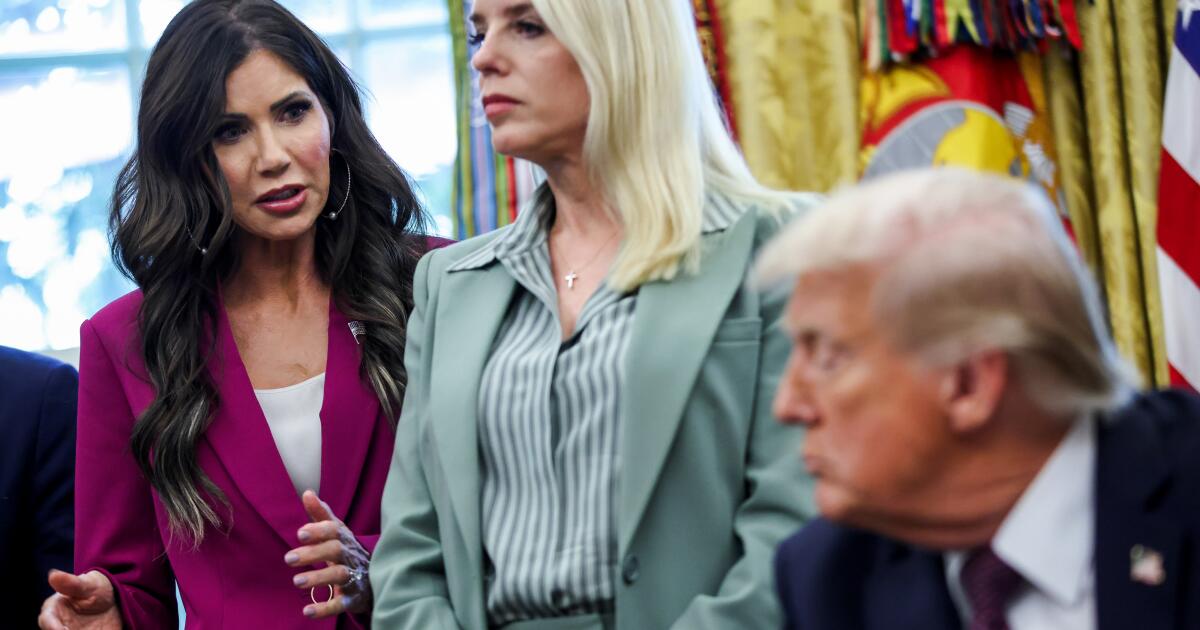
Bondi and Noem were incompetent. But that’s not the only reason they’re gone
Remember when our president attacked a female journalist for asking uncomfortable questions with a casual, sincere, “Quiet, piggy”?
That was five months ago, a lifetime in the chaos of the Trump administration, but it was a telling moment about how not just our president but those crafting his policy view women and their place in society. Hint: It’s not at the top.
While I have not a bit of pity or dismay that Pam Bondi and Kristi Noem — the former U.S. attorney general and the former secretary of Homeland Security, respectively — were given the ax by President Trump in recent days, it shouldn’t be lost that this is another “quiet, piggy” week in an administration that is increasingly openly hostile to women in power.
“I see a theme,” Texas Rep. Jasmine Crockett wrote on social media. “He will throw the incompetent women under the bus a lot faster than the incompetent men.”
When democracies decay, and especially when movements like Christian nationalism rise, an erosion of women’s equality almost always comes first. Bondi and Noem are part of a U.S. erosion that should alarm us all, whatever your gender identity.
First, the obvious. Good riddance. Noem seemed to relish cruelty, and treated her job like a costume party, constantly mugging for cameras with guns and faux toughness as if the dismantling of lives and imprisoning even children was a game. Never mind the grift.
Bondi, meanwhile, always seemed like the football team’s third-favorite cheerleader, desperately vying for the attention of the jock-gods around her, even if it meant groveling for approval, even if it meant selling out all women with her ultimate censoring of the Epstein files.
But while Bondi and Noem were obviously incompetent, incompetence has never been a fire-able offense for Trump. Just ask Pete Hegseth, whose Thor fantasies are currently playing out in an all-to-real war. Or Robert F. Kennedy Jr., who has dismantled American science while glorifying beef tallow and workouts in jeans. Don’t even get me started on Kash Patel.
It’s no accident that women at the top of Trump’s administration are being purged. They were useful in the first days of the regime, while power was still being consolidated and shimmers of diversity were helpful. But as the sexist and racist nature of the MAGA machine has gained mainstream acquiescence if not acceptance, the need to keep up the appearance of diversity is less and less.
Take, for example, the far-right attacks on Supreme Court Justice Amy Coney Barrett after her pointed and skeptical questions recently on Trump’s attempt to end birthright citizenship.
“A woman as a mother is a precious gift, but a woman as a civil magistrate is the death of the nation,” wrote far-right pastor and increasingly popular anti-equality influencer Joel Webbon on social media.
This is the same Texas gentleman who went viral recently for proclaiming, “Women, shut up! Of course. It is literally an offense to God” for women to have influence in the governing of society.
He’s also part of a group of far-right religious leaders — including a pastor associated with Hegseth — who support ending women’s right to vote and replacing it with a single “household” vote cast by, you guessed it, men.
Bondi and Noem may be the most high-profile examples of how this misogyny is playing out in MAGA reality, but they aren’t the only women forced out of power by Trump and his cronies this year. It’s a push that is far more systematic and insidious than we are giving them credit for. Hegseth has all but wiped women out of the top ranks of the military — just recently personally knocking two women off a promotions list.
RFK Jr. and others, meanwhile, are busy pushing women out of science. The Washington Post pointed out that last year at this time, the feds purged women and people of color from the boards that review the science and research happening at the National Institutes of Health— 38 out of 43 experts that were fired were women and minorities.
A report out last month also found that all those attacks on universities last year, with the cutting of grants even in areas such as cancer research — disproportionately affected female scientists. Many of these female scientists, especially younger ones, will never recover from those quashed research projects and lost jobs in a field that demands results and published work, meaning we are looking at a generational loss of female scientific talent.
And let’s not forget Renee Nicole Good, shot by an ICE officer in Minneapolis who, with as much casualness as Trump’s “quiet, piggy,” said “f—ing b—” after shooting her and walking away.
Bondi and Noem aren’t just unqualified villains shown the door. They are villainesses.
The Trump administration knows the difference, and so should we.