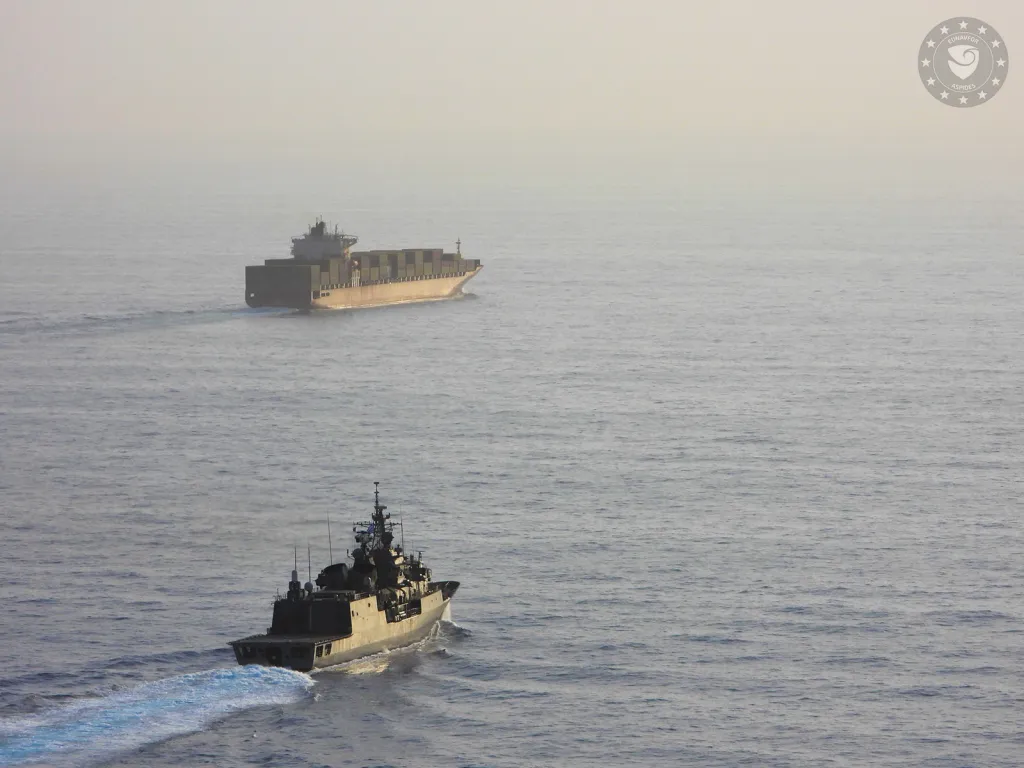
Red Sea Maritime Security Task Force Commander Talks Major Jump In Escort Requests (Updated)
The head of Operation Aspides, the European-led task force created to provide security for ships transiting the Red Sea region, tells TWZ that there has been a major increase in the number of commercial vessels seeking escorts since the U.S. and Israel started attacking Iran in February. Security concerns in that region have spiked after the Houthi rebels of Yemen imposed a blockade on Saudi shipping and began attacking the kingdom’s vessels and oil infrastructure. Late Thursday, the leader of the Houthis promised additional escalation against the Saudis.
“We have witnessed a significant increase in requests from commercial vessels seeking Aspides’ support for their safe transit through the High Threat Area (South Red Sea/Strait of Bab-al-Mandeb [BAM]/Gulf of Aden),” Rear Admiral Vasileios Gryparis, Commander of EUNAVFOR Aspides, told TWZ in an email. “In particular, the number of protection requests increased by 39% from February 2026 (the start of the US-Israel-Iran confrontation) until now.”

“The increasing number of protection requests clearly demonstrates that, in times of insecurity, the shipping industry views Aspides as a credible and reliable maritime security provider,” Gryparis added. “We are working daily to maintain and strengthen bonds with the shipping industry, as mutual understanding and effective collaboration are essential to maritime security and the preservation of Freedom of Navigation.”
As we were one of the first to report, Aspides was launched in February 2024 during the previous Houthi campaign against shipping that ended last September. It was created to provide “a shield…to act in purely defensive mode to protect merchant vessels, and two non-executive tasks of ‘accompanying’ to deter with [its] presence and to strengthen maritime situational awareness,” a now former top EU official told reporters at the time.
Since its founding, the task force “has facilitated the safe passage of more than 2,240 merchant vessels and has provided close protection to more than 690 merchant vessels of different flags and interests,” the Aspides commander explained.

Aspides did not provide assistance to vessels recently attacked by the Houthis because the task force was not asked, Gryparis told us.
“Those vessels were sailing within the territorial waters under the responsibility of the Kingdom of Saudi Arabia Maritime Rescue Coordination Centre (KSA MRCC),” he stated. “Consequently, assistance was provided by the Saudi Arabian authorities. The vessels in question had not registered their transit with the Maritime Security Centre Indian Ocean (MSCIO) and had not requested protection from EUNAVFOR Aspides.”
In addition to the blockade and strikes on Saudi assets, the Houthis are reportedly considering imposing a toll on Bab al-Mandeb Strait transits. Gryparis told us that such a move, which has yet to be enacted, would not alter Aspides’ goals.
“Such a development would not change the mandate or the mission of Operation Aspides,” the admiral proffered. “Our mission remains clear: to contribute to Freedom of Navigation, protect the lives of seafarers, support the secure flow of global trade by protecting merchant shipping, improve Maritime Situational Awareness, and contribute to regional stability.”
“Of course, any measure that could affect the free passage of commercial shipping has the potential to impact Freedom of Navigation and the confidence of the shipping industry,” he added. “How states or private shipping companies decide to address such a development would be a political and commercial decision for them.”
“From our perspective, we will continue to implement our mandate within our means and capabilities, continuously assess the maritime security environment, provide protection to eligible merchant vessels in accordance with our mandate, and support the shipping industry through Maritime Situational Awareness and the timely dissemination of information and recommendations via the Maritime Security Centre Indian Ocean (MSCIO),” Gryparis noted.
In a fiery speech, Houthi leader Abdul-Malik al-Houthi warned Saudi Arabia of an all-out escalation. He described his group’s actions as being in response to a Saudi “siege” on the Houthis in Yemen.
“The indicators show that the Saudi [side] is heading toward comprehensive escalation,” al-Houthi proclaimed. “We will seek God’s help against it — we will meet his comprehensive escalation with comprehensive escalation.”
“In this phase, regarding what the Saudi [side] has done, the outcome has been good since establishing the equation of (siege for siege) — in targeting Saudi oil tankers, in preventing their movement, turning back 16 ships, and also in shooting down the Saudi [-operated] aircraft that come to conduct reconnaissance and penetrate our airspace — armed drones,” the Houthi leader continued.
For its part, Saudi Arabia is creating its own maritime coalition to protect transits in the region.
“Recognizing the growing challenges facing global maritime security, and the resulting need to strengthen collective naval defense cooperation to protect freedom of navigation and international trade routes, and to secure global energy supply routes through the Bab-al-Mandeb Strait, the Red Sea, and the Gulf of Aden,” the Saudi Defense Ministry announced on Thursday. “The founding states affirm that the establishment of the Multinational Naval Defense Coalition represents a strategic step toward strengthening maritime security in the Bab-el-Mandeb Strait, the Red Sea, and the Gulf of Aden, consolidating defense cooperation among the member states, and supporting stability and prosperity — in a manner that contributes to complementing international efforts to protect international peace and security, in accordance with the provisions of international law.”
About 50 nations were asked to join and 14 so far have signed up. It is unclear at the moment how this will differ from Aspides.
Meanwhile, Iran claims it has completely shut down the Strait of Hormuz to vessels in the wake of recent U.S. attacks.
“Iran’s Persian Gulf Strait Authority (PGSA) says that passage through the Strait of Hormuz is currently impossible because of the continued ‘aggressive actions’ of US military forces in the region, adding that applications for transit would only be processed once stability returns,” the official Iranian Press TV media outlet claimed. Iran, however, frequently makes statements that are outright fabrications or extremely exaggerated. TWZ cannot independently verify this claim.
Traffic through that strategic chokepoint had already been significantly reduced by Iran since the launch of Epic Fury.
In a post on X, U.S. Central Command pushed back on that claim, saying the Strait remains open to shipping.
“CLAIM: Once again, the Iranian government claims it has closed the Strait of Hormuz. This is FALSE,” the command stated. “FACT: The Strait of Hormuz remains open for commercial vessel transit. Iran does not control it. Thousands of ships have sailed through the international waterway over the past four months.”
Regardless of the dueling claims, traffic through the Strait has slowed to a trickle, according to the Kpler global trade intelligence firm.
“The latest maritime risk data points to growing divergence across the region’s two strategic chokepoints,” Kpler stated on X. “Strait of Hormuz crossings fell 77% day on day to just five vessels, with all transits concentrated through the Iranian Unilateral Scheme, suggesting reduced operational confidence and limited routing flexibility. At the same time, Bab el Mandeb remained active, recording 47 crossings despite ongoing sanctioned vessel movements, shadow fleet activity and a dark transit. With US and Iranian public positions still at odds, operators are closely monitoring traffic volumes, routing behaviour and any diplomatic developments that could reshape risk across regional shipping lanes in the days ahead.”
Adding to concerns about energy exports, Egyptian officials yesterday confirmed that the port facility of Damietta was hit by a drone strike on Wednesday, the first public acknowledgment that the country has come under fire during this conflict. Cairo did not say who launched the attack, but Trump hinted it was the Iranians. The New York Times reported that two Iranians, who asked not to be named to discuss security matters, “said the explosion was a drone attack designed to show that global shipping and energy supplies could be more deeply disrupted if Iran chose to escalate. The individuals did not say whether Iran or an Iran-allied militia in the region had launched the attack, or from where.”
Iran, for its part, suggested Israel was to blame. Regardless, the incident raised the specter of another part of the region being brought into fighting that is largely centered on the flow of energy supplies.
While tensions on the waters are heating up, the pace of kinetic strikes on land targets seems to be slowing.
Kuwait reported its air defenses shot down several drones earlier on Friday.
“The sinful Iranian aggression targeted a number of vital and military facilities, where the hostile targets were dealt with and destroyed, resulting in material damage due to the fall of shrapnel, with no human casualties recorded, praise be to God,” the Kuwaiti Defense Ministry reported on X. “The armed forces affirm their continued execution of their missions and duties with high efficiency, within the framework of ongoing readiness and permanent preparedness, and taking all necessary measures to protect the sovereignty of the homeland, preserve its security and stability, in coordination with the competent authorities, in a manner that preserves the safety of citizens and residents.”
Tit-for-tat attacks between the U.S. and Iran have also slowed, with the last American strikes launched on July 29. However, during a cabinet meeting at Camp David, U.S. President Donald Trump indicated that more offensive action could be in the offing.
“We just want to win,” he stated. “We’ll be hitting them very hard. At some point, they will say we can’t take it anymore.”
When asked about a recent report that he had been given a proposal to “go big,” the president said that has already happened.
“We’ve already gone big,” Trump responded. “What’s big?”
That’s it for now. We’ll update this when there is more information to share.
UPDATE: 8:06 PM EDT –
The Houthis’ Sanaa-based Humanitarian Operations Coordination Center (HOCC) sent us a statement pushing back on claims that the Yemeni rebel group is seeking tolls on the BAM.
“The Humanitarian Operations Coordination Center (HOCC) has recently become aware of the circulation of a number of reports and claims across certain news websites and media platforms alleging that the Republic of Yemen [Houthis] intends to impose tolls for transiting the Bab al-Mandab Strait.
The HOCC categorically denies the accuracy of these claims and confirms that it has neither taken nor considered any decision to impose fees for transiting the Bab al-Mandab Strait. The HOCC further emphasizes that transit throughthe Bab al-Mandab Strait is free of charge.
Furthermore, the services provided by the HOCC — including the Safe Transit Service for vessels — are, as is well known, entirely free of charge. The Safe Transit Service is a voluntary and cost-free service offered by the HOCC to vessels/companies (falling outside the scope of the declared ban) that wish to confirm the safe transit of their vessels through the Red Sea, Bab al-Mandab Strait, the Gulf of Aden, and the Arabian Sea. All vessels outside the scope of the declared ban may transit safely. Additionally, for added assurance, such vessels may submit a Safe Transit Request by email to the following address: clearances@hocc.gov.ye at any time, and a response will be provided within a few hours.
Accordingly, the HOCC categorically confirms that any individual or entity requesting the payment of money in exchange for transiting the Bab al-Mandab Strait does not represent the Republic of Yemen or HOCC in any capacity whatsoever. The HOCC urges shipping companies not to make any payments or provide any information to unauthorized individuals or entities.
The HOCC warns against any unauthorized use of its name or logo, or any false claim of representation, for the purpose of collecting fees or other payments in connection with transiting the Bab al-Mandab Strait. It further calls upon anyone who is asked to pay such fees to refrain from making any payment, document the incident whenever it is safe and practicable to do so, and report the matter via the email address: compliance@hocc.go.ye, attaching all available details and supporting evidence that may assist in verifying the incident and taking the necessary action.
The HOCC calls upon all media outlets and news websites to adhere to professional standards, exercise due diligence and accuracy when reporting news and information, and refrain from publishing or circulating any information concerning transiting the Bab al-Mandab Strait before verifying it through the HOCC’s official channels.“
Contact the author: howard@twz.com