republican lawmaker

Trump delays Clayton’s nomination for intelligence director to try to push Congress on voter ID bill

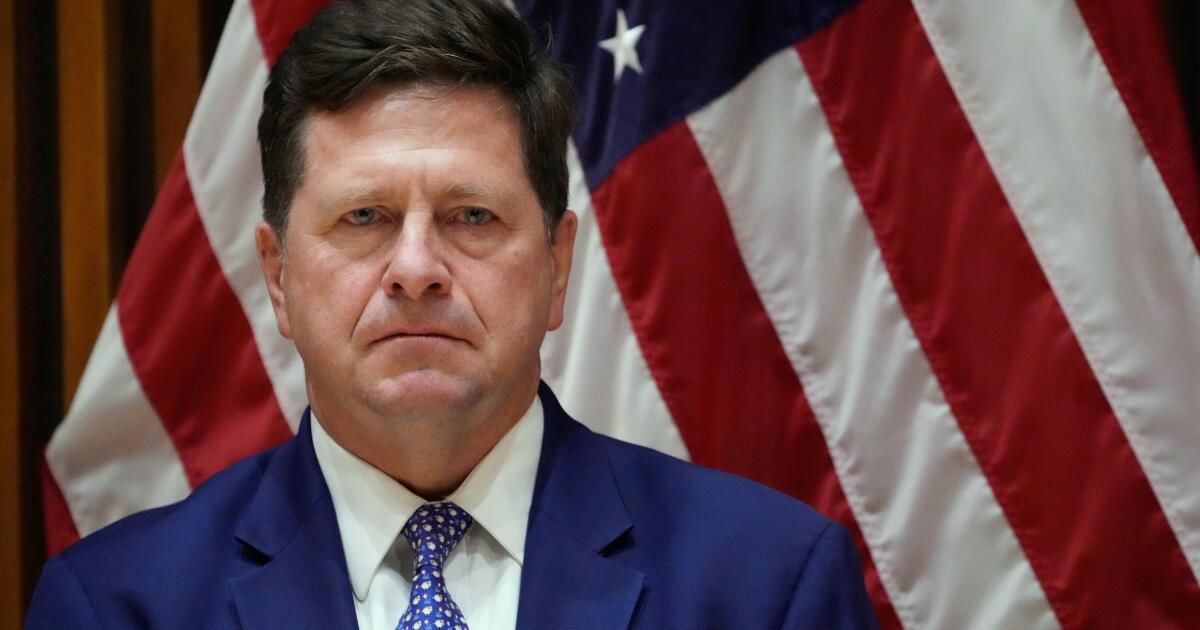
President Trump said Wednesday that he was delaying federal prosecutor Jay Clayton’s nomination to lead the U.S. intelligence community in a bid to force Congress to act on a voter ID bill that currently lacks enough support for passage.

The Republican president said in a social media post just hours before Clayton’s scheduled confirmation hearing that he will keep Bill Pulte, a top U.S. housing official, as acting director of national intelligence. Democratic and Republican lawmakers had opposed Trump’s selection of Pulte, citing his lack of known experience in intelligence and his use of his current administration perch to target perceived adversaries of the president — resistance that last week forced Trump to turn to Clayton.

The abrupt announcement creates instant uncertainty over the long-term leadership of the 18-agency intelligence community and dashes hopes for a swift renewal of a crucial surveillance program that expired in Congress last week due to bipartisan anger over Trump’s pick of Pulte.

That tool, Section 702 of the Foreign Intelligence Surveillance Act, permits spy agencies to collect without a warrant the communications of targeted foreigners located outside the United States. National security officials across both major political parties have for years described Section 702 as vital for gathering intelligence that can disrupt terror attacks and espionage operations, though some lawmakers and civil liberties advocates have raised concerns over the government’s use of information about Americans that is incidentally collected through the program.

Clayton had been set to appear on Wednesday for a Senate confirmation hearing that was fast-tracked because of the program’s lapse. Democrats had said they would not renew the expired surveillance programs until Trump withdrew the selection of Pulte.

Trump’s post suggests that debate to revive Section 702 could be indefinitely postponed. Lawmakers have sounded the alarm about the government operating without congressional authorization of the powerful spy tool.

A court order from last March certified that the program could continue for another 12 months, though it’s possible that communications companies could challenge the government’s authority to force them to cooperate and share data.

In his social media post, Trump accused Democrats of breaking a deal to renew the program after he nominated Clayton. Trump also said he does not want to remove Clayton from his current position as U.S. attorney for the Southern District of New York before his replacement, James McDonald, is approved. McDonald was named to the Justice Department post on Saturday.

And Trump added another condition: linking his approval of the surveillance program to the passage of a bill requiring people to show ID to vote.

“Therefore, to add a slight bit of intrigue but, for the Good of the Nation, and the People of our Country, I will not approve FISA without THE SAVE AMERICA ACT going along with it,” Trump said, using the acronym for the surveillance program and his name for the voter ID bill.

The Republican-controlled Congress has not acted on the voting bill because it does not have enough support in either chamber, particularly from Democrats.

Trump made the announcement in Evian-les-Bains, France, where he was participating in the final day of the Group of Seven summit of leading industrial economies.

The intelligence director position became available after Tulsi Gabbard, who had held the job, announced last month that she was resigning to spend time with her husband as he fights cancer.

Clayton, a chairman of the Securities and Exchange Commission during Trump’s first term, has spent the last 14 months as the top federal prosecutor in Manhattan, one of the Justice Department’s premier posts.

His office during that time facilitated the unsealing of thousands of pages of court records from the prosecutions of Jeffrey Epstein and Ghislaine Maxwell, documents that were made public as part of the Justice Department’s release of records related to the late sex offender and his longtime confidant.

Clayton has also overseen the prosecution of former Venezuelan President Nicolás Maduro and Maduro’s wife, Cilia Flores, on drug trafficking charges.

Epstein died by suicide in a New York jail cell in 2019 while awaiting trial on sex trafficking charges. Maxwell was convicted of luring teenage girls to be sexually abused by Epstein but insists she’s innocent. Maduro and his wife have protested their capture and said they’re not guilty.

Madhani, Superville, Tucker and Jalonick write for the Associated Press. Superville reported from Geneva. Tucker and Jalonick reported from Washington.

Source link

Trump’s $1.8-billion fund unravels amid court setbacks, bipartisan pushback

The Trump administration is backing away from plans to create a $1.8-billion fund to compensate people who claim the government was weaponized against them, a retreat that comes amid a cascade of legal setbacks and a revolt within members of the Republican Party.

But Senate Democrats say the concession is not enough, and are pushing legislation to ensure no president can ever attempt the creation of such a fund again.

“If Republicans are serious about ending this brazenly corrupt scheme, they should have no problem voting for legislation banning any president from creating such a slush fund in the future,” Sen. Adam Schiff (D-Calif.) wrote Monday in a post on X.

Senate Minority Leader Chuck Schumer (D-N.Y.) added that Democrats plan to force a vote on a measure to ensure that Trump and Republicans are “truly abandoning this corrupt scheme.”

“Trump’s word is nowhere near enough,” Schumer wrote on X. Earlier in the day, Schumer vowed to force a floor vote to make Republican lawmakers take a public stance on the issue.

Schiff, along with Sens. Mark Kelly of Arizona and Elissa Slotkin of Michigan, introduced the “Drain the Slush Fund Act” on Monday. The bill, if approved, would bar any payout arising from a lawsuit filed by a president or vice president, language that is designed to permanently foreclose the fund, or anything like it, from being put in place by a future administration.

The White House did not comment on the president’s thinking. But in a statement, the Department of Justice said the decision to scrap the fund was in response to a federal judge’s ruling last week that temporarily blocked payouts from the fund while legal challenges remain pending. The department said it “disagrees strongly” with the move, but stopped short of saying it would challenge the decision.

“This fund was open to anybody who was so weaponized, targeted, or persecuted, whether they were Democrat, Republican, Conservative, Independent, or otherwise,” the statement read. “The Department will abide by the Court’s ruling.”

U.S. District Judge Leonie Brinkema, who was nominated to the bench by President Clinton, a Democrat, has scheduled a June 12 hearing for argument on whether to extend the order blocking the fund.

While the court ruling is not permanent, the unraveling over the fund is a notable defeat for Trump, who has cast it as a long-overdue reckoning for Americans he says were targeted by “an evil, corrupt and weaponized Biden administration.” For Republicans who publicly criticized the fund, it may come as a relief as the concept had been widely seen as a political liability heading into the midterm elections.

The Department of Justice created the fund to settle a lawsuit Trump personally brought against the Internal Revenue Service over the leak of his tax returns. The settlement also includes a clause permanently barring the IRS from pursuing any tax claims against Trump and his businesses that were filed before May 19 — a provision that, according to an analysis by Forbes, would save Trump and his family more than $600 million.

The White House declined to comment on whether the administration would also make changes to the tax immunity clause. The Democrats’ bill does not address that provision.

“Congress doesn’t need to pass a law to remind the Acting Attorney General [Todd Blanche] that he doesn’t have the authority to grant a blanket pardon for tax crimes by the president, much less when the AG is his personal attorney,” a Schiff spokesperson said in a statement. “The attempt at IRS immunity is corrupt and undoubtedly illegal — and we look forward to seeing it exposed as a fraud.”

Beyond Trump’s own legal disputes with the IRS, the fund was structured to accept claims from anyone who said they had been targeted by the government, a category the administration made clear could include those who were convicted for attacking the U.S. Capitol on Jan. 6, 2021.

Trump pardoned and commuted the prison sentences of 1,500 people who were charged in connection with the attack, and neither he nor Vice President JD Vance ruled out the possibility that those individuals would be able to receive money from the fund.

That possibility immediately ran into trouble with lawmakers. Senate Republicans, many of whom were caught off guard by the arrangement, publicly revolted against the fund and derailed plans to vote on legislation to fund Trump’s immigration crackdown amid the deep disagreement.

A closed-door meeting last month between Blanche and GOP senators grew heated, with lawmakers demanding answers the administration was seemingly not prepared to give.

Sen. Ted Cruz (R-Texas), who attended the meeting, described it as “angry” in an episode of his podcast last month. Cruz said that roughly 45 Senate Republicans had attended and estimated that “at least half of them were blasting the attorney general.” Based on those reactions, Cruz predicted the administration would need to amend its position on the fund.

“We will see the administration announcing at a minimum a modification of this, because if they don’t they’ve got a full-on revolt in the Senate,” he said.

The fund also led to criticism outside of Congress. Former Vice President Mike Pence, who served in Trump’s first administration, told NBC News in an interview Sunday that it was a “bad idea from the start.”

“I would encourage the administration just to drop it,” Pence said.

Source link