Congolese President Denis Sassou Nguesso’s election success will extend his nearly 42 years in power.
Published On 17 Mar 202617 Mar 2026
Republic of Congo President Denis Sassou Nguesso has been re-elected for a fifth consecutive term, extending his nearly 42 years in power, according to provisional results.
On Tuesday, Interior Minister Raymond Zephirin Mboulou announced on state TV that Sassou Nguesso received 94.82 percent of Sunday’s vote.
Recommended Stories
list of 3 itemsend of list
State television also reported turnout of 84.65 percent; however, many polling stations in the capital, Brazzaville, on Sunday had short lines or no lines at all.
Sassou Nguesso, 82, was projected by analysts and diplomats to easily win the election after he ran against six candidates who were less well known.
Boycott
Two key parties had boycotted the elections over allegations of unfair electoral practices, with two of the best-known opposition figures, General Jean-Marie Michel Mokoko and Andre Okombi Salissa, imprisoned for nearly 10 years.
But in the run-up to the election, the internet was shut down as usual during a presidential vote, and traffic was restricted across the capital.
Supporters of incumbent President of the Republic of Congo and presidential candidate Denis Sassou Nguesso stand on the side of the road as they wait for him to arrive at a polling station in Brazzaville on March 15, 2026 [Daniel Beloumou Olomo/AFP]
Clarisse Massamba, a teacher who voted at the Lyce Javoueh in Brazzaville, told The Associated Press news agency that it was a given that Sassou Nguesso would win the election.
“Everyone knows that, faced with his six inexperienced opponents, President Denis Sassou Nguesso will be re-elected with a high score as usual. Since the election is not a big issue, we shouldn’t cut off communication,” Massamba said.
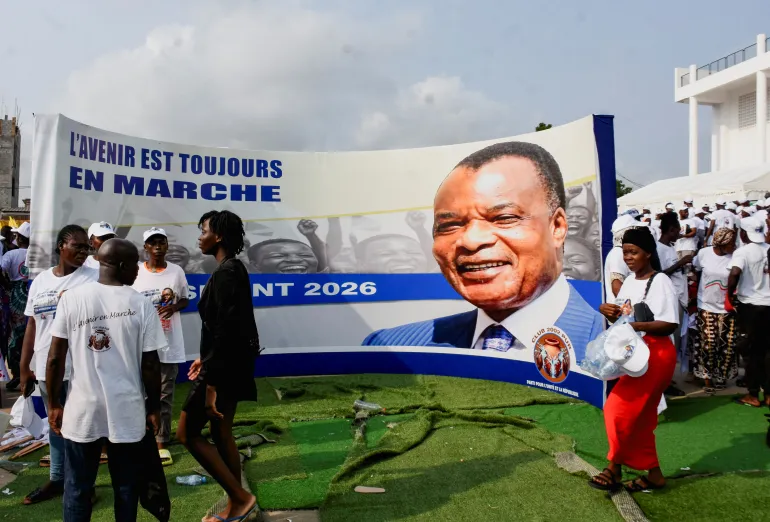
During the campaign period, Sassou Nguesso and his opponents were mismatched with the incumbent president, the only candidate to travel around the country to canvass voters, with effigies placed in the capital.
Moreover, Joe Washington Ebina, a Congolese human rights activist, told the Reuters news agency that human rights activists were arrested, several opposition parties were suspended, and public gatherings were closely monitored in the run-up to the election.
Decades in power
Republic of Congo continues to struggle with high international debt, which, according to the World Bank, stands at 94.5 percent of its gross domestic product, despite being an oil and mineral-rich country.
Sassou Nguesso, who runs the Congolese Party of Labour, first came to power in 1979 and ruled until 1992.
In 1997, Sassou Nguesso returned to power as militia leader following a four-month civil war. In 2015, a constitutional referendum removed presidential age and term limits, allowing him to run again.
Voters in the Republic of Congo will choose their next president on Sunday, although longtime leader Dennis Sassou Nguesso is likely to be elected unchallenged, analysts say.
The central African nation, which has been led almost continuously by Nguesso for more than 40 years, is one of the most politically repressive in the world, with Freedom House giving it a 17 out of 100 rating for freedom.
Recommended Stories
list of 4 itemsend of list
The country is Africa’s third-largest oil exporter. It sells between 236,000 and 252,000 barrels per day, alongside copper and diamonds.
Congo is also highly biodiverse. Sprawling expanses of tropical rainforest in the country form part of the Congo Basin – the second-largest rainforest network in the world after the Amazon. The Nouabale-Ndoki National Park in the north is a UNESCO World Heritage site and is home to elephants, endangered lowland gorillas, and chimpanzees.
Still, the country of 6 million people is racked by economic woes. Corruption and mismanagement, analysts say, contribute to Congo being 171st of 193 countries on the United Nations Human Development Index.
A fractured political opposition, meanwhile, has only allowed Nguesso’s governing Congolese Labour Party (PCT) to consolidate power over the years, although a newcomer is raising hopes.
Here’s what we know about Sunday’s polls:
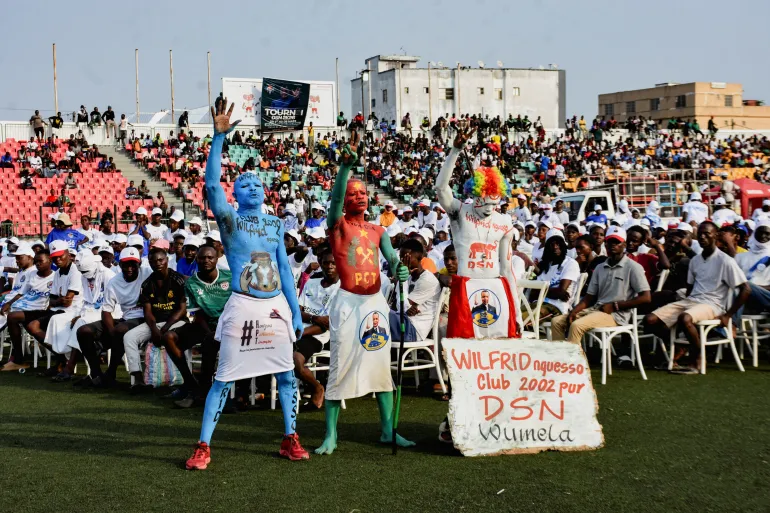
Supporters of outgoing President Denis Sassou Nguesso, who is running for re-election, take part in a campaign rally before the March 15 presidential election, in Brazzaville, Republic of Congo, March 7, 2026 [Roch Bouka/Reuters]
When do polls open?
Polls will open on Saturday, March 15, between 6am (05:00 GMT) and 6pm (05:00 GMT). More than 2.6 million people are eligible to vote; that is, they are more than 18 years old and have been registered.
Voter turnout in 2021 — during the last election — was 67.70 percent according to the International Foundation for Electoral Systems (IFES). Authorities have announced that borders will be closed during voting.
Candidates with an absolute majority usually win the elections, or in rare cases, a run-off will be called between the two top polling candidates.
Presidential terms in Congo are for five years. While the constitution had previously allowed a maximum of two terms and an age limit of 70, those were removed in 2015.
France’s President Emmanuel Macron speaks with President of Congo Denis Sassou Nguesso during the signing of a letter of intent by Denis Christel Sassou Nguesso, Congolese minister of international cooperation and promotion of partnership, and France’s Delegate Minister for Francophonie and International Partnerships Thani Mohamed Soilihi at The Elysee Presidential Palace in Paris on May 23, 2025 [File: Thomas Samson/Reuters]
Who’s running?
Dennis Sassou Nguesso: The 82-year-old was first elected to office in 1979 and led the country for 12 years under a one-party state. He lost elections after opposition lawmakers voted to introduce a multiparty system. On his second attempt in 1997, he seized power in a bloody civil war and has remained in office since. He is Africa’s third-longest serving ruler.
Nguesso’s legacy has been one of gross underdevelopment and corruption, said Andrea Ngombet, the exiled founder of Sassoufit, a group advocating for Nguesso’s exit. In 2015, Nguesso pushed through a controversial referendum that reset presidential term limits from two to three. It also completely removed age restrictions, allowing him to run for the fifth consecutive time in 2021.
A strong hold on the country’s judiciary and the Independent National Electoral Body (CENI) has helped secure Nguesso’s hold, analysts say. His strategic international alliances, from Beijing to Moscow to Paris, have ensured foreign investments and boosted his influence, according to Ngombet. However, since 2013, France has launched investigations into his family’s numerous assets in Europe and the US under pressure from civil society. French authorities seized property belonging to his son, Denis-Christel Sassou Nguesso, in 2022.
Melaine Deston Gavet Elengo: At only 35, Elengo’s candidacy has caused ripples. The oil sector engineer leads the Republican Movement and is the youngest contender in the race. Although a first-time presidential candidate, Elengo appears to be pulling an unusual amount of interest as he presents himself as a departure from the old system. His campaign has emphasised a government built on transparency, an independent justice system, and inclusive development.
“He could secure at least 20 percent of the vote, signalling a generational shift,” Ngombet said.
“His unique advantage lies in the unspoken support from UPADS dissidents frustrated with the boycott,” he added, referring to the opposition party, Pan-African Union for Social Democracy (UPADS), which boycotted the March 21, 2021, presidential election over concerns of integrity. UPADS is doing the same this year but has called on its supporters to go out and vote according to their “conscience”.
Elengo is also closely allied with political heavyweights like the opposition Union of Humanist Democrats, founded by the popular opposition figure, late Guy-Brice Parfait Kolelas, who came second in 2016.
A man walks past a campaign banner of presidential candidate Destin Gavet, before the presidential election scheduled for March 15, in Brazzaville, Republic of Congo, March 11, 2026 [Roch Bouka/Reuters]
Joseph Kignoumbi Kia Mboungou, 73: The veteran lawmaker is the leader of the political party The Chain and represents the southwestern Lekoumou department. He has run several times in the past without much success, with his 2021 bid resulting in just 0.62 percent of the vote. Mboungou’s campaign promised political change and an economy that diversifies from oil, while reducing poverty.
Uphrem Dave Mafoula, 43: The economist is leader of the New Start party. He is making his second bid for the top post after running as the youngest candidate in 2021 and securing just 0.52 percent of the vote. Mafoula’s goal, he says, is to implement governance reforms, create jobs, and reduce inequalities.
Vivien Romain Manangou, 43: The independent first-timer is a university lecturer campaigning on institutional reforms, improving public finances, and promoting national unity.
Mabio Mavoungou Zinga, 69: Running under the opposition coalition Alliance party, the retired customs inspector and former member of parliament promises to tackle corruption and free jailed opposition leaders. It’s his first bid.
Anguios Nganguia Engambe, about 60: The president of the Party for Action of the Republic is running for his fourth time as presidential candidate. In 2021, he won only 0.18 percent of the vote. This time, he has pledged to bridge political divisions in the country and foster better political participation.
Which opposition leaders have been targeted?
Several opposition leaders are either jailed or have fled into exile. Some are:
Jean-Marie Michel Mokoko,78: A former chief of the army and an adviser to Nguesso, who turned against the president and ran for elections in 2016. He called for protests after the results showed that he won 13.74 percent and placed third. He was arrested afterwards on charges of undermining state security and was in 2018 sentenced to 20 years in prison.
Andre Okombi Salissa: a one-time leading member of the governing Congolese Labour Party, and a former minister, Salissa also switched to the opposition in 2016 to contest the polls. He was arrested shortly after, also on security charges. In 2019, he was sentenced to 20 years of hard labour.
What are the key issues?
Poverty despite oil riches
Analysts have long warned that a lack of economic diversification hurts the country’s prospects. As Africa’s third-largest oil producer, Congo earns more than 80 percent of its export revenue from oil, according to the World Bank, making the economy vulnerable to shocks.
Government investment in hydrocarbons has only intensified in recent years. In 2015, authorities aimed to boost daily output to 500,000 barrels of oil per day within three years. Liquefied natural gas (LNG) production and export also began in 2024.
Despite this, around half the population lives below the poverty line. Most live in the main cities of Brazzaville and Pointe-Noire where access to electricity and roads is available but dismal. The situation is even worse in rural areas, analysts say.
While the population is young, with nearly half under 18, job creation is weak. Many young people with degrees have to turn to menial work for survival. The unemployment rate hovers at approximately 40 percent, with inadequate electricity being one of the major barriers for business, according to the World Bank.
Forests and agriculture
Before it began extracting oil in the 1970s, agricultural produce and timber were the biggest revenue generators in Congo.
However, Congo has become reliant on food imports amid the shift to oil.
Although the country has up to 10 million hectares (24 milllion acres) of arable land, only a small percentage is being cultivated, and that’s mostly for low-yield subsistence farming.
The government has touted plans to boost cassava, maize, sorghum, and soy farming, along with developing fisheries and poultry.
Meanwhile, deforestation in the Congo Basin, which encompasses parts of Congo and five neighbouring countries, nearly doubled between 2010 and 2020, compared to the previous decade.
Political freedom and post-Nguesso race
Protests are rare in the country as authorities don’t provide permits and respond with violence when demonstrators gather, according to the Africa Center for Strategic Studies.
Opposition members are routinely jailed. Nguesso appoints national judges himself, meaning the judiciary is not independent.
Many Congolese expect Nguesso to win Sunday’s elections, so much attention is now on who will likely take over leadership in the country in the coming years.
Analysts say an intense succession race is already brewing behind the scenes.
Denis-Christel Nguesso, the president’s son and minister of international cooperation, is the clear favourite, but he faces challenges from the president’s nephew and Head of National Security Jean-Dominique Okemba.
The Nguessos’ cousin, Jean-Jacques Bouya, who is currently the minister of planning and works, is another contender.
Pointe-Noire and Brazzaville, Republic of Congo – In Pointe-Noire, the economic capital of the Republic of Congo, the aisles of the Grand Marche come alive in the early hours of the morning. Among the market stalls, street vendors, and shoppers pushing their way through the crowd, Romain Tchicaya is selling medicines on the sly.
As the price of basics – including pharmaceutical products – rises, and people turn to more affordable unregulated options, merchants like Tchicaya step in to fill the gap while trying to earn a living in a struggling economy.
Recommended Stories
list of 3 itemsend of list
However, the 37-year-old’s background is far from typical for a street vendor.
With a degree in management, he thought he would find a stable job after graduating from university. But like many young Congolese, he found himself facing a tight job market with few opportunities.
“We are told that the country is rich in oil. But I don’t see that wealth in my daily life,” he told Al Jazeera. “Look at Pointe-Noire, formerly nicknamedas Ponton la Belle [Beautiful Pointe-Noire]. Today, the city is unrecognisable.”
Around the Grand Marche, the main roads are potholed, and when it rains, the streets get flooded, making it almost impossible to drive.
Like Tchicaya, Brice Makaya, in his 40s, has never managed to find a stable job here despite having a degree in computer science.
With no stable employment, he is unable to rent a house and now lives outside the church where he prays.
“I am still underhoused at my age and have no prospects for the future,” he told Al Jazeera. “Without a job, I can’t plan ahead. I’m just trying to survive.”
For many young Congolese, daily life is a paradox: though they live in a resource-rich country – the third largest oil producer in sub-Saharan Africa and a producer of liquefied natural gas (LNG) – nearly half the population live below the poverty line.
This Sunday, Congo goes to the polls in which President Denis Sassou Nguesso, 82, is again seeking another term. For young voters, jobs and the economy are a big concern. But for the government, there appear to be limitations to what is possible.
During one of his speeches in the election campaign, Nguesso pointed out that the civil service could not absorb all job seekers, and urged young people to take charge of their own futures by encouraging self-employment.
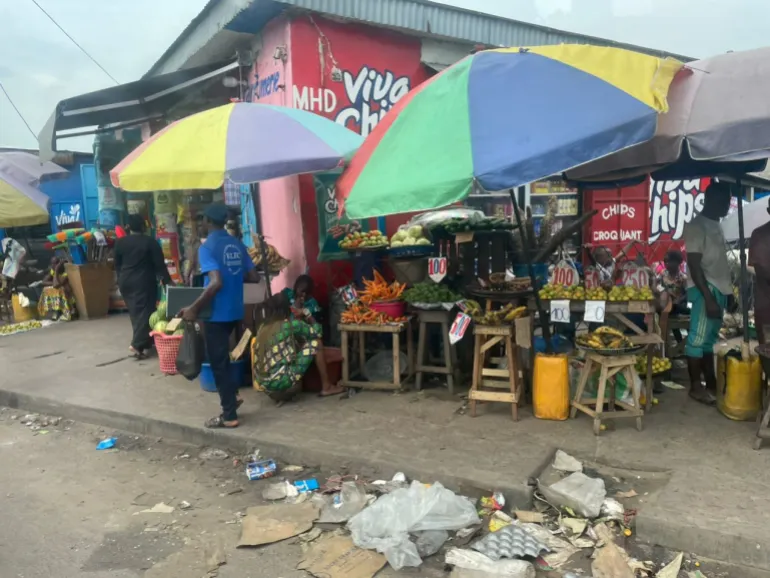
A market in the Republic of the Congo before the 2026 presidential election [Al Jazeera]
Oil: ‘Fuel of the political system’
According to the World Bank, oil accounts for about 70 percent of Congo’s exports and nearly 40 percent of its gross domestic product (GDP).
But this wealth does not automatically translate into an improvement in living standards for most of the populace.
The World Bank estimates that more than 40 percent of Congolese people live below the poverty line, despite the country’s significant natural resources.
For economist Charles Kombo, this can be explained in large part by the very structure of the Congolese economy, which is dependent on oil revenues.
“Oil dependency plays a structuring role in many African economies. In what some call a ‘rentier state’, a large part of public resources comes from the exploitation of natural resources rather than taxation,” he explained.
In a rentier state, the country generates substantial revenue from “renting out” natural resources, such as oil, to foreign companies. In exchange for the exploitation rights granted on these resources, the state receives royalties, taxes, or a share of production.
In this type of system, Kombo explains, the management of revenues becomes central to political power.
“Control of this revenue often reinforces institutional centralisation,” he said, explaining that dependence is no longer solely economic, but becomes institutional and sometimes psychological, as it influences budgetary priorities, political strategies, and even perceptions of development.
He points out that when the economy relies heavily on extractive revenues, economic and political resources tend to become intertwined, which can limit electoral competitiveness.
“Oil revenues can generate significant income, but they do not guarantee the structural transformation of the economy,” he said.
This oil dependence also exposes the country to fluctuations in oil prices on international markets.
After the fall in crude oil prices in 2014, the Congolese economy experienced a severe crisis. Public debt exceeded 90 percent of GDP, before being restructured under agreements with the International Monetary Fund and several international creditors.
Although this has helped stabilise the macroeconomic situation, the country remains heavily indebted. According to the World Bank, public debt fell from 103.6 percent of GDP in 2020 to about 93.6 percent in 2024, reflecting a gradual improvement, but also the continued vulnerability of Congo’s economy to fluctuations in global oil prices.
For political analyst Alphonse Ndongo, oil revenues also influence political life in Congo.
“Oil has become the fuel of the political system. It is used to finance parties, co-opt elites, and maintain social balance,” he said.
According to him, “oil money comes easily and quickly”, but this financial windfall has long delayed necessary structural reforms such as economic diversification.
In his view, the steady flow of money from the oil sector can create a sense of complacency within the system, reducing the pressure to pursue deeper structural reforms. As a result, debates around economic diversification tend to emerge mainly during periods of financial stress, when falling oil prices expose the limits of the model. But when revenues rise again, he argues, the urgency to diversify often fades, leaving the economy heavily dependent on the same resource.
A man walks past a campaign banner of first-time presidential candidate Destin Gavet, in advance of the election [Roch Bouka/Reuters]
‘An uphill battle’
As the country’s oil wealth fails to filter to the majority of the population, young people are particularly affected and many face unemployment.
According to data from the World Bank and the International Labour Organization, the youth unemployment rate in Congo is among the highest in Central Africa, while the informal sector absorbs the majority of new entrants to the labour market.
During a news conference on March 4 in Brazzaville, Prime Minister Anatole Collinet Makosso, who is also spokesperson for presidential candidate and incumbent leader Nguesso, said that young people were at the heart of the government’s policy.
“Youth has always been at the centre of Denis Sassou Nguesso’s policies and social projects,” he said, citing investments in education and the construction of universities.
He also claimed that the unemployment rate had fallen from 44 percent to 39 percent in recent years.
But on the ground, many young people remain sceptical.
Landry, 23, a student in the capital Brazzaville who did not want to give his last name, says he has lost faith in political promises.
“Promises of jobs come back every election. It’s become a cycle,” he said.
A months-long strike at Marien Ngouabi University, the country’s main institution of higher education, forced him to interrupt his studies.
“I went back to my parents’ house to wait and see what I could do. Today, I’m seriously thinking about going abroad.”
Another student in Brazzaville, a 26-year-old woman who did not want to give her name, expressed similar frustration.
“The only sector that is really recruiting today is the army. But not everyone can become a soldier. Becoming a civil servant is also an uphill battle,” she said.
Even sectors that are supposed to be structured are not immune to precariousness. Regine, a young journalist who also did not want to provide her last name, said she works without a stable employment contract.
“In the media, many young people live off ‘camora’, one-off payments for services. It’s not a real salary.”
She also lamented the difficulties of everyday life, including infrastructure issues, such as power cuts and inconsistent water supplies, despite repeated government investment plans.
“In the 21st century, people rejoice when the electricity comes back on. And when the water finally flows, everyone rushes to fill buckets,” she said.
President of Congo Denis Sassou Nguesso [File: Minasse Wondimu Hailu/Anadolu Agency]
‘Social time bomb’
Congo’s infrastructure problems are a reminder to Regine and many others that economic difficulties go beyond the issue of employment.
At the same time, the consequences of the country’s youth employment crisis also reverberate more widely and into the social sphere.
Analyst Ndongo sees this as a potentially explosive situation.
“When there are large numbers of young people who are unemployed and have no prospects, it can become a social time bomb,” he said.
This dynamic is already visible in the tensions that emerge when unemployment and inequality intersect, Ndongo explained: As large numbers of young people struggle to find work while wealth linked to the oil sector remains visible, frustration can build among those excluded from economic opportunities.
He says pressure can be contained for a time, but without meaningful job opportunities and stronger education systems, resentment may deepen. Over time, he warns, groups of unemployed and poorly trained youth can become more vulnerable to crime or gang activity.
The Congolese population is very young: more than 60 percent of people are under 25, according to United Nations data. This demographic reality represents both economic potential and a major challenge for the authorities.
For economist Kombo, the issue goes far beyond just unemployment.
“Demographics are a major political factor in many African countries. When the population is predominantly young, expectations for employment and social mobility are particularly high.”
According to him, long-term political stability will depend on the ability to create economic opportunities.
“Development is not distributed,” he said, “it is built.”
Despite the frustrations, political mobilisation remains limited, even as several candidates rally to compete against Nguesso in this weekend’s vote.
Chris Taty, a young student in Brazzaville, says he is not interested in the current election, as it is clear that the president who has already been in power for more than 40 years will once again reign supreme.
“Everyone already knows who is going to win. So why bother voting? I’d rather stay at home and do other things,” he said.
“Sometimes we joke that Sassou [Nguesso] is our grandfather,” the young journalist Regine said. “He has been ruling for so long that many of us have never known another president”
Nguesso has been a dominant figure in Congolese politics for decades, first ruling the country from 1979 to 1992 before returning to power in 1997 following a brief period out of office. His long tenure has enabled him to consolidate influence over key state institutions. Meanwhile, analysts say the country’s opposition remains fragmented and lacks the organisational capacity to pose a strong challenge.
For some potential voters, the perception of a largely predictable outcome has contributed to a degree of political disengagement, which Ndogo says is a “feeling of resignation”.
“Resignation is ingrained in everyone … Students, politicians, intellectuals … everyone is forced to scramble for a piece of the pie,” he said.
“We are all lulled into resignation because we tell ourselves that if we stand up against the established order, against those in power, we risk ending up in prison or even six feet under. It’s risky to oppose the system today.”
This combination of economic frustrations and limited political participation is a main challenge facing Congo, observers say. And the issue of youth unemployment risks becoming a major crisis in the coming years if nothing is done to fix it.
For many educated yet underemployed young people in the oil-rich country, the question is whether or not Congo can transform its natural wealth into concrete opportunities for its people.
“We are not asking for much,” said Regine. “Just the chance to work, to live in our own country with dignity and to believe that our future can be built here, without connections, with equal opportunities for young people, and without conditions.”
Brazzaville, Republic of Congo – On main roads and public squares across the Congolese capital, posters are up featuring the seven main candidates vying for president.
But at the Moukondo Market in Brazzaville’s fourth district – between lively discussions, people jostling for space and saleswomen trying to attract customers – many voters are less than enthusiastic about this weekend’s election.
Recommended Stories
list of 3 itemsend of list
Fortune, a 27-year-old unemployed university graduate who did not want to give his last name, said he does not expect much to come from the polls.
“When you see how money is spent during the campaign, you wonder if those in power really care about the living conditions of the population,” he said.
While Congo is the third largest oil producer in sub-Saharan Africa, about half the country’s population of about six million people live below the poverty line.
A few metres away, Gilbert, 44, shared similar sentiments. The civil servant explained that his salary is not enough to cover all his household expenses.
“I do odd jobs to supplement my income. At my age, believing that these elections will change our daily lives would be almost suicidal,” he said.
“I’ve known practically the same leader all my life,” Gilbert added. “Some call it stability. Others say that nothing changes.”
It’s a sentiment shared by many in the country: That after 40 years under a single leader, political continuity has become the norm.
President Denis Sassou Nguesso, 82, who is once again standing in the election, first came to power in Congo in 1979. After a period of political transition in the early 1990s, he returned to the presidency in 1997 after a civil war and has ruled the country without interruption ever since.
Two major constitutional revisions have marked his political trajectory. The 2002 constitution and the one adopted in 2015 notably changed certain eligibility requirements, allowing the head of state to continue to run for office.
For Nguesso’s supporters, this political longevity is primarily attributed to the stability the country has managed to maintain in a region often marked by conflict.
Congo’s neighbours include the conflict-racked Central African Republic; Gabon, which witnessed a coup in 2023; and the Democratic Republic of the Congo, where the government is facing armed groups, most notably M23.
In official discourse, peace and institutional continuity are regularly presented as the main achievements of the Nguesso government.
However, several foreign observers painted a more nuanced picture of the political situation. The pro-democracy organisation Freedom House classified Congo as a “not free” country while the Ibrahim Index of African Governance highlighted limited progress in democratic participation and political accountability.
Supporters of Nguesso, who is running for re-election, take part in a campaign rally in Brazzaville before the March 15, 2026, presidential election [Roch Bouka/Reuters]
‘Asymmetrical political competition’
In the last presidential election in 2021, the official results gave Nguesso more than 88 percent of the votes cast with a reported voter turnout of 67 percent.
Nguesso is widely expected to win again when the country goes to the polls on Sunday.
Some analysts said the president’s political longevity can be partly explained by the country’s political structure.
Charles Abel Kombo, a Congolese economist and public policy observer, described the political system as a hybrid model.
“The Congolese political system combines formally pluralistic institutions – elections, political parties, parliament – with a high degree of centralisation of executive power,” he explained. “Nguesso’s political longevity can be explained in part by the structure of the institutional apparatus and the predominant role of the executive branch in the management of the state.”
According to him, the continuity of power is also linked to perceptions of stability in a country marked by the conflicts of the 1990s.
“In this historical context, this continuity can be seen as a factor of stability. But it is also accompanied by asymmetrical political competition.” In other words, political change remains theoretically possible but politically difficult.
For the economist, however, the issue goes beyond political change alone.
“The central challenge remains the ability of political actors to propose a credible plan for economic transformation. Countries dependent on natural resources need a strategic state capable of diversifying the economy and guiding productive transformation.”
Other observers took a more critical view of this political longevity.
For economic and political analyst Alphonse Ndongo, the stability often touted by the authorities must be examined with caution.
“There is indeed a stabilising regime because it has succeeded in maintaining peace. This is what is being sold today as the main recipe for success: There is no war, so the country is at peace. But this peace also allows those in power to remain there. We are in a kind of democratic illusion where elections often resemble a deal,” he said.
According to him, the current political architecture makes a change in leadership unlikely in the short term.
“It is difficult for the institutions responsible for managing elections to produce a result that differs from what everyone already expects. Everything is structured, from voter registration to the organisation of the ballot. Under these conditions, a surprising result seems unlikely,” he said.
A campaign billboard touts candidate Uphrem Dave Mafoula in Brazzaville [Roch Bouka/Reuters]
‘Political alternatives exist’
As the debate continues in Congolese society over whether the country’s political continuity is a mark of stability or a system that is hard to change, the opposition appears fragmented and weakened.
Some established parties are boycotting the vote while some prominent potential candidates are in prison or exile.
In June, the party of opposition leader Clement Mierassa was removed from the official list of recognised political parties.
For him, the conditions for a truly democratic election are not in place.
“We have always called for essential reforms: a truly independent national electoral commission, reliable voter rolls and a law regulating campaign spending,” he said. “Without these guarantees, it is difficult to talk about free and transparent elections.”
Other political actors, however, have chosen to run in the election.
Christ Antoine Wallembaud, spokesperson for candidate Destin Melaine Gavet, said participation remains a way of defending the political space.
“The electoral system has flaws, but that does not mean that those who participate in it condone fraud. Participating also serves as a reminder of the need for reform and shows that a political alternative exists.”
For many observers, access to the media is also a key issue during election campaigns.
“Access to public media remains a recurring problem for opposition candidates. The ruling party candidate always gets the lion’s share even though the High Council for Freedom of Communication has established a list of appearances on state media so that all candidates can present their programmes,” said a Congolese journalist who requested anonymity.
Faced with these difficulties, opposition candidates often turn to private media outlets to spread their messages.
Congolese authorities, for their part, insisted that civil liberties are fully guaranteed for all.
The prime minister and spokesperson for Nguesso, Anatole Collinet Makosso, recently said freedom of opinion and expression “is doing very well”.
“Freedom of expression is alive and well in Congo. The proof is the multitude of foreign journalists here to cover this election. No journalist has been arrested because of their work or prosecuted,” he said.
For the government, this international media presence is evidence of the transparency of the electoral process and the ability of the media to work freely in the country.
However, some press freedom organisations paint a different picture. In its World Press Freedom Index, Reporters Without Borders regularly highlights the difficulties faced by local journalists, particularly in terms of access to public information, political pressure and economic constraints.
People shop at a market in the Republic of Congo days before the 2026 presidential election [Al Jazeera]
Adapting to circumstances
In the working-class neighbourhoods of Brazzaville, reactions to Sunday’s election range from resignation to pragmatism.
In Bacongo, a young man on the street explained that he has learned to adapt to circumstances.
“When the country goes left, we go left. When it goes right, we go right. Doing the opposite can be dangerous,” he said while refusing to give his name.
Beyond the political debate, economic concerns remain central.
The Congolese economy is heavily dependent on oil, which accounts for about 70 percent of its exports and nearly 40 percent of its gross domestic product (GDP), according to the World Bank. This dependence exposes the country to fluctuations in international energy prices.
Public debt has also reached high levels in recent years, exceeding 90 percent of the GDP before being partially restructured under agreements with international creditors.
In this context, several economists said the electoral stakes go beyond the single issue of political change.
Diversifying the economy, creating jobs for a predominantly young population and improving public services are major challenges in the years ahead.
But many Congolese aren’t hopeful that Sunday’s election will make a difference to their material reality because political and economic power will likely remain in the same hands.
“We all understand the system in this country,” Fortune said. “The [economic] crisis doesn’t affect everyone, nor does poverty.”