Netflix replaced one of its top executives in a major management shake-up on Thursday, a day after the company announced it was laying off 6% of its staff.
Chief Content Officer Bela Bajaria is leaving the company after a decade, Netflix said in a statement. She will be replaced by former Disney executive Peter Rice, who was most recently chairman of Walt Disney Television and chairman of general entertainment for Walt Disney Co.
“Peter is one of the most effective at-scale operators in the entertainment industry,” Netflix Co-Chief Executive Ted Sarandos said in the statement. “His business acumen is sharp, his talent relationships are exceptionally strong, and his experience across TV and film is deep and broad.”
Bajaria’s exit comes as Netflix has been under pressure from investors to turn out more hit shows and movies and increase the amount of time consumers spend on the platform amid rising competition from other streamers.
“Due to the slowdown in massive hits and viewer growth, an ax was gonna fall on some executives who led content strategy,” said Ross Benes, senior analyst at research firm Emarketer.
Bajaria oversaw the teams responsible for Netflix content around the world. She joined Netflix in 2016 and was named chief content officer in 2023. She was instrumental in expanding Netflix’s reach internationally and the streamer’s push into live events.
Hits released on Netflix during Bajaria’s tenure include the 2025 animated movie “KPop Demon Hunters” and crime drama series “I Will Find You.” Under her leadership, Netflix grew its reach in live programming, streaming NFL games as well as WWE matches. The company also changed its film strategy to focus on fewer movies that aimed to be bigger and better.
She also played a key role in helping Netflix generate large audiences for its non-English-language original series, reality shows and programs that featured talent from underrepresented communities.
But her tenure also coincided with mounting challenges to growing Netflix’s business.
Free, ad-supported streaming services like YouTube are increasingly taking up more streaming hours and investors are concerned about how Netflix will continue to grow. YouTube represented 14.2% of streaming time in the U.S. on TVs compared to Netflix’s 7.8% in July, according to Nielsen data.
Netflix has said efforts like live programming have been successful at getting significant subscription sign-ups. While live programming represents 5% of Netflix’s content budget, it holds 1% of watch time on the streaming service, Sarandos has said.
The company also was poised to buy Warner Bros. Discovery, which would have dramatically increased its library of content, but Netflix bowed out of the auction after the price became no longer “financially attractive.”
Netflix stock has declined 40% from a year ago. Shares closed Thursday at $72.61, up 3%.
“The drop in share price has been staggering,” said Stephen Galloway, dean of Chapman University’s Dodge College of Film & Media Arts. “That plunge, plus the negative reaction to its move to buy Warner Bros. left it vulnerable, and so you have to do two things. One is right the ship, but you also need to send a message to shareholders that you’re taking action.”
In a memo to staff announcing the change in leadership, Sarandos wrote, “I know this is a big change in a year that has already had its share. But I also see an opportunity to take our slate to the next level, especially in UCAN [U.S. and Canada] where we have an outsize impact in creating big, buzzy hits that our members love and drive conversation around the world.”
Rice is an experienced corporate executive who spent nearly three decades navigating Rupert Murdoch‘s media empire, serving as president of 21st Century Fox and CEO of Fox Networks Group.
He also brings deep roots in the feature film world, having previously run Fox Searchlight Pictures, which could mean he will want to put his own stamp on Netflix’s film group, Galloway said. That group is currently led by executive Dan Lin.
“Netflix has fundamentally changed the way stories are made, shared and experienced around the world,” Rice said in a statement. “They’ve shown again and again that they’re willing to take chances on distinctive voices and fresh ideas, and I’m excited to work with the team to help bring even more great stories to members everywhere.”
The United States is stepping up its campaign to sell Portugal the F-35. Speaking in Lisbon today, Secretary of State Marco Rubio said the United States would make Portugal a “very competitive” offer to replace its F-16 fleet. The development adds a high-level political push to an increasingly intense competition over the Portuguese Air Force’s next fighter.
Portuguese Foreign Minister Paulo Rangel said after meeting Rubio that Lisbon is seriously considering the American proposal, while emphasizing that other options remain under consideration.
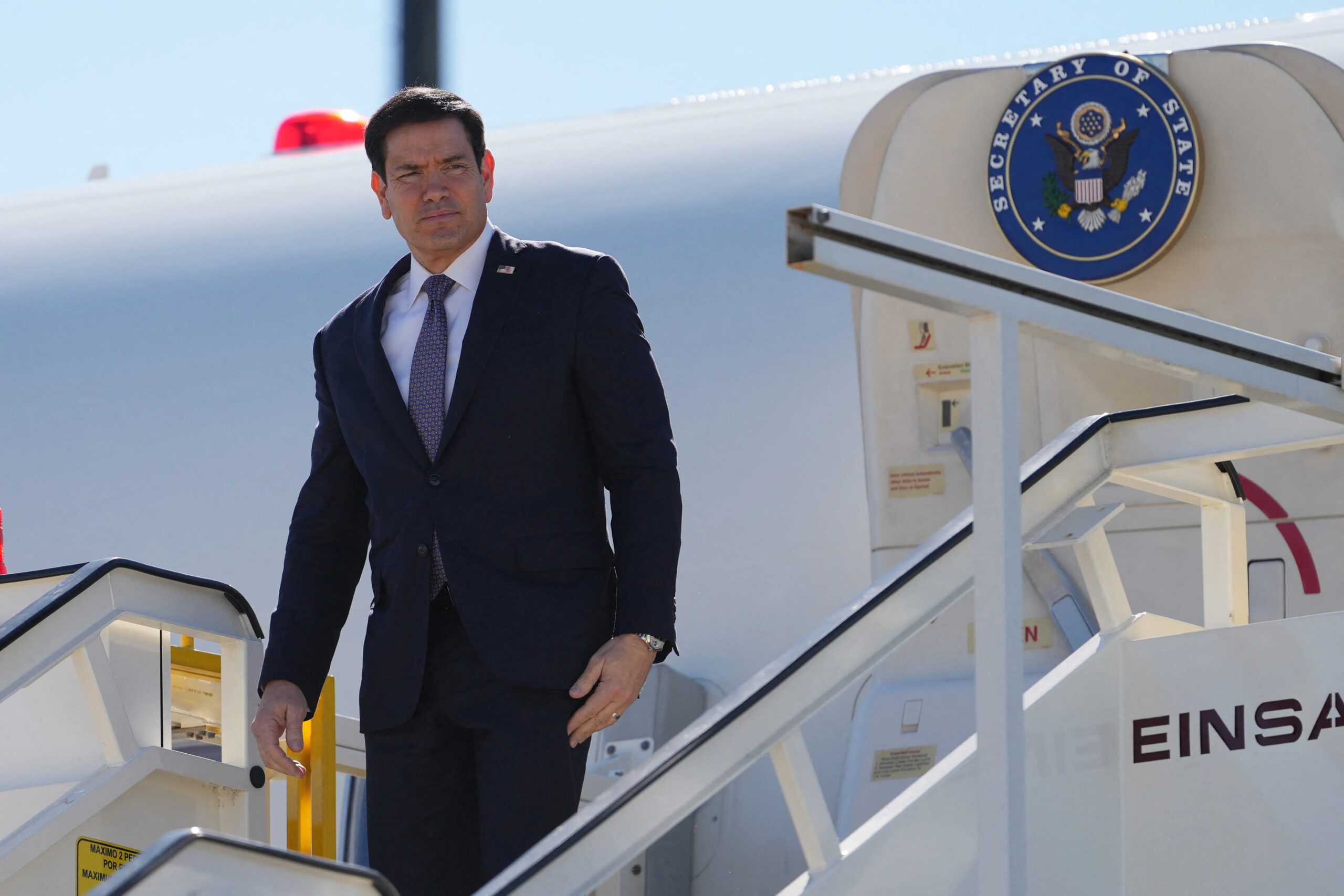
U.S. Secretary of State Marco Rubio disembarks from a plane upon arrival at Lisbon Airport during a three-country European tour, in Lisbon on October 8, 2026. Photo by Mark Schiefelbein / POOL / AFP
“The Portuguese state will always decide in accordance with the national interest,” Rangel said at a news conference after the meeting. “There is one point that is also clear: we are seriously considering the F-35 proposal, just as we are considering others.”
Portugal currently operates 25 modernized F-16AM/BMs, including 21 single-seat F-16AMs and four two-seat F-16BMs, from Monte Real Air Base, or BA5. The Portuguese Air Force, known as the Força Aérea Portuguesa (FAP), has not yet formally launched a replacement competition, but the aging fleet is increasingly becoming the focus of attention in Lisbon.
A Portuguese Air Force F-16 participating in NATO Exercise Ramstein Flag 24 flies over the west coast of Greece in 2024. U.S. Air Force photo by Tech. Sgt. Emili Koonce
Portugal acquired a total of 45 F-16A/B Block 15 aircraft through the Peace Atlantis I and II programs.
The first 20 aircraft were delivered beginning in 1994. These were new-build F-16A/B Block 15OCU aircraft, comprising 17 single-seat F-16As and three two-seat F-16Bs, and were used to equip Esquadra 201 “Falcões.”
A second batch followed in 1999, when Portugal received 25 former U.S. Air Force Block 15OCU aircraft. Twenty-one were F-16As and four were F-16Bs, with several intended as attrition replacements or spares. These aircraft had accumulated roughly 3,000 flight hours and underwent an extensive modernization program to bring them to the F-16AM/BM configuration. This means the aircraft are broadly comparable to the U.S. Air Force’s F-16C/D Block 50/52 fleet.
Esquadra 301 “Jaguares” finally became operational with its upgraded aircraft in 2005, while Esquadra 201 did not receive its upgraded F-16s until 2011.
A Portuguese F-16 in special markings associated with the Esquadra 301 “Jaguares.” U.S. Air Force photo by Staff Sgt. Jason Allred
Since then, the Portuguese Vipers have continued to receive incremental improvements. Their configuration has progressed through several mission-software standards, while the aircraft have been equipped with night-vision goggles, Joint Helmet-Mounted Cueing Systems (JHMCS), and advanced targeting and weapons capabilities.
Portuguese Air Force F-16s line up for takeoff. Portuguese Air Force
Twelve former Portuguese F-16s were transferred to Romania under a deal signed in 2013, with deliveries taking place in 2016 and 2017. Romania subsequently ordered five additional aircraft in 2019.
Structurally, the Portuguese F-16s could potentially remain in service into the mid-2040s. But maintaining their relevance against increasingly sophisticated air forces would require continued investment in avionics, sensors, communications, and self-protection systems.
The F-16AM/BM fleet continues to rely on the old AN/APG-66(V)2 pulse-Doppler radar. Replacing it with an active electronically scanned array (AESA) radar such as Northrop Grumman’s APG-83 would substantially improve detection and tracking performance, but would come at considerable cost.
A U.S. Air Force F-16C receives radar modification upgrades in conjuction with the U.S. Air Force Service Life Extension Program, which includes the APG-83 Scalable Agile Beam Radar. U.S. Air Force photo by Airman 1st Class Erin Stanley
Portugal faces a choice between continuing to invest in increasingly tired fourth-generation airframes or moving directly into the fifth generation.
Since the end of the Cold War, Portugal has become much more engaged in out-of-area operations and missions in support of NATO.
In the process, the Portuguese F-16 fleet has accumulated an impressive operational record.
The fighters have repeatedly deployed on NATO air-policing missions, including rotations to the Baltic States, Iceland, Romania, and Poland.
Armed with live missiles, Portuguese Air Force F-16s participate in the NATO Baltic Air Policing Mission in Lithuanian airspace near Siauliai, on May 23, 2023. Photo by PETRAS MALUKAS/AFP via Getty Images
The F-35A would give Portugal a fifth-generation fighter built around low observability, sensor fusion, advanced electronic warfare, and networked operations.
More than 900 F-35s are already in service or on order across Europe, according to previous comments by U.S. Ambassador to Portugal John Arrigo. Washington has repeatedly argued that joining that community would provide Portugal with a substantial interoperability advantage.
A U.S. Air Force F-35A assigned to the 493rd Fighter Squadron taxis on the runway after arriving for the Beja International Airshow in Portugal, in May 2024. U.S. Air Force photo by Senior Airman Renee Nicole S.N. Finona
Airbus has said it intends to submit an unsolicited Eurofighter proposal to Portugal in late October or early November. That package is expected to encompass not just the aircraft, but financing, industrial participation and broader military cooperation.
Selecting the American stealth fighter deepens Lisbon’s military relationship with Washington at a time when European governments are wrestling with fundamental questions about their dependence on U.S. military capabilities.
Across the continent, uncertainty over Washington’s stance on NATO is encouraging European allies to examine ways of reducing their reliance on American military technology, even as those same countries continue to increase defense spending and purchase U.S. equipment.
Procurement of the UH-60 Black Hawk underscores the reliance of the Portuguese Air Force on U.S.-made hardware for many of its needs. Portuguese Air Force
If Washington can combine the F-35’s capability advantages with an attractive acquisition and sustainment package, Portugal could find itself facing a difficult choice between the strategic benefits of joining Europe’s growing F-35 fleet and the industrial and political advantages of selecting a European fighter.
The final decision on the replacement of the F-16 will also determine what combat jet spearheads the Portuguese Air Force for the next several decades.
Macklemore’s replacement as the warm-up act for Ed Sheeran’s under-fire tour has come to lightCredit: GettyThe US leg of Ed’s Loop tour has been shrouded in controversy relating to politicsCredit: Getty
Billionaire businessman Robert Kraft banned the American musician, real name Benjamin Haggerty, from his stadium after he made a speech on stage in support of Palestinians amid the ongoing conflict with Israel.
At the time, Robert deemed his words “hate speech” and the move sparked a mass exodus of support acts who all quit 35-year-old Ed’s tour in solidarity with the Thrift Shop hitmaker.
Sign up for the Showbiz newsletter
Thank you!
Ed continued to perform alone, but he has now been joined by surprise guest, The Fray’s Isaac Slade.
The rock band’s former frontman, 45, opened proceedings at Atlanta’s Mercedes-Benz Stadium on Saturday, with his band’s hits, which included How to Save a Life and You Found Me.
The Fray’s Isaac Slade was Ed’s opening act in AtlantaCredit: GettyIsaac addressed the ‘wrong’ situation in Gaza life on stageCredit: Nick Ray – The TimesSinger Ed made it clear that he was not personally responsible for Macklemore’s departureCredit: ReutersThe pair have been pals for 13 yearsCredit: AFP
Despite politics taking precedence over performances during the Loop tour, Isaac had his say.
He told fans: “What’s happening over there [in Gaza] is wrong, but if we’re going to get through it, we’re going to need people to step into that middle place, that common ground.
“That bonfire in the middle of the field that sees both sides, that understands that peace is not a lack of conflict. Peace is not a blank canvas that we need to guard and be polite.”
“[Peace] holds enough beauty, enough tragedy, enough sorrow, enough joy and life if we learn how to integrate it and hold each other in balance.
“We will find a way through this together”.
It isn’t the first time that Isaac, who quit The Fray in 2022, has appeared on the tour.
He also took to the stage in Toronto in August.
Following the Macklemore controversy, which saw Billie Eilish‘s brother Finneas, Irish acts Aaron Rowe and Beoga, and Danish pop star Lukas Graham withdraw in solidarity, Ed spoke out.
Ed insisted in a statement that he would not be drawn on voicing his own views on the Israel/Gaza conflict publicly but is committed to ensuring his gigs are a place of “safety and sanctuary” for people from all ethnicities, faiths and backgrounds.
He also made it clear that he was not personally responsible for Macklemore’s departure and had been trying to find a solution with promoters and billionaire Robert, who owns Massachusetts‘ Gillette Stadium.
New England Patriots owner Robert had accused Macklemore of having a “broader history of antisemitic rhetoric and imagery that we believe has been deeply offensive and hurtful to the Jewish community”.
It was Macklemore declaring “Free Palestine” ahead of his protest song Free Hind’s Hall, written about pro-Palestinian protesters at Columbia University, which sparked the controversy.
In his own statement, Macklemore insisted his stance was a “criticism of apartheid and genocide” and not of the Jewish people.
Ed wrote on social media: “Macklemore coming off tour was the promoter’s decision, it was not mine.
“I would never let down the fans who had made plans, nor would I abandon the touring crew and the other support acts and musicians who rely on me for work and to make a living.”
He added that fans at his shows did not want a “political forum” and that despite his apolitical stance he is “not complicit”.
Ed and Macklemore’s friendship goes back 13 years and the latter said he hoped it would continue despite them having had “difficult conversations”.
The other acts also highlighted their friendships with Ed and their gratitude for being given the opportunity to perform on such a high-profile tour, but said they could not continue with clear conscience knowing a fellow artist had been “silenced”.
ITV have confirmed that gripping new six-part drama Winter starring Richard Armitage will replace Professor T in its schedule as the final episode of the fourth series airs
The fourth series of Professor T concludes tonight(Image: ITV)
The fourth series of Professor T comes to an end tonight.
ITV airs the sixth and final episode of the latest season titled The Warrior Gene on Thursday (September 24) evening as Professor Jasper Tempest (Death in Paradise’s Ben Miller) wrestles with his feelings for Dr Helena Goldberg (Bend It Like Beckhams star Juliet Stevenson).
The synopsis reads: “In the run up to Wilfred and Zelda’s wedding, Jasper is wrestling with his feelings for Helena. Dan is stunned by a new case where he sees a dying man admit he killed someone.
“Whilst Dan and Chloe try to track down who’s been killed, Maiya thinks they are going on a wild goose chase, concerned this is about Dan’s grief over Lisa.
“Zelda has second thoughts about the wedding but when Jasper explains to her that ‘love is enough’, he realises his feelings for Helena and invites her to Zelda’s wedding.”
It continues: “Ms. Snares takes Jasper to Lyndon Collins’ lecture on the warrior gene and Jasper is intrigued by something Collins says about the case Dan is investigating.
“On the day of the wedding and Lisa’s memorial event, Jasper uses the case to get Dan to open up about Lisa and gain the strength to attend her memorial.
“After helping Dan, Jasper returns to Zelda and Wilfred’s wedding and is thrilled when Helena appears. Helena spots Jasper has finally removed his gloves. It’s clear he’s come a long way.”
ITV will fill the Professor T shaped gap in the schedule next week by airing Richard Armitage’s new drama Winter as the actor takes on the role of an unconventional forensic pathologist whose unique approach to murder investigations puts him at the heart of a series of complex cases.
Winter kicks off on ITV1 on Wednesday (September 30) at 9pm with each episode featuring a self-contained murder investigation alongside an ongoing personal storyline for Armitage’s character.
The synopsis for the new six-part series reads: “Although Winter does not always follow the expected rules, he has an exceptional ability to examine the evidence and uncover clues that others might miss.
“His skills bring him together with DI Lauren Bell, played by Annabel Scholey, a meticulous and no-nonsense detective who is equally determined when it comes to solving a case.
“Together, Winter and Bell form a formidable investigative partnership as they attempt to solve some of the most challenging murder cases.”