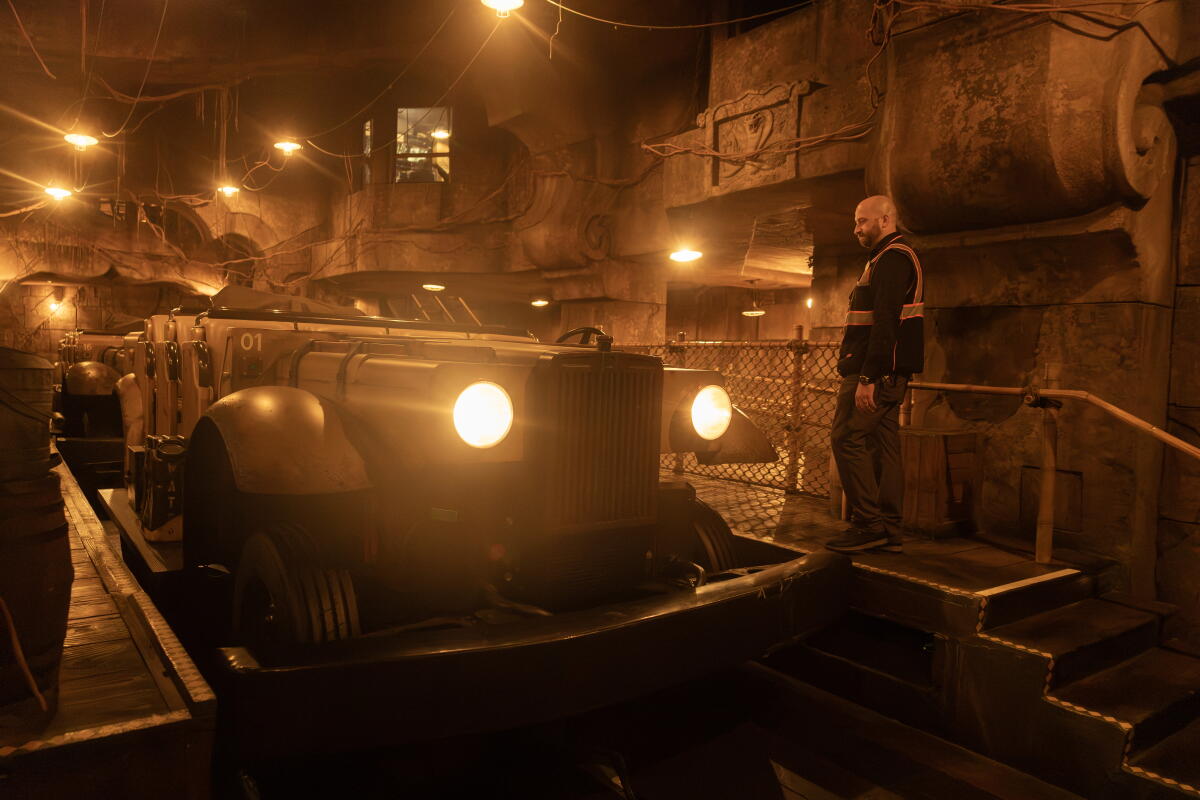
reopens

Major UK holiday park reopens after huge £5m makeover AND you can stay with Hols from £9.50

A MAJOR holiday park has reopened after a huge £5million revamp with loads of brand new attractions, and what’s even better – you can stay there with The Sun’s new Hols from £9.50 campaign.

The refreshed resort has been unveiled at one of the UK’s top British beach destinations.

Indoor swimming pool at Vauxhall Holiday Park, featuring slides and a wooden arched ceiling.
The indoor pool at Vauxhall Holiday Park in Great YarmouthCredit: Parkdean Resorts

Vauxhall Holiday Park in Great Yarmouth has opened its doors to the public once more, boasting a new sports bar, darts and indoor adventure golf.

After a £5million cash injection, the holiday park has also been upgraded to include more kids’ play zones and high rope courses.

This means there is even more to tempt the whole family, from Bear Grylls escape rooms and a bingo hall, to the large indoor pool plus waterslides.

The freshly updated park will be included in the Hols from £9.50 restock TONIGHT, alongside thousands of other new holidays AND new holiday parks.

STAY CLOSE

Brits say why staycations are better than holidays abroad – pubs make the list


ON THE UP

Popular English seaside city reveals £750,000 makeover of Victorian promenade

You can access these offers early by signing up to Sun Club for just £1.99 a month, where members gain automatic access onto the website one day earlier than everyone else, at just past midnight.

Once you’re a member, go to the Sun Club Offers hub and find the Hols From £9.50 page. Follow the link from the offers page, and you can book your break from midnight on Tuesday, March 31.

That’s a whole 24 hours headstart, as the Sun newspaper readers who are collecting tokens get access to the holidays on April 1.

Vauxhall Holiday park’s two to three room caravans sleep up to eight people, while the park also offers apartments and luxury lodges.

Great Yarmouth on Norfolk‘s east coast has long been one of the UK’s top beach resorts for holidaymakers seeking sand and sun.

The town boasts a soft sand beach known as ‘the golden mile’, with plenty of shops, cafes and restaurants within a short walking distance.

Smack-bang on the beachfront is Joyland, a historic amusement park with plenty of classic rides that are sure to fill you with nostalgia.

This colourful family theme park is perfect for little ones, home to mini rollercoasters and the award-winning Super Snails. The attraction is free to enter, with ride tokens costing £3 each.

For older kids, Great Yarmouth Pleasure Beach is sure to go down a treat with an exciting mix of white-knuckle thrills, child friendly rides and even a 4D cinema.

Undoubtedly the star of the show is a traditional wooden roller coaster, which first opened in 1932 and one of only two still standing in the UK.

All the ways to book a holiday from £9.50

There are five routes to book our Hols From £9.50

  1. Book online: Simply collect codewords printed in The Sun paper up until Wednesday, April 1. Then enter them at thesun.co.uk/holidays to unlock booking from April 1.
  2. Book with Sun Club: Join Sun Club at thesun.co.uk/club for £1.99 per month or £12 for the year. Go to the Sun Club Offers hub and click through to the Hols from £9.50 page. You do not need to collect any codewords or Sun Savers codes. Booking opens for Sun Club members on Tuesday, March 31.
  3. Book with Sun Savers: Download the Sun Savers app or register at sunsavers.co.uk. Then go to the ‘Offers’ section of Sun Savers and click ‘Start Collecting’ on the ‘Hols From £9.50’ page. Collect TWO Sun Savers codes from those printed at the bottom of the Sun Savers page in the newspaper up until April 1. Then enter or scan the codes on Sun Savers to unlock booking.
  4. Book by post: Collect TWO of the codewords printed in The Sun each day up until Wednesday, April 1. Cut the codeword out and send it back with the booking form – found in paper on April 1 or online at thesun.co.uk/holidays.
  5. Book with The Sun Digital Newspaper: Sign up to The Sun Digital Newspaper at thesun.co.uk/newspaper. Then download the Sun Savers app or sign up at sunsavers.co.uk, log in to Sun Savers with your Sun account details (the same email and password you use for your Digital Newspaper) and enjoy automatic access to Hols, without the need to collect Sun Savers codes daily. Booking opens on April 1.

Britannia Pier and Theatre in Great Yarmouth with amusement arcades, donkey rides, and families on the beach.
Great Yarmouth has been one of the UK’s most popular beach staycations for centuriesCredit: Alamy

Source link

Jardinette Apartments, Neutra’s first Los Angeles building, reopens

One of the most painstaking architectural renewals in recent Los Angeles memory has finally pulled a world-class jewel of modern architecture from obscurity.

Designed by pioneering Modernist architect Richard Neutra in 1928, with limited collaboration from another Modernist icon, Rudolph Schindler, the Jardinette Apartments had been hiding in plain sight on an unassuming Hollywood street for nearly a century. The complex was a technical and spatial breakthrough, and quickly gained international renown as one of the earliest International Style structures in the United States, not to mention Neutra’s first L.A. commission.

But the building’s original owner, Joseph H. Miller, went bankrupt during construction and skipped town to avoid his creditors, and the Jardinette slipped from view. “After that early burst, it just disappeared,” said Barbara Lamprecht, historical consultant for the Jardinette’s rehabilitation, which is just now wrapping up.

For decades the building stood quietly along West Marathon Street: an austere, four-story complex that most people passed without a second glance. Wedged between Western Avenue and Manhattan Place, amid stucco apartment blocks and scrappy bungalows, the edifice had, until recently, grown increasingly shabby as time and neglect took their unforgiving toll.

That changed with the intervention of a newcomer to historic preservation named Cameron Hassid. For years the tireless local developer and his tenacious team have willed the Herculean restoration project to the finish line. Hassid plans to bring the apartments to market before the end of the month.

Two men on the roof of a building.

Property owner Cameron Hassid, left, and Neema Ahadian, commercial real estate agent for Hassid, on the scenic rooftop of the Richard Neutra-designed Jardinette Apartments in Los Angeles. Neutra imagined the Jardinette Apartments as a prototype for future garden apartment buildings. Nearly 100 years later, the Jardinette is set to reopen after a lengthy redevelopment.

(Myung J. Chun / Los Angeles Times)

A Radical Design

When the Jardinette first opened it was featured prominently in a seminal survey of early avant-garde apartment housing called “The Modern Flat,” while European architectural publications from Paris to Moscow showcased it as an exemplar of functionalist design, noted Nicholas Olsberg, an architectural historian and curator who has written extensively about Neutra. “It was seen worldwide as one of the signal examples of the new architecture,” Olsberg added.

The Northeast corner of the Jardinette Apartments, circa 1930.

The Northeast corner of the Jardinette Apartments, circa 1930. When the building first opened in 1928 it was a technical and spatial breakthrough—but it suffered from years of neglect after falling from view.

(Richard and Dion Papers, Collection 1179, UCLA Special Collections)

Built inside and out with reinforced concrete — a modern industrial material that had rarely been employed for housing— the sculpted, U-shaped building, whose jogging corners, projecting sills and swaths of dark and light paint gave it a powerful visual rhythm, used its structural heft to liberate its facade.

Long horizontal bands of easy-to-open steel casement windows, some complemented with concrete balconies, drew daylight and air deep into its 43 efficiently organized units — studios and one bedrooms, ranging from about 400 to 700 square feet — and opened them to wide views of the street and, on higher floors, the Hollywood Hills. Hallways and stairs were saturated with natural light thanks to skylights and strategically placed windows. At the forecourt a modest garden, then dominated by a huge cedar tree, softened the building’s mass, giving the project its name: Jardinette, the little garden.

Skylights in a newly restored apartment building.

A roof covered the original skylights in the Jardinette Apartments, but they are now fully exposed.

(Myung J. Chun / Los Angeles Times)

“Arguably my father had more influence on apartment design than he did on house design,” said Neutra’s son Raymond, pointing to several Neutra designs offering indoor/outdoor lifestyles via “garden apartments.” Raymond, who was on site a few weeks ago, has toured the rehabilitation multiple times.

The Jardinette was listed on the National Register of Historic Places in 1986 and designated a Los Angeles Historic-Cultural Monument two years later. Yet despite its formal protections, the building continued its long drift into disrepair.

In 2016 Jardinette’s previous owner, Robert Clippinger, began reviving it, hiring Lamprecht’s firm, Modern Resources, as well as June Street Architecture and land use consultants Cali Planners. The team filed a comprehensive Historic Structure Report that helped secure much-needed tax relief via the Mills Act, a state preservation program. But Clippinger soon faltered under the weight of the many developmental requirements to bring the historic building back. Lawsuits followed. Financing collapsed.

A hallway with a skylight in an apartment building.

A carpeted hallway beneath an original skylight at the Richard Neutra-designed Jardinette Apartments in Los Angeles. The Jardinette was listed on the National Register of Historic Places in 1986 and designated a Los Angeles Historic-Cultural Monument two years later.

(Myung J. Chun / Los Angeles Times)

Hassid bought the building in December 2020, in the thick of the COVID-19 pandemic, keeping Clippinger’s core designers and consultants in place.

Decades of negligence and neglect had proved both a curse and a blessing. Many original steel windows had been swapped out for cheap vinyl replacements. Larger units had been subdivided. At one point the building had been repainted an unfortunate pastel peach and green. Electrical systems dated back nearly a century. Gas water heaters punched vents through the concrete walls.

Yet because the building never attracted a well-funded modernization campaign, much of its essential fabric remained intact.

“Had it been owned by people with more resources,” noted Lamprecht, “there might have been upgrades that blurred the sense of history.”

Corey Miller, a principal at June Street Architecture, described his first encounter with the almost empty property: “There had been 43 units with 43 different people who had been left to their own devices,” Miller said. “Every time we peeled back a layer, there was something worse.”

Unit 302, inhabited for four decades by a single tenant, retained the most original fabric, including an early icebox cabinet. But it also contained endless layers of grime and clutter. It was “disgusting,” Miller said bluntly, but invaluable as forensic evidence. Much of it — like tiles, windows and millwork — were reproduced around the building.

A historic kitchen with an icebox.

The 128 Jardinette Apartments were painstakingly restored with an eye toward preserving original details including kitchen cabinets, sinks and iceboxes.

(Myung J. Chun / Los Angeles Times)

The perils of rehabilitating a historic treasure

When Hassid called Miller to ask about buying the building, Miller remembers his response clearly. “You probably have no idea what you’re getting yourself into,” he told him.

Hassid’s love of early modern architecture began as a child. His grandparents lived at 848 N. Kings Road in West Hollywood, with a balcony overlooking Schindler’s famed house. So Hassid was familiar with Jardinette’s geometric forms and clean lines. His mother reacted with angry skepticism when he first raised the idea of acquiring the building, but encouraged him to buy it after she learned about the connection.

Nostalgia did not make the rehabilitation any easier. Technical plans required approval, and fixes weren’t straightforward within a protected treasure. “You can’t just go into a historic building with a sledgehammer,” Hassid said. Every move had to align with federal preservation standards and the commitments embedded in the Mills Act contract. Lambert Giessinger, Los Angeles’ historic architect and Mills Act administrator, acted as liaison. Inspections were frequent. Conditions were exacting.

“It’s stressful to have people looking at everything,” Miller admitted. But he credits both Giessinger and Lamprecht with pragmatism. “They were under no illusion that this was going to be done 100% perfect,” he added.

“There’s a lot of wonky stuff in this building that will remain wonky forever,” noted Lamprecht, pointing to settling areas and imperfect details.

A man on a balcony.

Michael Norberg, a land use consultant for the Jardinette Apartments preservation project, stands on the balcony of a unit at the Richard Neutra-designed complex, which will soon reopen after prolonged development issues.

(Myung J. Chun / Los Angeles Times)

The astonishingly complex rehabilitation revealed a simple-looking building that was anything but. The board-formed concrete carried a subtle wood-grain texture, which had to be left intact, even as seismic reinforcements were added beneath the surface. The finish on white stucco shifted from smooth to pebbled on the walls’ higher reaches, and this had to be carefully re-created.

Original trim had to be salvaged and repaired wherever possible. Kitchens were rebuilt based on archival drawings and surviving fragments. Bathrooms, originally designed around tubs, required discrete tile extensions to accommodate modern showers. The paint scheme, which has been returned to a warm, off-white concrete field with blackish-green bands emphasizing the window walls, had to be reconstructed from historic photographs. Wine red concrete lobby floors were revealed under ungainly tile. Large stairwell skylights were uncovered, while unique, cube-shaped stair post lights were rehabilitated.

White tiles in an old-fashioned bathroom.

Plenty of white tiles replicate the original look in this bathroom in the historic Richard Neutra-designed Jardinette Apartments. One floor of the newly preserved 1928 complex features original doors and kitchen cabinets.

(Myung J. Chun / Los Angeles Times)

Support infrastructure, threaded through the thick concrete frame, was perhaps the messiest challenge. Fire sprinklers, mandated by code, had to remain visible because they could not run through joists without compromising historic fabric. New electrical, plumbing and ventilation had to snake around (or burrow through) beams that original plans didn’t note.

Hassid chose to add air conditioning, and the resulting electrical loads required a 13-foot-deep vault beneath the courtyard. That addition will limit what can be planted in the central garden.

A view of Hollywood from a row of apartment windows.

The view from the large windows in a newly restored unit of the Richard Neutra-designed Jardinette Apartments. Original skylights were also preserved during a remarkably complex historic preservation effort.

(Myung J. Chun / Los Angeles Times)

The team preserved as many original steel casement windows as possible on the primary north-facing facade. These are interspersed with custom reproductions throughout.

The rehabilitation costs climbed past $5 million — accounting for structural analysis, waterproofing, electrical overhaul, plumbing, mechanical, windows, flooring, sprinklers, cabinetry, landscaping — an ever expanding list.

“If I knew then what I know now,” Hassid said with a weary laugh, “I’m not sure I would have done it.” He paused. “But listen, I’m happy I did.”

Today, the building’s value is clear. The courtyard, with vegetation still waiting to grow, is again a communal garden framed by cantilevered balconies. The flat facades have regained their subtle play of depth and shadow. New systems hum quietly, concealed as carefully as possible.

But the building’s renewal has not made it immune to its surroundings. Portions of the exterior were tagged during construction, and some windows have even been shot out by BB guns. As it reemerges, Jardinette could become a lightning rod for those who fear gentrification.

A building with large, modern windows.

Modernist architect Richard Neutra imagined his first Los Angeles project, the Jardinette Apartments, as a prototype for future garden apartment buildings, but the building fell into disrepair and obscurity for decades. A newly completed historic preservation project will allow it to reopen soon.

(Myung J. Chun / Los Angeles Times)

Hassid, who initially planned to keep the building, is now testing the waters for a sale with the help of local broker Neema Ahadian of Marcus & Millichap. He said he’s already gotten calls from potential buyers in both the affordable and market-rate sectors. Affordable housing, he added, would be fitting because the smaller units were originally used that way — often for people working in nearby Hollywood studios. The building’s lack of parking could be another factor pushing the sale in that direction.

“I want to leave my options open,” said Hassid. “It’s bittersweet, because we put so much into it.”

Despite swearing off the project more than once, he is hooked by the process.

“I’m looking for my next historic building. After doing it, I know the mistakes I made and how to minimize the lag,” he said.

“This is such a good niche. Others run away from it. I love it because I love the challenge.”

Source link

UK train station with 7million passengers a year reopens TODAY after 10-month closure for £2.5m revamp

A UK train station that welcomes more than seven million passengers a year will reopen its doors today after being closed for almost a year.

The London station has undergone a £2.5m revamp with major upgrades to the escalators, which frequently caused travel disruptions.

Two long escalators descend into a subway station, with a man standing near a red train car on the right.
More than 3,000 people signed a petition after failing escalators at Cutty SarkCredit: Unknown

The opening follows a campaign to replace the old escalators that dates back to 1999.

More than 3,000 people signed the petition after failing escalators at Cutty Sark routinely caused closures.

As a result, thousands of passengers were forced to take the 121 station steps instead. 

Four new escalators have been installed in “the most complex escalator replacement scheme ever undertaken on the DLR and the London Underground“.

TRAIN TRIUMPH

‘Remote’ towns welcome trains for first time in 60 years in mega project


RAIL-Y?

I get ready for bed in the loos at Euston station – trolls say it’s ‘nasty work’

The shiny new escalators will be up and running from today – eight days earlier than TfL had announced – and should last the station 30-40 years.

The station is also much brighter as the escalators have rows of lights and the area has been whitewashed.

The pale blue panels have been replaced with white panels, which reflect light much better and have a noticeable effect on the station’s appearance.

A new lift has also been installed as well as energy-efficient lighting, upgraded safety features, local artwork, and a new raised ceiling.

Seb Dance, Deputy Mayor for Transport, told The Sun previously that it was “fantastic” the major upgrade at Cutty Sark DLR station could be delivered earlier than expected.

Before it closed, Cutty Sark was the third busiest station on the Docklands Light Railway (DLR), after Canary Wharf and Limehouse.

A Docklands Light Railway (DLR) train enters the northbound platform at Cutty Sark for Maritime Greenwich Station.
Thousands of passengers were forced to take the 121 station steps at Cutty Stark due to faulty escalatorsCredit: Alamy Stock Photo

Source link