Renewable

Schwarzenegger signs two renewable energy measures

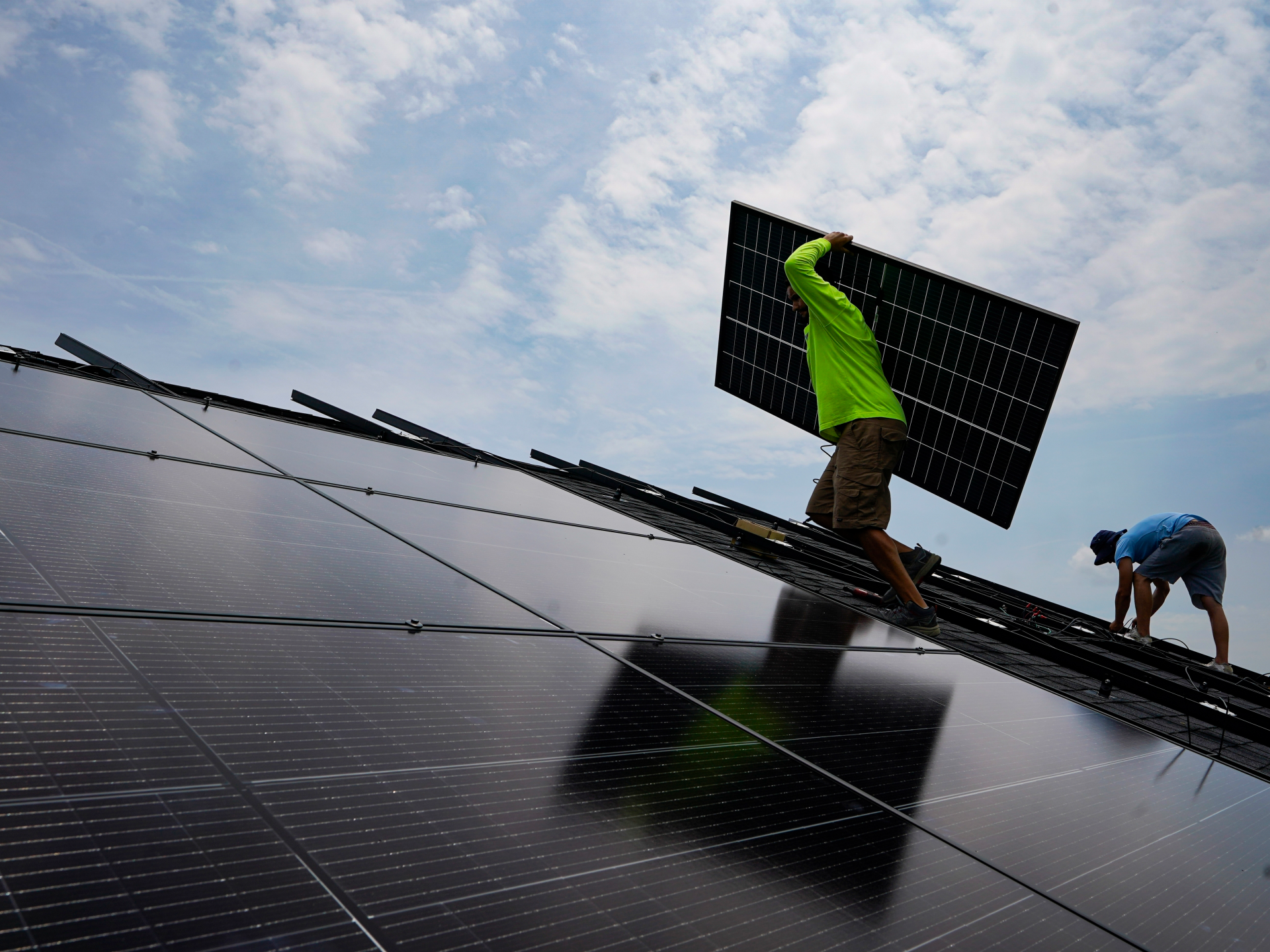
Gov. Arnold Schwarzenegger has approved two major initiatives that will require utilities to pay consumers for generating extra power and will boost the payoff for certain solar facilities.

Homes, businesses and schools that have solar panels or wind turbines previously had no financial incentive to use less electricity than they generated. But AB 920, written by Assemblyman Jared Huffman (D-San Rafael), will encourage efficiency, supporters say.

SB 32, by state Sen. Gloria Negrete McLeod (D-Chino), requires utilities to purchase solar electricity from facilities that produce up to three megawatts and could increase installations on unused spaces such as warehouse roofs. The old limit was 1.5 megawatts.

The two bills will go into effect Jan. 1. Schwarzenegger signed them late Sunday, the last day to act on bills from this year’s legislative session.

Under AB 920, the state Public Utilities Commission will set a rate for utilities to compensate customers whose solar or wind systems produce more power than they use in a year. Under California’s current law, customers are not paid for any surplus electricity they feed back into the grid.

The state requires that when a consumer installs a solar power system, it be the right size to produce only enough power necessary for on-site use. Rebates from the California Solar Initiative, overseen by the utilities commission, discourage anything larger. So customers who later reduce their energy consumption often end up underutilizing their solar panels.

“The current system instills a perverse incentive for people to waste their solar electricity just so they don’t give it away for free to the utilities,” said Bernadette Del Chiaro, a clean energy advocate with Environment California, which sponsored the bill.

The new law could boost sales of photovoltaics, especially in regions with sunny summers. Homes that use less power than they did when their solar panels were installed — such as those that add energy-efficient appliances, insulation or weatherproofing — and those with children who have moved out can also benefit.

“This bill applies to individual homeowners as well as small businesses, farms, wineries, schools and even affordable housing developments,” Huffman said in a statement.

Customers can either receive a check for the extra energy or have credit rolled forward on their electricity bills. Experts, however, said they should expect little profit.

SB 32, meanwhile, could spark more interest in commercial rooftop systems. The law expands an existing program to include municipal utilities, which now must purchase solar power at a set rate until they reach their portion of a statewide 750-megawatt cap. The limit was previously set at 500 megawatts.

The utilities commission will set the rate, which will be higher than market price after incorporating environmental compliance costs and other benefits, said Sue Kateley, executive director of the California Solar Energy Industries Assn., which sponsored the bill.

Between the sweeping solar installations in the desert and the small-scale ones on homes, she said, there had been a category of properties that had plenty of space but didn’t use enough power to justify setting up huge solar panels.

But now, owners of large storage units and similar low-energy facilities will be able to install solar power systems and sell the extra electricity back to the utilities, a program known as a feed-in tariff.

The program took cues from countries such as Germany — where, some in the industry have complained, a similar tariff format stimulated the market so much that prices of solar energy shot too high. Other critics are worried that the tariff could be too low to interest investors.

“We didn’t want to replicate the German model, which was a social movement to create an industry,” Kateley said. “In California, we already had an industry, but we wanted to fill a market gap. And within the community, it’s really exciting because this law will create local jobs.”

In a note to the state Senate on Sunday, Schwarzenegger encouraged the utilities commission to continue investigating an expanded tariff for small to medium-size producers of renewable energy.

“In order to meet our greenhouse gas emission reduction goals and a Renewable Portfolio Standard of 33% by 2020, we will need to use all the tools available under our existing programs,” he said.

But Schwarzenegger vetoed a slate of bills — including SB 14 and AB 64 — that would have required the state to rely on renewable resources for at least one-third of its electricity. He has issued an executive order to meet the 33% goal using a different plan and supports efforts to create 1 million solar roofs by 2018.

Assemblyman Paul Krekorian (D-Los Angeles), chairman of a renewable energy committee, called the vetoes a dangerous setback. The bills, Krekorian said, would have created “green” jobs and steadied price volatility while cutting market manipulation from solar hubs outside of California. He said the vetoes would sour developers to the California market, leading them elsewhere.

“If we don’t get started now,” he said, “our opportunities to complete projects are going to be missed.”

[email protected]

Source link

US families’ ‘mind blown’ with cuts to solar rooftop funds | Renewable Energy News

San Francisco, United States – Just weeks ago, Brandon Praileau, a pastor from Norfolk, Virginia, was speaking to families in his community about a federally funded programme that would help them install rooftop solar units in their homes. The government funds would take care of their installation costs, and once installed, lower the burden of rising electricity costs, a pressing concern.

Then, Praileau heard the federal government had scrapped the $7bn Solar For All programme through which his project and other solar projects across the country were to be funded, leaving them stranded.

Recommended Stories

list of 4 itemsend of list

It is one of several federally funded renewable energy projects that have been scrapped or will end early, veering off the country’s planned shift to renewable energy, also making it harder to meet climate goals.

Praileau, Virginia programme director for Solar United Neighbors, had been helping roll out the project that received $156m in federal funds to support 7,500 low- and middle-income families with solar installation. Praileau say he was “mind blown” by the sudden withdrawal.

The federal government will also end the 30 percent tax credit for solar rooftop installation in homes this December. For businesses, these tax credits will only be available if they start construction of factories, malls or other businesses, for which the solar installations are meant, by June 2026.

The Department of Energy also withdrew $13bn in funding from a range of other renewable energy projects, including upgrading power grids, carbon-neutral cement production, and battery energy storage. The administration also ended several funding initiatives for wind energy.

President Trump has said, “We’re not going to be approving windmills unless something happens that’s an emergency.”

This could lead to a $114bn loss in delays or cancellation of wind energy projects, according to an April 2025 report by BloombergNEF.

In Florida, intake forms for 10,000 low- and middle-income households to enrol for federal subsidies to get solar units installed on their rooftops were ready when the $156m project was scrapped in August.

A resident of Miami-Dade County had told volunteers who were helping her fill in the forms to enrol for the grant that she was “scared to use power. I am scared to put on air conditioning”, because the steep rise in power costs in the state had put it out of reach for her.

Power costs in the state are up 60 percent for some residents since 2019, Heaven Campbell, Florida programme director of Solar United Neighbors, which was working on implementing the project, told Al Jazeera.

Other states have also seen varying power cost hikes due to hurricanes and the war in Ukraine, which made Russian natural gas more expensive.

Florida Power and Light, the utilities provider, has also currently made a case to increase rates further to raise nearly $10bn over the next four years, according to Florida’s Office of Public Counsel.

Solar United’s staff has tried to educate residents that not using power could get them disconnected, and reconnecting comes with a fee.

Early ending of the tax credit will mean “consumers are stuck at the mercy of utilities”, and their rising rates, says Bernadette Del Chiaro, senior vice president for California at the Environmental Working Group.

‘Rain shadow impact’

With the solar rooftop tax credits set to expire in December, there has been a scramble to install, and some solar installers say they are having to turn away customers.

“We will see the rain shadow impact of this in 2026,” Del Chiaro says, referring to a sharp drop in business and jobs that the industry is steeling itself for next year.

“This is a big plunge on the solar coaster,” says Barry Cinnamon, chief executive of Cinnamon Energy Systems, a San Francisco-based solar installation company.

Ed Murray, president of the California Solar and Storage Association, told Al Jazeera he expects the elimination of tax credits to double the payback time for installation and other costs associated with the solar units to up to 12 years.

It would also lead to job losses for thousands of skilled workers in the sector, Murray said, even as the air quality is likely to worsen and the state is expected to fail to meet its climate goals.

In its announcement withdrawing from these projects, the Department of Energy notification said the projects “advance the previous Administration’s wasteful Green New Scam agenda”.

In the statement, Energy Secretary Chris Wright said that, “By returning these funds to the American taxpayer, the Trump administration is affirming its commitment to advancing more affordable, reliable and secure American energy and being more responsible stewards of taxpayer dollars.”

Critics of solar projects have said they drive up costs for households still on the power grid because solar customers pay less to utilities but still use that power when needed.

The Trump administration has, instead, supported oil and gas production through several measures, including plans to open up the entire Arctic National Wildlife Refuge (ANWR) for oil and gas leasing recently. It has also eased permitting for drilling on federal lands.

Rising costs

The Biden administration had funded renewable energy projects under what it called the Green New Deal, a programme to accelerate economic growth and job creation while having a positive climate impact.

But even as these projects began rolling out, power costs have risen sharply in many states, including Virginia.

A recent study by the Lawrence Berkeley National Laboratory found that the rise in power costs had outpaced inflation in 26 states and listed a range of factors for it, including the Ukraine war and extreme weather factors such as wildfires and hurricanes that have damaged an already ageing electric poles and grid.

For instance, prices in California have risen more than 34 percent since 2019, the study says, in part because the record-breaking wildfires forced utilities to replace and strengthen their power lines. Federal funding of $630m to strengthen grids in California was among the projects scrapped by the Department of Energy.

“A majority of the projects that were scrapped were mid-implementation,” says Ryan Schleeter, communications director of The Climate Center, a California-based think tank.

Federal incentives also meant that more than 20 percent of the cars sold in the state over the last two years had been electric vehicles (EVs). These allowed middle-income families to buy EVs, Schleeter says. With incentives having ended on September 30, “the central challenge will be how to be equitable,” he says.

Susan Stephenson, executive director of California Power and Light, which supports places of worship to have renewable energy, says several places of worship that had planned to move to solar energy or install EV charging stations are now struggling to find installers and have seen costs going up beyond their initial budget due to federal cuts.

In Virginia, Praileau says power costs came up as one of the greatest concerns in his interactions with his congregants. The state has among the most data centres in the country, and Praileau believes that could be a reason for rising costs.

Voter dissatisfaction over rising power costs has been among the top issues in the governor’s elections in the state that went to the polls on November 4. One of the promises that Abigail Spanberger, the Democrat candidate who won, had made was to reduce power costs by increasing energy production and getting data centres to pay a higher share of power costs.

Praileau hopes the solar project, the cuts to which are already being litigated, can also be revived by the new governor. In Florida, too, there is ongoing litigation on the federal funding cuts.

Several states, including California, have announced their own rollbacks on renewable energy incentives.

But with funding withdrawals hurting residents, Steve Larson, a former executive director of the California Public Utilities Commission, expects more litigation to restore programmes and mastering “techniques of delay”, for federal cuts in grants and to allow renewable energy projects to keep going.

Source link

Why Brazil, a Renewable Energy Giant, Still Can’t Quit Coal

In July, one of Brazil’s last coal plants in Candiota resumed operations after significant investment from Ambar, owned by billionaires Wesley and Joesley Batista. They believe that Brazil will continue to use coal despite having over 80% of its electricity from renewable sources. As Brazil prepares to host the UN climate summit COP30, President Luiz Inacio Lula da Silva expressed concern that the war in Ukraine has revived coal mining.

Coal plants, including Candiota, still supply 3% of Brazil’s electricity, highlighting the influence of special interest groups and the absence of a proper transition plan away from coal. Experts like Christine Shearer from Global Energy Monitor argue that Brazil has the resources to phase out coal, but the strong coal lobby in mining regions keeps these plants running.

The Candiota plant lost its government contract last year, leading to local economic downturns and outmigration. It now sells energy on the spot market during peak hours when solar and wind energy are less available. Nevertheless, Brazil’s Congress recently passed a bill allowing coal plants to operate until 2040, which Lula could potentially veto. The government also made coal eligible for a capacity auction aimed at improving energy security by using thermal plants during low renewable output.

Critics note that including coal in these plans contradicts the goal of energy flexibility, as coal plants cannot start quickly. They argue that poor long-term planning allows coal to persist, despite a surplus of clean energy that goes underutilized due to inadequate demand and transmission infrastructure. This situation makes the government susceptible to coal and natural gas lobbying, leading to higher financial and environmental costs.

Ambar asserts that coal from the Candiota plant is reliable and necessary for power supply, denying claims of relying on political influence. They also argue that critics prioritize the interests of large energy consumers over those of smaller entities and the broader public. Keeping coal operational aligns Brazil with countries like India and South Africa, where strong lobby groups impede efforts to transition away from coal, which is crucial to local economies.

Shutting down Candiota could result in around 10,000 job losses in the region. Local coal miner Jose Adolfo de Carvalho asserts that eliminating the plant won’t significantly impact global carbon issues. The future of the plant causes anxiety among residents, with former employee Graca dos Santos emphasizing the need for a just energy transition to avoid leaving the community jobless.

Lula’s administration lacks a transition plan for Candiota, and little progress has been made in strategizing for other coal facilities. Some suggest diversifying into sectors like beef, wine, and olive oil, which could provide new jobs for former coal workers. Local union leader Hermelindo Ferreira highlights the potential job losses from shutting down Candiota while recognizing that faith in the coal industry is wavering. Ferreira encourages workers to gain new skills, such as maintenance for wind energy, as a way to adapt to future opportunities.

With information from Reuters

Source link