
Renee

Minnesota sues Trump administration over shootings, including deaths of Alex Pretti and Renee Good

Minnesota officials sued the Trump administration on Tuesday for access to evidence they say they need to independently investigate three shootings by federal officers, including the killings of Renee Good and Alex Pretti.

The lawsuit claims that the federal government reneged on its promise to cooperate with state investigations after the surge of federal law enforcement in Minneapolis, and are seeking a court order demanding that the Trump administration comply.

“We are prepared to fight for transparency and accountability that the federal government is desperate to avoid,” Hennepin County Atty. Mary Moriarty told reporters.

The lawsuit marks an escalation in the clash between Minnesota leaders and the Trump administration over the investigations into the high-profile shootings by federal officers that sparked public outcry and protests. The Trump administration has suggested that Minnesota officials don’t have jurisdiction to investigate, but state officials insist they need to conduct their own probes because they don’t trust the federal government to investigate itself.

“There has to be an investigation any time a federal agent or a state agent takes the life of a person in our community,” Moriarty said.

The administration sent thousands of officers to the Minneapolis and St. Paul area for the immigration crackdown as part of President Trump’s national deportation campaign. The Department of Homeland Security considered its largest immigration enforcement operation ever a success but was staunchly criticized by Minnesota’s leaders who raised questions over officers’ conduct.

There continues to be fallout from Operation Metro Surge in the form of a Homeland Security shutdown, as Democrats in Congress hold up funding in an effort to secure restraints on Trump’s immigration agenda.

Minnesota’s lawsuit said the federal government is not permitted to “withhold investigative evidence for the purpose of shielding law enforcement officers from scrutiny where a State is investigating serious potential violations of its criminal laws, targeting its citizens, within its borders.”

Moriarty said Tuesday that the federal government “has adopted a policy of categorically withholding evidence,” calling the practice unprecedented and alarming. She said the lawsuit followed formal demands for evidence after the federal government blocked Minnesota investigators from accessing evidence related to the shootings.

In addition to the Pretti and Good cases, the lawsuit demands access to evidence in the case of Julio Cesar Sosa-Celis, who was shot and wounded in his right thigh by a federal agent in January.

Federal officials initially accused Sosa-Celis and another man of beating an Immigration and Customs Enforcement officer with a broom handle and a snow shovel. But federal prosecutors later dropped all charges against the men and authorities opened a criminal investigation into whether two immigration officers lied under oath about the shooting.

Emails seeking comment were sent to DHS and the Justice Department.

The Justice Department in January said it was opening a federal civil rights investigation into Pretti’s killing but has said a similar federal probe was not warranted in the killing of Good. The decision in Good’s case marked a sharp departure from past administrations, which moved quickly to investigate shootings of civilians by law enforcement officials for potential civil rights offenses.

Deputy Atty. Gen. Todd Blanche has said that the department’s Civil Rights Division does not investigate every law enforcement shooting and that there have to be circumstances and facts that “warrant an investigation.”

Moriarty has said a lack of confidence in the federal government’s review of these incidents makes the state’s independent investigations into the shootings, as well as officers’ actions during the immigration enforcement operation altogether, especially important. The county office received over 1,000 tips from the public on the shootings of Good and Pretti via an online portal they opened to collect evidence. Earlier this month, Moriarty initiated a second portal and said her office was investigating a number of incidents of potentially unlawful action by officers over the course of the immigration enforcement operation.

Fingerhut and Richer write for the Associated Press. Fingerhut reported from Des Moines, Iowa.
Source link

Renee Good ‘slow to anger, quick to love,’ her father says

Renee Good loved sparkles and laughter and any excuse for a celebration. She loved pretty much everyone she met, and was late for pretty much everything.

“She had this way of making you feel special and loved that I didn’t even understand … until we lost her,” Donna Ganger said Friday of her daughter, who was shot and killed by an immigration officer during the federal crackdown in Minneapolis.

She was “slow to anger, quick to love, quick to care,” said her father, Tim Ganger. “That’s the essence of who she was.”

Good, a 37-year-old mother of three, was killed Jan. 7 as immigration agents surged through the Minneapolis area, sparking waves of protests. Her death and that of another U.S. citizen, Alex Pretti, weeks later in Minneapolis sparked outrage across the country and calls to rein in immigration enforcement.

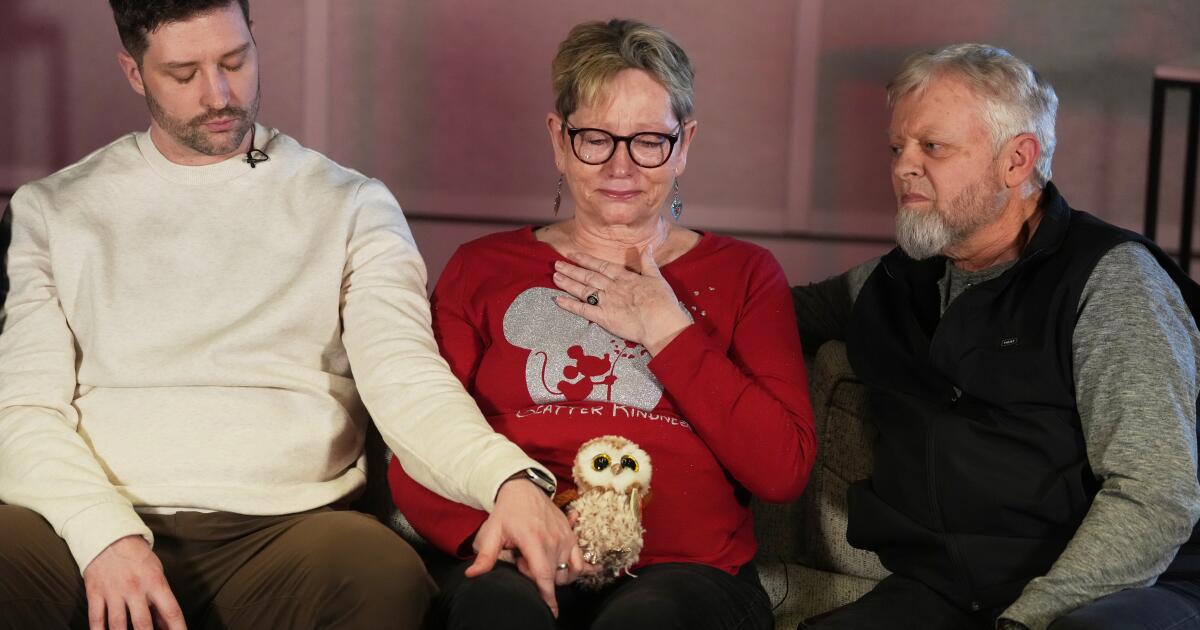
In a wide-ranging interview in Colorado, where some of the family lives, Good’s parents and two of her brothers, Brent and Luke Ganger, talked to the AP about the joy Good found in life, their grief and their hopes that her death can bring about change in a deeply polarized nation.

“It’s going to be hard in the future,” Donna Ganger said. “It’s going to be kind of a constant pain.”

Settling in Minneapolis

Good, who graduated from college later in life, was volunteering in a local school district and working as a substitute teacher when she was killed, her parents said.

“She was working so hard to get her education, and then she was finally able to use it, and I could just tell how happy she was and how fulfilled,” Donna Ganger said.

Good, her 6-year-old son and her partner, Becca Good — the women were not legally married, according to a family lawyer, but referred to each other as wives — had only recently relocated to Minneapolis from Kansas City, Mo., settling on a quiet residential street in a tight-knit neighborhood known for its progressive activism.

In social media accounts, Renee Good described herself as a “poet and writer and wife and mom.” On Pinterest, a profile picture shows her smiling and holding a young child, alongside posts about tattoos, hairstyles and home decorating.

The family “settled very quickly into the community in Minneapolis,” said Donna Ganger, describing how the neighborhood had also welcomed the rest of the family when they came after the shooting. They see that as the result of the love that Good had showed her new neighbors.

“It was incredible to receive that back,” Luke Ganger said.

Donna Ganger held a stuffed toy owl as she spoke, a gift from her daughter, who knew how much she loved the birds. It had sparkles on its feet, a reminder of Good’s love for glitter.

At Good’s memorial service, a table of glitter had been set out for guests. Donna Ganger had put a piece on a lens of her glasses and it’s remained there.

“She just kind of sparkled all the way through,” said Donna Ganger. “I think of her and I look down and see my little sparkle.”

‘A very American blend’

The family is “a very American blend,” Luke Ganger said recently in testimony to Congress. “We vote differently, and we rarely completely agree on the finer details of what it means to be a citizen of this country.”

Yet “we have always treated each other with love and respect,” he said.

On Friday, the family didn’t want to discuss the specifics of their differences, but Donna Ganger said she’d long prayed for guidance: “Before all this happened, I said, ‘Make me a wise woman.’”

In the hours after Good’s death, Trump administration officials said she had been shot as she tried to drive her car into an immigration officer. Homeland Security Secretary Kristi Noem said Good had committed “an act of domestic terrorism.”

But as video evidence and other details of the confrontation emerged, and criticism of the crackdown began growing, administration comments softened.

President Trump said he’d been told that Tim Ganger had supported him.

“He was all for Trump, loved Trump. And, you know, it’s terrible,” he told reporters. “I hope he still feels that way.”

Tim Ganger declined to talk about his political affiliation or whether it had changed with his daughter’s killing.

“I think I’m just going to leave that go,” he said. “There’s so many other important things” to deal with now, he added.

But family members said they hoped their ability to get along would be an inspiration.

“Our purpose through this whole tragic, difficult, unbelievable time, is to have something good come out of this,” Tim Ganger said. “Otherwise the senselessness of this is overwhelming.”

Sadness echoed in Donna Ganger’s voice as she talked about navigating family differences.

“Sometimes I’m just silly, you know, and I joke with them and I’m goofy,” she said. “But I want to be able to talk about hard things — and that’s hard sometimes with your own family to talk about hard things that maybe you don’t agree on. And I don’t want there to be any hardships between us or hurt.

“But it’s important that we learn to be careful with our words, but share them in a deep way,” she said. “It’s really important.”

Family members spoke only in general ways about the change they’d like to see come from Good’s death.

“I think it’s evident that something is broken, right?” said Brent Ganger. “And when something is broken, you have to take a deep look to see what it is that can be changed and fixed in order for it to not happen again.”

The morning of the shooting

On the morning of the shooting, as immigration raids and protests were flaring across the city, Becca Good has said she and Renee stopped their car in the street to support neighbors during an immigration operation.

Video shows Renee Good in a maroon SUV blocking part of the road and repeatedly honking her horn.

Two immigration officers get out of a truck and one orders Good to open her door. She reverses briefly, then turns the steering wheel as the officer says again, “Get out of the car.” Almost simultaneously, Becca Good, standing in the street shouts, “Drive, baby, drive!”

When Good begins pulling forward, an ICE officer standing in front of the vehicle — later identified as Jonathan Ross — pulls his weapon and fires at least two shots into the car, through the driver’s-side corner of the windshield and the driver’s window, killing Good.

Weeks later, Tim Ganger said he hoped the family’s tragedy would lead to change, though “I’m not even sure what that will look like.”

“But for something good, for people to stop and take a breath and take a look and have a dialog,” he said. “That’s the broader mission of what we want, for people to come together and take care of each other.”

The Justice Department has said it sees no basis to open a federal civil rights investigation into Good’s death, but the family has hired a law firm that is conducting its own investigation and exploring potential legal action.

Family members said no one from the federal government has contacted them about Good’s killing, and they are unsure whether anyone will be held accountable.

“All we can do is speak out and hope that our sincere words are enough to enact some kind of change,” Brent Ganger said.

Slevin and Sullivan write for the Associated Press and reported from Denver and Minneapolis, respectively.

Source link