OPEC+ members announced Sunday they would modestly boost production as worldwide oil supplies tighten and prices spike amid the American-Israeli war on Iran. File Photo by Olivier Matthys/EPA
April 5 (UPI) — Members of the Organization of the Petroleum Exporting Countries said Sunday they will again modestly boost oil production as war rages in Iran and the Persian Gulf, although the move is largely symbolic as the Strait of Hormuz remains closed.
As first they did in March, the eight OPEC+ countries — Saudi Arabia, Russia, Iraq, United Arab Emirates, Kuwait, Kazakhstan, Algeria and Oman — on Sunday agreed to a 206,000 barrel-per-day production increase amid attacks by Iran on the oil and gas facilities of several of its members in the Persian Gulf.
Iran has blocked the key Strait of Hormuz shipping lane in response to the American and Israel attacks that started on Feb. 28.
Since then the global price of oil has shot up by close to 60% while gas prices at the pump in the United States have surpassed $4 per gallon.
Although the waterway remains choked off, the OPEC+ move indicated producers will likely ramp up production to help alleviate the worldwide oil shock once the Strait is reopened and production facilities in the Gulf states are secured from Iranian drones and missiles.
U.S. President Donald Trump on Sunday continued to threaten Iran with destruction of civilian and military infrastructure by Tuesday unless Tehran loosens its grip on the Strait.
But Iran has remained defiant, continuing to launch drone attacks against OPEC members who host U.S. military facilities, particularly targeting Kuwait, Bahrain and the UAE, where critical infrastructure again came under attack on Sunday.
Damage was sustained at civilian facilities in all three countries, officials reported.
The Kuwait Petroleum Corp. announced “significant material losses” after Iranian drone attacks on several of its facilities, the KUNA news agency reported.
Meanwhile, Kuwaiti Interior Ministry spokesman Brig. Gen. Nasser Bousleib said officials had registered nine reports of falling shrapnel during the preceding 24 hours, boosting the total of such incidents since the beginning of the Iranian aggression to 678.
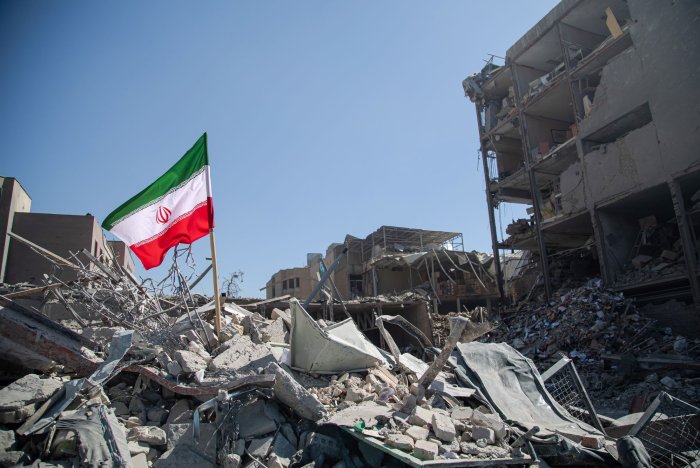
An Iranian flag stands amid the destruction in Enghelab Square following the attacks carried out by the United States and Israel on Tehran, Iran, on March 4, 2026. Photo by Nahal Farzaneh/UPI | License Photo
Investors remain wary, as the Wall Street Journal report came on the same day the US president threatened to destroy Iran’s key oil export hub and desalination plants unless it accepts a deal, while also suggesting that diplomacy was making progress.
ADVERTISEMENT
ADVERTISEMENT
The news comes as governments around the world scramble to implement measures to ease the burden of surging fuel prices while also seeking to conserve energy, with around one-fifth of global crude oil and gas passing through the waterway.
The Wall Street Journal, citing administration officials, said Trump and his aides had concluded that a mission to reopen the waterway would extend beyond his four- to six-week timeline. It added that he had decided to focus on targeting Iran’s missiles and navy, before seeking to pressure the country diplomatically to reopen the Strait.
Further fuelling concerns, a drone struck a Kuwaiti oil tanker in Dubai waters, causing a fire on Tuesday morning. Dubai authorities said the blaze had already been extinguished, but concerns about a potential oil spill remain.
Maritime traffic disruptions in the Strait of Hormuz, through which roughly a fifth of the world’s oil normally passes, remain a key pressure point for global energy supplies. US Secretary of State Marco Rubio said Trump has “options available” in response to Tehran’s threats to control the strait, after Iran was reported to have effectively created a “toll booth” there.
Both major oil benchmarks fell on Tuesday, though West Texas Intermediate and Brent crude remained well above $100 a barrel. At 7 a.m. CET, the international benchmark Brent was trading at nearly $113, while WTI crude was above $102 a barrel.
Most equity markets in Asia rose briefly, but by this point Tokyo’s Nikkei 225 was down 1.3%, South Korea’s Kospi had fallen 3.3%, Hong Kong’s Hang Seng had shed 0.5%, and the Shanghai Composite index was down 0.4%.
US futures were up between 0.6% and 0.8%.
In other early Tuesday trading, gold and silver prices rose. Gold was up 0.7% at $4,587.80 an ounce, while silver climbed 2.4% to $72.25 per ounce.
The US dollar stood at 159.61 Japanese yen, down from 159.71 yen. The euro was trading at $1.1472, up from $1.1465.
President Trump on Thursday continued projecting confidence in the U.S. war effort in Iran, suggesting online and during a high-level Cabinet meeting that Iran has been “obliterated,” that its leaders were “begging” for a deal, and that the U.S. is “roaming free” over Iran and “NEEDS NOTHING” from its European allies.
His description of the war as all but finished — he actually said “we’ve won” — stood in contrast to the facts on the ground, where Iran continued to launch attacks and threaten oil tanker traffic in the vital Strait of Hormuz, and the U.S. continued sending troops and warships to what is already the largest U.S. military buildup in the Middle East in decades.
Trump’s framing of the conflict also contrasted with that of Iranian officials, who have remained publicly defiant, downplayed negotiations and outwardly rejected several of Trump’s conditions for ending the war — as Trump himself acknowledged, accusing them of saying one thing in private and another in public.
“They better get serious soon, before it is too late,” the president wrote on social media, “because once that happens, there is NO TURNING BACK, and it won’t be pretty.”
“They are begging to make a deal, not me,” Trump reiterated later Thursday, while hosting his first Cabinet meeting since the war began. “Anybody that sees what is happening understands why they are begging to make a deal.”
Trump asserted that Iran’s military capabilities have been destroyed, and that the American mission is “ahead of schedule.” He said American forces were operating without opposition over Iran, and “there’s not a damn thing they can do about it” because they’ve been “beat to s—.”
Trump’s outward confidence, a defining feature of the war campaign that has been consistently echoed by Secretary of Defense Pete Hegseth and other administration loyalists, continued despite growing concerns this week in Congress — and not only from Democrats.
Several Republicans emerged from a classified war briefing Wednesday clearly frustrated with the administration for not providing a clearer picture of the path out of the now monthlong war, or clear answers on whether it planned to deploy ground troops.
“We want to know more about what’s going on,” said Rep. Mike Rogers (R-Ala.), chairman of the House Armed Services Committee. “We’re just not getting enough answers.”
“I can see why he might have said that,” said Sen. Roger Wicker (R-Miss.), chairman of the Senate Armed Services Committee.
Democrats have hammered the president — contrasting the war and its massive budget with rising fuel costs for average Americans and lamenting the deaths of U.S. service members.
“Thirteen American lives lost and tens of billions of taxpayer dollars spent in just three weeks since Donald Trump plunged us into war without congressional authorization. There is still no plan, no clear justification, and no end in sight,” Sen. Alex Padilla (D-Calif.) said. “Americans called for lower prices, not endless wars.”
For weeks, Trump, Hegseth and other war leaders such as Gen. Dan Caine, the chairman of the Joint Chiefs of Staff, have focused on U.S. wins in the conflict — tallying up Iran’s sunken ships and grounded planes, assassinated leaders and undermined missile capabilities.
In recent days, Trump has suggested that, because of those wins, Iran is buckling and its leaders reaching out for a deal. He has said the U.S. is pushing a 15-point plan that will forever block Iran from developing a nuclear weapon or threatening the U.S. or its allies. And he and others in his administration have accused the media of ignoring tremendous battlefield wins to harp on losses instead.
Israel, America’s major partner in the conflict, has projected similar confidence while showing no signs of slowing its attacks on Iran. On Thursday it announced it had killed several senior Iranian naval commanders, including Commodore Alireza Tangsiri, the head of Revolutionary Guard’s navy.
Israel’s Defense Minister Israel Katz said the deaths should send a “clear message” that Israel will continue to hunt down top Iranian military officials. Iran did not immediately acknowledge Tangsiri’s death.
The head of U.S. Central Command, Adm. Brad Cooper, praised Tangsiri’s killing, said U.S. strikes would continue, and called on Iranian fighters to “immediately abandon their post and return home to avoid further risk of unnecessary injury or death.”
Meanwhile, death, destruction and environmental and economic damage from the war spread far beyond Iran, where officials recently increased their estimated death toll to nearly 2,000.
Israel was fighting off a barrage of incoming missiles Thursday, with booms heard in Tel Aviv and Jerusalem and an impact reported in the central town of Kafr Qassem. Iraqi Defense Ministry spokesman Maj. Gen. Tahsin al Khafaj on Thursday said 23 people had been wounded in a Wednesday strike on a military clinic in western Iraq’s Anbar province.
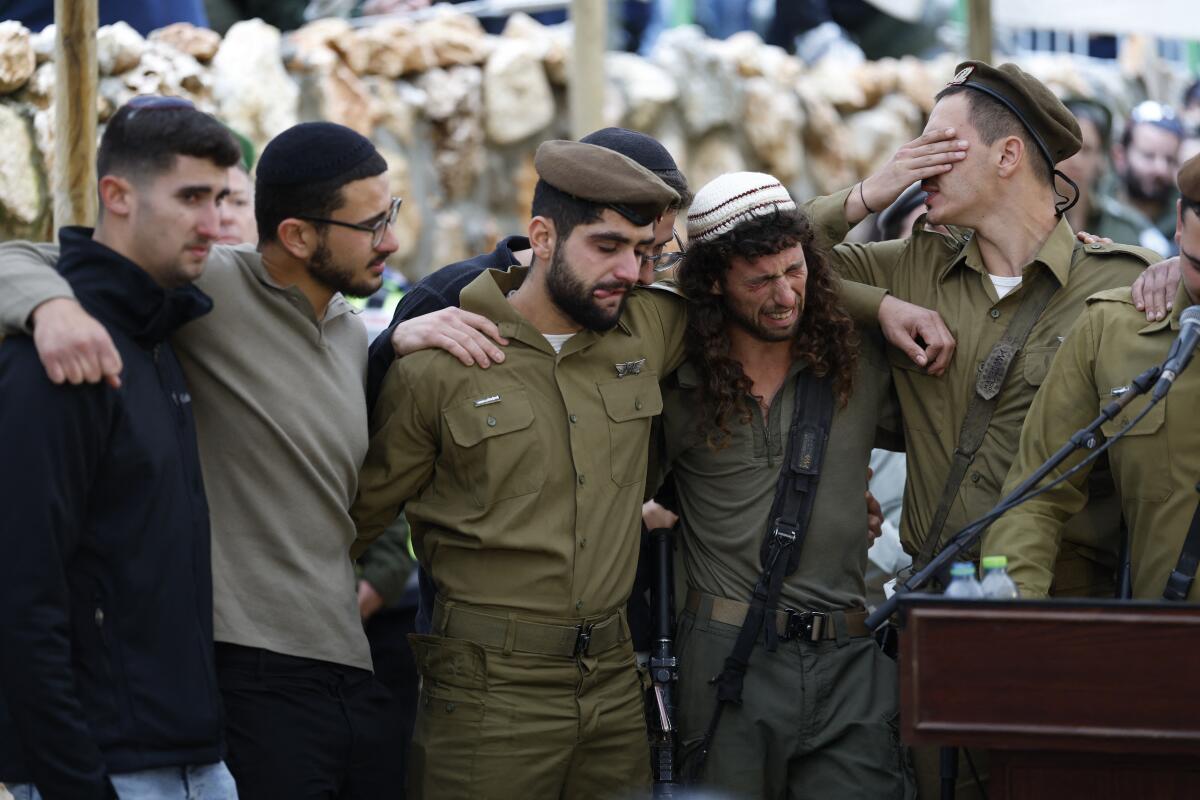
Israeli soldiers grieve during the funeral of Staff Sgt. Ori Greenberg, 21, at the Mount Herzl military cemetery in Jerusalem on Thursday.
(Odd Andersen / AFP via Getty Images)
Thousands of additional U.S. troops are on their way to the region, while many of the tens of thousands already stationed there have been displaced into hotels and other temporary housing — diminishing their war-fighting capabilities — by Iranian attacks that have left the 13 regional military bases they normally live on “all but uninhabitable,” the New York Times reported.
Iran announced Thursday that it had launched drone and missile attacks on a U.S. military base in Kuwait and a separate air base used by American forces in Saudi Arabia.
Jasem Mohamed al-Budaiwi, the secretary-general of the Gulf Cooperation Council, accused Iran of charging fees for ships to safely transit the Strait of Hormuz, continuing the economic toll on global oil supplies. Environmental experts warned of massive pollution from burning oil and gas fields.
Russia, emboldened by the Iran war, which has drawn resources away from Ukraine and led the U.S. to ease sanctions on Russian oil, has launched a renewed spring offensive against Ukraine.
The distance between U.S. and Iranian messaging about the war and their negotiations to end it — which foreign officials have said are occurring through intermediaries — has contributed to the tensions and the reluctance of allies to get involved, with some citing similar frustrations as Republicans in Congress this week.
Many allies have largely stayed out of the conflict despite Trump vacillating between demanding their help and insisting it isn’t necessary.
In one of his posts to social media Thursday morning, Trump blasted allies in the North Atlantic Treaty Organization, or NATO, for having “DONE ABSOLUTELY NOTHING TO HELP” in the conflict, and said the U.S. would “never forget.”
During his Cabinet meeting, Trump said that when the “right deal” is made with Iran, the Strait of Hormuz will reopen — while insisting that Iran no longer has any “mine droppers” that would threaten merchant vessels passing through the key oil route.
Steve Witkoff, one of Trump’s top advisors leading the negotiations in the Middle East, said the Iranians were looking for an “offramp,” that Pakistan is serving as a mediator between Washington and Tehran, and that the U.S. has presented a 15-point plan that “forms the framework for a peace deal.”
“These are sensitive, diplomatic discussions and you have directed us to maintain confidentiality on the specific terms and not negotiate through the news media, as others do,” Witkoff said. “We will see where things lead and if we can convince Iran that this is the inflection point, with no good alternatives for them other than more death and destruction.”
Trump has also declined to say whom Washington is negotiating with in Iran, but described them as “very smart,” “not fools,” and “very lousy fighters, but great negotiators.”
He also said he knows they are “the right people” for the U.S. to be dealing with because they had given him a “present” — and proved they are in control — by allowing “eight big boats of oil” travel through the strait this week.
Asked if he intended to send U.S. troops into Iran to take its enriched uranium, he called it a “ridiculous question” that he wouldn’t answer.
Treasury Secretary Scott Bessent said he is confident that more merchant vessels will soon be able to safely pass through the Strait of Hormuz. He also told the president that he believed the oil market is currently “well supplied” and that once the war ends, energy prices will drop.
Hegseth repeatedly slammed the media for falsely framing the war effort as floundering or unfocused, saying Iran’s “air defenses are gone,” its leaders hiding in “underground bunkers,” and its fighters losing morale.
He said Iranian officials in private are admitting “very heavy losses,” and that the U.S. and the world are benefiting from having Trump, whom he called the “ultimate deal maker,” working toward a peace deal.
In the meantime, he said, the U.S. military will “continue negotiating with bombs.”
WASHINGTON — In session for rare weekend votes with the election fast approaching, Congress acted Saturday to keep the government running for another 24 hours but made little apparent progress in breaking a budget impasse.
Despite the action of the House and the Senate on the eighth stopgap spending measure since the fiscal year began Oct. 1, a weird limbo enveloped the Capitol as neither Republicans nor Democrats predicted a quick deal. Gone for the time being was the usual year-end pressure to adjourn. Instead, both sides seemed willing to wait to see who would blink first.
Negotiations focused on the handful of issues still dividing the parties, issues that might or might not influence voters at the polls Nov. 7. Among them were tax credits for school construction, proposed workplace safety regulations and measures to ease immigration law.
President Clinton, who forced the weekend votes by insisting that lawmakers pass daily stopgap budget measures, urged the Republican-led Congress to wrap up its budget work and include an increase in the federal minimum wage.
“I’m not trying to harass [Congress],” Clinton said at a news conference. “I’m just trying to get them to finish their job and go home.”
Clinton cited an agriculture spending bill he signed Saturday as a model of bipartisanship. The president said he signed the bill–which included milestone language easing a decades-old trade embargo on Cuba to allow U.S. agricultural exports–even though he was critical of provisions that would limit the effect of the trade opening.
In a GOP radio address, New Jersey Gov. Christine Todd Whitman called the budget showdown “a case in point” of Washington gridlock that voters will punish.
“I think we are ready for a change,” Whitman said. “And the difference between the parties is striking. Republicans at all levels of government work with people to accomplish results–not make excuses for why we can’t even try to solve them.”
Republican congressional leaders note that they wrapped a minimum-wage increase Clinton supports into tax legislation that he is holding up with a promised veto. And they accuse the White House of constantly shifting its goals on the two government spending bills for fiscal 2001 that have not been finalized.
“I tell you, I’ve reached the end of my rope,” said Sen. Ted Stevens (R-Alaska), chairman of the Senate Appropriations Committee. To illustrate his frustration, Stevens said in an interview on the Capitol steps that the administration had sought $3.5 billion in extra spending on a bill containing $106.8 billion for discretionary spending on education, health and other programs. Then $4 billion. Then $4.1 billion. And now, he said, the demand is up to $4.5 billion.
“What can you do?” Stevens asked.
To register his protest, Stevens was one of two senators to vote against the daily budget resolution. The other was Sen. Patrick J. Leahy (D-Vt.). Sixty-seven senators voted for the resolution.
Thirty-one senators–11 Democrats and 20 Republicans–were absent for what the chamber regarded as a ritual vote. Many missed it because of campaign events, a few for health reasons. California’s Democratic senators, Dianne Feinstein–who is running for reelection–and Barbara Boxer, were both absent.
The House vote for the stopgap measure was 339 to 7. All seven dissenters were Democrats, including Rep. George Miller of Martinez. Of the 86 representatives who were absent, 42 were Republicans and 44 Democrats.
Twelve of California’s 52-member House delegation did not vote. They were Feinstein’s opponent in the Senate race, GOP Rep. Tom Campbell of San Jose, and Reps. Brian P. Bilbray (R-San Diego), Ken Calvert (R-Riverside), Christopher Cox (R-Newport Beach), Matthew G. Martinez (R-Monterey Park), Howard P. “Buck” McKeon (R-Santa Clarita), George P. Radanovich (R-Mariposa), Joe Baca (D-Rialto), Xavier Becerra (D-Los Angeles), Tom Lantos (D-San Mateo), Pete Stark (D-Hayward) and Maxine Waters (D-Los Angeles).
The roll call showed the political importance of the vote to many House members–all wary of the potential charge that their absence would reflect an insensitivity to the possibility of a government shutdown.
Bilbray was the only California absentee in a tough reelection race. Other California incumbents in contested races, such as Reps. James E. Rogan (R-Glendale), Steven T. Kuykendall (R-Rancho Palos Verdes), Calvin Dooley (D-Visalia), Lois Capps (D-Santa Barbara) and Stephen Horn (R-Long Beach), all eschewed campaign events to remain in Washington for the vote.
Qatar, UAE, Kuwait and Saudi Arabia report new blasts, interceptions, with war edging to 3-week mark.
Published On 18 Mar 202618 Mar 2026
Iran has fired missiles and drones at several Gulf Arab nations, which have sought to intercept them, in a now-daily fallout from the United States-Israel war launched on Iran nearly three weeks ago that has engulfed the Middle East with deaths, destruction, assassinations, and an energy crisis spreading far beyond the region.
Early Tuesday, Qatar’s Ministry of Defence said its armed forces intercepted a missile attack against the country.
Recommended Stories
list of 4 itemsend of list
The Kuwait National Guard said it shot down an unmanned aircraft at dawn. The statement came hours after the Kuwaiti army said it was intercepting hostile missile and drone attacks.
The UAE, Saudi Arabia and Bahrain have also reported intercepting missiles and drones in recent hours.
Saudi Arabia’s Ministry of Defense reported the interception and destruction of a drone in the Eastern Region.
Earlier Tuesday, the UAE Ministry of Defence said the country’s air defences were “currently responding to incoming missile and drone threats from Iran”. The announcement came four hours after another reported attack from Iran. Later, a loud bang was heard in Dubai as authorities said air defences were dealing with a missile threat.
Al Jazeera’s Zein Basravi, reporting from Dubai, said, “The UAE has been the hardest hit by Iran’s retaliation. For instance, there have been 3000 different projectiles – missiles and drones – fired at GCC countries by Iran in terms of its retaliation. More than half, well over half, have targeted places in the UAE. Overnight was no different … Multiple explosions heard throughout the city.
“That glow of defensive weapons and interceptions in the night skies, something that has become all too familiar, not just in Dubai, but in cities across the GCC. Once again seen over the skies here.
“Dubai’s media office confirming that they were the result of air defence interception operations,” he added.
There have been several deaths in the Gulf nations, where an economic effect is also being acutely felt since the war began.
Gulf economies bear brunt of Iran war
The economies of the Gulf are suffering some of the worst damage.
Iran has launched continuous attacks on Gulf states since the onset of the conflict on February 28, arguing that it is attacking military bases used by the US for the war. Gulf nations have rejected Tehran’s claims, insisting the attacks on them are unjustified.
The Iranian strikes have upended energy production and inflicted major disruption to tourism and travel, putting the region at risk of some of the most severe economic harm since the 1990-1991 Gulf War.
After nearly three weeks of war, the economic effect on the region has already been substantial.
Middle Eastern oil producers’ daily output declined from 21 million barrels to 14 million barrels after a little more than a week of conflict as they deal with the closure of the Strait of Hormuz, according to Rystad Energy.