Tensions rose in The Apprentice as a candidate shared a decision he would “regret for the rest of my life”.
22:10, 12 Mar 2026Updated 22:35, 12 Mar 2026
The Apprentice’s Lord Sugar calls out ‘nasty move’ as candidate admits ‘regret’(Image: BBC)
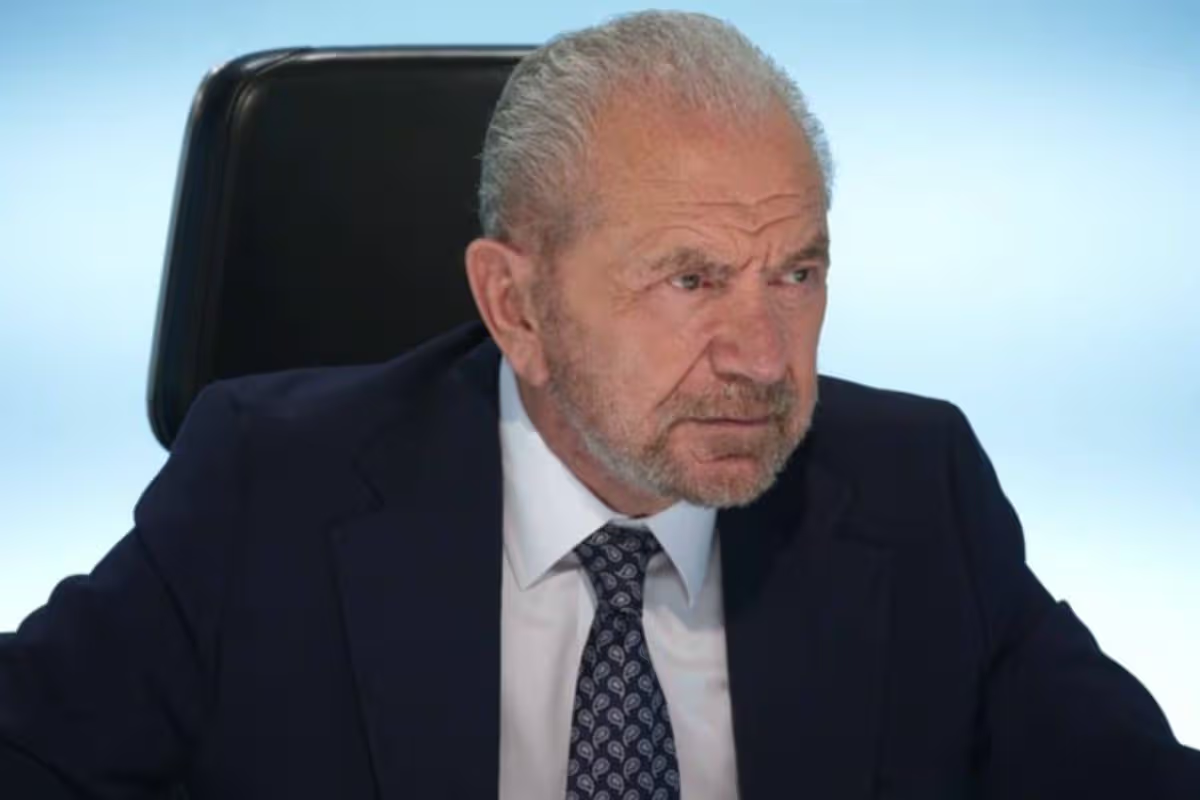
BBC The Apprentice said goodbye to yet another candidate this week but not before Lord Sugar addressed someone’s “slimey” actions.
In week seven of the hit BBC business show, the remaining candidates took on virtual reality fitness where they were tasked with building demos and brands before chasing investment.
Unfortunately, when it came to the boardroom, it was game over for Team Eclipse, headed up by project manager Lawrence Rosenberg who scored an investment four times lower than Team Alpha.
The drama really began in the boardroom when it came to Lawrence choosing who he would be bringing back with him.
He first decided to pick Rajan Gill for his “lack of contributions” before sharing the controversial reason for his second choice of Levi Hague.
Lawrence said: “With respect Lord Sugar, I think you have made it quite clear about your mind on Levi so I will need to bring back Levi as well.”
Prior to his decision, Lord Sugar had questioned Levi what he had achieved in the past seven weeks of the process but despite his own reservations, The Apprentice legend wasn’t happy with this “naughty”, tactic.
“This is not how this process is supposed to work, you’re supposed to bring people back in who you think did not contribute to this task.”
Lord Sugar described it as a “nasty move” with Lawrence apologetically saying that “I’ll regret it for the rest of my life”.
The Apprentice legend said he was going to be “fair” to Levi though and keep him for another week, putting him forward as next week’s project manager with the candidate laughing “happy days”.
Despite this business between Lawrence and Levi, it was actually Rajan’s turn to be fired for his lack of contributions to the task.
This didn’t stop Lord Sugar from giving Lawrence one last telling off though as he warned: “You were this close to getting out of here.”
The drama wasn’t quite over yet though as when the saved pair went back to the house, Lawrence admitted to the rest of the group that he was “beyond embarassed”, having made a “weak decision”.
Levi wasn’t going to let him off the hook just yet though as he simply stated to the remaining candidates: “Don’t ever use me as a scapegoat in there, don’t ever do that to me.”
The Apprentice continues every Thursday at 9pm on BBC One.
For the latest showbiz, TV, movie and streaming news, go to the new **Everything Gossip** website.
The BBC’s director-general has issued a statement of regret after a moment when John Davidson, who has Tourette’s Syndrome, shouted the N-word during the BAFTAs was broadcast
BBC boss says they ‘profoundly regret’ broadcast of BAFTA racial slur(Image: BANG Showbiz)
The BBC’s outgoing director-general Tim Davie has said the corportation “profoundly regrets” that a racial slur was broadcast during the time-delayed coverage of the BAFTA Film Awards on BBC One.
During the BAFTAs, which were aired on 22 February, John Davidson, who has Tourette’s Syndrome, involuntarily shouted several slurs and offensive comments at guests and presenters.
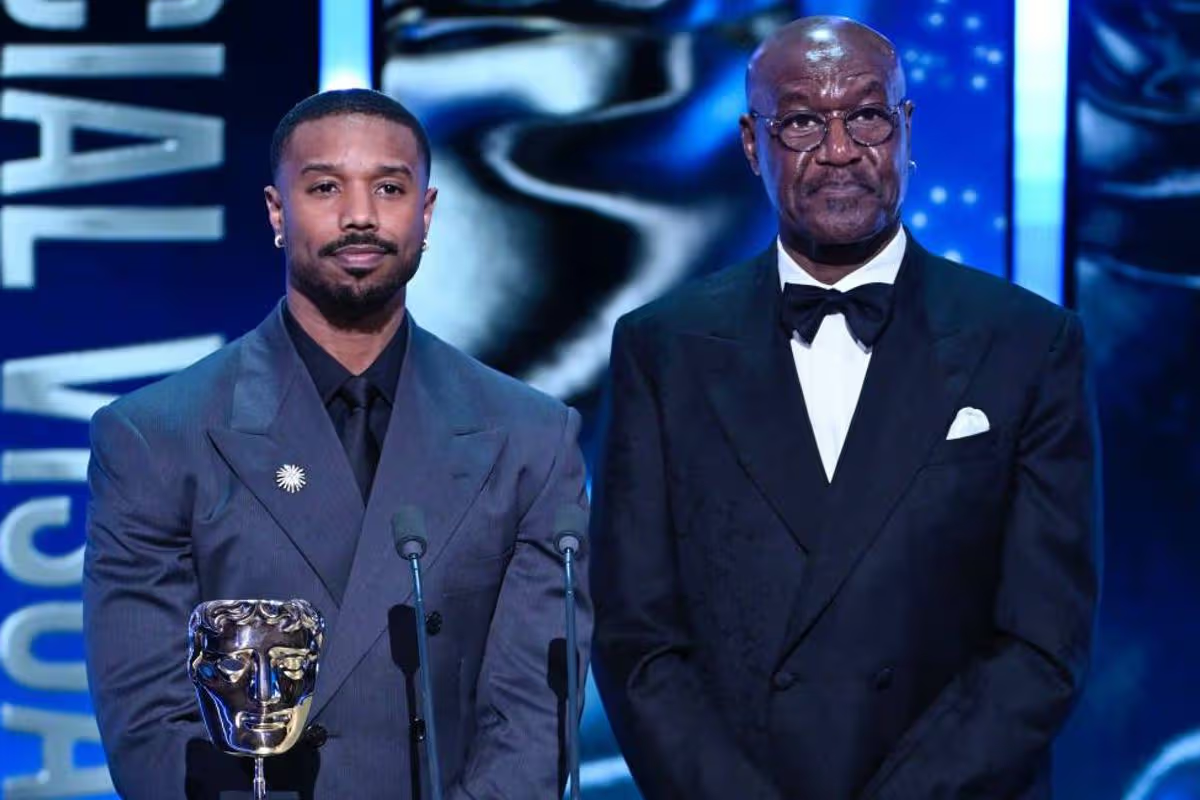
This included the N-Word, which was shouted at Michael B. Jordan and Delroy Lindo as they presented the award for Best Visual Effects, which made it into the live broadcast, despite the show airing hours after it was recorded. Davidson has coprolalia, a form of Tourette’s where vocal tics include expletive and offensive remarks.
Ensure our latest headlines always appear at the top of your Google Search by making us a Preferred Source. Click here to activate or add us as your Preferred Source in your Google search settings.
In a letter to the chairwoman of the Culture, Media and Sport Committee, Dame Caroline Dinenage, Davie said: “I’d like to make clear: although the racial slur was symptomatic of a disability and an involuntary tic, it should never have been broadcast. It was a genuine mistake, and we take full responsibility for our error.”
Davie also responded to questions about why the incident was not edited out of the broadcast. He said: “Although this is the subject of ongoing review, our initial evidence gathering has found that no one in the on-site broadcast truck heard this when they were watching the live feed.
“Because no one in the broadcast truck was aware it was on the live feed, there was therefore no editorial decision made to leave the language in.”
Davidson has said he is “deeply mortified” by what happened at the BAFTAs. In a statement released on 23 February, he said: “I wanted to thank BAFTA and everyone involved in the awards last night for their support and understanding and for inviting me to attend the broadcast.
“I was heartened by the round of applause that followed this announcement and felt welcomed and understood in an environment that would normally be impossible for me.”
Referencing an announcement made by show host Alan Cumming explaining Davidson’s condition to the audiences there and at home, he added: “In addition to the announcement by Alan Cumming, the BBC and BAFTA, I can only add that I am, and always have been, deeply mortified if anyone considers my involuntary tics to be intentional or to carry any meaning.
“I was in attendance to celebrate the film of my life, I Swear, which, more than any film or TV documentary, explains the origins, condition, traits, and manifestations of Tourette’s Syndrome. I have spent my life trying to support and empower the Tourette’s community and to teach empathy, kindness, and understanding from others, and I will continue to do so. I chose to leave the auditorium early in the ceremony as I was aware of the distress my tics were causing.”
His team added that Davidson reached out to the Sinners team to apologise directly to Jordan and Lindo. Lindo said he and Jordan “did what they had to do” during the incident but wished “someone from BAFTA spoke to us afterward”.
BAFTA released a statement in which they said: “At the BAFTA Film Awards last night our guests heard very offensive language that carries incomparable trauma and pain for so many. We want to acknowledge the harm this has caused, address what happened and apologise to all.
“One of our guests, John Davidson MBE, has Tourette Syndrome and has devoted his life to educating and campaigning for better understanding of this condition. Tourette Syndrome causes involuntary verbal tics, that the individual has no control over. Such tics are in no way a reflection of an individual’s beliefs and are not intentional. John Davidson is an executive producer of the BAFTA nominated film, I Swear, which is based on his life experience.
“We take the duty of care to all our guests very seriously and start from a position of inclusion. We took measures to make those in attendance aware of the tics, announcing to the audience before the ceremony began, and throughout, that John was in the room and that they may hear strong language, involuntary noises or movements during the ceremony.
“Early in the ceremony a loud tic in the form of a profoundly offensive term was heard by many people in the room. Michael B. Jordan and Delroy Lindo were on stage at the time, and we apologise unreservedly to them, and to all those impacted. We would like to thank Michael and Delroy for their incredible dignity and professionalism.
“During the ceremony, John chose to leave the auditorium and watch the rest of the ceremony from a screen, and we would like to thank him for his dignity and consideration of others, on what should have been a night of celebration for him.
“We take full responsibility for putting our guests in a very difficult situation and we apologise to all. We will learn from this, and keep inclusion at the core of all we do, maintaining our belief in film and storytelling as a critical conduit for compassion and empathy.”
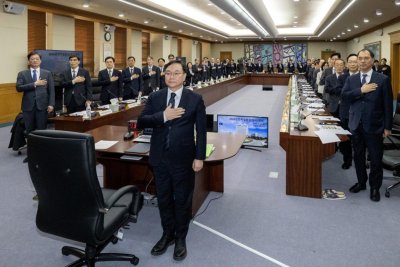
Park Young-jae (C), head of the National Court Administration, and justices salute the national flag during a meeting with chiefs of district and appellate courts nationwide at the top court in Seoul, South Korea, 25 February 2026. Park said that the opinions of the judiciary should be reflected in deliberations for controversial judicial reform bills pushed by the ruling Democratic Party (DP), after three DP-led bills were met by strong opposition from the judiciary. Photo by YONHAP / EPA
Feb. 25 (Asia Today) — Senior judges from courts across South Korea expressed “serious regret” Tuesday over a package of judicial reform bills advanced by the ruling party, warning of potential side effects and calling for broader consultation.
At an extraordinary meeting held at the Supreme Court in Seoul, court presidents reviewed the so-called three judicial reform bills – which include creating a new offense of “distortion of law,” introducing a constitutional complaint system against court rulings and expanding the number of Supreme Court justices.
The meeting was led by Court Administration Chief Park Young-jae and attended by chief judges from courts nationwide.
In a joint statement, the judges said fundamental changes to the judicial system could produce irreversible and significant consequences and should be subject to in-depth discussion through a consultative body that includes multiple institutions and experts.
Regarding the proposed “distortion of law” offense, the judges said the elements of the crime remain abstract even under a revised draft and warned that the scope of punishment could be overly broad. They cautioned that the measure could lead to a surge in complaints and accusations against judges, potentially undermining the swift administration of justice and the protection of citizens’ fundamental rights.
On the proposed constitutional complaint system against court rulings, the court presidents said it could delay the finality of judgments and subject litigants to repeated proceedings.
While acknowledging the need to increase the number of justices at the Supreme Court of Korea, the judges said adding a large number in a short period could weaken trial quality. They suggested first expanding the bench by four justices and reviewing the impact before considering further increases.
In opening remarks, Park said the bills would significantly affect the judiciary’s core role in safeguarding constitutional order and citizens’ rights and stressed that the courts’ views should be reflected in the legislative process.