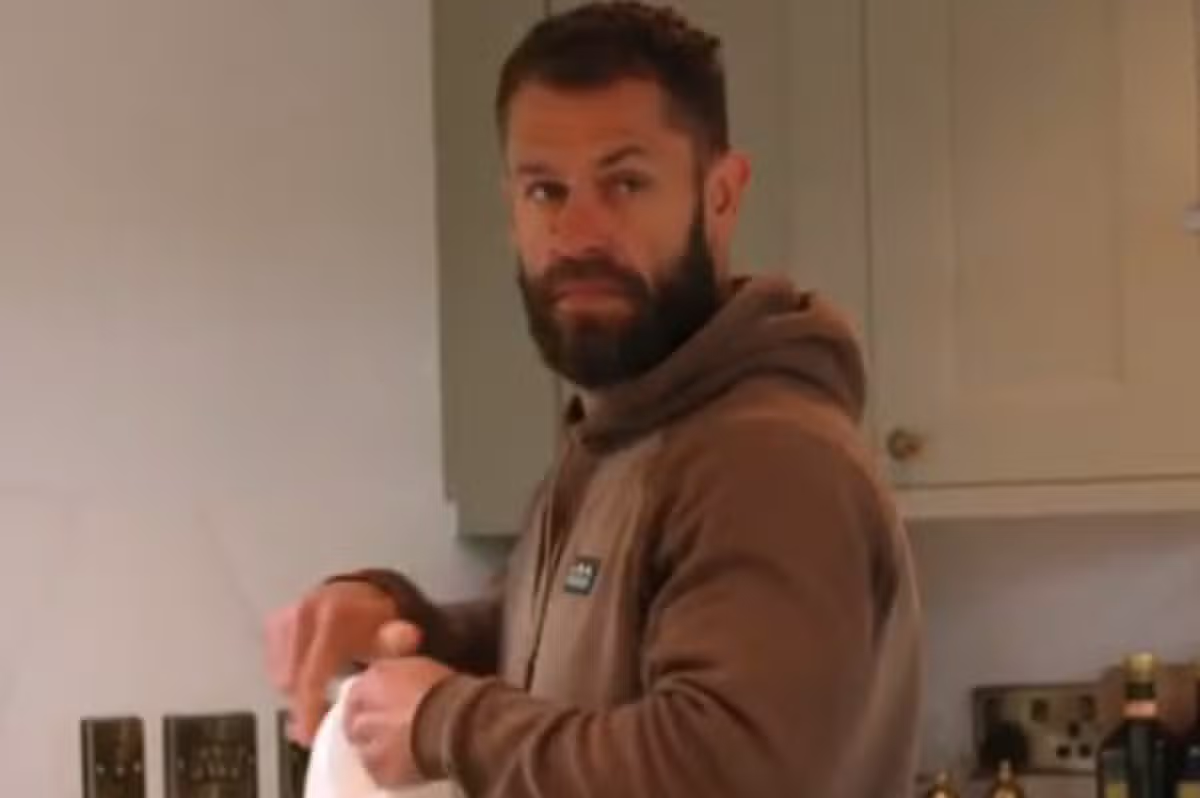
reflects

Victor Marx reflects the unsettling nature of today politics

When Victor Marx was 3 years old, he was forced into a voodoo ritual involving a beheaded cat. At age 7, he killed a man.

Or so Marx says.

But he was not just a precocious child.

As an adult running a “high-risk” Christian ministry, Marx says he rescued 45,000 women and children from captivity and abuse. As a civilian, he supposedly called in a U.S. military airstrike that killed 70 ISIS fighters. He’s exorcised demons — and can do so over the telephone, he says, if need be.

True or, most likely, false, those woolly claims and epic tales of derring-do aren’t the weirdest thing about Marx.

The weirdest thing is that Marx is the Republican nominee for governor of Colorado, an actual part of these United States.

A political newcomer, Marx eked out his victory in a three-way race by less than 2,500 votes out of more than 520,000 cast. (It took almost nine days to declare a winner, but surely you knew that already, given the national outcry over how long it took Colorado to count its ballots. Oh, wait. Never mind.)

Although slender, Marx’s victory delivered a strong statement: about the grave condition of mainstream Republicanism; about the increasing embrace of oddity and extremism by a deeply disaffected slice of the American electorate; about the unsettled and unsettling nature of today’s politics.

“It’s almost cult-like,” Dick Wadhams, a former Colorado GOP chairman, said of Marx’s support. “You talk to some of these people, and there is no doubt in their mind he will be governor, because God has decided that he’s going to be governor.”

There’s fat chance of that. (Please don’t smite me.)

Colorado has elected only one Republican governor in the last 55 years, and that was back in 2002. It’s been 10 years since a Republican won any statewide office. The Democratic nominee, Atty. Gen. Phil Weiser, is as close to a November shoo-in — after stomping U.S. Sen. Michael Bennet in the primary — as it gets.

But Marx, 61, a former Marine and expert in martial arts, is nothing if not swaggering. His role model is, of course, the political disrupter and fabulist-in-chief currently occupying the White House.

Like President Trump, Marx relies heavily on personal charisma, a strong social media presence and the purposeful shunning of campaign norms which, to the politically alienated, speaks to his independence from the establishment and offers a welcome break from the same old, same old.

He casts himself as a problem-solver and negotiator par excellence. He skimps on policy and skipped most of the preprimary debates; at the one he did attend, Marx brought his dog, a Dutch shepherd, onstage. In lieu of a closing statement, Marx prayed.

When asked, he hasn’t backed off his fantastical claims. But Marx hasn’t done a very good job substantiating them.

As a young boy growing up in Louisiana, he says, his abusive stepfather — the one who supposedly involved him in a satanic feline decapitation — drove him to rural Mississippi, where Marx shot and killed a man. Police told Colorado Public Radio they had no record of any unsolved homicides from that time.

“How many people have you killed?” Kyle Clark, an anchorman on Denver’s 9News, asked the candidate in a persistent and revealing sit-down interview.

“I don’t think that’s important,” Marx replied. “It’s actually kind of — it’s an odd question to me.”

Actually, it’s not.

(Conceding the Republican race, state Sen. Barbara Kirkmeyer — the runner-up — conspicuously declined to endorse Marx, urging voters to choose the path that is best for Colorado” in November. “For the record,” she added. “I still haven’t killed anyone.”)

In many ways, Marx is a mainstream conservative Republican. He founded All Things Possible Ministries, a Christian nonprofit that tends to refugees and other victims of trauma. His focus on law and order, tax relief, small government and deregulation are all standard GOP fare.

But his florid tales of youthful homicide, telephonic exorcisms, personally intercepting human smugglers on the U.S.-Mexico border — well, not so much.

Most voters will probably have a hard time getting past those autobiographical extravagances, which could spell trouble — depressed GOP turnout, guilt by association — for other Colorado Republicans, including freshman Rep. Gabe Evans, who’s fighting to hang onto a closely fought congressional seat in the north-central part of the state.

It’s a loss Republicans can ill afford as they desperately seek to preserve their bare House majority.

Despite its preference for Democratic governors, Colorado was, until not that long ago, a competitive two-party state. It was a presidential battleground as recently as 2012. Republicans held a majority in the state Senate as recently as 2018.

But the MAGA-fication of the state GOP has hastened Colorado’s evolution from political battleground to a solidly blue bastion.

“The Colorado Republican Party right now is impotent and irrelevant,” said Wadhams, who fought unsuccessfully against its takeover by Trump-worshiping zealots. “The ironic twist to this story is that polling has shown over the past several months that voters are getting restless about what they see as the decline of Colorado in terms of education, energy, roads and transportation.”

Just last week, the annual Colorado Health Foundation issued its annual Pulse Poll, a dour report card on the state of the state that found three-quarters of respondents were concerned they may not be able to live there in the future.

But don’t expect Democrats to lose their sovereignty anytime soon.

That’s what happens when a party and its voters stop seriously competing and instead indulge their passions and fever dreams. You get candidates, and political caricatures, like Victor Marx.

God help us.

Source link

Death in Paradise star Ralf Little reflects on ‘bonkers’ audition for BBC role

Death in Paradise star Ralf Little has been acting for over three decades, and he has reflected on nearly 30 years since his Royle Family journey began.

For four years, Death in Paradise audiences watched Ralf Little portray Detective Inspector Neville Parker in the enduring BBC drama. The actor departed the programme in 2024, with Don Gilet assuming the role as the lead DI in the cherished show.

However, prior to solving crimes in the BBC series, Ralf was recognised as Jonny Keogh in the sitcom Two Pints of Lager and a Packet of Crisps.

His acting journey commenced over three decades ago when he featured as Robbie in the 1990s ITV children’s drama Children’s Ward, which he credits with securing him a part in The Royle Family, the breakthrough that propelled his career.

In a clip he posted on Instagram from the programme Ricky & Ralf’s Very Northern Road Trip, he detailed the audition process for becoming Antony Royle, reports the Express.

He captioned the post: “It’s been nearly 30 years since my Royle Family journey began! It all started after I was on an ITV drama called ‘Children’s Ward’, which also launched the careers of Danny Dyer and Stephen Graham. Here’s the backstory, taken from ‘Ricky & Ralf’s Very Northern Road Trip’.”

Ralf told Ricky: “I’d done a few episodes of that, and I can only assume that Caroline (Aherne) and Craig (Cash), when they were doing the Royle Family, they couldn’t be bothered seeing hundreds of kids, like what normally happens.

“They said, ‘Just send three or four lads that you know’. I walked in, I sat down, and I read the script with them. I must’ve have been in the room more than three minutes, four minutes tops.

“I walked out going, ‘I did nothing, nothing interesting, nothing different’. Got to my car, got a parking ticket that was £50, which I couldn’t afford. It was like, ‘This is the worst day of my life. Got in the car, drove home back to Bury, got in, this was before mobile phones.

“I walked in, and my mum said, ‘Just had a phone call from Granada, they offered you the part’ before I’d even got home! Never happens like that, it was bonkers.”

It didn’t take long for the comments to flood in, with fans quick to reminisce about his iconic past role. One person said: “So glad they picked you to be in The Royle Family, leading to an amazing career for a fantastic actor.”

Another wrote: “Still going strong & still an incredible actor. Well done Ralf.” A third chimed in: “Right choice! And this was just the beginning of a versatile, great career. Thx for so many wonderful TV moments.”

One follower added: “Great story. Time is flying.” While another remarked: “Dang, I can’t believe it is going to be almost 30 years.”

Ricky & Ralf’s Very Northern Road Trip is available to watch on U.

Source link

French Open 2026 results: Maja Chwalinska reflects on ‘unforgettable three weeks’ at Roland Garros

Maja Chwalinska’s French Open ended almost three weeks after it started – but her journey to the brink of a first Grand Slam title began long before that.

A former Australian Open junior doubles finalist alongside fellow Pole Iga Swiatek, Chwalinska has spoken openly about the depression that led her to take a break from tennis early in her professional career.

In the build-up to Roland Garros, she was playing events on the second tier of the women’s tour across Europe.

Her French Open campaign began in the first round of qualifying on Monday, 18 May. Nine wins later, only teenager Mirra Andreeva stood in the way of Chwalinska becoming just the second qualifier to win a Grand Slam singles title in the Open era.

It was not to be for Chwalinska, who fell 6-3 6-2 to Andreeva on Saturday, but finishing runner-up will have a profound effect on her life and career.

She will climb from 114th in the world to a new high of 21st on Monday, while her Roland Garros prize money of 1.4m euros (£1.21m) is almost double what she had previously earned in her entire career.

“It’s been 18 years of hard work, patience and perseverance,” said 24-year-old Chwalinska, who took up tennis as a young girl.

“I had to go through so much to be in this position. Life is weird sometimes and you’ve just got to do your thing and believe it will click someday, and I’m happy that it did.

“It is definitely an unforgettable three weeks for me. I’ll never forget it.”

Source link

Martin Lewis visibly emotional as he reflects on tragic loss of mum at BAFTA TV Awards

The nation’s financial advisor admitted there was a connection between the date he found himself writing his awards acceptance speech and the day his mum died when he was a young boy

Martin Lewis has reflected on his childhood as a “broken, scared boy” who “barely left the house” as he picked up a BAFTA special award for his work in the TV industry.

The financial journalist and broadcaster, 54, was acknowledged for his dedication to helping the nation change the way it thinks about money, and had previously been hailed by Bafta as “the most trusted man on television”.

The Money Saving Expert gave an emotional speech after being presented with the prize by Richard Osman, during the award show at Royal Festival Hall on Sunday night.

The Manchester-born broadcaster opened his speech by joking that his Martin Lewis Money Show on ITV, which he has hosted since 2012, is “basically a powerpoint presentation with a Q&A after”.

He added: “TV doesn’t have to be format-driven. People will embrace something actionable, something real, something that helps. They will even embrace complexity, if we make it worth it.”

Growing visibly emotional, Lewis admitted he wrote the speech on Thursday, 42 years after his mother’s sudden death days before his 12th birthday.

He said: “For six years, barring school, I barely left the house. Now I’m picking up a BAFTA. For all those of you out there struggling with your own demons, know this: life can be transformed, it can get better.

“If you had told that broken, scared boy that I’d proudly be a campaigning journalist, his jaw would have dropped. So I dedicate this to consumer journalism, where I found my fire.”

Lewis continued: “It’s not seen as sexy, sadly, but in recent years, it’s helped people navigate pandemic support, pushed governments to backtrack on energy hikes, legislate against scam ads – though far more is needed on that – and against aggressive, destructive council tax debt collection and far more.”

He also issued a plea to Rachel Reeves, criticising the “morally wrong” freezing of the repayment threshold for plan 2 student loans, which is due next year, saying: “Chancellor, please.”

He continued: “That power to hold power to account with trust and impartiality is needed more than ever in our fractured world.”

Lewis wrapped up the speech by thanking his viewers, who “don’t just watch, but act and save a shedload” and that his audience is “what keeps me doing this”.

He also thanked his wife of almost 20 years, Lara Lewington, and their daughter Sapphire. Through his decades-long career as a financial expert, Lewis has become known as a consumer champion who provides tips on issues such as debt and consumer rights through his broadcasting work and his website.

He was made an MBE in the Queen’s Birthday Honours in 2014 and a CBE in the New Year Honours in 2022, for his services to consumer rights and charitable services.

The BAFTA special award is one of the academy’s highest honours and previous recipients include historian and broadcaster David Olusoga, comedian Sir Lenny Henry, TV presenter Cilla Black and actor Idris Elba.

Like this s tory? F or more of the latest showbiz news and gossip, follow Mirror Celebs on TikTok , Snapchat , Instagram , Twitter , Facebook , YouTube and Threads .


Source link

King’s US Visit Reflects UK’s Long Game To Steady Strained Alliance

The visit of King Charles III to the United States comes at a time of visible tension between Washington and London. His meetings with Donald Trump and symbolic engagements linked to the anniversary of the United States Declaration of Independence highlight Britain’s effort to preserve a relationship that has faced increasing political strain. Rather than seeking immediate policy breakthroughs, the visit underscores a broader diplomatic strategy focused on long term stability.

Worst tensions in decades
Relations between the US and the United Kingdom are being described by analysts as the most difficult since the Suez Crisis. Disagreements over global conflicts, defence commitments, and rhetoric from Washington have created friction not only with Britain but also with other European allies.

Political differences driving the strain
Tensions have been sharpened by clashes between President Trump and Keir Starmer, particularly over foreign policy decisions such as Britain’s stance on the Iran conflict. Criticism from Washington, alongside broader disagreements within alliances like NATO, has added to the sense of divergence.

Role of royal soft power
King Charles III’s visit is less about direct political negotiation and more about reinforcing deeper ties. Through speeches, public appearances, and outreach beyond government circles, the monarch is aiming to remind Americans of the longstanding cultural, security, and historical links between the two nations. His address to Congress and symbolic messaging emphasise shared values while subtly encouraging cooperation and openness.

Beyond politics to public diplomacy
The visit targets not just policymakers but the American public. By engaging across different states and institutions, the British monarchy is working to sustain goodwill that can outlast any single administration. This reflects a strategy of insulating the broader relationship from short term political tensions.

Questioning the special relationship
The idea of a “special relationship,” first popularised by Winston Churchill, is increasingly being reassessed. Some British officials argue the term feels outdated in a changing global order, where alliances are more transactional and expectations around defence and economic contributions are rising.

Analysis
The UK’s approach reveals a calculated reliance on continuity rather than confrontation. With limited leverage over US policy decisions, London is using soft power to maintain influence and access. The monarchy provides a unique diplomatic channel that operates above partisan politics, allowing Britain to keep communication lines open even during periods of disagreement.

However, this strategy has limits. Symbolism cannot fully offset structural tensions such as defence spending gaps, diverging foreign policy priorities, or shifting global power dynamics. While royal diplomacy can ease atmospherics, it cannot substitute for alignment at the governmental level.

In the longer term, the visit illustrates Britain’s recognition that its global role depends heavily on sustaining strong ties with Washington, even in less favourable political conditions. By playing a long game, the UK is attempting to ensure that current strains do not permanently weaken one of its most important strategic partnerships.

With information from Reuters.

Source link