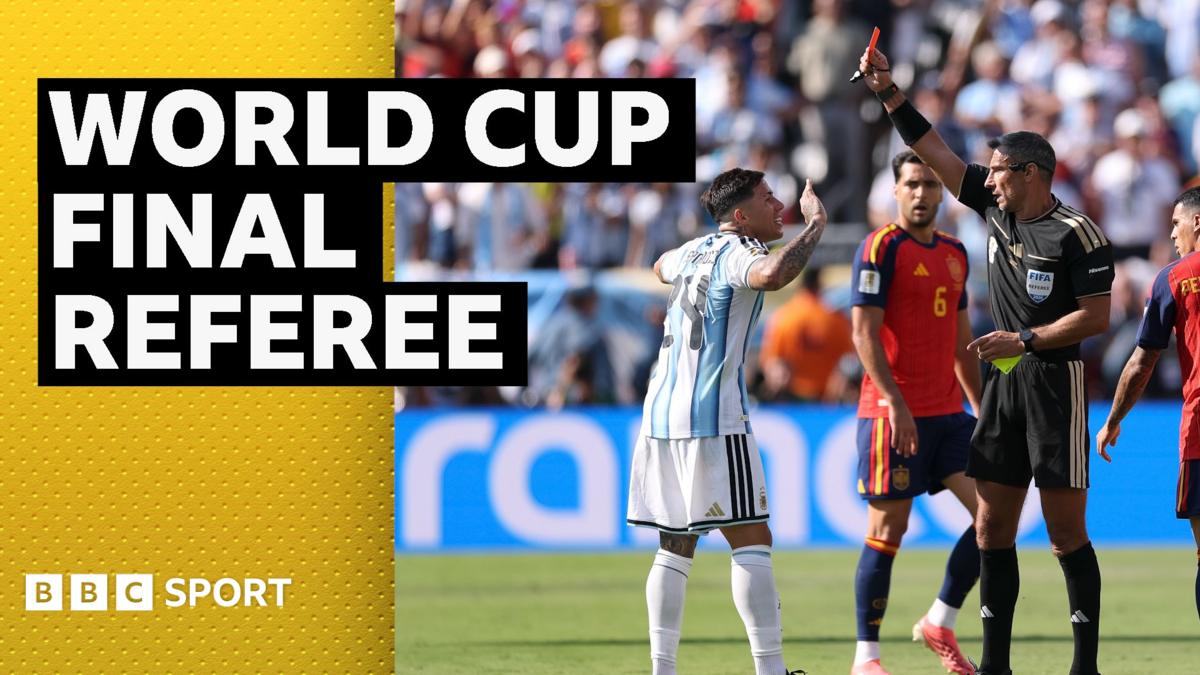
referee

Fox versus Telemundo: How World Cup viewers are watching

Fox is under fire for missing on-field action during the first match of the World Cup last week. .

Many sports fans were irate when the network aired a full-screen ad when play resumed after a water break during last Thursday’s Mexico–South Africa match.

In the second half, the referee called for the newly instated hydration break, but the call came during a replay, which led to a miscommunication over when the three-minute break actually started.

Fox ran its full-screen ad late, and because the break didn’t last the full three minutes, players were reportedly left stalling on the field — and many Fox viewers missed the restart entirely.

“The reason that I keep coming back to these games as a fan is for 45 solid minutes of entertainment. Anything that interrupts that, whether it’s [these hydration breaks] or anything else, is not great for the game,” Garrett Denney, an avid World Cup fan and frequent user of the World Cup Reddit page, said. “What we want to see is that kind of rhythm and tempo, the intensity for a full half of soccer.”

Fox declined to comment.

The hydration break is new to the World Cup. FIFA announced it in December as a way to protect players’ health in the summer heat. In every match, the referee is to call for a break around the 22-minute mark of both halves, regardless of weather.

A FIFA spoesperson declined to comment, but pointed to a previous press release describing the breaks as a “focused attempt to ensure the best possible conditions for players, drawing upon the experiences of previous tournaments.”

The extra minutes also created something else — a new advertising window, and broadcasters are taking advantage.

Networks are supposed to leave the on-field action 20 seconds after the referee signals the break and return 30 seconds before play resumes, allowing for ads of up to two minutes and 10 seconds in total. They can air any full-screen ad they’d like, or run a split-screen ad — though a split-screen has to feature a FIFA partner, like Coca-Cola or Adidas.

The stakes are especially high for Fox, which is also leaning on the tournament to promote Fox One, its streaming service that lets subscribers watch its programming without a traditional pay-TV subscription. The World Cup broadcast has been a major plus for the platform, which costs $19.99 a month.

For some soccer fans, though, the commercial breaks are an intrusions.

“The FIFA hydration break is pure capitalism,” comedian Kevin Fredericks wrote on X.

Musician Lloyd Cole made a similar point about the new ad windows: “US tv finally got their 4 quarters. Fifa, corrupt? Fifa?”

After Fox’s stumble, many fans started questioning the intention behind the rule itself.

That frustration has pushed some viewers toward an alternative: Telemundo. The Spanish-language network, available through the Peacock streaming platform, opted for minimal hydration-break ads instead of full-screen takeovers.

During the same Mexico–South Africa match, while Fox aired its full-screen ad, Telemundo kept players on camera, let its commentators share their thoughts, and ran a Lays ad in the corner of the screen. The network has described it as a conscious decision to prioritize authenticity and keep viewers immersed.

“No ads on Telemundo and I’m learning Spanish at the same time!” one user quipped on the World Cup subreddit.

Denney, who’s rooting for Team USA, said his family prefers the Telemundo stream too — even with only part of the household fluent in Spanish.

“Part of our household is fully fluent in Spanish, part is not. And even despite the language barrier, we’ve really gravitated toward the quality of the Telemundo stream,” Denney said. “It’s really more of a rhythmic commentary. You can get deep into the game, you’re not pulled so far out of that experience and it feels almost like you’re at the stadium.”

Source link

FIFA clears World Cup referee accused of making white supremacist gesture | Football News

Australian referee Shaun Evans says he didn’t intend to ‘communicate a message, affiliation, game or belief of any kind’.

FIFA says it has found “no evidence” that one of the referees at the World Cup breached its code of conduct after he was accused of making a white supremacist hand gesture during one of the games.

“FIFA’s independent Disciplinary Committee can confirm that, after looking into the matter involving support video assistant referee Shaun Evans, it has found no evidence of breaches of the FIFA Disciplinary Code,” football’s global governing body told Al Jazeera in an emailed statement on Monday.

Earlier, FIFA’s discrimination monitor at the World Cup called for Evans, working as a VAR official in the tournament, to be removed for appearing to make a hand gesture resembling a white supremacist sign.

When the official broadcast of Germany’s opening game against Curacao on Sunday cut pre-game to show the team of video review analysts, Australian official Evans made an “OK” symbol with his right hand in front of his right leg.

Though the game was played in Houston, video officials work in Dallas at the World Cup broadcast centre.

Evans said the hand gesture was not intentional, nor did he make it to “communicate a message, affiliation, game or belief of any kind”.

“The only explanation I can offer is that the movement was an involuntary, subconscious twitch and I was unaware I had done it at the time,” the official said in a statement shortly before FIFA announced its decision.

“Images taken later during the match showed that I repeated this movement many times while holding a pen between my fingers,” Evans went on to add.

“The coverage following this incident simply does not reflect who I am. Of course, I understand how the gesture has been interpreted and I regret this; however, I want to be very clear and categorically say that I did not knowingly or deliberately make the hand symbol suggested.”

Source link

No World Cup for Somali referee Omar Artan suspected of terrorist ties

Somali referee Omar Abdulkadir Artan was denied entry into the United States for the World Cup after enduring an 11-hour interrogation in Miami, according to media reports. Andrew Giuliani, head of the White House Task Force on the World Cup, indicated Artan was suspected to having ties to a Somali militant group.

“We want to make sure we are not going to allow a soccer tournament to be the opportunity for terrorists to potentially get in the country or anybody who is actually talking to them,” Giuliani told the British Broadcasting Corporation.

The New York Times reported that Artan’s name is similar to that of a man identified as linked to Al Shabab, a group that has been the target of U.S. government sanctions.

“I am very, very disappointed,” Artan told the Times from Istanabul, where he stopped on his way back to Somalia. “I’m just simply a referee who’s trying to live his dream, the biggest dream of my life, to come to the World Cup.”

Safety was purportedly the concern with Artan, whose interrogation was conducted by the U.S. Customs and Border Protection.

“During processing, the traveler underwent additional inspection, a routine part of CBP’s inspection process when officers need to verify information or determine admissibility,” CBP said in a statement. “Following inspection, the traveler, a referee for the FIFA World Cup, was determined to be inadmissible due to vetting concerns and was denied entry.”

Somalia is on the U.S. list of banned countries for immigration, although exceptions can be made. Artan is considered one of the best referees in Africa, having officiated in the Somali national football league championship and at the African Cup of Nations.

“Despite the circumstances, I am in a positive mood and focused on the next challenges in my refereeing career,” Artan said in a statement. “I would like to thank FIFA and [the African federation] for all their support and I promise to keep my refereeing levels up as I concentrate on the future.”

Artan, Africa’s Referee of the Year in 2025, was greeted Wednesday at Aden Adde International Airport in Somalia by government officials and hundreds of well-wishers.

“I want to thank FIFA for supporting me all the way, and for Somali people also,” he told Al Jazeera. “So I am very grateful for FIFA and for CAF also. This is what I have to say.”


Source link

NFL, referees good to go with new collective bargaining agreement

There will be no replacement referees — and therefore, hopefully, no “Fail Mary” repeat — in the NFL this fall.

The league and the NFL Referees Assn. have avoided a work stoppage by agreeing on a new collective bargaining agreement that runs through the 2032 season.

The current deal was scheduled to expire May 31. The sides having been negotiating since the summer of 2024, and the NFL had begun the hiring process for replacement officials last month.

“This agreement is a testament to the joint commitment of the league and union to invest in and improve officiating,” NFL executive vice president of football operations Troy Vincent said in a statement. “It also speaks to the game officials’ relentless pursuit of improvement and officiating excellence. We look forward to working together for the betterment of the game.”

Terms of the agreement have not been released, but the Associated Press reported in March that the league had increased its offer to a 6.45% annual growth rate”growth rate” = increase? in compensation over a six-year labor deal.

“We see this new CBA as a partnership with the league that benefits our membership but also seeks to make our game better,” NFLRA president Carl Cheffers said in a statement. “It is good to get these negotiations behind us so we can focus on preparing for the 2026 season.”

No such agreement between the sides was reached during the 2012 offseason, leading to a lockout that lasted 110 days. It all culminated in Week 3 of that season with the notorious “Fail Mary” call at the end of the Green Bay Packers-Seattle Seahawks game on “Monday Night Football.”

With the Seahawks down by five in the closing seconds, quarterback Russell Wilson threw deep to receiver Golden Tate in the end zone. Green Bay defender M.D. Jennings appeared to come down with the ball first, with Tate attempting to wrestle the ball away.

Two officials stood above the players, with one signaling touchdown (meaning Tate caught the ball, Seattle wins) and the other signaling touchback (meaning Jennings caught the ball, Green Bay wins). The final call on the field was a touchdown, which stood after a lengthy review.

It got worse. The next day, the NFL released a statement saying the officials missed a pass interference call on Tate that would have negated the touchdown. A day after that, the NFL and the referees union announced a new collective bargaining agreement that brought the regular officials back for that weekend’s games.

The Associated Press contributed to this report.

Source link