Which countries waste the most food, and how to reduce waste at home | Hunger News
For every five plates of food served around the world, roughly one ends up in the bin. That adds up to more than a billion tonnes of food a year.
Meanwhile, 645 million people, about one in 13 of the world’s population, went hungry in 2025, according to the UN.
That gap is the focus of World Food Day on October 16, the annual UN observance marking the founding of the Food and Agriculture Organization (FAO) in 1945. This year’s theme, “Innovate today, nourish tomorrow”, calls for food systems that feed more people and waste less.
In this visual explainer, Al Jazeera looks at global hunger, which countries waste the most food and simple ways to waste less at home.
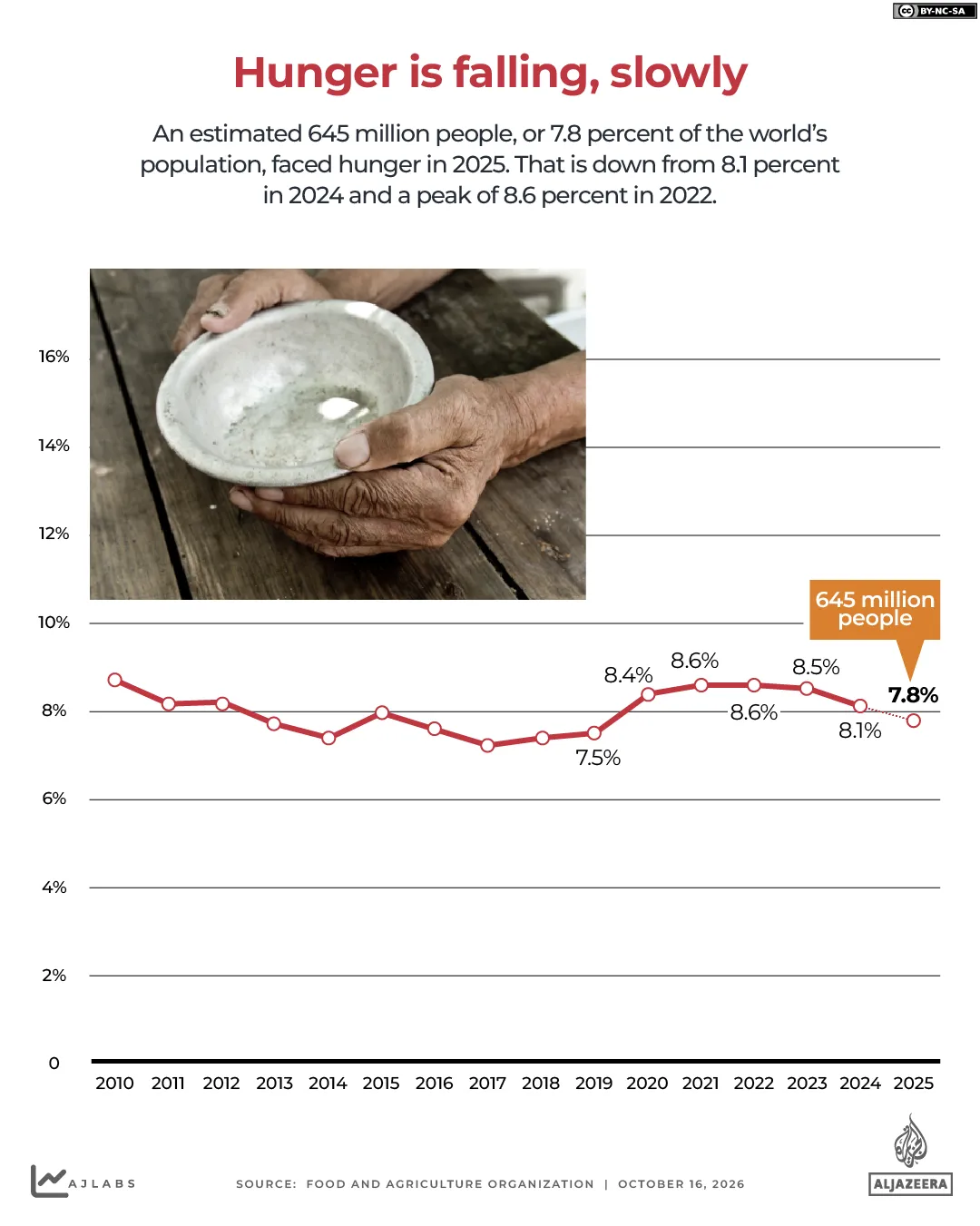
Hunger is falling, slowly
Global hunger has fallen for a third year in a row, but it remains above levels seen before the COVID-19 pandemic.
According to the UN’s annual State of Food Security and Nutrition in the World report, an estimated 645 million people, or 7.8 percent of the world’s population, faced hunger in 2025. That is down from 8.1 percent in 2024 and a peak of 8.6 percent in 2022, but still about 61 million more people than in 2019.

Where are people the most hungry?
Africa has more hungry people than any other region.
In 2025, an estimated 309 million people in Africa were undernourished. That is one in five people on the continent and almost half of the world’s hungry people.
By comparison, 292 million people in Asia (6 percent of the population) and 32 million in Latin America and the Caribbean (4.8 percent) were undernourished.
The 2026 Global Hunger Index shows a similar pattern at the country level. The index scores countries out of 100, combining undernourishment with child stunting, child wasting and child mortality. Scores of 35 or more are considered “alarming”.
Hunger is classed as alarming in eight countries, seven of them in Africa. Somalia has the worst score of the 122 countries ranked, followed by the Democratic Republic of the Congo, Chad and Madagascar.
Sudan, South Sudan, Burundi and Yemen were also classed as alarming, but conflict and data gaps meant the index could not calculate their scores.
At the same time, a large share of the food the world grows never reaches a plate.
How much food is wasted every year?
Food is lost and wasted at every stage of its journey from farm to table.
According to the FAO, about 13 percent of the food produced globally is lost after harvest and before it reaches shops, spoiling in storage, during transport or in processing. Fruits and vegetables suffer the highest losses.
Food lost before it reaches shops is worth more than $400bn a year, according to the FAO.
Shops, restaurants and households then throw away almost a fifth of the food available to consumers, about 1.05 billion tonnes in 2022, according to the UN Environment Programme (UNEP). That is equivalent to 52.5 million trucks, each carrying 20 tonnes.
Households account for the most, 60 percent, followed by restaurants and other food services at 28 percent and shops at 12 percent.

How to reduce food waste at home
Most food waste happens at home, which means households can make a real difference. Here are some simple steps recommended by food waste campaigners and UN agencies:
- Plan before you shop: Check what you already have, plan meals for the week and shop with a list to avoid buying more than you need.
- Understand date labels: “Use by” dates are about safety, but “best before” dates are about quality. Food is often still safe to eat after its “best before” date.
- Store food properly: Keep your fridge at 5C (41F) or below, and store fruit and vegetables where they last longest. Bananas, for example, speed up the ripening of other fruit nearby.
- Use the freezer: Bread, cooked meals, meat and many fruits and vegetables can be frozen before they go off.
- Cook the right amount: Measuring portions, especially for rice and pasta, cuts down on leftovers that get thrown away.
- Eat the oldest food first: Move older items to the front of the fridge and cupboard so they get used before newer ones.
- Use leftovers and scraps: Turn leftovers into new meals, and use vegetable peels and stalks in soups and stocks.
- Compost what you can’t eat: Composting inedible parts such as peels and eggshells keeps them out of landfills, where rotting food releases methane.

Which country wastes the most?
On average, every person in the world wastes about 132kg (291 pounds) of food a year, roughly the weight of two adults. Of that, 79kg (174 pounds) was thrown away at home.
But the amount varies widely. Hotter countries tend to waste more at home, UNEP says, possibly because of more fresh produce and less refrigeration.
The Maldives wastes the most food, with each person throwing away about 260kg (573 pounds) a year, about twice the global average. Syria, the Dominican Republic, Seychelles, Mexico and Tunisia follow, each wasting more than 210kg (463 pounds) per person, according to UN estimates.
Spain recorded some of the lowest levels, at around 39kg (86 pounds) or less per person.
What does food waste cost?
Food loss and waste costs the global economy more than $1 trillion a year, according to the UN.
To put that in perspective, what else could $1 trillion buy?
Use the + buttons to add items to your cart and see how the money would be spent across 35 categories.
Throwing food away also wastes the money, land and energy used to produce it.
About 1.4 billion hectares (3.5 billion acres) of land, or 28 percent of the world’s agricultural land, is used to grow food that is never eaten. That is an area larger than Canada.
Food loss and waste also generate an estimated 8 to 10 percent of global greenhouse gas emissions, including methane released as food rots in landfills.