redrawn 22nd congressional district

Democrats keep Proposition 50 promise alive through primary

California Democrats made it out of last week’s primary election having kept the promise of Proposition 50 alive — advancing candidates to November runoffs in all five Republican-held Congressional districts that last year’s redistricting measure targeted.

They now head into November bullish about turning those districts blue, wresting control of the U.S. House from Republicans and delivering their party important leverage to challenge President Trump through the remainder of his second term.

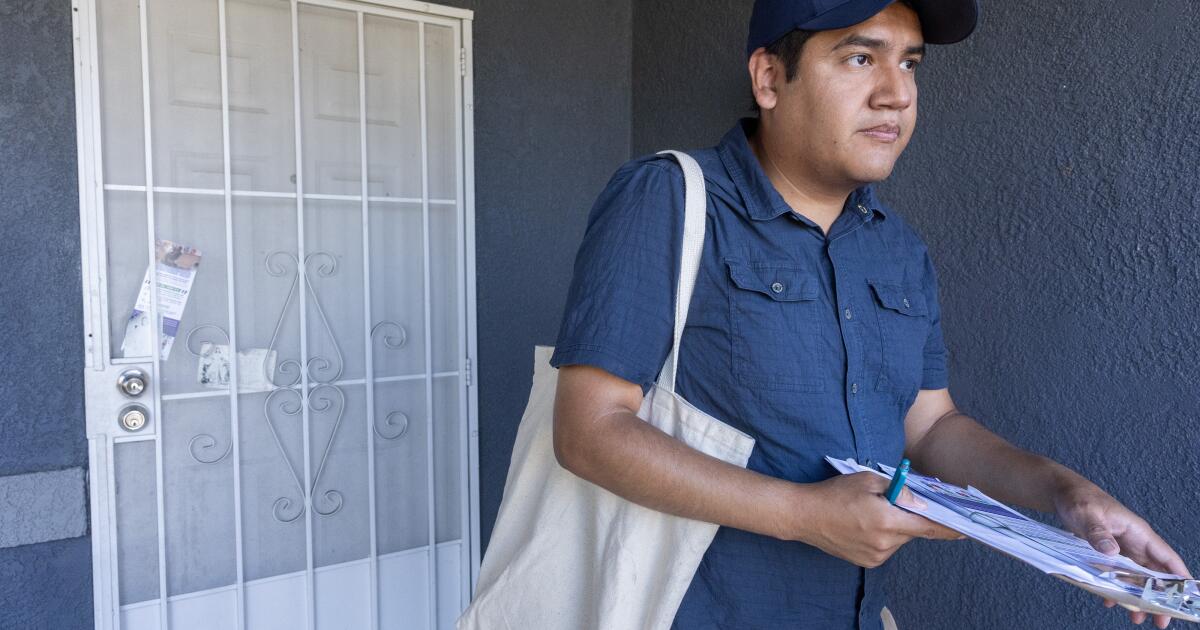
“As Democrats, we are united in our fight to flip this seat and to take back the House for Democrats here in ‘26,” progressive college professor Randy Villegas told The Times on Wednesday after besting his Democratic challenger to advance and take on Rep. David Valadao (R-Hanford) in the redrawn 22nd Congressional District. “We know the path to taking back the House runs through the Central Valley.”

Robert Jones, a Valadao campaign strategist, said Valadao “is always humbled to receive the support of Democrats, independents and Republicans across the Central Valley,” and that his “brand of independent, bipartisan leadership is all too rare in Congress and California.”

“We look forward to a campaign that puts the Central Valley ahead of any political party and wins again in November,” Jones said.

In a social media post Wednesday, former state Sen. Richard Pan, who advanced in the redrawn 6th Congressional District in the Sacramento suburbs to take on Rep. Kevin Kiley (I-Rocklin), cheered his race being added to the Democratic Congressional Campaign Committee’s “Red to Blue” program highlighting winnable seats. He said his race is “one of the top chances to flip a House seat and take back the majority.”

Kiley did not respond to a request for comment, but wrote on X that the November race between him and Pan “will be a choice between the extreme partisan policies that have made California the most unaffordable state in the country, and the independent leadership that allows our local communities to thrive in spite of the state’s failures.”

The two races are considered among the most competitive in California in November, but primary results to date show substantial momentum in the Democrats’ favor, experts said.

In the 22nd Congressional District race, Valadao had received substantially less than half of the vote as of Wednesday, while Villegas and his Democratic rival, moderate Assemblymember Jasmeet Kaur Bains (D-Delano), had together received well over half the vote.

In the 6th Congressional District race, Kiley and the leading Republican candidate had together received well under half the vote as of Wednesday, while Pan and four other Democratic candidates had collectively won well over half the vote.

Those results are not final, nor do they necessarily reflect how voters will break in November’s head-to-head competitions. Just because a voter cast a ballot for a Democrat or Republican in the primary doesn’t mean they will back another candidate of the same party or partisan alignment in the general, experts said.

Still, the Democratic candidates clearly have an advantage in a year when the electorate — facing high gas prices and other economic headwinds — appear to be shifting against the president’s party, said Mike Madrid, a Republican political consultant in the state.

“We’re in an anti-Republican moment,” Madrid said. “Is there time to turn it around? I guess. But there’s also time for it to get worse — and that’s the way it seems to be heading.”

Bob Shrum, a longtime Democratic strategist and director of the Dornsife Center for the Political Future at USC, said Democrats stand to perform even better in November based on historical trends that show much larger Democratic turnout in general elections.

“I would not be surprised if Democrats won all five targeted seats, and the primary certainly increases the possibility that happens when you look at the results,” he said. “Maybe one of these places will surprise us, but right now, just looking at the numbers, I don’t think Republicans are in good shape.”

In the redrawn 1st Congressional District in Northern California, where incumbent Rep. Doug LaMalfa (R-Richvale) died in January, Republican Assemblymember James Gallagher handily won a special election — using the old district lines — for the remainder of LaMalfa’s term.

However, in the primary race for the next full term using the newly drawn district, state Sen. Mike McGuire and other Democrats collectively outperformed Gallagher by a substantial margin as of Wednesday — giving McGuire the momentum heading into the November runoff with Gallagher.

In the redrawn 41st Congressional District in Los Angeles and Riverside counties, Rep. Linda Sánchez (D-Whittier) and Republican Mitch Clemmons advanced. As of Wednesday, Sánchez and her fellow Democratic candidates had collectively outperformed Clemmons by a wide margin.

In the redrawn 48th Congressional District in San Diego and Riverside counties, where Rep. Darrell Issa (R-Bonsall) retired rather than run for reelection, moderate Republican San Diego County Supervisor Jim Desmond advanced alongside Democratic San Diego Councilwoman Marni von Wilpert. Results as of Wednesday showed Von Wilpert and other Democrats in the race collectively outpacing Desmond and the other Republican in the race.

Republicans have long held on to hope that Valadao might be able to hold on to his San Joaquin Valley district, spoiling Democratic hopes for a flip there. They also seemed buoyed by early results in the Kiley race. But neither race went as Republicans hoped — and both Kiley and Valadao face a tough road ahead, experts said.

Having abandoned the Republican Party to run as an independent in a district that was designed to favor a Democrat, Kiley “now has to work all three lanes,” Madrid said. “He has to get a consolidation of the Republican vote, he has to communicate directly to independents, and he’s going to have to get crossover Democrats.”

That’ll be extremely difficult, especially given that any move he makes back toward Trump, to woo Republican voters, risks alienating moderate voters he also needs to win, Madrid said.

Shrum blamed Trump for the difficult spot in which the GOP now finds itself, referring to the president calling on Texas Republicans to redistrict in favor of Republicans.

“These California Republicans are paying the price for Trump starting this mess in Texas,” Shrum said.

“Kiley in his old district probably would have been easily reelected. This new district is a whole different story.”

Shrum also said it “doesn’t look good” for Valadao, despite the political argument picked up by GOP leaders that Villegas is too progressive for the Central Valley.

“Randy Villegas endorses every far-left policy that would destroy any hope for Central Valley residents looking for relief from Gavin Newsom’s high-tax, high-fraud system,” Republican National Committee Chairman Joe Gruters said in a recent statement.

Shrum said he doubts that message will resonate with enough voters to sway the race to Valadao “in an environment where the things people are worried about are the cost of living, the war.”

Madrid had even less confidence in a Valadao victory, saying that “in an environment like this, a tree stump could beat Valadao” given how frustrated voters are with the economy and the president’s party.

Villegas, who racked up endorsements Wednesday from a raft of Democratic leaders in the state, said the district’s primary results were “rooted in the reality that Central Valley residents are fed up with David Valadao” — not just Trump — and want a change.
Source link

California to play big role in fight for Congress. Tuesday’s primary sets the stage

California’s decision to redraw its congressional map to flip as many as five House seats to Democrats in November is poised to play a big and potentially decisive role in the nation’s broader, bare-knuckle fight for control of Congress.

Tuesday’s primary races — where the top two candidates will advance to November runoffs — won’t determine which Republicans are ousted in most cases, but they will provide an important first look at voter sentiment and bring the fall’s most crucial head-to-head contests into focus.

“There will be some real cues and signals about what to expect,” said Christian Grose, a redistricting scholar and political science professor at USC. “We’re going to know how strong the Democrats’ chances are going to be based on who advances.”

As one example, Grose pointed to the redrawn 22nd Congressional District in the Central Valley, where incumbent Rep. David Valadao (R-Hanford) is facing challenges from moderate Assemblymember Jasmeet Kaur Bains (D-Delano) and progressive college professor Randy Villegas.

Grose said Bains is probably a stronger challenger than Villegas in a district that’s still a reach for Democrats — even if “either one could probably beat Valadao if 2026 is a big Democratic wave.”

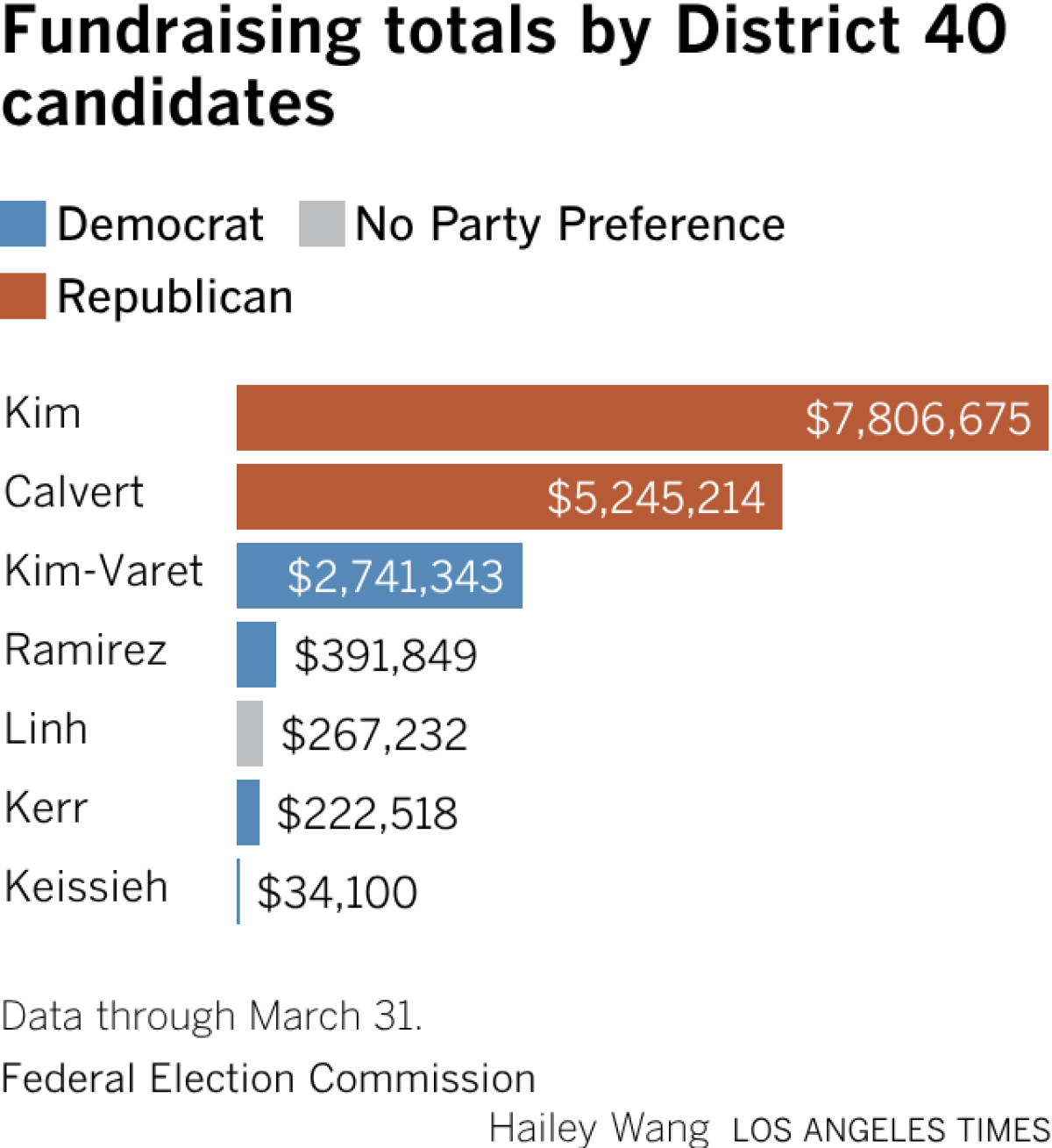
Grose will also be closely watching the race between incumbent Reps. Young Kim (R-Anaheim Hills) and Ken Calvert (R-Corona) in the redrawn Congressional District 40, which covers a swath of inland Orange County and portions of San Bernardino and Riverside counties, including parts of Kim’s and Calvert’s current districts.

The district race wasn’t designed to deliver Democrats a seat, but will produce “one of the first casualties for Republicans from the new map” — months before other expected ousters — if Kim and Calvert don’t both advance.

The national picture

The redistricting war was prompted by President Trump’s unprecedented pressuring of Republican-controlled states to redraw their maps mid-decade for partisan advantage in order to retain control of Congress, given his sinking approval ratings and a history of midterm voters punishing the president’s party.

After Texas Republicans heeded Trump’s call to redraw five districts in their party’s favor, California Democrats responded with Proposition 50, a ballot measure passed by voters in November to sideline the state’s independent redistricting committee and allow Democrats to redraw five congressional districts in their favor.

The war ratcheted up — with more Republican states suddenly considering map changes — after a U.S. Supreme Court decision in April that weakened the 1965 Voting Rights Act and its long-standing protections for majority-Black districts in the South.

Republicans have now acted to redraw congressional maps in Alabama, Florida, Louisiana, Missouri, North Carolina, Ohio and Tennessee, with varying degrees of success, while a battle in Utah could add a single additional Democratic seat there. Attempts in other states have failed, including by the GOP in South Carolina and Democrats in Virginia.

Experts say the net result from the flurry of redistricting will probably be a gain of a handful or more seats for Republicans — but in a year when Democrats are expected to make gains more broadly, leaving control of the House up for grabs. California’s new map is “a huge deal” precisely because that math is so close, said David Wasserman, senior editor and elections analyst for the independent, nonpartisan Cook Political Report.

“Democrats are modest favorites for House control based on the political environment, but also because of California,” Wasserman said in an interview with The Times. “Picking up these four or five seats is a prerequisite to Democrats getting the majority.”

California seats in play

California has 52 seats in the U.S. House of Representatives, by far the most of any state. With their new map, California Democrats are hoping to increase their 43 House seats to 48. That would leave just four seats represented by members of the GOP despite Republicans accounting for a quarter of the state electorate.

But that outcome isn’t guaranteed.

Paul Mitchell, a Democratic redistricting expert who devised California’s new map, said the reconfigured congressional districts had to create a pathway for new Democrats to win additional seats without undermining incumbent Democrats’ reelection. And the result is a map with three pretty safe pickups for Democrats, and two districts that are “100% on the table, ready for Democrats to win,” but will nonetheless “require shoe-leather and grit.”

The redrawn congressional district boundaries enacted by Proposition 50 promise to shake up at least three seats, experts said.

Congressional District 1: Held by the late Rep. Doug LaMalfa (R-Richvale) for 13 years until his death in January, the district is currently rural and conservative, stretching from the Sacramento outskirts through Redding to the Oregon border and California’s northeastern corner. Under the state’s new congressional district map, it loses some of its rural reaches and picks up liberal coastal communities, and favors a Democrat such as state Sen. Mike McGuire, who is one of the leading candidates.

Congressional District 3: The seat is currently held by Rep. Kevin Kiley (I-Rocklin) and stretches from the Sacramento suburbs through Lake Tahoe and south along the Nevada border. Under the new map, it holds more tightly to the Sacramento suburbs, favoring a Democrat.

The changes were enough to convince an incumbent Democrat, Rep. Ami Bera (D-Elk Grove), to leave his current district — Congressional District 6, which includes the city of Sacramento and the suburbs of Roseville and Rocklin in Placer County — and run in District 3 instead.

Meanwhile, Kiley did the reverse. He quit the Republican Party, became an independent and announced he would be leaving District 3 and running instead in District 6 — the one Bera is leaving — against a slate of new Democratic challengers.

Congressional District 41. The seat is now held by Calvert, a 17-term incumbent, and currently stretches from Corona to the Coachella Valley. The new map made the district more liberal, losing voters in Riverside County and gaining them in Los Angeles County, and Calvert decided to run instead in Kim’s redrawn but still Republican-leaning Congressional District 40 that is just to the west.

The two toughest flips for Democrats, experts said, are Congressional District 22, Valadao’s heavily Latino district in the Central Valley, followed by Congressional District 48 in San Diego and Riverside counties, where Rep. Darrell Issa (R-Bonsall) decided to retire rather than run for reelection.

Valadao is viewed as especially vulnerable because of his recent support for Medicaid cuts, but he has proved resilient in the past. Meanwhile, his two leading Democratic challengers, Bains and Villegas, are in a bitter fight, with Bains receiving Democratic establishment support and Villegas winning endorsements from prominent progressives.

In Issa’s district, moderate Republican San Diego County Supervisor Jim Desmond is running against several infighting Democrats, including San Diego Councilwoman Marni von Wilpert and former Obama labor official Ammar Campa-Najjar.

Not new, or over

Jeff Wice, a New York Law School professor who was involved in California redistricting efforts in 2010, said the state “has long played hardball politics on redistricting,” including when then-Rep. Phil Burton, a powerful San Francisco Democrat, bragged more than 40 years ago that the complex congressional boundaries he’d crafted for Democrats were his “contribution to modern art.”

But in five decades studying redistricting, Wice said he has never seen such “politically driven, partisan politics” as are occurring now across the nation, which he said have “no root in law, reason or fairness” — and are only likely to continue.

“This state-by-state war is far from over, and may continue all the way through 2030,” he said. “A lot of it depends on the outcome of this November’s election.”

Wasserman said the country has “entered an era of no-holds-barred redistricting,” and he also sees redistricting efforts continuing — including in California, where they would present a distinct threat to the state’s few remaining Republicans.

Michael Li, senior counsel in the Democracy Program at the Brennan Center for Justice at NYU Law, said California is a “big part of the story” this election cycle, thanks to Proposition 50. “Democrats in California proved to be very determined and resourceful and managed to get that done, and right now California is the big offset to Republican gerrymandering around the country,” he said.

But what will come of it all — in California and across the country — is still to be determined.

“When you’re gerrymandering, you’re making a bet that you know what the politics of the future will look like, and it’s hard to predict,” he said. “It’s a high-risk, high-reward venture.”

Source link