rebuke

After Supreme Court rebuke, Democrats call for government to refund billions in Trump tariff money

A trio of Senate Democrats is calling for the government to start refunding roughly $175 billion in tariff revenues that the Supreme Court ruled were collected because of an illegal set of orders by President Trump.

Sens. Ron Wyden of Oregon, Ed Markey of Massachusetts and Jeanne Shaheen of New Hampshire are unveiling a bill on Monday that would require U.S. Customs and Border Protection to issue refunds over the course of 180 days and pay interest on the refunded amount.

The measure would prioritize refunds to small businesses and encourages importers, wholesalers and large companies to pass the refunds on to their customers.

“Trump’s illegal tax scheme has already done lasting damage to American families, small businesses and manufacturers who have been hammered by wave after wave of new Trump tariffs,” said Wyden, stressing that the “crucial first step” to fixing the problem begins with “putting money back in the pockets of small businesses and manufacturers as soon as possible.”

The bill is unlikely to become law, but it reveals how Democrats are starting to apply public pressure on a Trump administration that has shown little interest in trying to return tariff revenues after the Supreme Court announced its 6-3 ruling on Friday.

Because of the ruling, going into November’s midterm elections for control of Congress, Democrats have begun telling the public that Trump illegally raised taxes and now refuses to repay the money back to the American people.

Shaheen said that repairing any of the damage caused by the tariffs in the form of higher prices starts with “President Trump refunding the illegally collected tariff taxes that Americans were forced to pay.” Markey stressed that small business tend to have ”little to no resources” and a “refund process can be extremely difficult and time consuming” for companies.

The Trump administration has asserted that its hands are tied, because any refunds should be the responsibility of further litigation in court.

That message could put Republicans on the defensive as they try to explain why the government isn’t proactively seeking to return the money. GOP lawmakers had planned to try to preserve their House and Senate majorities by running on the income tax cuts that Trump signed into law last year, saying that tax refunds this year would help families.

Treasury Secretary Scott Bessent told CNN on Sunday that it’s “bad framing” to raise the question of refunds because the Supreme Court ruling did not address the issue. The administration’s position is that any refunds will be decided by lawsuits winding their way through the legal system, rather than by a president who has repeatedly stressed to voters that he has the ability to act with speed and resolve.

“It is not up to the administration — it is up to the lower court,” Bessent said, stressing that rather than offer any guidance he would “wait” for a court opinion on refunds.

Trump has defended his use of the 1977 International Emergency Economic Powers Act to impose broad tariffs on almost every U.S. trading partner, saying that his ability to levy taxes on imports had helped to end military conflicts, bring in new federal revenues and apply pressure for negotiating trade frameworks.

The University of Pennsylvania’s Penn Wharton Budget Model released estimates that the refunds would total $175 billion. That’s the equivalent of an average of $1,300 per U.S. household. But determining how to structure reimbursements would be tricky, as the costs of the tariffs flowed through the economy in the form of customers paying the taxes directly as well as importers passing along the cost either indirectly or absorbing them.

The president has previously claimed that refunds would drive up U.S. government debt and hurt the economy. On Friday, he told reporters at a briefing that the refund process could be finished after he leaves the White House.

“I guess it has to get litigated for the next two years,” Trump said, later amending his timeline by saying: “We’ll end up being in court for the next five years.”

Boak writes for the Associated Press.
Source link

House votes to block Canada tariffs in rare rebuke of Trump

Feb. 12 (UPI) — In a rare rebuke of the Trump administration, the Republican-led House on Wednesday moved to block sweeping tariffs imposed on Canada by President Donald Trump.

In a 219-211 vote on Wednesday evening, House lawmakers approved legislation terminating a national emergency Trump declared early in his administration to slap tariffs on the United States’ northern neighbor.

Six Republicans joined their Democratic colleagues to pass the legislation into an uncertain future in the Senate. One Democrat, Rep. Jared Golden of Maine, voted against terminating the emergency.

The legislation, however, could end up being only symbolic. Even if the GOP-led majority approves it, President Donald Trump would be expected to veto it.

Even as the resolution faces an uncertain future, Rep. Gregory Meeks, D-N.Y., the ranking member of the House Foreign Affairs Committee and sponsor of H.J.Res.72, said Democrats, joined by several GOP lawmakers, forced the measure to the floor to put Republicans on record.

“The question was simple: stand with working families and lower costs, or keep prices high out of loyalty to Donald Trump?” Meeks, who has argued the tariffs have increased household costs, said in a statement following the vote.

“House Democrats will continue fighting to lower costs, even if most Republicans won’t.”

Tariffs have been a mechanism central to Trump’s trade and foreign policy, using economic measures to right what he sees as improper trade relations and to penalize nations he feels are doing him and the United States wrong.

On Feb. 1, Trump declared a national emergency with respect to Canada over drugs entering the United States across their shared border, alleging Ottawa was “failing to devote sufficient attention and resources or meaningfully coordinate with the United States law enforcement partners to effectively stem the tide of illicit drugs.”

Under the International Emergency Economic Powers Act, Trump imposed a sweeping 25% tariff on most Canadian goods and a 10% duty on Canadian energy products.

The tariffs have kicked off a trade war with Canada and have begun fraying the United States’ relations with Ottawa, which, in the months since, has sought to lessen its dependency on Washington.

Premier Doug Ford of Ontario, Canada’s most populous province, on Wednesday night thanked the members of Congress who voted to terminate the emergency declaration, saying they “stood up in support of free trade and economic growth between our two great countries.”

“An important victory with more work ahead,” he said in a social media statement.

“Let’s end the tariffs and together build a more prosperous and secure future.”

Trump lashed out against House and Senate Republicans on Wednesday, warning that those who vote against his tariffs “will suffer the consequences come Election time,” suggesting that he could interfere with their chances of winning their next primary.

The president argued in a post on his Truth Social platform that tariffs improve the United States’ economic and national security “because the mere mention of the word has Countries agreeing to our strongest wishes.”

“Tariffs have given us Economic and National Security, and no Republican should be responsible for destroying this privilege,” he said. In a second post, Trump said Canada was taking advantage of the United States without providing proof, calling Ottawa “the worst in the World to deal with.”

“TARIFFS make a WIN for us, EASY,” he said. “Republicans must keep it that way!”

Democrats have criticized Trump’s tariffs since they were announced, and now point to economists’ estimates that say the measures — including those imposed against Canada — have increased household costs.

According to the Budget Lab at Yale University, income loss due to Trump’s tariffs, including those imposed on Canada, amounted to about $1,700 per American household last year. The nonpartisan Tax Foundation said the tariffs amount to an average tax increase per U.S. household of $1,000 in 2025 and $1,300 this year.

Though estimates vary, economists generally agree that the tariffs have raised costs for American households.

The U.S.-Canada relationship has greatly degraded during Trump’s second term. Threats to make Canada the United States’ 51st state, his imposition of tariffs and the shifting right of Washington’s foreign and domestic policies have prompted officials in Ottawa to look elsewhere for stable economic partnerships.

Last month, Trump threatened to impose a 100% tariff on Canadian imports in response to Canada seeking to forge a new trade deal with China.

Last October, the U.S. Senate passed a similar resolution to end the emergency declaration related to Canada, but the GOP-led House did not take it up before the end of the congressional session.

In the courts, the legality of Trump’s tariffs is being challenged by multiple lawsuits, with opponents, including states and companies, arguing that the president exceeded his authority in imposing the taxes, which historically are Congress’ responsibility as holder of the purse.

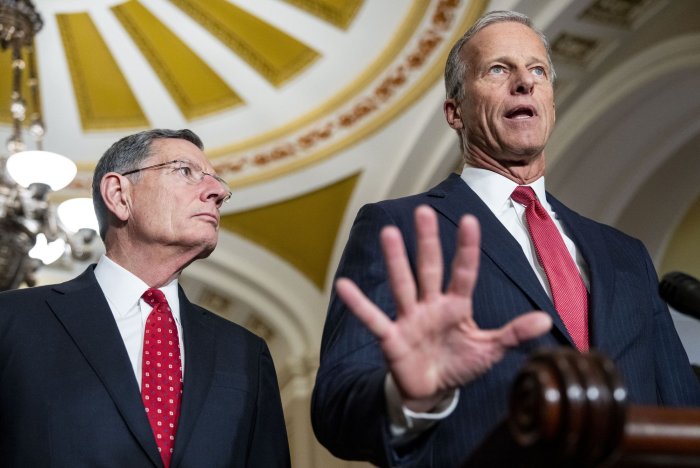
Sen. John Barrasso, R-Wyo., looks on as Senate Majority Leader John Thune, R-S.D., speaks during a press conference after weekly Senate Republican caucus luncheon at the U.S. Capitol on Tuesday. Photo by Bonnie Cash/UPI | License Photo

Source link