Katie has appeared in a clip with mate and TV presenter Olivia Attwood as she insisted she still has no idea where Lee is.
Katie turned to Olivia and said: “We’re missing something,” to which Olivia replied: “Yeah, I have looked for him but…”
Katie continued: “Well mine’s missing, so at the moment it doesn’t look good, does it?” Olivia, who split from husband Bradley Dack earlier this year, replied: “No, we’ll keep looking I guess.”
Katie looked at the camera and said:” We’re missing our husbands,” which prompted Olivia to burst out laughing. They followed it up with a picture of them looking shocked with their hands covering their mouth. Olivia captioned it: “2 gals. Not a husband in sight.”
Weekly insights and analysis on the latest developments in military technology, strategy, and foreign policy.
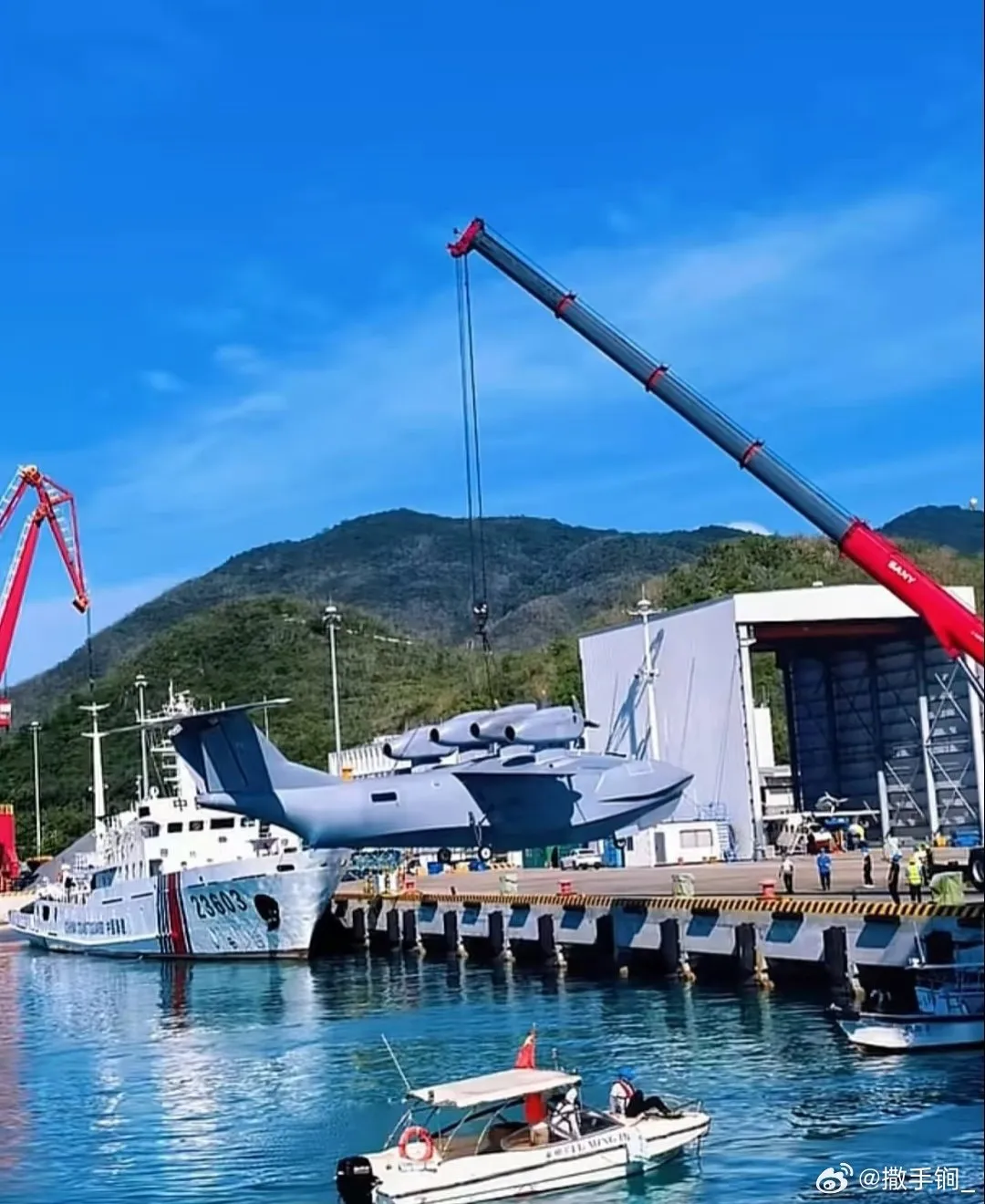
Less than a year after we got our first proper look at China’s wing-in-ground effect (WIG) craft, dubbed the ‘Bohai Sea Monster,’ the aircraft has appeared again, with evidence that it has a combat role, likely including launching weapons. We can also confirm that, contrary to some earlier assessments, the craft is powered by four turboprop engines, rather than turbofans. This confirms our original analysis that the craft may have propeller engines as opposed to jets.
The ‘Bohai Sea Monster’ is lifted by a crane in one of the newly appeared images of the craft. via Chinese internet
The Bohai Sea Monster was first identified by submarine warfare analyst HI Sutton in June 2025. The aircraft, with its distinctive flying-boat hull and joined v-tail, was spotted on a pier on the Bohai Sea, at the northwestern end of the Yellow Sea. The following month, better imagery appeared, showing the craft on the water, but without its propellers fitted, adding to speculation that it might be jet-powered.
The craft made its first appearance last year on a pier along the Bohai Sea in China. via X
New images show the Bohai Sea Monster in greater detail, including its powerplants, which appear to be regular turboprops, rather than a hybrid-electric propulsion system, something that would make a lot of sense for an aircraft of this kind. Each of the four engines drives a three-bladed propeller.
Another, earlier view of the Bohai Sea Monster, before the propellers were fitted. via X
Perhaps even more interesting is the appearance under each wing of a pair of hardpoints, which appear to be intended to release stores. Potentially, these pylons could be used to mount external fuel tanks or sensor pods. However, they appear to be fitted with shackles, which would clearly indicate a plan to release stores. While some kind of search-and-rescue payload, such as life-raft containers, is a possibility, the military paint scheme and PLA doctrine point more to the craft being armed with some kind of offensive weapons. Air-launched drones could be another payload, with this being an area of growing interest for the Chinese military.
The development raises questions about some reports that this is a “civilian” program nominally tied to the China Coast Guard, although cover stories of this kind are hardly unusual for Chinese military programs.
Another new view of the ‘Bohai Sea Monster,’ this time on the water. via Chinese internet
At the very least, the Bohai Sea Monster is certainly not a pure transport craft. Some kind of multi-role platform is also a strong possibility.
There is also the possibility, one that we raised in the past, that the Bohai Sea Monster is actually a subscale demonstrator, one that’s intended to prove out the WIG concept. If successful, this could then lead to a much larger craft and one that would, of course, have a different powerplant and much greater payload — including weapons.
The Bohai Sea Monster’s broad similarities to the now-abandoned, U.S.-designed Liberty Lifter could also point to the Chinese craft being a subscale technology demonstrator.
Aurora Flight Sciences capture
Notably, subscale demonstrators of flying boats are nothing new. Indeed, Germany built one to trial the flight characteristics of its planned Dornier Do 214 transatlantic flying boat back in World War II. In the 1950s, the Soviet Union built a single example of its first jet-powered flying boat, the Beriev R-1, before the same company fed this experience into the much larger and more ambitious Be-10 Mallow.
As for WIG craft in general, these were extensively explored by the Soviet Union during the Cold War, leading to some enormous vehicles, including anti-ship strike platforms and assault craft, which even saw some military service. In Russian parlance, they are known as Ekranoplans.
A video showing the Soviet Lun class missile-armed Ekranoplan:
Video Lun class Ekranoplan (Caspian)
Post-Cold War, the WIG concept fell from favor, but it has made something of a return in more recent years. These craft are able to skim the dense air above the surface of the water with relatively high efficiency and speed, while most are also capable of less-efficient higher-altitude flight.
In the context of the Pacific, specifically, WIG craft are seen as a potential partial answer to some of the challenges of fighting in that theater. This includes moving cargoes (including very heavy ones), as well as personnel and materiel to far-flung locations that may not be served by runways. In the process, large distances may need to be covered, and fast. It is for the logistics mission that the U.S. military was looking to the Liberty Lifter.
A full view of the same image of the ‘Bohai Sea Monster’ as seen at the top of this story. Note the apparent weapons stations below the wings. via Chinese internet
There is also the very important fact that, by skimming low over the water, a WIG craft can stay below the radar horizon, avoiding the gaze of surface- and land-based sensors. At the same time, it is immune to mines, submarines, and other hazards that can threaten even relatively safe waters. These advantages have to be weighed up against an airframe that remains generally vulnerable in a heavily contested combat zone.
For China, a platform of this kind would also be very useful, especially in the highly strategic South China Sea. In peacetime, a WIG craft could be used to support bases in the region, as well as search and rescue, and other missions. In a conflict, the same types of craft could perform rapid resupply, as well as surveillance, in island chains and littoral regions.
The People’s Liberation Army (PLA) is expected to be a recipient of the AG600 amphibious flying boat, which could perform similar missions. Unlike most militaries, the PLA has never fully moved away from operating flying boats, most recently the SH-5, a handful of which were completed, primarily for anti-submarine warfare, but were apparently withdrawn in recent years.
The fourth production AG600 amphibious aircraft completed its first flight earlier this month. via Chinese internet
When it comes to an armed WIG craft, even in its current size, the Bohai Sea Monster could be a very useful sea control platform, undertaking both anti-submarine warfare and anti-shipping strike over regional distances, perhaps as a more ‘tactical’ counterpart to the AG600 and shore-based types. It would still be large enough to accommodate sensors, with up to four torpedoes or smaller anti-ship missiles carried underwing. Depth charges are another possibility.
The Harbin SH-5 flying boat. This aircraft was equipped with a search radar in its nose and a magnetic anomaly detector (MAD) in its tail. via Chinese internet
Such a craft would be suitable for local patrols of littoral areas, as well as support of special forces, etc. A smaller WIG craft would also be valuable for combat search and rescue (CSAR), likely to be a key mission should China go to war in the Pacific.
Of course, a scaled-up Bohai Sea Monster would be much more capable across all these kinds of missions. It would likely offer the capacity for an internal stores bay, as well as a heavier payload, a more comprehensive sensor suite, and a longer range.
Exactly what role the Bohai Sea Monster will ultimately fill, and whether it represents an operational platform or merely a stepping-stone toward something far larger and more capable, remains unclear.
A cropped version of the photo showing the ‘Bohai Sea Monster’ on the water. via Chinese internet
However, its reappearance with apparent weapons-carrying provisions strongly suggests China is exploring far more than a niche transport or utility aircraft. Instead, it points to a broader effort to revive and adapt the WIG concept for modern military operations in the Pacific, where speed, range, payload, and access to austere maritime areas could all prove critical.
At the same time, the craft joins a growing list of highly ambitious and sometimes novel Chinese aerospace and naval programs that are emerging at a remarkable pace, often revealing themselves only in fragments before their true purpose becomes apparent.