From west to east, Iowa voters have starkly different realities and fears
Reporting from ORANGE CITY, Iowa — They met decades ago, when they were first married, and the three sisters-in-law still gather each week at the Dutch Bakery to catch up amid the sweet smell of flour and sugar floating through the air.
Despite the cozy setting here on the state’s western edge, they can feel the country beneath their feet slipping away, eroding under the threats of immorality and terrorism.
“I never thought we would live in so much fear,” said Joanne Niezen, as her coffee sat cooling before her in a Styrofoam cup.
There’s fear on the other side of the state as well, though for different reasons.
In the college town of Iowa City, with its hip music scene and pita restaurant advertising “fresh thinking and healthy eating,” Veronica Tessler worries about the harsh rhetoric directed at immigrants and the economic inequality that lingers years after the Great Recession.
“I really fear for our country,” said Tessler, who left her job at a foreign policy foundation to open a frozen yogurt shop near the University of Iowa campus.
A sense of dread is about the only thing that unites Orange City, a bastion of religious conservatism, and Iowa City, known for its blue-sky liberalism. Together they bookend not only the state’s geography but its political spectrum as Iowa prepares to kick off the presidential selection process Monday night with its closely watched caucuses.
The two communities, located in the most lopsidedly partisan counties in the state, reflect the vast political chasm here and across the country, a divide that President Obama was unable to heal and which may prove insurmountable for whomever takes his place.
“Republicans see an America where the government is too big at home and too feeble abroad. Democrats see an America where the economy is out of whack,” said David Nagle, a Democratic attorney who used to represent Iowa City and surrounding Johnson County in Congress. “It’s like two trains in the night, passing in opposite directions.”
Republicans see an America where the government is too big at home and too feeble abroad. Democrats see an America where the economy is out of whack.
— David Nagle, a Democratic attorney who used to represent the Iowa City area in Congress
But the division goes far beyond a profound disagreement on issues. While partisan tensions are nothing new, they have deepened and intensified during the presidencies of George W. Bush and Barack Obama as the parties have splintered along the lines of age, race and culture. The result is a separation of America into mutually estranged and suspicious tribes.
Today, as conversations at opposite poles of Iowa show, voters on each side often get their news from different sources, worry about different problems and view political adversaries with mistrust and even contempt. One voter’s vision for America is nothing less than another’s nightmare; it’s common to hear candidates of the opposing party described as “concerning” or “scary” or “crazy.”
In 2014, a major study released by the nonpartisan Pew Research Center found that more than one-third of Republicans and just over a quarter of Democrats — especially those most engaged in politics — go as far seeing the other party as a “threat to the nation’s well-being.”
In Johnson County, known both affectionately and derisively as the “People’s Republic,” life in Iowa City revolves around the university, with young people constantly hustling between classes or hunkered down in coffee shops with headphones and homework.
Obama is largely viewed with gratitude or, at worst, disappointment for failing to deliver an even more liberal agenda.
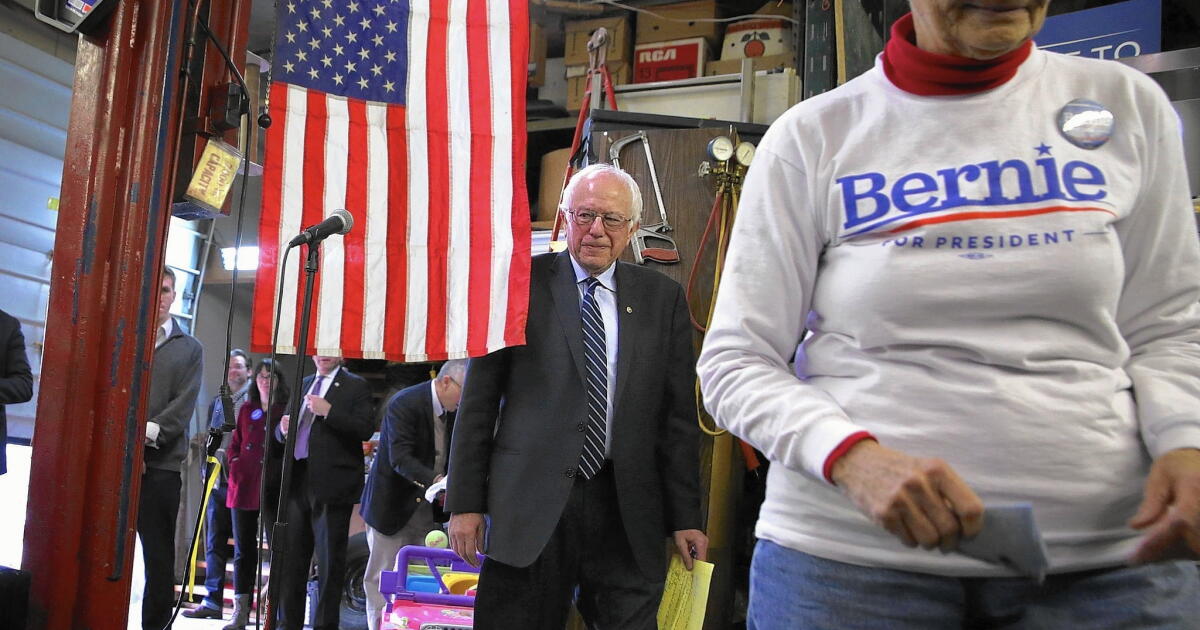
The city’s leanings are evident at the Hamburg Inn, where jars labeled with the names of presidential candidates are lined up in the window. Diners drop in coffee beans to show their preferences; some of the Republican jars are nearly empty, while a second container was added for Bernie Sanders, a democratic socialist, because the first overflowed.
Tessler, 30, is volunteering with the Sanders campaign, and she’s been alarmed by what she hears coming from the mouths of Republican contenders.
In response to Donald Trump’s proposal to ban Muslims from entering the U.S., she helped make T-shirts to protest his Iowa City visit last Wednesday. “I stand with my Muslim neighbors,” they read.
She doesn’t dismiss the threat of terrorism — in fact, she was visiting family near San Bernardino on the day of the attack there that killed 14 people in December. But she’s also the daughter of a Soviet Jew who escaped to Los Angeles in 1973, and she thinks Republicans are scapegoating immigrants and refugees.
“They are not American ideals,” she said.
For many in Iowa City, issues like economic inequality and student debt feel most urgent, not fears of terrorist attack.
“ISIS could do something terrible anywhere,” said Chuck Michaelson, 61, a piano instructor who lives in nearby Coralville, using an acronym for the militant group Islamic State. He paused while flipping through a biography of writer Joan Didion at a bookstore near campus. “But the likelihood of it being personally affecting is slim. It’s like being struck by lightning.”
About 300 miles away in Orange City, across a vast expanse of fertile farmland, the fears of terrorism seem more immediate despite the area’s isolation and outward serenity.
“The whole thing of ISIS scares me,” said Bob Hulstein, 64, who publishes the Orange City newspaper and owns a printing business with his brother-in-law, Dave Pluim, 51.
After attacks in Paris and San Bernardino, Hulstein said, “I’m afraid we’re going to see that closer and closer. I guess I want that stopped before it comes to my front door.”
Pluim agreed. “In fact, it would be real easy to do something horrible in Orange City,” he said. “Come to a high school basketball game.”
Settled largely by Dutch immigrants, this region proudly promotes its heritage; Orange City, the seat of Sioux County, was named after a Dutch prince, and decorative windmills, wooden shoes and tulip-themed businesses abound.
The area was hardly touched by the Great Recession — strong commodity prices and a boom in farm values helped see to that — and now there is something close to full employment. “Help wanted” signs are everywhere: at the florist, the bakery, restaurants, the post office.
So it is not economics that drives the anxiety here so much as concerns about the country’s place in the world.
“Are we willing to back our allies?” said Tony Vande Brake, 25, a financial advisor and newly elected member of the Orange City Council. “Are we willing to stand behind our military prowess, show strength if we had to?”
Back at the Dutch Bakery, Niezen and her sisters-in-law describe the election as a chance to reclaim the moral authority and military strength that, in their opinion, has withered under Obama and fueled a rise in Islamic extremism.
“He’s taken our military way down,” said Niezen, who is in her 70s. “When they were cutting our people’s heads off, he should have gotten in there right then.”
Leona Noteboom, an 83-year-old retiree, agreed. “I don’t trust him for taking care of my country,” she said.
“We’re just losing all our Christian values,” piped in Carol Noteboom, 74, who lives on a nearby farm.
Amid all the anxieties, there were glimmers of optimism.
Morgan Brittain, a political science student, crosses the ideological fault line every time he travels from his family’s home in Winterset, a small town outside Des Moines, to school in Iowa City. When he last got his hair cut back home, the woman holding the shears confided she planned to support Trump.
“I was like, ‘Oh my gosh, Heidi, you’re killing me,’” Brittain said.
At the barbershop close to campus, everyone seems bewildered by Trump’s popularity.
Asked if any candidate could bridge the divide, Brittain laughed and said, “I’m going to say absolutely, anybody can unify us.”
But he’s just 22, Brittain said, and still an idealist.
Twitter: @ChrisMegerian
Twitter: @markzbarabak
Megerian reported from Iowa City and Barabak from Orange City.
Hoy: Léa esta historia en español
For more, go to latimes.com/politics.
ALSO:
Everything you need to know about the Iowa caucus and why it matters
How Martin O’Malley could decide who wins the Democratic caucuses in Iowa
Republican rivals take advantage of Trump’s absence in Iowa presidential debate
Trump makes a big show of skipping GOP debate and staging benefit for veterans