A divided Trump team closes ranks ahead of AI talks with China
GUANGZHOU, China — Behind the scenes, Treasury Secretary Scott Bessent spent months pushing for action that would signal resolve within the Trump administration against China’s pursuit of the most powerful American computer chips, a flashpoint in their race for superiority in artificial intelligence, multiple sources said.
But Trump’s courtship of Xi Jinping, seeking to alleviate tensions among the world’s greatest powers, and a contingent of advisors skeptical of commercial warfare against Beijing slowed the process down — giving China months of opportunity to gain access to U.S. semiconductors through the back door.
Ultimately, just hours before departing for Asia alongside President Trump, Bessent got his way, bolstering his position ahead of talks with Chinese officials in Shenzhen this week on the risks posed by frontier systems.
A new rule tightening loopholes in U.S. export controls sends a dual message to Beijing ahead of Thursday’s summit, that Washington is serious about curbing Chinese circumvention — and that China hawks within the administration may be gaining the upper hand.
Trump has repeatedly sidestepped confrontation with Xi over the intensifying AI race in their two previous meetings this year, in Beijing and Washington, wary of upsetting a carefully managed détente and reluctant to jeopardize a technology boom increasingly central to the U.S. economy.
But the administration, from the president down, is acutely aware of China’s ambitions to dominate an industry that could reshape the global balance of power. That competitive drive was underscored this month by a scandal involving a Chinese espionage campaign targeting Jensen Huang, co-founder of Nvidia, the world’s leading AI chip maker.
Before resigning from the company in disgrace over the weekend, Huang admitted to having an affair with a suspected Chinese spy — a woman who worked at a Singaporean firm accused by American authorities of helping to divert restricted Nvidia chips to China, in violation of U.S. export controls.
The national security scandal has roiled the markets — and in so doing, commanded Trump’s attention — inflicting a significant devaluation on Nvidia and reverberating well beyond it, wiping nearly $1 trillion from the combined market value of major technology companies in a single trading session on Monday.
Trump, who counts Huang a friend and ally, indicated he would be open to his return as Nvidia’s chief executive. Bessent suggested otherwise, expressing confidence its board could find competent new leadership and urging a full investigation.
Trump is not expected to raise the Nvidia matter directly with Xi. But Bessent plans to do so in his own meetings, one official said.
The Treasury secretary has thus taken on the role of an enforcer, pursuing a tougher line than Trump is willing to take himself in his highly personalized relationship with the Chinese leader.
Bessent is scheduled to meet with Chinese Vice Premier He Lifeng on the sidelines of the summitry in Shenzhen to discuss potential collaboration on AI safety protocols, standards for testing of advanced models, and a direct communications channel for AI emergencies.

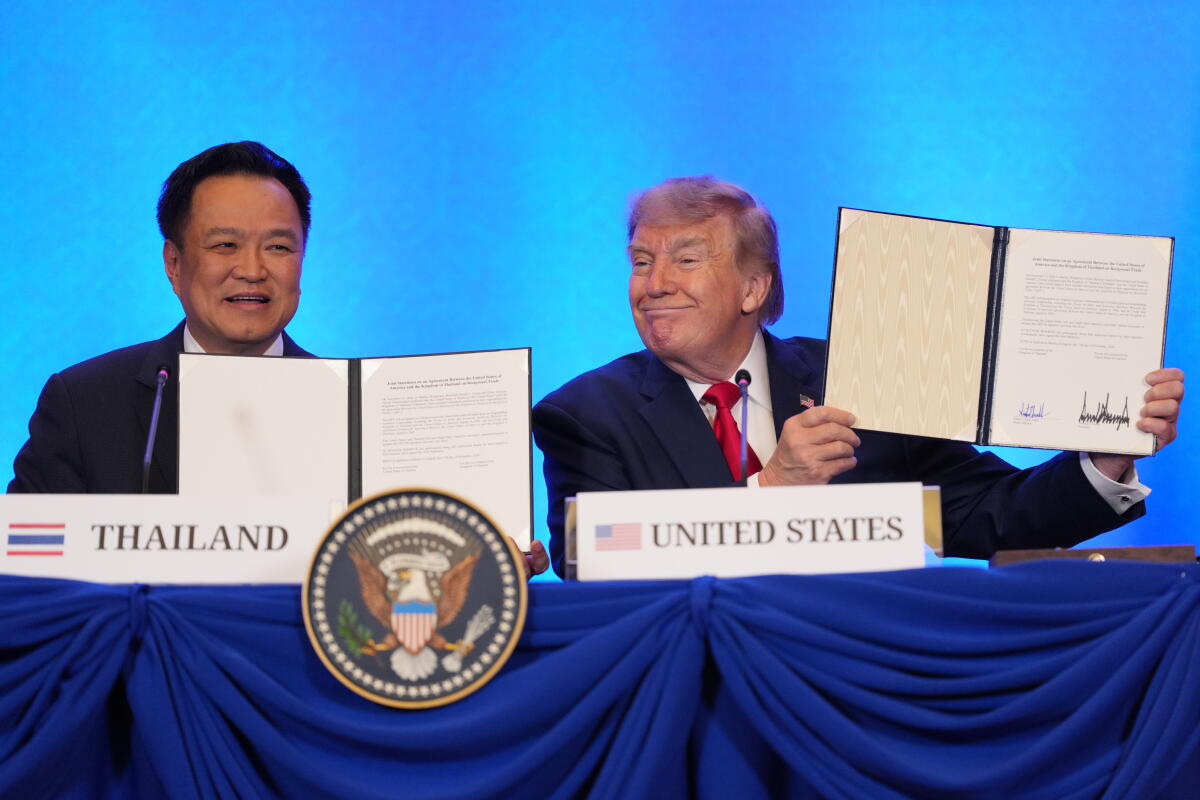
President Trump and Thailand’s Prime Minister Anutin Charnvirakul shows documents during a signing ceremony in Manila.
(Mark Schiefelbein / Associated Press)
The two men have met before to discuss AI, most recently in New York, where they agreed in principle to coordinate. But the talks have yet to produce much in the way of tangible results.
“Bessent is signaling that, while he sees working with Beijing to mitigate AI risks as a priority, it won’t come at the expense of actions that he sees as necessary to protect U.S. national security, like limiting AI chip exports to China,” said Daniel Remler, a senior fellow with the Technology and National Security Program at the Center for a New American Security.
The administration’s latest action marks a policy defeat for Howard Lutnick, secretary of the Commerce Department, who oversees chip policy and had advocated for a less restrictive approach than Bessent, Secretary of State Marco Rubio and Jamieson Greer, the U.S. trade representative.
The feud began spilling into public view ahead of the president’s travel, and in light of the Nvidia scandal, after Bessent said in a television interview that the Commerce Department “has the pen” to act, implying a split within the team.
“Look, there’re two different views,” Trump told reporters on Monday, answering questions on the matter. “One view is you don’t want to insult China. We have a very good relationship with China, and you don’t want to insult them.”
“The other view is just go, you know, down and dirty and do what you have to do,” Trump continued. “You can’t say either is wrong or right. We’ll let you know.”
Beyond the diplomatic niceties, Trump has been explicit and consistent since resuming office that the United States must “win” the race for AI superiority, calling the alternative “not acceptable.”
“Whoever wins AI,” Trump said at the UN General Assembly in September, “whoever wins superintelligence, wins.”
Trump will arrive in China on Wednesday after meeting with world leaders in Manila, including those from the Quad — an alliance of Japan, India, Australia and the United States — which discussed AI at their own summit Tuesday evening.
Describing “superintelligence” — Trump’s preferred term for AI — as “the greatest opportunity for economic growth since the industrial revolution,” Trump announced a Quad effort to accelerate adoption of the technology, including an investment of more than $85 million to enhance AI ecosystems throughout the region.
“We want to be careful with it,” Trump said, “but it’s amazing, the things that have come out, in terms of science and in terms of medical breakthroughs. No one can believe what we’re finding. And we’re finding it fast.”
“We want to be very careful, but we want to cherish it,” he added. “The United States as you know is leading in that capacity, by quite a bit.”
The new U.S. rule requires overseas data centers serving customers in China, Russia, Iran and Cuba to identify their end users before gaining access to chips. It also imposes additional licensing requirements on chip sales to Indonesia, Malaysia, Singapore, Thailand and Brazil, which the Commerce Department identifies as posing a “higher-than-normal risk of diversion” to unauthorized destinations.
U.S. officials say that export controls are not up for negotiation in talks with the Chinese. But Beijing sees them as yet another historic example of Washington trying to contain its rise — a posture that has repeatedly stifled diplomatic progress between the two superpowers.
“While administration officials say export controls aren’t up for negotiation, Chinese officials will certainly bring them up,” Remler said. “These restrictions are the key obstacle to China’s AI progress, which is increasingly important to the Chinese economy and to Xi’s strategic goals.”

Protesters in Manila take part in a demonstration Tuesday against President Trump visit to the Philippines for the ASEAN summit.
(Ezra Acayan / Getty Images)
China claims it does not seek an all-powerful, generalized “superintelligence,” but rather specialized AI systems embedded across industries to boost productivity and improve quality of life.
In Beijing’s telling, it is the United States — pursuing generalized AI through a private sector largely unchecked by the federal government — that poses an existential threat to the global order.
Sheila Jasanoff, a professor of science and technology studies at the Harvard Kennedy School, said China “has a much clearer vision of what it is seeking to accomplish in the so-called AI arms race, as well as the capacity to benefit from Nvidia’s chips.”
“I doubt that China will be interested in launching a discussion that calls attention to its spying operations, or jeopardizes any supply networks it has built over the years,” Jasanoff added, “by innocent or nefarious means.”
Pressed by The Times, Chinese officials would not say whether they expected progress in the AI talks — before the announcement of the new rule on export controls.
And “what the U.S. president chooses to bring up,” Jasanoff added, “is anyone’s guess.”