Thousands flock to the National Mall for prayer rally
WASHINGTON — Thousands of people streamed onto the National Mall for a daylong prayer rally Sunday headlined by President Trump and billed as a “rededication of our country as One Nation under God.”
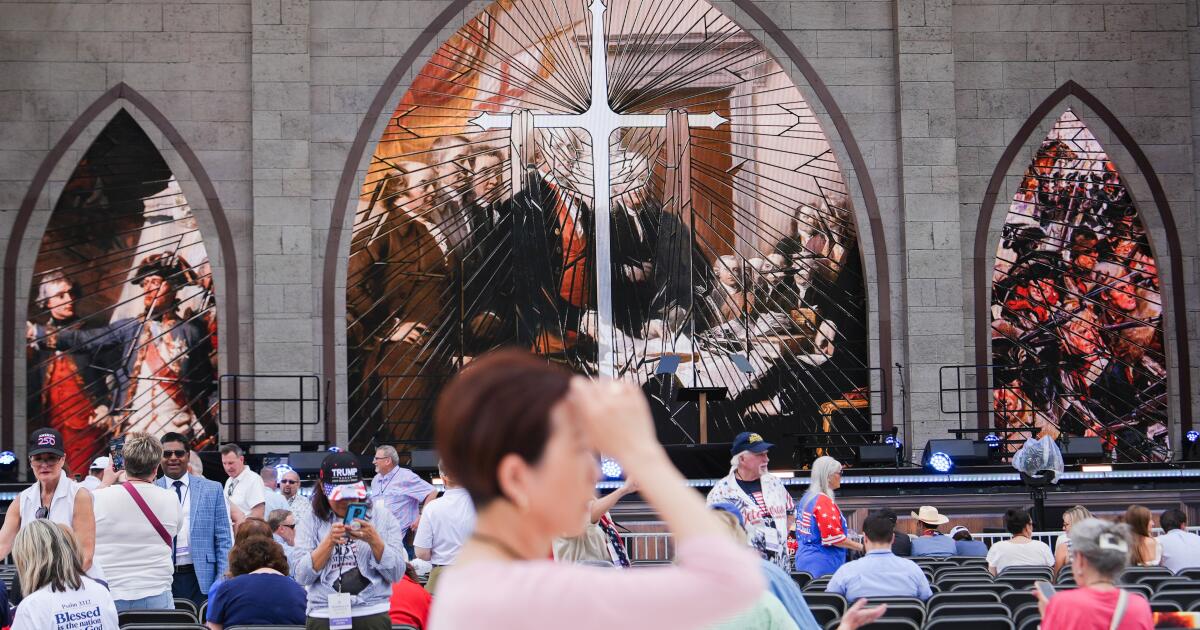
Against the backdrop of the Washington Monument, worship music blared from a stage that made clear the event’s Christian focus. Arched stained-glass windows, set underneath grand columns resembling a federal building, depicted the nation’s founders alongside a white cross.
The nation’s tradition of separating church and state, however, was not on display. Most speakers celebrated Christianity’s ties to American history, a blending of ideas that critics decried before the gathering as Christian nationalism.
Trump read a passage of Scripture in a video shown at the rally. Filmed in the Oval Office, it was the same footage used during a marathon Bible-reading event last month. The verses from 2 Chronicles are often cited by those who claim America was founded as a Christian nation.
“If my people, which are called by my name, shall humble themselves, and pray, and seek my face, and turn from their wicked ways,” Trump read, “then will I hear from heaven, and will forgive their sin, and will heal their land.”
Other leading Republicans, including Defense Secretary Pete Hegseth, Secretary of State Marco Rubio and House Speaker Mike Johnson (R-La.), were also on the schedule for the event, part of the celebrations marking the nation’s 250th anniversary.
Only one name on the Rededicate 250 program was not Christian. Most were among Trump’s longtime evangelical supporters, including Paula White-Cain of the White House Faith Office and evangelist Franklin Graham of Samaritan’s Purse.
“We are deeply concerned that what is really being rededicated is a nation to a very narrow and ideological part of the Christian faith that betrays our nation’s fundamental commitment to religious freedom,” said the Rev. Adam Russell Taylor, a Baptist minister who leads the progressive Christian organization Sojourners.
The conservative Christian lineup featured guests who often assert that the United States was founded as a Christian nation, a narrative disputed by many historians and other religious traditions and inconsistent with American legal precedent.
Rabbi Jonah Dov Pesner, director of the Religious Action Center of Reform Judaism, noted the religious diversity of early America, including Jews, Muslims and Indigenous people. “I want to shine a light on America’s history as a nation that welcomes, celebrates and protects people of all faiths and those of no faith,” Pesner said.
‘It’s all about Jesus’
Many in the crowd wore Trump hats and patriotic colors, joining the festivities under a sweltering sun.
“It’s all about Jesus,” said Denny Smith, 72, of Rhode Island, who rented a motorized scooter to traverse the National Mall.
Retha Bond, a 58-year-old from southern Illinois, said she was here to hear Trump speak nearby on Jan. 6, 2021. She said she did not join the protesters who rioted later that day at the Capitol, attacking police officers while attempting to overturn the presidential election result, but she has remained a steadfast Trump supporter.
“I’m not saying Trump is the savior,” Bond said. But she said that “this is one of the most important things that could be going on in the world, for us to rededicate our nation back to God.”
At least one event speaker mentioned the slain conservative activist Charlie Kirk. Kirk’s activism has been a powerful example for Alessandra Seawright, 15, of Santa Fe, N.M., who came to Rededicate 250 with her mother.
“I think we just need more of this in our country, and we just need to share the word of the Lord,” she said. “We love going to events like this.”
They also attended Kirk’s memorial service in Arizona, which mixed Christian worship and political messages. Events like these, Seawright said, help her feel less alone in her conservative Christian beliefs.
Prayer event spurs protest
Hegseth, who has infused Christian language and worship with his role leading the Pentagon — drawing criticism — asked the gathering in a video to pray to “our Lord and Savior Jesus Christ.” Referencing George Washington’s faith, he said, “Let us pray without ceasing. Let us pray for our nation on bended knee.”
Orthodox Jewish Rabbi Meir Soloveichik was the only non-Christian religious leader listed on the program. To applause, he told the crowd, “Antisemitism is utterly un-American” — a seeming reference to debates dividing the right.
Soloveichik serves on the Trump administration’s Religious Liberty Commission along with White-Cain, Graham and Cardinal Timothy Dolan and Bishop Robert Barron, Catholic clerics also featured on the program.
The event was organized by Freedom 250, a public-private partnership backed by the White House. Congressional Democrats have questioned the nonprofit’s structure and finances, which they see as a Trump-controlled end run around a separate commission charted by Congress a decade ago to prepare semiquincentennial events.
Progressive groups staged counter-programming. Among them were the Freedom From Religion Foundation, which advocates a strict separation of church and state, and the Christian organization Faithful America. The two groups displayed a large balloon near the mall of a Trump-like golden calf, a biblical reference to idolatry.
On Thursday evening, the Interfaith Alliance projected protest slogans onto an exterior wall of the National Gallery of Art. “Democracy not theocracy,” said one. Another said: “The separation of church and state is good for both.”
Stanley writes for the Associated Press. AP writer Peter Smith in Pittsburgh contributed to this report.