raised

Security Levels At U.S. Bases In England Raised Without Explanation

At least two bases in England hosting U.S. Air Force aircraft are operating under beefed-up security protocols, a U.S. official told us Monday afternoon. The official was responding to our questions about what appeared to be unusual aircraft movements out of RAF Mildenhall. It is unclear what spurred these measures, how long they have been in place or whether they are connected to an ongoing investigation into whether Iran was behind a security incident at RAF Fairford in September that reportedly prompted the hasty departure of B-1 Lancer bombers.

“Enhanced force protection measures are in effect across RAF Lakenheath and RAF Mildenhall,” the official told us. “We constantly assess a variety of factors that determine what measures we institute or modify to protect our installations, our people and their families. We are working closely with our host nation counterparts to minimize impacts from enhanced force protection activities and ensure the safety of U.S. personnel, their families and the local community.”

The official declined to say what steps were taken.

“For operational security reasons, we do not discuss specific force protection measures,” the official added.

RAF Mildenhall and RAF Lakenheath are both major hubs for the U.S. Air Force. Mildenhall’s host unit is the 100th Air Refueling Wing, which operates KC-135 Stratotanker aerial refueling jets. The base is also home to Air Force RC-135V/W Rivet Joint reconnaissance aircraft, Air Force Special Operations Command (AFSOC) CV-22 Osprey tiltrotor aircraft and MC-130J Commando II special operations cargo planes. Lakenheath hosts Air Force F-15E Strike Eagle and F-35A Lightning II aircraft.

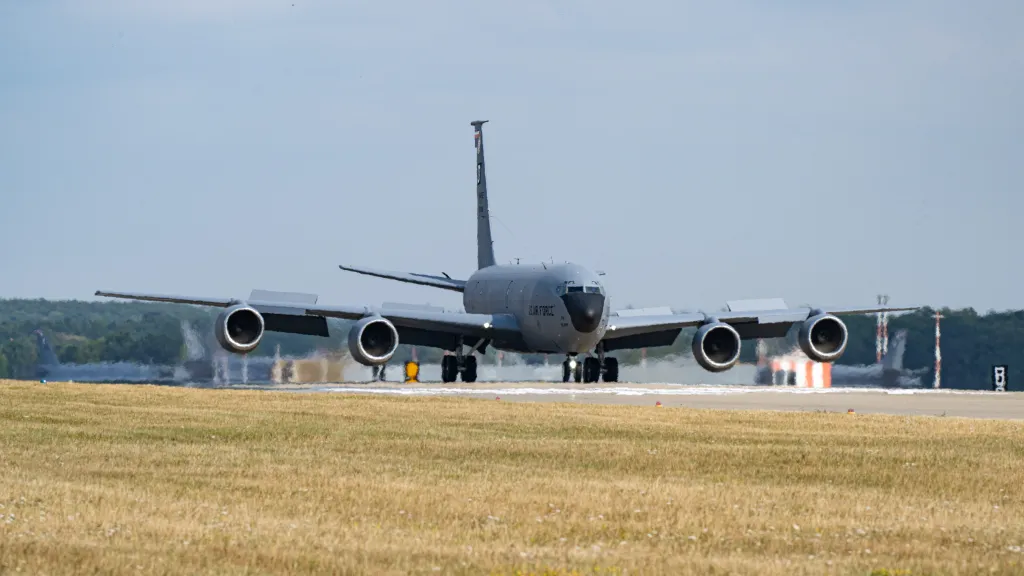
A U.S. Air Force KC-135 Stratotanker from the 100th Air Refueling Wing taxis down a runway after landing at RAF Mildenhall, England, July 22, 2026. The 100th ARW provides fuel to U.S., NATO Allies and partners across the European theater, extending the Air Force’s global reach. (U.S. Air Force photo by Senior Airman Aidan Martínez Rosiere)
A U.S. Air Force KC-135 Stratotanker from the 100th Air Refueling Wing taxis down a runway after landing at RAF Mildenhall, England, July 22, 2026. (U.S. Air Force photo by Senior Airman Aidan Martínez Rosiere) Senior Airman Aidan Martinez Rosiere
A U.S. Air Force F-15E Strike Eagle aircraft, assigned to the 492nd Fighter Squadron, takes off for Atlantic Trident 25 at RAF Lakenheath, England, June 12, 2025. Atlantic Trident 25 is a multinational training exercise focusing on air to air defense, hosted by Finland for the first time. (U.S. Air Force photo by Airman 1st Class Sierra Casteel)
A U.S. Air Force F-15E Strike Eagle aircraft, assigned to the 492nd Fighter Squadron, takes off for Atlantic Trident 25 at RAF Lakenheath, England, June 12, 2025. (U.S. Air Force photo by Airman 1st Class Sierra Casteel) Airman 1st Class Sierra Casteel

Both bases also see frequent flights transiting to other locations.

As we noted earlier in this piece, the official was responding to our questions about unusual aircraft movements out of Mildenhall. They were first noticed by the @DefenceGeek open-source flight tracker account.

“Over the course of today, a number of US Air Force assets at RAF Mildenhall (EGUN) have made unannounced/unexpected movements to other locations, with several of those movements in motion presently,” DefenceGeek wrote on X. “The initial few this morning I assumed were due to heavy fog in the area, but other information is now suggesting something else… – Several KC-135s have moved to Spangdahlem (ETAD) or Prestwick (EGPK) – CV-22Bs have moved from Mildenhall to Lakenheath It remains unclear if there is an ongoing exercise or information of a potential threat (following the incident at RAF Fairford)…”

DefenceGeek also noted that RAF Lakenheath posted a notice this morning on Facebook urging vigilance in spotting and reporting drones.

“Our strongest security asset is an observant community,” the RAF Lakenheath Facebook post read. “Staying vigilant and reporting suspicious activity, including unauthorized drone activity, helps protect our Airmen, families and mission. If you see something unusual on or around the Tri-Base area, report it to Security Forces.”

It is unclear what connection, if any, the Lakenheath post has to the enhanced force protection status. U.S. Air Forces in Europe – Air Forces Africa (USAFE) declined to discuss security measures. The command oversees U.S. Air Force operations in Europe and Africa.

“U.S. Air Force aircraft rotate between installations and operating locations for a variety of reasons including training and real world requirements,” USAFE told us. “U.S. military aircraft are hosted in accordance with access, basing, and overflight agreements with our Allies and partners. Due to operations security, we will not provide further information on movement of assets.”

The departures from Mildenhall took place amid an ongoing flow of refueling tankers and other aircraft to the Middle East as President Donald Trump continues to mull whether to resume strikes against Iran. This afternoon, Trump wrapped up his meeting with Qatari Prime Minister Mohammed bin Abdulrahman Al Thani to discuss a flagging effort to resolve the conflict with Iran through diplomacy.

It should also be noted that in late November 2024, Lakenheath, Mildenhall and two other RAF bases hosting U.S. forces experienced drone incursions, which we were the first to write about.

As we mentioned earlier in this piece, security concerns about bases in England hosting U.S. Air Force aircraft and personnel were raised following an incident at RAF Fairford.

Like Mildenhall and Lakenheath, RAF Fairford is a major hub for U.S. military aircraft in the United Kingdom. It is a regular host of strategic assets, including bombers and U-2 spy planes. It also acts as a pit stop for other aircraft, including fighters, that are being ferried to and from the United States. Bomber strikes launched from Fairford were a central aspect of major U.S. combat operations against Iran earlier this year.

RETRANSMITTED CORRECTING DATE A US Air Force Rockwell B-1 Lancer bomber at RAF Fairford in Gloucestershire. Five British nationals were detained on suspicion of explosives offences and terrorism on Sunday after three vans were found near RAF Fairford in Gloucestershire, which has been used by the US military to carry out strikes against Iran. Picture date: Tuesday September 29, 2026. (Photo by Ben Birchall/PA Images via Getty Images)
A U.S. Air Force Rockwell B-1 Lancer bomber at RAF Fairford in Gloucestershire. (Photo by Ben Birchall/PA Images via Getty Images) Ben Birchall – PA Images

In late September, five men were arrested on suspicion of driving bomb-laden vans toward it. They were soon released on bail after no explosives were found, but two men were later arrested, one of who was “charged with assisting a foreign intelligence service, which police earlier said they believed to be Iran,” according to the BBC.

A week after the security incident, U.S. Air Force B-1B Lancer bombers that had been deployed to RAF Fairford in the U.K. since Operation Epic Fury returned to their home stations, a U.S. defense official confirmed to TWZ at the time. The hasty movement was reportedly sparked by new Iranian threats against the base. As we previously reported, Tehran directly threatened RAF Fairford in July over its use as a base to launch attacks against Iran.

We can’t say for sure what prompted the enhanced security at RAF Lakenheath and RAF Mildenhall or whether the aircraft movements at Mildenhall are precautionary or just normal shifting of resources. We will continue to monitor the situation and provide updates when warranted.

Contact the author: howard@twz.com

Howard is a Senior Staff Writer for TWZ. He writes frequently about conflict, focusing heavily on the Middle East and Ukraine, and interviews with military and intelligence officials and industry leaders from around the globe. He lives near Tampa, Florida, home of U.S. Central Command, U.S. Special Operations Command.


Source link

Questions are raised about President Trump’s plans for a D.C. Park

On the same week that a court filing showed that construction on President Trump’s hotly contested triumphal arch could begin as soon as Nov. 5, another less reported development pointed to the possibility that the government might be misrepresenting its plans for Trump’s National Garden of American Heroes in West Potomac Park.

On Monday, the National Park Service held a meeting about a proposed redesign to the park, which is part of the National Mall and also where Trump wants to put his Garden of Heroes featuring more than 250 statues ranging from Humphrey Bogart to Kobe Bryant to Benjamin Franklin. Trump first proposed the idea in 2020, but it wasn’t until his second term — when he began a crusade to remake much of Washington, D.C.’s historic core according to his own predilections — that the plan looked as if it might manifest. The One Big Beautiful Bill Act even appropriated $40 million for the project.

The Garden of Heroes has remained largely in the background while preservationists focused on the demolition of the White House East Wing and the construction of a massive ballroom in its place, as well as the botched painting of the Reflecting Pool, and, of course, the gigantic triumphal arch.

But Monday’s NPS meeting about plans for West Potomac Park rang alarm bells for some when Judy Chesser, chair of the nonprofit conservation and preservation group the Committee of 100 on the Federal City, asked, “How does this relate to the Garden of Heroes that is being discussed in West Potomac?” to which the NPS spokesperson replied, “This is just an update to the tidal basin master plan we started before. This is not the Garden of Heroes.”

However, the Washington, D.C.-based education and advocacy organization Cultural Landscape Foundation noted that the rendering in NPS’ presentation and the illustrated “Pledge Agreement” from the National Garden of American Heroes Foundation contain similarities that “go way beyond coincidental.”

“Each includes a great lawn, a giant oval/circle, an amphitheater, a fountain, and a staircase to the Potomac River,” Charles A. Birnbaum, founding president and chief executive of the foundation, wrote in an email.

“In addition, the new design shown Monday amputates part of the FDR Memorial to accommodate the Oval. This is intentional. Clearly the Oval is meant to host something else or it would be re-scaled so as not to interfere with the FDR Memorial,” the email continued.

If this is the case, the strategy of downplaying or downright denying an intention to work on a Trump-backed project is eerily reminiscent of the strategy government lawyers used in a recent, highly publicized court battle over the removal of dozens of trees from a golf course that Trump is trying to transform into a premiere golfing destination.

In that instance lawyers repeatedly said there were no plans to renovate the golf course (thus preventing U.S. District Judge Ana Reyes from issuing an injunction against said renovations), only to chop down hundreds of trees on the course with no notice over a holiday weekend. Reyes was irate and sources familiar with the feud say that the judge expects the case to go all the way to the Supreme Court.

Meanwhile, as of 2 p.m. PDT, Thursday, opponents of Trump’s arch have filed a motion for an injunction on the possible Nov. 5 construction, arguing that Congress needs to approve any plan moving forward. This head-snapping whirlwind of motions and counter motions is expected by critics to continue to be the norm as Trump tries to push through as many of his D.C.-based renovations as possible before a new Congress is seated in January.

“What better way to celebrate the nation’s 250th anniversary than to shut down the legally required review process, ignore some 100,000 negative public comments, and fast track the construction of a bloated and deeply unpopular monument that the president claims is for him,” wrote the Landscape Foundation’s Birnbaum in a statement about the arch.

I’m Arts editor Jessica Gelt pitching preservationists for my personal garden of heroes. This is your arts and culture news for the week.

You’re reading Essential Arts

Our critics and reporters guide you through events and happenings in the SoCal arts scene. In your inbox every Friday.

The week ahead: A curated calendar

FRIDAY

American Sound Takes Flight
MUSE/IQUE explores the nation’s music from Aaron Copland to Paul Simon in a concert setting infused with storytelling and cultural context. Featuring Brandon Victor Dixon, Liv Redpath and the MUSE/IQUE Orchestra, led by Artistic and Music Director Rachael Worby.
7:30 p.m. Friday, 2:30 and 7:30 p.m. Saturday. The Wallis, 9390 N. Santa Monica Blvd., Beverly Hills. thewallis.org

Bach to Broadway
The 31st annual concert, featuring Pueri Cantores SGV, the St. Andrew School Choir, Los Angeles Children’s Chorus and members of the L.A. Opera and L.A. Master Chorale benefits the restoration of historic St. Andrew Church.
7:30 p.m. St. Andrew Church, 311 N. Raymond Ave., Pasadena. saintandrewpasadena.org

Ballet Festival: Jerome Robbins at the Ahmanson Theatre

Ballet Festival: Jerome Robbins at the Ahmanson Theatre

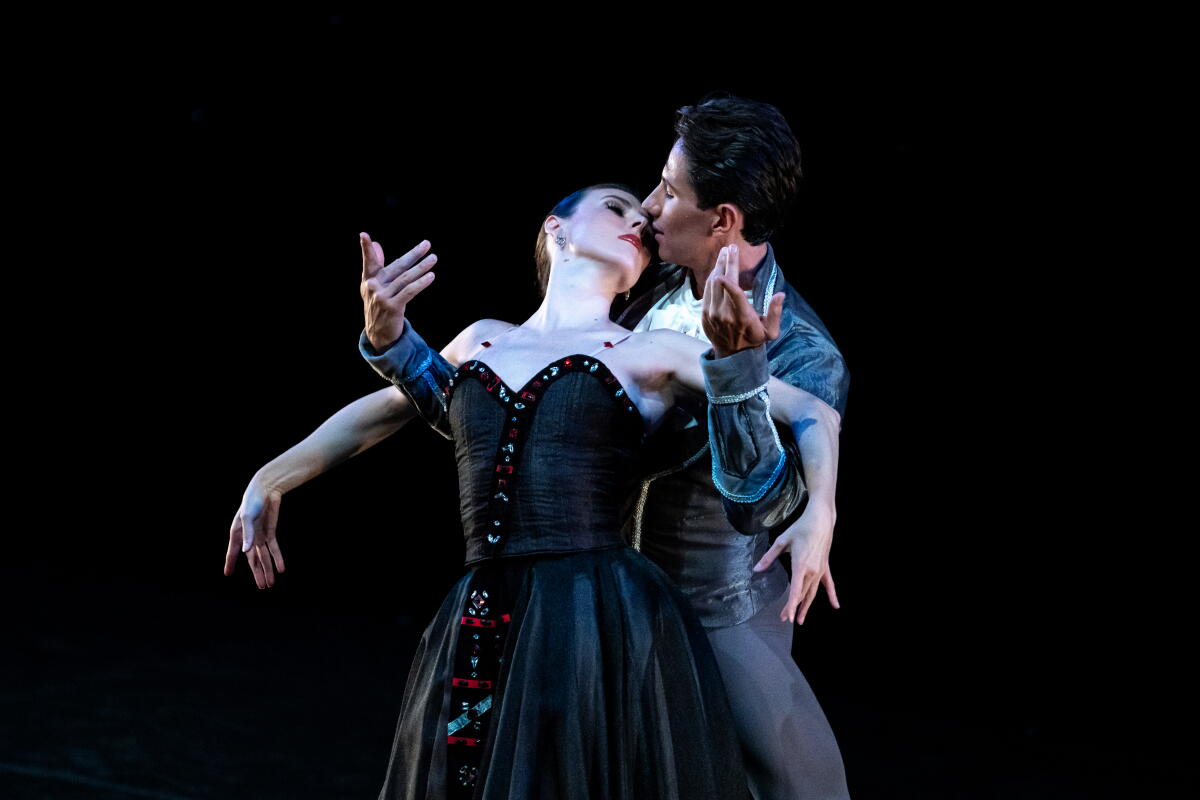
(Steven Pisano / The Joyce Theater Foundation)

Ballet Festival: Jerome Robbins
Three programs of the choreographer’s masterworks, curated by New York City Ballet principal dancer Tiler Peck, with dancers from New York City Ballet, Paris Opera Ballet and other major companies performing to live chamber music
7:30 p.m. Friday, 7:30 p.m. Saturday, 2 p.m. Sunday. Ahmanson Theatre, 135 N. Grand Ave., downtown L.A. musiccenter.org

Andrew Bird
The acclaimed multi-instrumentalist and songwriter joins with the Los Angeles Philharmonic to mark the 20th anniversary of his album, “The Mysterious Production of Eggs,” with orchestral arrangements, plus popular songs from his catalog.
8 p.m. Walt Disney Concert Hall, 111 S. Grand Ave., downtown L.A. laphil.com

Aymeric Hainaux and François Chaignaud
The musician and choreographer team up for “Mirlitons,” a marathon vocal and dance duet.
8 p.m. Friday and Saturday. The Nimoy, 1262 Westwood Blvd. cap.ucla.edu

Museum on Haunted Hill: A Celebration of Vincent Price
The institution pays homage to its original patron, the noted actor, art collector, advocate and historian, with an evening of after-hours access to exhibitions, casual screenings of classic Price films, drinks and snacks, music, a photo booth and haunted decor.
5-8 p.m. Vincent Price Art Museum, East Los Angeles College, 1301 Avenida Cesar Chavez, Monterey Park. vpam.org

PLAY: A Play
EmIly Mast’s unscripted conceptual performance features six players, guided by a coach, working against a clock and an evolving set of rules to examine “the invisible systems that govern power, behavior and care.” With Hugo Armstrong, Gregory Barnett, Chu-Hsuan Chang, Jessica Emmanuel, Jessica Hemingway, Aramazd Stepanian and Maxwell Transue.
7:30 p.m. Friday-Saturday, 4:30 p.m. Sunday. The Geffen Contemporary at MOCA, 152 N. Central Ave., Little Tokyo. moca.org

Sinners: Sounds That Summon
This exhibition examines the standout Club Juke scene in Ryan Coogler’s Oscar-winning 2025 film focusing on the guitar played by the character Sammie Moore (Miles Caton), costumes, objects and archival material.
Through March 14, 2027. California African American Museum, 600 State Drive, Exposition Park. caamuseum.org

SATURDAY

Grand Ave Arts: All Access
Tenth annual celebration of L.A. downtown cultural corridor with free exhibitions, tours, performances, family-friendly activities and more from participating organizations including the Broad, Center Theatre Group, Colburn School, Classical California, Dataland, Gloria Molina Grand Park, Grand Performances, L.A. Opera, L.A. Phil, Los Angeles Central Library, Metro Art, MOCA, the Music Center and REDCAT.
11 a.m.-4 p.m. Grand Ave., between Temple and 6th Streets, downtown L.A. grandavearts.org

Kabuki in Motion: The Lion Returns
U.S. Kabuki Ken Kyu Kai presents this program of kabuki dance, Nihon buyō (Japanese classical dance), and live koto and shamisen music featuring artists from Japan and California.
4:30 p.m. The Huntington, Rothenberg Hall, 1151 Oxford Road, San Marino. huntington.org

Picasso Ceramics From the Rosenbaum Collection
The exhibition presents 63 original prints and limited-edition ceramics, including vessels, plates, pitchers and sculptural forms created by the artist after 1947.
Through Feb. 28, 2027. Bowers Museum, 2002 N. Main St., Santa Ana. bowers.org

SUNDAY

Lucile Dollat
The French organist performs music from the 16th century to the present.
7:30 p.m. Walt Disney Concert Hall, 111 S. Grand Ave., downtown L.A. laphil.com

TUESDAY

Jason Moran Presents Duke Ellington: My Heart Sings
The pianist and composer performs with members of the Pacific Symphony to engage with Ellington’s work through a contemporary frame.
8 p.m. Segerstrom Center for the Arts, 600 Town Center Drive, Costa Mesa. scfta.org

The Music Man
Meredith Willson’s Tony Award-winning musical comedy brings smooth-talking con man Harold Hill to River City, where his schemes are curtailed when he falls for Marian, the local librarian.
Through Nov. 8. Ahmanson Theatre, 135 N. Grand Ave., downtown L.A. centertheatregroup.org

Orchestre Symphonique de Montréal with Rafael Payare
The Canadian ensemble and its charismatic Venezuelan conductor (who also leads the San Diego Symphony) perform Dmitri Shostakovich’s “Symphony No. 10 in E minor, Op. 93,” plus Felix Mendelssohn’s “Violin Concerto in E minor, Op. 64” with Leonidas Kavakos.
8 p.m. Walt Disney Concert Hall, 111 S. Grand Ave., downtown L.A. laphil.com

The 39 Steps
Patrick Barlow’s adaptation of Alfred Hitchcock’s 1935 spy thriller (itself an adaptation of a novel by John Buchan) about an ordinary man entangled in international intrigue. Directed by Hunter Foster.
Through Nov. 22. Laguna Playhouse, 606 Laguna Canyon Road, Laguna Beach. lagunaplayhouse.com

The Who’s Tommy
The band’s 1969 rock opera featuring “I’m Free,” “See Me, Feel Me,” “Sensation” and, of course, “Pinball Wizard,” is transformed into a Broadway musical by composer Pete Townshend and original director Des McAnuff.
Through Nov. 15. Hollywood Pantages Theatre, 6233 Hollywood Blvd. broadwayinhollywood.com

WEDNESDAY

Nedra Ryan Taylor and Sarah Scott Davis in the play "Confederates."

Nedra Ryan Taylor and Sarah Scott Davis in the play “Confederates.”

(Davis Northern)

Confederates
Institutional racism, as experienced in two different eras by Black women, is the subject of Dominique Morisseau’s 2022 dramatic comedy. Best known for her three-play cycle “The Detroit Project” as well as the book for the musical about the Temptations “Ain’t Too Proud,” Morisseau juxtaposes the plight of an enslaved rebel and Union spy during the Civil War with that of a contemporary political science professor facing a threatening work environment. Fountain Artistic Director Raymond O. Caldwell directs this sharp-eyed satire examining an unbroken thread of racial and gender bias in American history. (Charles McNulty)
Previews, 8 p.m. Wednesday-Thursday, play runs through Dec. 13. Fountain Theatre, 5060 Fountain Ave. fountaintheatre.com

THURSDAY

Seasons of America With Teddy Abrams & Ray Chen
The world premiere of Abrams’ L.A. Phil commission, written especially for violinist Chen, along with Julia Perry’s “A Short Piece for Orchestra.” Charles Ives’ “Three Places in New England, S. 7” and George Gershwin’s “An American in Paris.”
8 p.m. Walt Disney Concert Hall, 111 S. Grand Ave., downtown L.A. laphil.com

Sasha Velour: Travesty
The Season 9 winner of “RuPaul’s Drag Race” performs a new solo work that spans queer history through lip-sync performances embodying various personas including a witch burned in a field, a clown who builds a theater and patrons of an underground gay bar.
7:30 p.m. Thursday-Oct. 30. The Wallis, 9390 N. Santa Monica Blvd., Beverly Hills. thewallis.org

The SoCal scene

A woman puts on makeup in the mirror.

Katie Folger gets ready at her home before her performance of “Getting in Bed With the Pizza Man” at the Elysian Theater.

(Carlin Stiehl / For The Times)

ICYMI, the best of this week’s L.A. Times arts coverage:

Katie Folger moved to L.A. hoping to make it for the third time in nine years. She created a one-woman show and sold it out. Will the TV pilot sell next?

Former Times arts columnist Carolina A. Miranda wrote a fantastic profile of Todd Gray as he opens a new solo show at the Brick.

The Broad announced that it’s shipping 164 works to Fondation Louis Vuitton in Paris for its most extensive exhibition ever mounted outside Los Angeles, timed to coincide with the most extensive phase of construction on its expansion.

Reggie Burrows Hodges, "Blackness in the Looking Glass and the Images of Currency: Carriage," 2022.

Reggie Burrows Hodges, “Blackness in the Looking Glass and the Images of Currency: Carriage,” 2022.

(Reggie Burrows Hodges / Karma)

Artist Reggie Burrows Hodges has three concurrent shows in L.A. at the Getty, Art + Practice and California African American Museum. He prefers a low profile, but contributor Tara Anne Dalbow penned this lovely profile.

Latino Theater Company’s production of “Yamel Cucuy” is the story of a 13-year-old girl, ICE and Mexican folkloric monsters.

Times theater critic Charles McNulty headed to New York to review Billy Crystal’s “tremendously moving new Broadway show” “860.”

Enjoying this newsletter? Consider subscribing to the Los Angeles Times

Your support helps us deliver the news that matters most. Become a subscriber.

Culture News

Ahmanson Theatre.

Ahmanson Theatre.

(Ryan Miller / Capture Imaging)

Center Theatre Group and the YMCA of Los Angeles this week announced a new partnership called “Every Age. Every Stage,” with the aim of making live theater more accessible to a larger swath of city residents. The program includes free ticket offers for Y members as well as theater workshops and career mentorship.

A marble torso sculpted during the early Roman Empire set a new world record for ancient classical sculpture at auction earlier this week when it sold at Sotheby’s New York for $34.3 million. That was almost three times more than its pre-sale estimate of between $8 million and $12 million.

— Jessica Gelt

And last but not least

California has an adults-only train car featuring stiff drinks and great views of the redwoods.

Source link

Why the Cornell gang rape case has raised concerns about fraternity culture | Education News

For more than 40 percent of US presidents, the fraternity hall was an early stop on the road to the White House.

Fraternal organisations, more commonly known as fraternities or frats, have a long and storied history on college campuses in the United States.

Recommended Stories

list of 3 itemsend of list

One industry group, the North American Interfraternity Conference (NIC), represents 58 fraternities spread across 600 schools. It claims nearly 200,000 undergraduate students as active members and an alumni population of 4.2 million.

The draw for college-aged men is the promise of brotherhood, a bond that transcends keg parties and late-night revelry. Like sororities and other members-only student organisations, fraternities are often touted as pathways to personal, academic and professional success.

But critics argue that some fraternities have leveraged their exclusivity to encourage and normalise violence, dangling social acceptance as a reward for compliance.

“This isn’t [some sort of] a hobbyist club,” said anthropologist Aldo Cimino, a Kent State University professor who studies fraternity hazing. “It is the seriousness of the affiliation that has generated the intensity of these induction rituals.”

In recent weeks, one case has renewed debate over fraternity culture and whether the campus organisations use their exclusivity to shield bad behaviour.

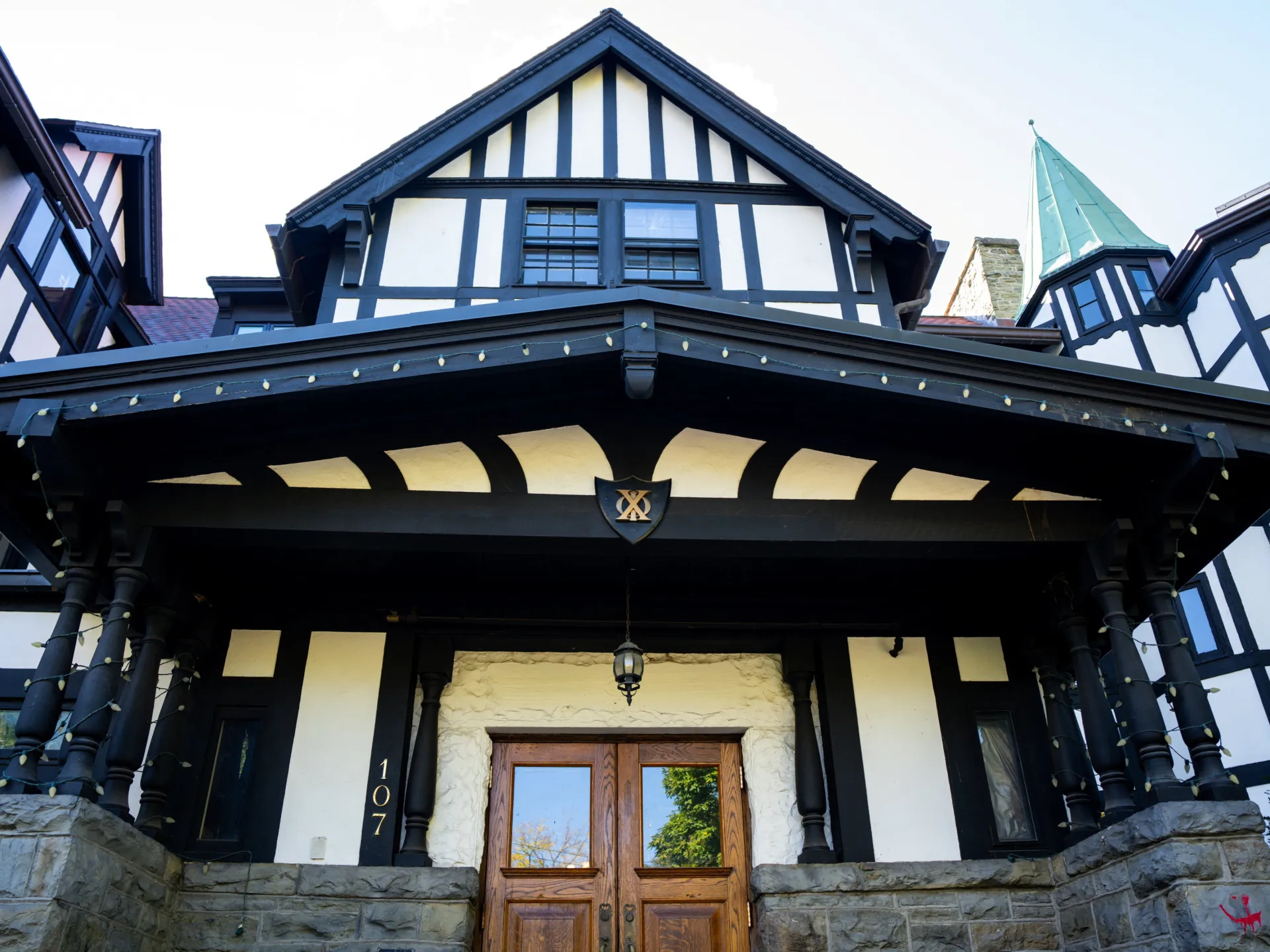
In September, an anonymous woman known as Jane Doe filed a civil lawsuit against the Chi Phi fraternity at Cornell University and seven of its members, accusing them of gang raping her during a party on the night of October 19, 2024.

Doe’s sorority, Delta Delta Delta, and Cornell itself are among the co-defendants.

Her lawsuit raises questions about fraternity and sorority culture at US schools, collectively known as “Greek life” for the groups’ use of Greek lettering and symbols.

Upon her admission to Cornell, Doe argues she encountered a “glorified – yet materially false and misleading – facade” for Greek life.

“She arrived on a campus where the University actively promoted Greek membership as a ‘vital’ part of the campus community and endorsed these organizations as well-managed, worthy pathways to new friendships and improving one’s educational and professional opportunities,” the lawsuit said.

The complaint accuses the fraternities of instead perpetuating a pattern of sexual assault and abuse.

What are fraternities?

Now a multibillion-dollar industry, fraternities in the US trace their origins to men-only clubs established at some of the country’s oldest universities.

The tradition began at the College of William and Mary in 1776, when Phi Beta Kappa was founded as a secret society for debate and scholarly exchange.

Its adoption of the Greek alphabet, oath of secrecy, and arcane membership rites helped establish a blueprint for future fraternities and sororities. Often with houses of their own, fraternities eventually grew into informal extensions of the campus residential system.

Historian Nicholas Syrett wrote about the origins of such groups in his book The Company He Keeps: A History of White College Fraternities.

In an interview with Al Jazeera, he explained that fraternities have long embraced so-called masculine ideals. But those ideals have changed from generation to generation.

In the past, fraternities sought to position themselves in “opposition to boyhood” by embracing “independence, strength of character, handsomeness and loyalty”, Syrett explained.

But their modern iteration has shifted to include a greater emphasis on “athleticism, sexual success with women, and recklessness” as well as alpha-male posturing.

Syrett argues that the fraternity system’s cult of toughness reflects a wider matrix of gendered expectations and social hierarchies.

Early fraternity men, Syrett says, prized intellect and academic distinction, provided neither betrayed too much effort. But “this has largely taken a backseat in contemporary fraternities”, he explained.

“When [men] are initiated, they are taught that loyalty to the brotherhood is of the utmost importance,” Syrett said of fraternities today. “This leads to the keeping of all kinds of secrets, including things that are against the rules and/or the law.”

A mark of elite status

In the two and a half centuries since the first fraternities were formed, Greek life has expanded to include different races and identities outside of white men.

Some Greek groups have even eschewed the traditional gender divide altogether to better embrace transgender and non-binary members.

But fraternities and sororities overall tend to act as “microcosms of the larger society”, according to Elizabeth Allan, a professor at the University of Maine and director of its Hazing Prevention Research Lab, “with race, pretty privilege and economic segregation helping shape the system”.

“The [social] stratification that we see in the larger society is going to be reflected, in large part, in many of these organisations, unless they’re actively working to disrupt it,” she added.

Between membership dues and rent at fraternity chapter houses, Greek organisations can price out all but the more affluent students, according to Allan.

“Pretty privilege” – the social bias in favour of those deemed conventionally attractive – can add to the pressure, with sorority applicants in particular shelling out hundreds, if not thousands, of dollars for cosmetic treatments and outfits.

Experts say the sense of exclusivity that many fraternities and sororities cultivate is a powerful draw for incoming students, who see membership as a path to upward social mobility.

That perception is reinforced by the groups’ internal dynamics. Many sororities and fraternities encourage networking among members.

A 2021 Gallup survey commissioned by the NIC and the National Panhellenic Conference found that 42 percent of fraternity or sorority alumni said a fellow member had helped them find an internship or job.

Meanwhile, 51 percent of Greek members reported having a job waiting at graduation or found employment within two months. The rate was much lower among those who were not members of such fraternities or sororities, at 36 percent.

How hazing shapes fraternities

Critics often point to hazing rituals in particular as shaping a culture of violence at some fraternities and sororities.

Hazing is a process through which prospective Greek life members undergo humiliating and sometimes perilous tasks to secure admission.

The phenomenon is prohibited by law in most US states, though the definitions, penalties and scope of such laws vary. The consequences, however, can be deadly.

One of the earliest recorded deaths associated with fraternity hazing took place at Cornell in 1873.

At the time, a group of “pledges” – would-be fraternity members – were blindfolded and led far from campus at night, with instructions to make their way back on their own.

In the dark, one of the pledges, Mortimer M Leggett, and two fraternity members stumbled over a cliff and plunged into the gorge of Six Mile Creek. The two fraternity members survived. Leggett, however, did not.

Secret initiation rituals can forge an “informal psychological social contract in which members feel obligated to protect the organisation”, according to Pietro Sasso, who studies college student experience at Old Dominion University.

Some members may feel the need to rally around the fraternity even when “doing so conflicts with their personal values or responsibilities to others”, Sasso added.

“My research on fraternity cultures suggests that organisational socialisation can normalise behaviours that individuals might otherwise question, making the environment itself an important part of prevention,” he explained.

Inside Doe’s lawsuit against Chi Phi

Doe’s case cites some of the social pressures and incentives that lead young men and women to Greek life on campus.

“She was drawn to the sorority and its promises of sisterhood and lifelong friendships, the status it conferred on its members, and the community it provided on campus when she was over 1,000 miles away from home,” the lawsuit said of Doe.

But Doe said she joined Cornell’s Greek community without being fully aware of the pattern of sexual assault associated with the local fraternities.

During Doe’s first semester, in 2022, there were at least five reported cases of victims at Cornell being drugged, and two alleged cases of sexual assault. All of those cases, according to her lawsuit, took place at fraternities.

Two years later, on the night of the alleged gang rape, Doe claims she was pressured by fraternity members to take drugs like ketamine, marijuana and alcohol. After agreeing to a threesome, she said she found herself in a “room full of predatory, fraternity men” who raped her while she was incapacitated.

A photo of a group chat included in her lawsuit shows one Chi Phi member informing his fellow fraternity brothers that there was “free pussy” in an upstairs alumni room. A member of the chat replies, “I f***ing love chi phi.” Another chimes in, “Like you can walk in and whip it out.”

Several of the men have denied any wrongdoing.

But the case has sparked questions about whether the culture of Greek life contributes to a high rate of sexual assault in fraternities and sororities.

One 2021 survey published by the American Psychological Association tracked male students from high school through their second year of college. It found that fraternity members were 62 percent more likely to report sexual aggression during their first two years of college.

Separately, a 2009 study published in the journal Violence Against Women estimated that 29 percent of sorority members reported suffering sexual assault during college, roughly four times the rate of non-members.

Reforming Greek life

After the alleged gang rape in 2024, Cornell’s Chi Phi chapter was closed, and the fraternity remains barred from campus. Two male defendants in Doe’s lawsuit were expelled, while another two were suspended.

But some student activists say too little is being done to reform Greek life in the wake of Doe’s case. They want stronger measures to enforce accountability within private, members-only groups where secrecy often reigns.

CJ Barles, a junior at the University of California, Davis, is one of the students across the US organising protests in support of Doe. She told Al Jazeera she understands the appeal of the fraternity and sorority systems.

“Affiliated students say it looks good on their resume,” Barles explained. “They see it as a built-in cult, a seat at the table and a crew to call their own.”

But Barles said she has heard troubling reports. Some fraternities, she explained, hold parties “requiring every man” to arrive with several women in tow. That requirement says “a lot about the culture some of these spaces cultivate”, she added.

At a rally last week, Barles and other protesters called on the University of California system to implement new measures to hold fraternities accountable for sexual assault, including enshrining students’ right to withdraw consent during sexual encounters.

But Barles said she left feeling dumbstruck by the accounts of sexual violence shared by women on campus, many of whom spoke from personal experience.

“It’s unbelievably upsetting, the amount of stories I heard,” said Barles. The litany of grievances has fanned her scepticism of the Greek system: “I wouldn’t step within a mile of most of them.”

Source link