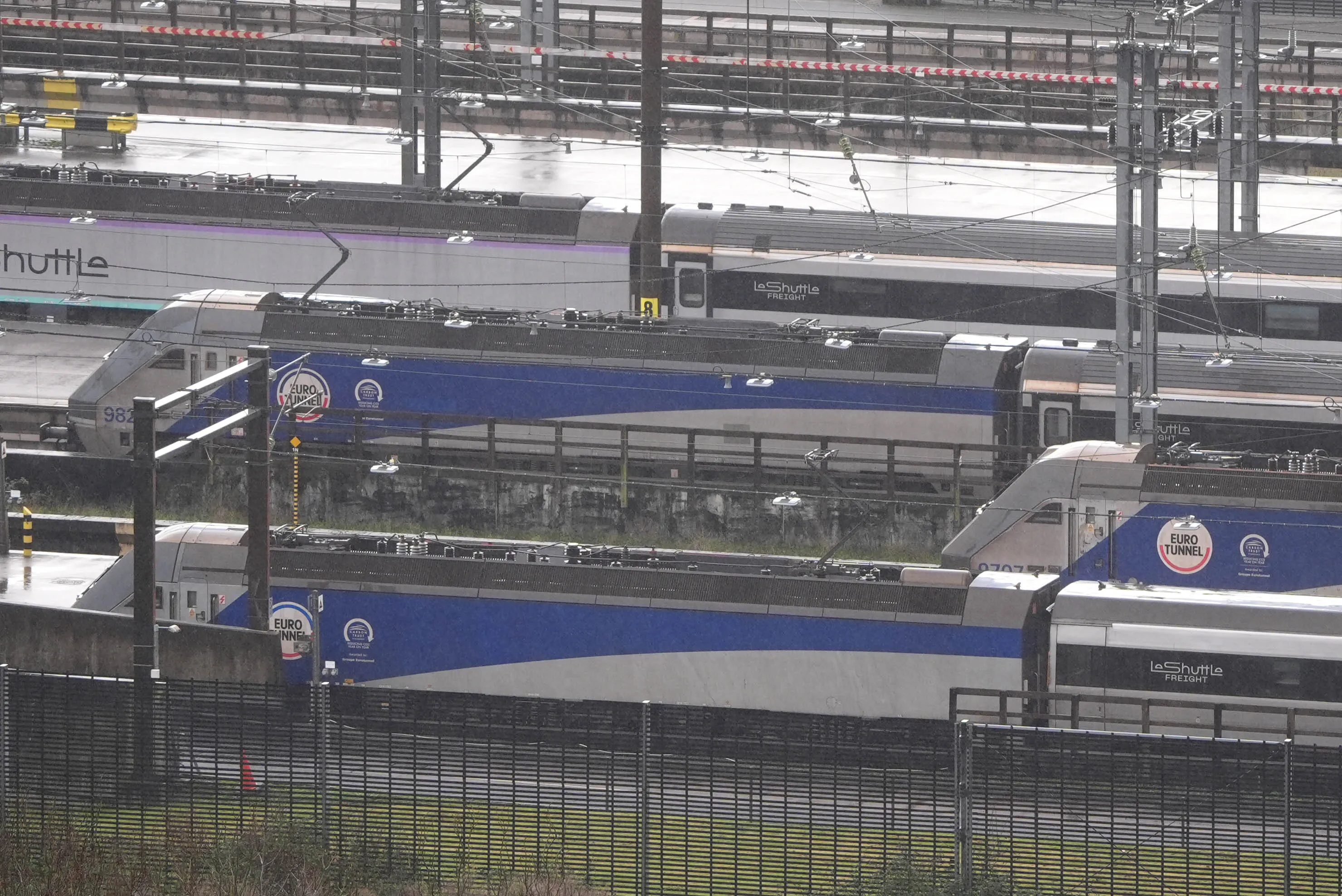
BRITS are facing huge queues and delayed trains after an operational issue has caused problems at the border.
Le Shuttle – previously called Eurotunnel Le Shuttle – has warned passengers not to arrive early in Folkestone for their train.
Passengers are being forced to wait hours for their trains due to ongoing Le Shuttle issuesCredit: PA
This is due to huge ongoing delays.
In a statement, they said: “Due to an operational issue, you may experience longer waiting times than usual.
Sign up for the Travel newsletter
Thank you!
“Please do not arrive more than two hours before your booked departure.”
The website warns of departure delays of approximately four hours from Folkestone to Calais, while the return Calais to Folkestone has delays of three hours.
However on the website, a 11:24am departure from Folkestone to Calais has now been scheduled for 4:45pm, with this having a knock on effect for the rest of the departures today.
The latest update on the website is for the 3:24pm departure which will now leave at 6:45pm.
A Calais to Folkestone train scheduled for 4:36pm is now set to depart at 7:51pm.
According to local media, one traveller said their train was delayed by 3.5 hours.
Another wrote on social media: “I am on my way to the terminal for a train at 8:24.
“You are running 4.5h late! How can I cancel my trip and get a full refund?”
A third said there were “hundreds of delayed people waiting to board”.
It isn’t clear what has caused the issue or when it will be fixed.
As dilemmas go, it’s an unusual one: saddle up a giant squid or board a submersible for a voyage to the bottom of the ocean. In the end, I find myself drawn to a fierce-looking merhorse and tentatively take the reins. High above, my daughter glides by on a flying fish, metallic fins flapping, while her Dad is battling stormy seas at the helm of a huge conch shell. A ride on the Carrousel des Mondes Marins (marine worlds carousel) – a three-storey steampunk merry-go-round inspired by Jules Verne’s novel Twenty Thousand Leagues Under the Sea – is one of the highlights of a visit to Nantes. A surreal fairground ride, a work of art and a homage to the city’s most famous son. It’s also a lot of fun.
On the banks of the Loire, 30 miles from the Atlantic ocean, Nantes is a city whose fortunes were built on the sea. As a young boy growing up near the docks in the 1830s, Verne dreamed of being a ship’s captain, but it wasn’t to be. Instead, he embarked on a series of journeys of the imagination, channelling his wanderlust into novels such as Around the World in 80 Days and Journey to the Centre of the Earth. The last of Nantes’ shipyards closed in the 1980s, but Verne’s unique vision provided the inspiration for a radical art and regeneration project, Les Machines de l’Île, that has breathed life into the abandoned quays and warehouses of the Île de Nantes, the river island that was home to the city’s docks.
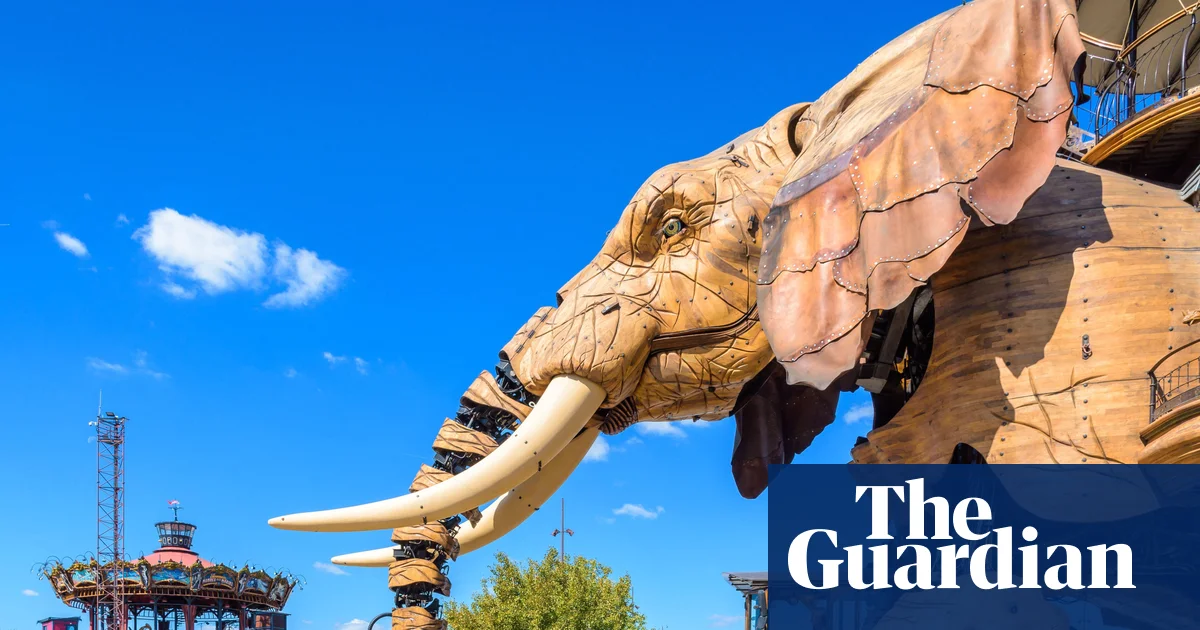
This is now the stomping ground of the Grand Éléphant, a 12m-high mechanical pachyderm that carries passengers on tours of the island, spraying bystanders with water from its trunk. I’d seen photos but nothing prepares you for the thrill of turning a corner and seeing the real thing lumbering towards you. You can learn about the magic behind the machinery at the nearby Galerie des Machines, where the creators bring a mechanical menagerie of strange creatures to life.
Théo Mercier’s ‘Fossil Opera’, one of the temporary art installations of Le Voyage à Nantes 2026 festival. Photograph: Martin Argyroglo
The Verne connection also inspired the name of the city’s summer arts festival, Le Voyage à Nantes, which transforms streets, parks and public spaces into an open-air art gallery from July to September. Our visit coincides with the festival’s opening weekend, and the squares and avenues of the elegant Graslin districtare busy with DJ sets, food stalls and people checking out the new artworks. In the Place Graslin, a beautiful square built – like much of Nantes – from chalky-white tuffeau stone from the Loire valley, some kind of cataclysmic eruption has been conjured up in front of the opera house. Huge ammonites appear to have been forced up from beneath the earth, engulfing cars in a mountain of rubble, their doors wide open, radios playing, as though abandoned in haste.
Just yards away, children are playing in the dancing water fountains of the square, while the white-aproned waiters of art nouveau brasserie La Cigale weave through the pavement tables delivering seafood platters to diners unfazed by the apocalyptic scene before them. Titled Fossil Opera, the artwork is a commentary on consumerism and the fleeting nature of human endeavour, and is one of about a dozen site-specific installations that have appeared in the city, as if by magic.
Even outside the summer months, there is plenty to discover in France’s sixth largest city. Each year, a handful of the festival installations are selected to become permanent fixtures, which has resulted in an impressive collection of contemporary public art, from Les Anneaux, a series of 18 giant steel rings on the Quai des Antilles, which frame views of the Loire and light up at night, to Tadashi Kawamata’s Belvédère de l’Hermitage, a viewing platform inspired by a swallow’s nest, which juts over a sheer cliff.
La Cigale, an art nouveau brasserie on Place Graslin. Photograph: Hemis/Alamy
All of these cultural highlights, old and new, are linked by the Ligne Verte, a 12-mile (20km) green line painted on the pavement. We follow the trail through the Passage Pommeraye, an exquisite 19th century glass-roofed shopping arcade; past the imposing Château des ducs de Bretagne, a moated 15th-century castle; stop off at the excellent Musée d’arts de Nantes, which houses an impressive collection of international art spanning seven centuries; and finish up at the peaceful Jardin des Plantes, a charming (and free) botanical garden which is home to a handful of modern art installations and a good cafe. From here it’s a short stroll to the Lieu Unique, a cultural space and concert venue in the factory that once produced the city’s beloved buttery LU biscuits.
And there’s more to come. The Jardin Extraordinaire is a newly created garden and climbing wall in a disused granite quarry in the Bas‑Chantenay district. The exotic planting, waterfall and paddling pools were inspired by descriptions in Verne’s novel, The Mysterious Island. The nearby Chantenay docks have been colonised by studios, music spaces and the Little Atlantique Brewery, housed in a 19th-century former oil mill. Opposite the quarry, a derelict industrial building is being transformed into a new riverside cultural hub, the Cité des Imaginaires, which will eventually provide a home for an expanded Jules Verne museum. It’s an ambitious project: creative, unconventional and looking to the future. I’m sure Jules Verne would approve. Joanne O’Connor
Winter’s Journey, a seasonal festival of concerts, temporary light installations, artworks and gastronomic events, runs from 21 November to 3 January.
Basel, Switzerland
Swimmers in the Rhine beside Basel Cathedral. Photograph: Hemis/Alamy
Unless you’re a professional who makes their way to the Art Basel fair every year, chances are Switzerland’s third largest city will have passed you by – or rather you will have passed it by. Basel is one stop before Zurich on the fast train from Paris, but to whiz through would be a mistake. For art and design lovers, it is the perfect city to explore on a long weekend.
Basel bills itself as “the city of art and culture on the Rhine”, and it lives up to its boast. Stroll around the charming old town and marvel at the cathedral before enjoying a cold beer at one of the many cafes. If temperatures soar, you might want to join local people with a dip in the Rhine.
Once you’ve done all that, you need to engage with the area’s art offerings. Within the city, the Kunstmuseum holds more than 300,000 works spanning eight centuries, with big hitters such as Monet, Van Gogh and Warhol, while Museum Tinguely is home to the work of the idiosyncratic Swiss sculptor Jean Tinguely and his dada-esque machines.
But the two real draws are on the outskirts of the city. Fondation Beyeler in the suburb of Riehen is home to an impressive collection of modern and contemporary art, and always has a blockbuster exhibition (currently Pierre Huyghe) to check out. A short bus or train ride across the German border in Weil am Rhein isthe Vitra Design Museum, home to one of the world’s largest permanent exhibitions of modern furniture design.
Miniatures of designer chairs at the Vitra Design Museum near Basel. Photograph: Sipa US/Alamy
Before you admire the furniture collection, take a walk around the campus, where you can marvel at the main museum building designed by Frank Gehry; the Vitra Schaudepot – which houses the furniture collection – designed by Herzog & de Meuron; Zaha Hadid’s former fire station; and Tadao Ando’s conference centre. There is a beautiful garden bythe Dutch designer Piet Oudolf, and the recently added Doshi Retreat for a moment of quiet reflection designed by theIndian architect Balkrishna Doshi, his first completed project outside India and the last he worked on before he died in 2023.
That’s half the day gone, so time to head inside. In lots of ways, exploring the Schaudepot is like walking through a giant doll’s house, with the rooms filled with instantly recognisable furniture icons from the 19th century to today, including works by Verner Panton, Le Corbusier, Alvar Aalto and Charles and Ray Eames. The museum also puts on temporary exhibitions. And if all of that has exhausted you, head to the VitraHaus Café, which serves a delicious lunch. Max Benato
The Volkshaus, a boutique hotel in the old town, has doubles from 152 swiss francs (£138) room-only
Lübeck, Germany
The ‘wonky’ Holsten Gate in Lübeck. Photograph: SW Travel Imagery/Alamy
Unless you’ve read Buddenbrooks, Thomas Mann’s epic family saga, you may not have heard of Lübeck. But in the middle ages, this port city in Germany, 70km north-east of Hamburg, was one of the richest and most powerful places on Earth. Today, despite the best efforts of the RAF to destroy it in 1942, it remains a beautifully intact medieval gem.
The old town is a Unesco world heritage site. It sits on an island in the centre of the city, encircled by the rivers Trave and Wakenitz, and the water is a good place to start exploring. My boyfriend and I hired an electric boat (€49 for up to six people) and spent an hour circumnavigating and gazing at its distinctive seven church spires.
Back on dry land, we set off on a guided walking tour, starting at the imposing – if wonky – Holsten Gate. We took in the five red brick churches the spires belong to (two have doubles), and climbed one of them, St Petri’s viewing tower, for a panoramic view. We also stopped at the 800-year-old town hall on the marketplace.
But just as fascinating was what lies behind the gothic splendour. At one time, there were 180 hidden alleyways and courtyards threaded through the old town, and about 80 remain. These labyrinthine lanes were built behind wealthy merchants’ mansions to house the poor. Today, the restored cottages are sought-after and the flower-filled, cobbled alleys are charming to explore.
To better understand Lübeck’s past, we visited the European Hansemuseum in the old castle monastery. It tells the story of the Hanseatic League, the powerful trade network that stretched from England to Russia and gave Lübeck (“the Queen of the League”) its wealth in the middle ages and its status as a free city state right up to 1937.
In a nearby palace, the Museum Behnhaus Drägerhaus displays 19th- and early 20th-century German and European art, including work by Edvard Munch, who visited Lübeck and painted its salt warehouses. Just round the corner is the Günter Grass-Haus, where the writer regularly stayed (he died in Lübeck in 2015).
Lübeck has three natural open-air swimming areas, one on the island. And the seaside isn’t far away – we had a day trip to Travemünde, a historic resort town with miles of sandy beach, taking a scenic river ferry there (90 minutes) and a 20-minute train back.
The old town of Lübeck is encircled by the rivers Trave and Wakenitz. Photograph: Acnakelsy/Getty Images/iStockphoto
In town, the medieval Schiffergesellschaft (Seafarers’ Guild) is now a traditional Hanseatic restaurant, with long communal tables. Alongside North Sea fish and Holstein meat dishes are vegetarian versions of labskaus, a sort of hash.
Sadly, we couldn’t visit Buddenbrookhaus, the museum dedicated to the novel, as it is being renovated. It is expected to reopen in 2030 – which gives you plenty of time to read Mann’s 864-page doorstopper. Like Lübeck itself, it is worth the effort. Rachel Dixon
Parma Cathedral and the octagonal baptistery. Photograph: Peter Adams/Getty Images
Parma is just far enough off Italy’s main travel routes to discourage the huge crowds of tourists that flood the likes of Venice and Florence. Most travellers reach this tranquil Italian gem by flying into Milan or Bologna, followed by an hour’s train ride. It is definitely worth that extra effort, as I discover a city that ticks every box for a weekend getaway: fabulous museums and frescoed churches without long queues or the need to book a timeslot in advance; friendly, affordable trattorie and osterie showcasing a feast of local food and wines; and, if you time it right, the chance to catch an opera composed by locally born Giuseppe Verdi in the intimate Teatro Regio.
The historic centre of Parma is small and easily explored on foot, taking me past an array of architectural masterpieces. I kick off at the grand Piazza Duomo, dominated by the imposing 900-year-old romanesque cathedral. Everyone’s eyes are drawn up to the ornate cupola, decorated with a captivating illusionist fresco by local Renaissance artist Antonio da Correggio. Next to the cathedral stands the early gothic Battistero, an octagonal baptistery whose bare, minimalist exterior contrasts with an incredible explosion of colours from the 13th- and 14th-century paintings that cover the interior. Then, tucked away behind the Duomo, I come upon the entrance of the medieval Monastero di San Giovanni Evangelista, whose cloisters and garden are a peaceful oasis. Entry to the monastery and cathedral is free.
Parma’s big must-see is the monumental Palazzo della Pilotta, a baroque complex of palatial museums, a library and remarkable 400-year-old theatre, all included in a single €18 entry ticket. Just by the Parma river that slices the city into two, the palazzo was built by the Farnese family, whose patronage created most of the city’s Renaissance monuments. The Teatro Farnese, made almost entirely of wood, is rarely used as a venue today, but a visit remains an incredible experience. I leave most sightseeing time, though, for the Pilotta’s landmark Galleria Nazionale di Parma, a treasure trove of old master paintings. It may not quite rival the collection of the Uffizi, but I enjoy the chance to just turn up without booking in advance and quietly appreciate works by Leonardo da Vinci, Fra Angelico, Canaletto and Tintoretto without being surrounded by crowds.
Antonio Correggio’s Assunzione della Virgine in the cupola of Parma’s Duomo. Photograph: Gordon Sinclair/Alamy
Sightseeing is only part of Parma’s attraction, however, as this is one of Italy’s food capitals. I walk into the rustic, raucous OsteMagno bar, where everyone is tucking into tagliere – wooden boards piled with razor-thin slices of cured ham, the famous prosciutto crudo di Parma, artisan salami and crumbly aged parmigiano reggiano cheese, accompanied by a glass of the local’s favourite tipple, fizzy red Lambrusco wine, which is a lot more drinkable than I expect.
This is not a city to seek out chic, gourmet restaurants, but rather one of the many traditional trattorie such as Da Antonia, whose eponymous owner has overseen the cucina for more than 50 years, or the 120-year-old Trattoria Corrieri, serving up generous plates of homemade pasta for less than €15. John Brunton
El Sardinero beach, Santander. Photograph: Miguel Moya/Alamy
Often dismissed as little more than a ferry terminal – somewhere to stop overnight if you want to take your dog to Europe or lower your carbon footprint – the port city of Santander is undergoing something of a cultural renaissance. It’s already blessed with a spectacular bay facing the Cantabrian mountains, wide sandy beaches, grand, colonnaded plazas and superb food, but the opening of new art spaces and museums in the coming months will put the Cantabrian capital firmly on the weekend-break map.
Leading the way on 8 September is Faro Santander – a new cultural centre in a grand historical building housing a 1,000-piece art collection belonging to Banco Santander, including works by Velázquez, Goya, Titian, Rubens and Picasso. Different parts of the collection will be shown at different times.
With its ornate white facade facing the bay, the Pereda building was previously the bank’s headquarters, but has been transformed into a striking, 21st-century museum space by Pritzker prize-winning British architect David Chipperfield.
Santander’s moment in the spotlight will extend into 2027 when Madrid’s Reina Sofia Museum opens its first outpost, set in a similarly grand neo-Renaissance building just a few metres away from Faro Santander. The museum will house the Archivo Lafuente, with paintings, sculptures and manuscripts, including major collections on dadaism and the Spanish civil war, as well as art from Spain, North America and Latin America.
Faro Santander and Archivo Lafuente will form two points on a kind of “art triangle”, along with architect Renzo Piano’s 2017 Centro Botín contemporary art centre just over the road. With a bijou but impressive permanent collection, including works by Matisse, Juan Gris, Joaquín Sorolla and Mark Rothko, the Centro Botín sits on the waterfront like a giant, stilt-mounted, 60s alarm clock sawn in half.
Renzo Piano’s Centro Botin. Photograph: Nick Hatton/Alamy
Spaniards cottoned on to Santander’s charms long ago, and the seafront is lined with elegant fin-de-siècle villas built when well-heeled Madrileños discovered that the city’s Atlantic breezes were the perfect respite from the Spanish capital’s infernal summer. More than 100 years later, while Britain was experiencing its own heatwave, I followed their lead. Temperatures were in the balmy high 20s as I ambled past toddlers building sand castles and teenagers frolicking in the surf on El Sardinero beach, just 15 minutes by bus from the city centre.
The centre itself is wonderfully walkable and there’s an unhurried, laid-back vibe in the streets, grand plazasand narrow alleys near the gothic cathedral, lined with bars serving pinchos – the Cantabrian equivalent to tapas.
After tucking into tender, grilled squid, laced with gutsy garlic and olive oil, at Mesón Rampalay on a leafy square, I spent a fascinating couple of hours at Mupac – the Museum of Prehistory and Archaeology of Cantabria, just a few minutes’ walk away from Faro Santander.
The museum, which is home to one of Spain’s most important prehistoric collections, features excellent interactive displays, and in 2027 it is moving to a brand new, multimillion-euro building. By next year, it seems, Santander will be not just the capital of Cantabria, but a capital of culture too. Eddi Fiegel
The trip was provided by Faro Santander. Abba Santander, near the Centro Botín,has stylish doubles from €66 room-only
A spokesperson for the airport said: “The longer queues at passport control on Tuesday afternoon were caused by an extraordinary operational issue and were not related to the EES system.
“On Tuesday afternoon, an unfortunate water leak occurred in a server room connected to the passport control area in Pier E, one of the airport’s two passport control facilities.
“As a result, all passengers had to pass through passport control in Pier C for the remainder of the day.
“When half of the available passport control capacity is taken out of operation, longer waiting times are unfortunately unavoidable.
It followed a water leak at the airportCredit: Alamy
“We sincerely apologise for the inconvenience this caused our passengers.”
Sun Travel has contacted Ryanair for comment.
This is the latest in a number of incidents of passengers missing their flights in Europe recently.
However, other cases have been caused by long queues at airports due to EES.
For example, back in April, about 100 passengers were left stranded at Milan Linate Airport after their easyJet flight to Manchester left without them.
It doesn’t surprise me – having recently visited, we had a fantastic family day out in the forest.
Sign up for the Travel newsletter
Thank you!
We were pedalling, paddling and playing in the dappled light beneath the trees in this woodland of wonder, with paths winding here, there and everywhere and something new to discover in every nook and cranny.
It’s green by name and green by nature here, with a rollercoaster powered by people and the UKs first solar-powered water ride among the eco attractions.
As you arrive, you’re getting a cawr-some glimpse of what’s to come, with a quirky metal giant (cawr in Welsh) greeting you on the path to the ticket office.
It was lovely to hear youngsters chatting away in Welsh and switching between their two native languages with ease.
Despite the gaggles of youngsters, we never had to queue for long for any of the attractions and, because of the clever layout, it felt bustling but not overcrowded.
GreenWood is firmly rooted in its surroundings, with bilingual signage, nods to local legends and a fantastic use of the forest landscape, from a river course low down where water pools to playframes and rides capitalising on slopes and gravity.
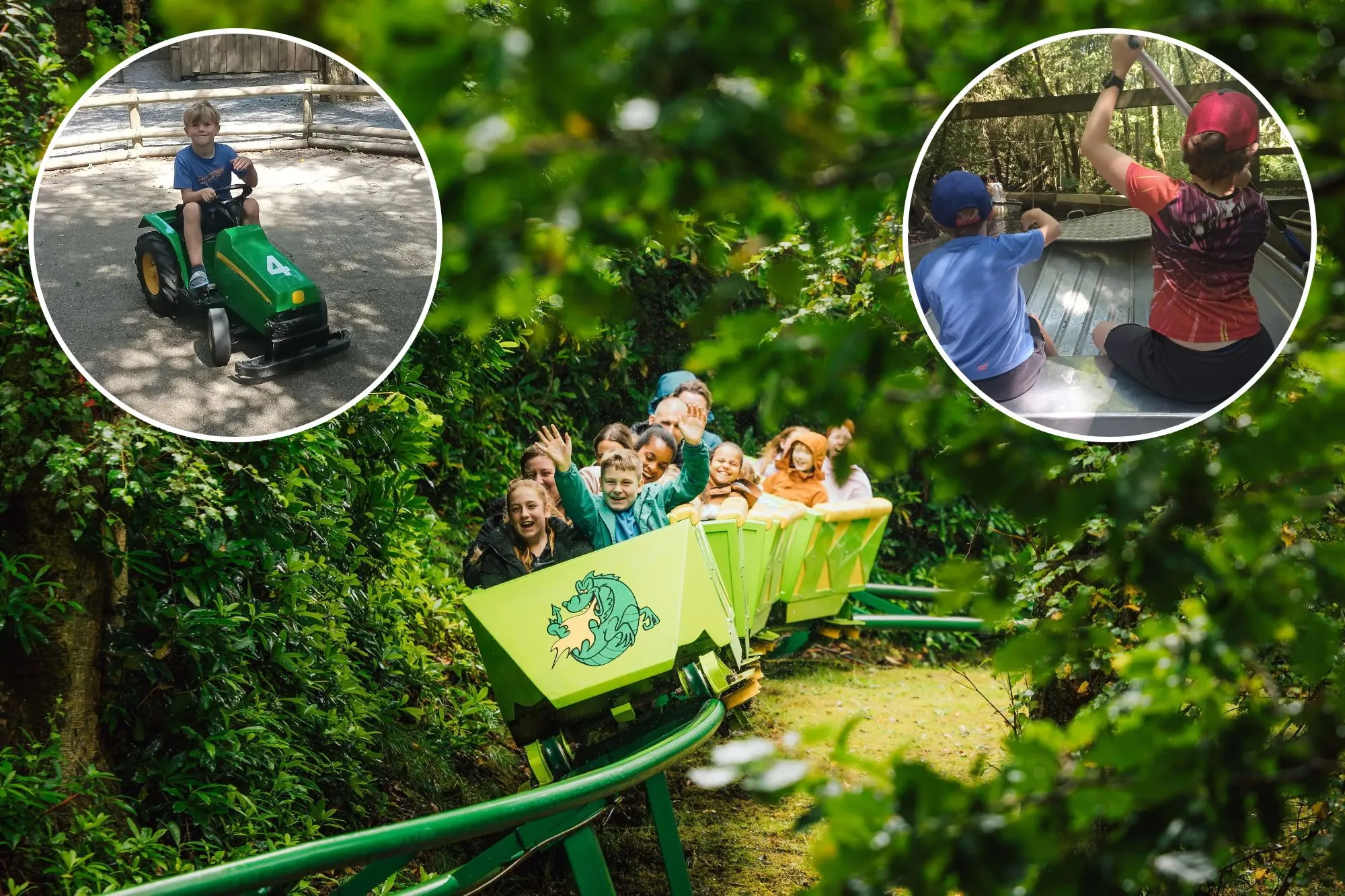
That’s how the Green Dragon rollercoaster works – you climb up a gentle hill to enter a funincular carriage next to the start point of the rollercoaster.
As the funicular then descends full of passengers, its weight hoists the empty rollercoaster back up to the top of its track.
There’s also plenty of play areas for little ones to let off steam – my favourite was the Giant’s Quest, set in one corner of the woodlandCredit: Greenwood Family ParkThere’s loads of attractions here that are entirely people-poweredCredit: SWNSMy boys loved the moon karts, with double and single seaters to pedal around a trackCredit: Catherine Lofthouse – The SunThe Green Dragon rollercoaster is one of the best rides at Greenwood Forest ParkCredit: SWNS
Then the funicular passengers exit at the bottom of the slope, use a second path to get back up to the top, climb into the rollercoaster and whizz through the trees at speed. It’s an incredibly clever design – fun and physics combined!
There’s loads of attractions here that are entirely people-powered.
My boys loved the moon karts, with double and single seaters to pedal around a track.
The Enchanted River Ride is great for all the family as you hop into a flat-bottomed boat to paddle around a course, with dangling ropes to grab along the way for extra propulsion if needed.
The Forest Glider is a 75m snow tubing slope where riders carry their own ring up to the top to set off.
Meanwhile the Solar Splash uses the sun’s energy to power its water chutes, with riders setting off from a 12m tower with views over Snowdonia.
There’s also plenty of play areas for little ones to let off steam – my favourite was the Giant’s Quest, set in one corner of the woodland.
The boys also loved the jumping pillow and the chance to have a go at archery, under the watchful eye of an expert instructor.
It was lovely to hear youngsters chatting away in Welsh and switching between their two native languagesCredit: Catherine Lofthouse – The SunDay tickets start from £21.50 for adults (or anyone over 1m) while anyone under £1m pays from £8.65Credit: Catherine Lofthouse – The Sun
We grabbed a bite to eat in the oak-framed WoodBarn cafe, which has a large soft play extending up into its eaves and lots of natural light streaming in through its skylights.
Kids’ meals even have £1 off over the summer, so staples like sausage and chips plus a juice carton are less than £7.
Day tickets start from £21.50 for adults (or anyone over 1m) while anyone under £1m pays from £8.65.
If you’re heading from further afield and want a couple of days at the park, there’s a glamping site with tipis that can accommodate up to six people, with unlimited park access and a communal kitchen to make meals.
Overnight stays for a family of four during the summer holidays cost from £220 midweek and £260 at weekends.
Park entry this summer is £84.85 for a family of four.
You’ll certainly want to take your clan to GreenWood – I can’t wait to return and check out what the new owners do with this woodland wonder, with the promise of new rides, attractions, play experiences and guest facilities on the cards.
This may help reduce a lot of travel stress – especially for families
Many passengers may not know this(Image: Getty)
Some airports across the UK offer perks to passengers to make the start of their trip less stressful – but they often come at an extra cost.
With holidays already expensive, many people skip the add-ons. However, not everyone realises that travellers at London Luton Airport (LLA) can pre-book a security time slot and potentially avoid the worst of the queues for free.
The Airport explains that this option is called “Prebook Security”. It boasts that this is a “FREE service that allows you to skip the security queues by reserving a 30-minute slot ahead of your arrival.”
The service is currently only available to passengers arriving at security between 3am and 3pm. Travellers can book a 30-minute security slot in advance, then on the day follow the “Prebook Security” signs to the dedicated entry point, where a staff member will be on hand to help.
Airport officials further explain: “You can pre-book this service from 4 days before your arrival, right up until 60 minutes before you arrive at security (subject to availability). Booking this service is completely free, does not require any login or registration and is available to all guests.”
Prebook Security is first-come, first-served. You’ll go through the usual checks and will be processed in the order you arrive, along with other pre-booked passengers. If you use Prebook Security, LLA says they cannot guarantee how long it will take to complete security checks through the Airport Security area.
How does Prebook Security work?
Book your appointment slot up to 4 days before your travel date.
On arrival at the airport, make your way to the security area and scan your boarding card at one of the signposted “Prebook Security” gates.
Upon entry to the security area, head to the left where you’ll find signs for “Prebook Security”. A member of our security team will be waiting to welcome you and scan your QR code.
You will then be directed to the front of the line.
Children aged four and under don’t need to be included in your group size. Children aged five and over must be included when booking.
To change or cancel your Prebook Security booking, use the “change” or “cancel” option on your booking confirmation page. You can also do this via the links in your confirmation email.
What information is required to pre-book security?
There’s no need to create an account or log in. Passengers should enter their departure date and flight details (destination, airline and flight number), plus group size. People should also provide a name and email address to receive a confirmation email containing a QR code.
If you need to check-in bags, ensure you allow plenty of time for this. The Airport stresses: “Slots are limited and may book up fast, so we recommend booking up to 4 days before your flight.”
If you are late for your appointment, don’t panic too much. The Airport reassures passengers: “Please make sure to arrive 15 minutes before or after your booking time, the QR code will still be valid.”