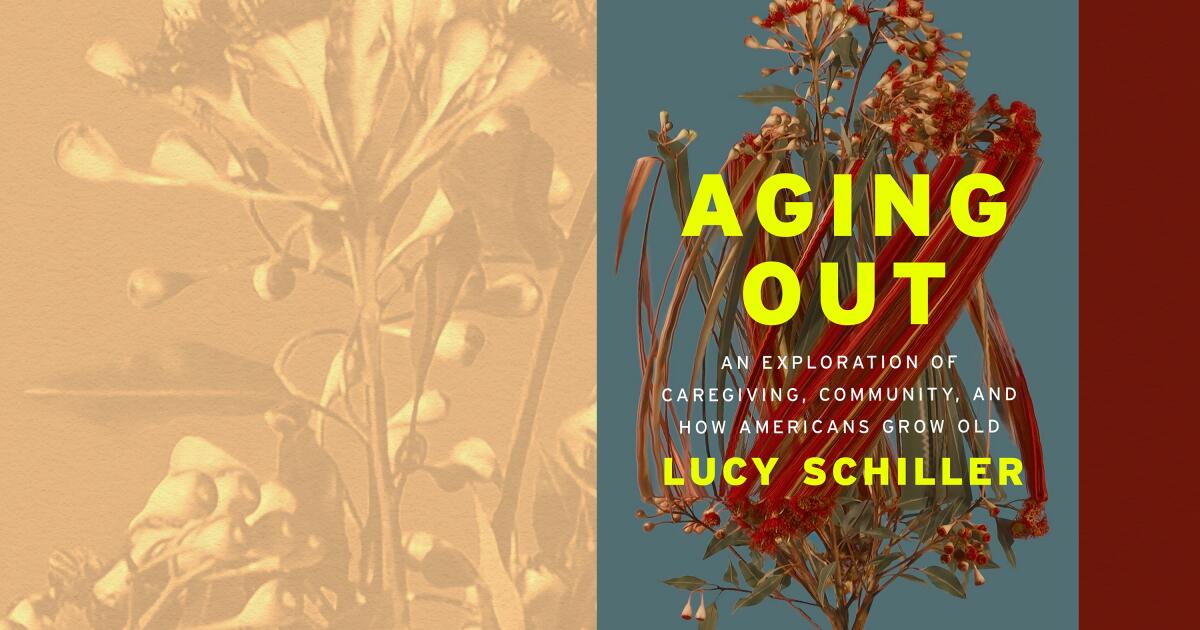
Lucy Schiller ‘Aging Out’ review: A millennial caregiver examines aging in America
Freelance writer and editor Lucy Schiller bumped up against the issues of aging, eldercare and loneliness through her grandmothers. When the family pulled her maternal grandmother, Mary Ann, from assisted living during the pandemic, Schiller became her primary caregiver. Her paternal grandmother, Anita, was less fortunate; she contracted COVID-19 from a home healthcare aide and died in a hospital.
Book Review
Aging Out: An Exploration of Caregiving, Community, and How Americans Grow Old
By Lucy Schiller
Flatiron Books: 272 pages, $30
If you buy books linked on our site, The Times may earn a commission from Bookshop.org, whose fees support independent bookstores.
As she relates in “Aging Out,” the shock of Anita’s death was a factor in Schiller’s abrupt relocation from a central New York college town to Pittsburgh, where she knew no one. Schiller calls the move “a half-desperate plan to simply change the background scenery of my life for the millionth time.”
While grieving, scrambling to make a living, taking long walks with her dog and wrestling with her chosen solitude, Schiller embarks on a quest to understand the institutions and attitudes that shape old age in America. “What was the relationship between personal fear of oldness and the ways in which oldness was structured in society?” she asks.
The resulting book, a deliberately meandering account of her Steel City sojourn, weds memoir, travelogue, philosophical rumination and journalistic investigation. Schiller, an MFA graduate of the University of Iowa and now an assistant professor of nonfiction at Texas Tech University, is a fluid writer. But most of what she covers is well-trod ground.
It’s worth asking whom she envisions as her audience. Most older readers know this territory; younger ones have other, more pressing concerns, including how to afford life in the here-and-now.
Perhaps Schiller, a millennial in her 30s, hopes they will identify with her personal struggles. But her loneliness seems largely self-imposed, perhaps compounded by what she describes as “a severe strain” of obsessive-compulsive disorder. “It turns out, laughably, that an interest in privacy, and staying quiet about internal feelings, are hallmarks of this condition,” she writes, offering a partial explanation for her wariness of company.
Pondering the American way of aging, Schiller initially adopts a posture of ignorance and naivete so extreme that it seems like a pose. She puzzles out the distinctions among nursing homes, assisted living facilities and continuing care retirement communities, as well as home healthcare. And she underlines the fact that, when it comes to long-term care in the United States, only the relatively well-off have good choices. This isn’t exactly news.
Another Schiller inquiry involves the familiar complexities of Medicare. She notes that, as a public program for seniors, it is so inadequate that it requires private options, such as Medigap and Medicare Advantage, to paper over coverage gaps. Picking the best plan for one’s needs can be a daunting option, requiring trained help or careful study. Schiller attends an informational seminar by a broker for Medicare Advantage plans and decides, unhelpfully, that they are neither “a solution or a problem.”
Schiller’s reporting methods rely, to some extent, on serendipity. “I tended toward … a kind of diffuse sallying through the world, staying open to the coincidence, digression, and movement,” she writes. She calls the method “antinarrative.”
All that sallying takes her down some unexpected byways. She returns to a western Pennsylvania town called Harmony, where she once had “a horrible, endless date over crepes,” to investigate a strike over pay and working conditions at a troubled nursing home. That leads to a long discussion of the use of restraints on the elderly.
At one point, Schiller finds a company called Papa that employs younger “Pals” to assist older adults. With the backing of health insurance companies, the Pals provide companionship, transportation, housecleaning services and more. Schiller tries something similar as a volunteer for a health insurance company, reaching out to an elderly Black woman by phone. They stumble over time into an unlikely friendship.
One problem with all these efforts to mitigate old-age loneliness, Schiller notes, is that the loneliest generation is actually Gen Z. And the loneliness surveys themselves, she suggests, may be suspect.
Schiller delves, inevitably, into the history of AARP, an organization that even in its earliest days was entangled with the health insurance industry. And consumer advocate Ralph Nader, for whom she does some editing work, tips her to the story of activist Maggie Kuhn, founder of the Gray Panthers.
Kuhn, Schiller writes, understood “the tension between the social so-called nothingness of old age and its vibrant realities.” Which brings Schiller to the intersection of aging and disability, and to Programs for All-Inclusive Care for the Elderly (PACE), which provide community-based care as an alternative to nursing homes.
In the end, Schiller has a go at parsing her own motivations. “I had descended into the strange subterranean structures of aging, almost as a way to avoid the contemporary world … ,” she writes. “Age … was a helpful distancing tool: older people’s vulnerabilities, including those of my own grandparents, helped to distract me from my own present and future. … I still did not know how to seal over the gaping wound of the pandemic, how to move forward.”
For all her verbiage, she can find no easy fix, nor even a complicated one. “It was not possible for me to imagine a solution to the level of fragmentation, pain, and dysfunction I saw,” she writes, leaving readers without much justification for having followed her rambling, idiosyncratic quest.
Klein, a cultural reporter and critic in Philadelphia, has been a three-time finalist for the National Book Critics Circle’s Nona Balakian Citation for Excellence in Reviewing.