Iranian attacks on the Gulf countries draw condemnation from across the region.
Published On 18 Nov 202618 Nov 2026
Iran has launched new attacks on its Gulf neighbours, targeting an airbase used by the United States military in Kuwait and carrying out several attacks on Bahrain after the US bombed Iran’s Qeshm Island.
Kuwait said it activated its air defences to counter drone strikes – the first since early September – and Bahrain said it fended off an Iranian attack early on Wednesday, a day after the US attacked a missile launch site on Qeshm Island in the Strait of Hormuz.
Bahrain, which hosts the US Navy’s 5th Fleet, has experienced four Iranian attacks in six days, ending a weeks-long respite in the war that started with US-Israeli strikes on Iran on February 28.
Iran said its recent attacks were in response to US drone surveillance operations and an attack on Iranian communications towers.
The uptick in fighting raises the risk of a wider escalation towards the resumption of all-out conflict nearly nine months into the war, and complicates negotiations for a diplomatic solution, which have stagnated despite intensified mediation efforts from Qatar.
A municipal employee stands next to military drones on display at Baharestan Square in Tehran on September 28, 2026 [Atta Kenare/AFP]
Gulf and Arab condemnation
The Iranian attacks on the Gulf countries have drawn condemnation from across the region.
Saudi Arabia’s Ministry of Foreign Affairs condemned the Iranian attacks on Kuwait and Bahrain “in the strongest terms” and denounced an attack on a tanker belonging to the United Arab Emirates.
The ministry said the kingdom rejects Iran’s disruption of shipping routes and urged a negotiated solution.
Arab League chief Nabil Fahmy said the repeated attacks on Arab countries reveal “a continuous escalation pattern that threatens to widen the circle of confrontation”. He also condemned the targeting of a ship belonging to the UAE’s national oil company, ADNOC, as it crossed the Strait of Hormuz.
Jasem Mohamed Albudaiwi, the Gulf Cooperation Council’s secretary-general, held Iran “responsible for this escalation and its repercussions on regional security”.
Qatar’s Foreign Ministry called the attacks “a dangerous escalation” that risks undermining diplomatic efforts. Kuwait and the UAE also condemned them.
Kuwait’s Foreign Ministry described the drone attacks as flagrant violations of its sovereignty and a direct threat to its security, Al Jazeera’s Zein Basravi reported from Doha.
Basravi also said Qatar’s Foreign Ministry spokesman, Majed al-Ansari, warned that continued escalation without restraint from both the US and Iran makes a negotiated solution, or even continued dialogue, harder.
Meanwhile, Iran’s army chief, Major-General Amir Hatami, said the armed forces were “monitoring the enemy’s movements” after a third US aircraft carrier arrived in the Middle East, the Fars news agency reported.
He said Iran’s response to any misstep by the US and its “backers” would be “even more crushing”.
Kuwait’s army has said the Gulf country is under attack by drones while the United States and Iran traded blows, marking escalating tensions in the region as a peace deal remains elusive.
The military said in a statement on X on Tuesday that “any explosion sounds heard are the result of air defence systems intercepting hostile attacks”.
Recommended Stories
list of 3 itemsend of list
The US earlier carried out several attacks on Iran’s southern island of Qeshm, in the Strait of Hormuz, hours after Iran said it launched a drone attack on a US radar system in Bahrain.
“The American attack on locations on Qeshm island caused no damage to residential, commercial, or infrastructural areas,” Ahmad Nafisi, deputy governor of Iran’s southern Hormozgan province, told the official IRNA news agency on Tuesday.
He said the situation was under control and relief agencies were on full alert. IRNA reported five to six explosions on the island on Tuesday evening.
A US official told Al Jazeera the strike hit a missile launch site on Qeshm, in response to Iran’s earlier attack on a US base in Bahrain.
US Central Command said Iranian drones aimed at a US radar system at an air base in Bahrain “were intercepted without any damage to US equipment or personnel”.
Bahrain attack
Iran’s Islamic Revolutionary Guard Corps said it carried out a “precision operation” with drones on the US-operated radar at the Sheikh Isa air base, in response to “repeated violations of Iranian airspace by US military drones”.
Bahrain, which hosts the US Navy’s Fifth Fleet, said its air defences intercepted the attack, and blasts were heard over the capital, Manama, according to the AFP news agency.
It was the third Iranian drone attack on Bahrain in five days after a lull of several weeks. Friday’s strike was the first Iranian attack on a Gulf country since early September, AFP reported. Reuters said it came after a Bahraini court sentenced 64 people, mostly Shia clerics, to life in prison for allegedly colluding with Iran.
Kuwait’s armed forces said on Tuesday night that its air defences were responding to “hostile drone attacks” and urged the public to follow safety instructions.
It did not say where the drones came from or whether there were casualties or damage.
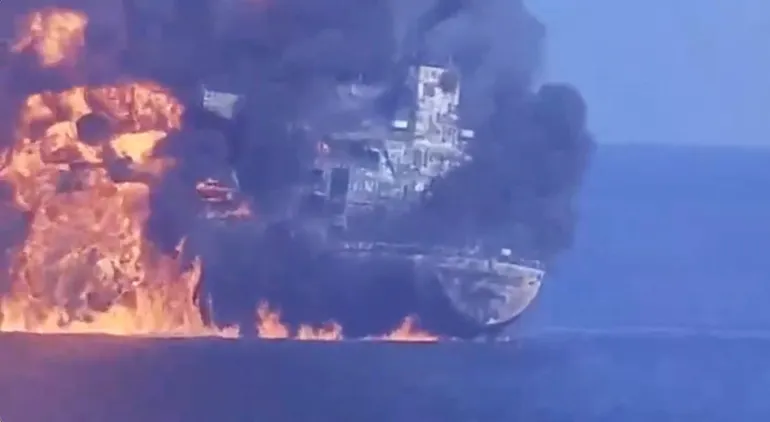
A still image from a social media video released on Tuesday shows a tanker on fire in the Strait of Hormuz, off the coast of Oman [Social media via Reuters]
Tankers hit in Hormuz
Iran’s armed forces said three oil tankers struck naval mines while trying to cross the strait on Tuesday. The US military says it cleared the main routes of mines.
Since the war began on February 28, Iran has tried to restrict traffic through the strait, which normally carries about a fifth of the world’s oil, insisting that ships use only routes it has authorised. The US has responded with a naval blockade of Iranian ports and has escorted tankers.
Another tanker, the Panamanian-flagged Tara Gas, was struck on Monday about seven nautical miles north of Khasab, in Oman, causing a fire in its engine room, according to the security firm Vanguard.
Vanguard and India’s ports minister initially said all 25 crew, 24 of them Indian, were safe. But the United Kingdom Maritime Trade Operations agency said the vessel was hit a second time and the crew were “currently unaccounted for”. India’s ports minister later said the crew had abandoned the vessel after a second attack and that one Indian sailor was missing. Another Panamanian-flagged tanker, the On Phoenix, was hit by an unidentified projectile off Oman’s coast on Monday.
Ongoing diplomacy
Iran’s foreign minister, Abbas Araghchi, and his Omani counterpart, Badr Albusaidi, discussed safeguarding shipping and diplomatic options in Muscat, Oman’s news agencies said.
A third US aircraft carrier, the USS Theodore Roosevelt, arrived in the Middle East on Monday, and US President Donald Trump is due to hold a three-way summit on Thursday in China with Chinese President Xi Jinping and Russian President Vladimir Putin, where the Iran war is on the agenda.
Amid growing concerns about renewed attacks on Iran following Tuesday’s midterm elections in the United States, US forces have struck Iran’s Qeshm Island in what officials have reportedly described as a defensive measure.
In the first attack since June on Qeshm Island, which serves as the primary platform for Iran’s “asymmetric” naval power, according to analysts, the US strikes come as both sides continue to adopt military and diplomatic postures.
Recommended Stories
list of 3 itemsend of list
Mediation efforts led by Qatar are continuing in a bid to avert a return to all-out war, which began on February 28 when the US and Israel launched strikes across Iran, triggering the closure of the critical Strait of Hormuz, surging oil and gas prices and massive damage to military, civil and energy facilities around the Gulf.
Here’s what we know:
What happened in the attack on Qeshm Island?
Several explosions were heard on Qeshm Island late on Monday, as US media reported that the US military had carried out what officials called “defensive strikes” in the Strait of Hormuz.
The blasts came in rapid succession, according to Iran’s state-owned IRNA news agency. Witnesses told the agency they saw two planes flying over the island, located off Iran’s southern coast along the waterway.
According to The Wall Street Journal, which quoted an unnamed official, the strikes on Monday night appeared limited and were not a resumption of a major operation.
The Associated Press news agency also quoted an unnamed US official as saying Washington had conducted the defensive strikes against “Iranians using surface-to-air missiles against US assets”.
The attack came after IRNA reported that the Iranian Revolutionary Guard Corps (IRGC) had destroyed a US MQ-9 drone east of the Strait of Hormuz.
The US first struck a critical desalination plant on Qeshm Island on March 7 – one week into the war. The strike, which Tehran branded a “flagrant crime” against civilians, cut off freshwater supplies to 30 surrounding villages.
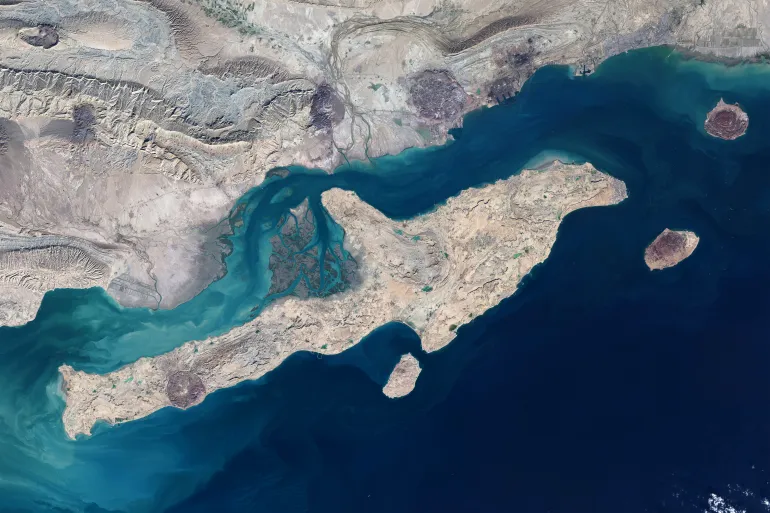
A satellite view of Qeshm Island, Hormozgan Province, Iran, within the Strait of Hormuz region on January 17, 2026 [Gallo Images/Orbital Horizon/Copernicus Sentinel Data 2026]
But isn’t diplomacy ongoing?
It is, but it is fragile, and mixed messages are coming from both sides.
Qatari mediators have been engaged in indirect talks with Iranian officials in recent days. They have passed messages between the two sides, but the talks appeared to come to an end on Monday with no news of a breakthrough.
An official briefed on the talks told the Reuters news agency that Iran’s delegation had departed from Doha on Sunday, but that a draft proposal was still being circulated, without elaborating on the content.
Qatari mediators travelled to Tehran on Monday night for talks with Iranian Foreign Minister Abbas Araghchi regarding a version of a draft US-Iran deal which has been under negotiation for the past eight days, an official told Reuters.
Araghchi told IRNA on Monday: “Consultations through mediators are very intensive. We have presented our conditions and proposals, and everything depends on the political rationality of Washington.”
Ministry spokesperson Esmaeil Baghaei also told a news conference on Monday that the “ball” was in the US’s court as Iran’s demands were “clear and logical”.
He said the plan Iran submitted in September to end the war remained the focus of talks, but that the proposal could be shortened and implemented in “two days”, including reopening the Strait of Hormuz and returning to talks about Iran’s nuclear programme.
On Monday, Iranian President Masoud Pezeshkian also said Supreme Leader Ayatollah Mojtaba Khamenei had given the government “certain authorities” over talks with the US, local media reported.
The president added that Tehran would look to resolve the conflict through dialogue.
Khamenei’s apparent approval of diplomacy marks a change since the breakdown of the June memorandum of understanding, which allowed a brief ceasefire and peace negotiations, when the supreme leader said the US could not be trusted.
For the US side, Vice President JD Vance also told reporters on Monday that he was hopeful for a diplomatic solution – just hours before the strikes on Qeshm Island.
“The president and I both feel pretty good about the prospects for potentially coming to a negotiated settlement,” Vance said. “We’ve certainly made some progress. We’ll see if we can make some more.”
Parliament Speaker Mohammad Bagher Ghalibaf reiterated on Tuesday that Iran’s response to any US “miscalculation”, such as launching strikes, would be unpredictable.
“The enemy seeks to force the Iranian nation into submission through threats and military action, but they are sorely mistaken; Iran will not submit,” he said.
What has Trump said about diplomacy?
Oil prices dropped by more than 7 percent on Monday. In response, Trump wrote on his Truth Social account that people believe the war with Iran will not resume as mediation efforts continue.
“Iran wants a settlement, as soon as possible. It could happen!” Trump wrote.
He told media at the Lincoln Memorial Reflecting Pool in Washington, DC, that it looked like efforts were “coming together very nicely”.
“That’s why I guess the oil prices dropped. People found out about it.”
However, Trump also told the US media outlet Axios before his post on Truth Social that he was “in no rush” to decide whether to resume strikes on Iran.
“One way or the other, we will do something, but there is no rush. We crippled them financially. They have no money, no gasoline, and their people are getting very tired of it,” Trump told Axios in an interview.
What happens next?
The US midterm elections are being viewed as the inflexion point for Trump’s decision on what path he takes next.
The president has suggested several times that he could attack Iran following the vote and told the Right Side Broadcasting Network (RSBN) on Sunday that the conflict would end “very soon one way or the other”, adding that Tehran would either “make a deal, or we’ll just end it”.
Observers say the US will likely renew strikes on Iran’s nuclear facilities if they do resume.
In particular, this could include Iran’s Pickaxe Mountain, a highly fortified site that contains two tunnel complexes buried deep underground, and which Trump told US outlet Newsmax last month could be a target. He said the US “may have to go there. We’ll take a shot at that one. We’ll knock it out fast.”
Iranian media report several explosions in Qeshm Island and Bandar Lengeh, as US media say the US military carried out the strikes.
Published On 3 Nov 20263 Nov 2026
Several explosions have been heard on Iran’s Qeshm Island, as media outlets in the United States reported that the US military carried out what officials called “defensive strikes” in the Strait of Hormuz.
The blasts came in rapid succession late on Monday, according to Iran’s state-owned IRNA news agency. Witnesses told the agency they saw two planes flying over the island, located off Iran’s southern coast near the Strait of Hormuz.
Recommended Stories
list of 4 itemsend of list
The semi-official Fars news agency said explosions were also heard in the port city of Bandar Lengeh, coming from the direction of the sea.
The Wall Street Journal, citing US officials, reported that the US military carried out the strikes.
Some officials told the Journal the strikes were defensive, aimed at restricting Iran’s ability to attack commercial shipping in the Strait of Hormuz. One official said Washington had deliberately kept the campaign quiet to avoid signalling a return to major combat operations.
The Associated Press news agency also cited a US official as saying the US had conducted defensive strikes against Iranian targets in the Strait of Hormuz. The official said that “Iranians using surface-to-air missiles against U.S. assets” had been targeted.
Reporters with Fox News and Axios said the attacks were in response to Iran’s Islamic Revolutionary Guard Corps (IRGC) firing at a US aircraft in the Strait of Hormuz on Monday. Citing a US official, Fox News reporter Jennifer Griffin said the incident did not mark “the start of expanded strikes by the US”.
There was no immediate comment from authorities in Iran or the US.
Earlier on Monday, the IRGC claimed it had captured two US reconnaissance drones south of Qeshm, using electronic warfare systems, and destroyed an MQ-9 drone east of the Strait of Hormuz.
The alleged US attacks come on the eve of crucial midterm elections in the US, with President Donald Trump’s Republican Party fighting to keep control of the House of Representatives and the Senate.
They also come amid intensifying diplomatic efforts to prevent renewed US attacks on Iran.
Trump, writing on his Truth Social platform on Monday, suggested that a deal with Iran could happen soon.
“Oil Prices are dropping like a rock, down almost $10 a Barrel, a record, because people feel that there will not be a war with Iran,” he wrote. “Iran wants a settlement, as soon as possible. It could happen!”
Earlier, when asked by reporters if he was considering striking Iran after Tuesday’s midterm elections, Trump replied “no”.
Iranian Ministry of Foreign Affairs spokesman Esmaeil Baghaei had said Tehran’s demands for peace had been clearly communicated to Washington and “the ball is in the US court”.
He said Iran’s proposed plan to reopen the Strait of Hormuz had been condensed and could be implemented within two days if Washington met Tehran’s conditions. These included the US lifting its naval blockade of Iranian ports and securing an end to hostilities, paving the way for the reopening of the strait and renewed negotiations.