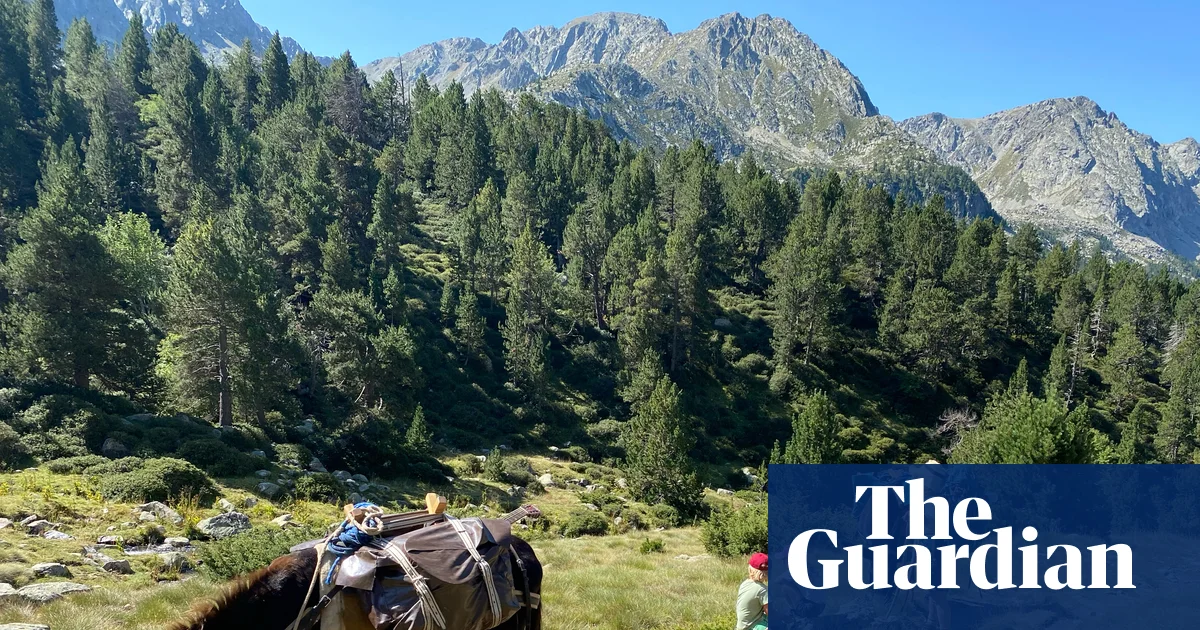
A family holiday on the hoof: donkey trekking in the Spanish Pyrenees | Family holidays
It’s said the 19th-century Parisian flâneur, intent on not rushing past the beauties of the street, would take a tortoise on a lead to set the pace. I thought about this as my donkey bent his head to another thistle and I turned my attention to the view, waiting for him to finish. Every way I looked, layers of mountains receded in deepening shades of eggshell blue. There were no sounds but the wind, the squeals of marmots and the giggles of my two young kids. I was extremely, uncomplicatedly happy.
Our donkeys were on loan from Burrotrek, a small outfit run by Swiss-born Denise Wirth. Twenty years ago, Denise spent four and a half months walking the Camino from Switzerland to Santiago de Compostela with two donkeys. She liked Spain, and she loved donkeys, so she settled on the idea of offering donkey treks in the Pyrenees. She has not looked back. For much of the year she is based where she settled, near Cadaqués, and offers a variety of self-guided itineraries through the vineyards in the foothills and along the Mediterranean coast, with trips lasting between a day and a week. But for the summer months, when temperatures soar, she relocates with her donkeys to Cal Jan de la Llosa in the province of Girona, a gorgeous ruin of a farm several miles up an unpaved track. From here, she lends her animals to people who, for whatever reason, have a romantic notion of what it might be like to take a donkey up a mountain.
My family (myself, Ulli, and our two kids, aged five and seven) bought Interrail passes (under-12s go free) and caught the sleeper down from Paris, crossed the border to Catalonia at Puigcerdà and, after a late lunch of tapas at the station bar, piled into a taxi for an hour’s drive up a long series of switchbacks to the farm. That first night we pitched our tents in a field behind the barn. The dark welled up from the valley floor and house martins shuttled through the dusk. We fell asleep to the rushing of the river and the occasional braying of a donkey.
The next morning we met our animals. We would be borrowing two donkeys, Om and Rebot, which we called Robot or, in moments of frustration, Roadblock. Om was described by Denise as “sporty”, and seemed up for most things, while Rebot was older and content to bring up the rear. Denise ran us through the basics: how to saddle them; how to groom them; how to check their hooves. A donkey can carry a fifth of its bodyweight, which meant around 30kg each. It was just as well, as we had a lot of stuff with us: a week’s worth of food and the explosion in camping gear that seemed to have occurred along with having children.
We had not taken our children to the mountains before, and I hadn’t had an interaction with a donkey since Bournemouth beach about 35 years previously. The learning curve was steep. The donkeys had a powerful sense of what they wanted, which didn’t always align with ours. Yet they were generally amenable, and we soon grew very fond of them. Denise waved us off with our children clutching the ropes and Om and Rebot trotting amiably behind them. She had suggested a loop that would take a week, with a mix of wild camping and mountain huts.
The going was easy, along wooded valleys, through pretty stone villages. At lunchtime, we tied the donkeys up to graze beside a stream while we splashed around, and then lay basking on the rocks, eating bread and cheese. Four hours in and I felt like Laurie Lee.
On the second night, we camped in a meadow during the worst storm I’ve ever known. It came out of a wide blue sky and suddenly it was hailing, the ground blanketed white. The donkeys stood stolidly beneath a tree, ears drooping. The downpour continued until dawn, the thunder like cannon fire. The kids, of course, slept through it, while Ulli and I sat up all night, watching their faces in the lightning. Were we out of our depth? Our tents were not meant for such weather and by morning the kids were the only dry things we had. The sun was out and the grass was steaming. We saddled the donkeys and carried on.
We dried out in Refugi dels Estanys de la Pera, a wonderful cabin alive with warm hospitality and good food. And then the path began to climb in earnest, winding up towards Andorra. At times it felt as though we were carrying two donkeys up the mountain. A group of Spanish hikers advised us to shout “arré,” an Arabic word imported by the Moors. It was unclear if it worked, but it gave us something to do. The donkeys took cautious, dainty steps, selecting each foothold before placing it. We were learning that they set the pace, and we should follow where they led.
By the time we made the border at the Perafita Pass, at an altitude of 2,574 metres, we were in the cloud and giddy with success. We squatted in an ancient corral of stones and ate biscuits. But as we descended the cloud burned off and Andorra opened up before us. A vast plateau of long grasses and crooked, lightning-struck spruce trees, scattered with lakes in craters gouged by ancient glaciers. It was achingly beautiful, silent and wild. A herd of chamois, flushed from their hiding place, took off down the slopes at full pelt.
The path unwound along a series of thin rivers that burst out of the mountainsides, Riu de Perafita, Riu Madriu, rattling urgently along their rocky beds. We drank straight from springs bubbling out of the rocks and plunged into small pools, blisteringly cold. A herd of horses approached us one morning to examine their diminutive relatives, and Om and Rebot stood there, stoic as ever, until the horses galloped on.
I had worried this trip might be a hard sell to the kids, but their capacity to create fun proved boundless. Every time we stopped, and we stopped a lot, they found a stream to paddle in, a frog to play with, a marmot to sneak up on. The days weren’t long, six or seven miles at most, but if we try a walk at home we rarely get beyond the car park. The donkeys and the mountains meant they scarcely noticed we had tricked them into walking. In the evenings, they groomed the animals and charged about the camp. They ate everything we gave them – noodles, lentils, pasta – and fell asleep in seconds. It was a revelation.
We spent our last night in Refugi de l’Illa, a vast, metal-clad, solar-panelled structure on a barren plateau that appeared to have touched down from space. We washed in hot water, drank wine at dinner and slept on a mattress. It was nice, but I hadn’t missed it. We were keen to get going again. As we walked back into Spain, the donkeys seemed to know they were nearing home. The path eased down across pastures of wild flowers and by dinner time on the eighth day we were back at the farm.
Some of my happiest moments as a parent are when I am doing something that I loved before having kids, but now with these brilliant, curious people – sharing the basic pleasures of cooking after a long day outside, or looking up at a sky bright with stars. We pitched our tent for one final night outside and reluctantly handed our donkeys back. They trotted into their field with the others, nosing each other’s necks in welcome. We were very sorry to see them go.
The trip was provided by Burrotrek; donkey hire from €55 a day including an introductory course and equipment. Half-board at Refugi de l’Illa, €61 adults/€48 children. Half-board at Refugi dels Estanys de la Pera, €46 adults/from €33.50 children
Lone Wolf by Adam Weymouth is published in paperback by Penguin on 25 June (£11.99). To support the Guardian, order your copy at guardianbookshop.com. Delivery charges may apply.