Six months after Nicolás Maduro’s military removal by US forces, the political situation in Venezuela can be summarized very schematically.
Under the 1999 Constitution, on July 3, Maduro’s absence became absolute. Under this assumption, Article 233 of the Constitution states that presidential elections must be held within 30 consecutive days following July 3. Meanwhile, Delcy Rodríguez remains as acting president, filling Maduro’s absolute absence.
The elections would be the final part of the third phase of the plan that Trump administration officials and Marco Rubio in particular often mention.
However, we know that elections will not be held in the short term, as there is a consensus that a new National Electoral Council (CNE) and conditions of electoral integrity are necessary. That is because, in theory, the first two phases outlined by the US government—stabilization and recovery—should first be completed.
So, how can the Venezuelan opposition push for free elections someday?
To do so, Venezuelans must first determine who within the Venezuelan opposition should lead the charge.
Naturally, it would be María Corina Machado. However, there is evidence that the Trump administration does not want her to be that lead person. I am not saying the White House does not want Machado to be a presidential candidate, but that everything seems to suggest that the Trump administration does not want her to lead the process toward those elections. Which is a different matter.
No political actor can achieve anything significant without the support, or at least the acquiescence, of the US.
Therefore, if the US government does not want Machado to lead the political process that will lead us to free elections, who is the US government backing? It has only given two indications so far.
One, somewhat farcical even in terms of US foreign policy, was that Trump invited Enrique Márquez, a satellite political leader, to the State of the Union address. It was a message to say that the US president does not want Machado leading the process that would lead to free elections.
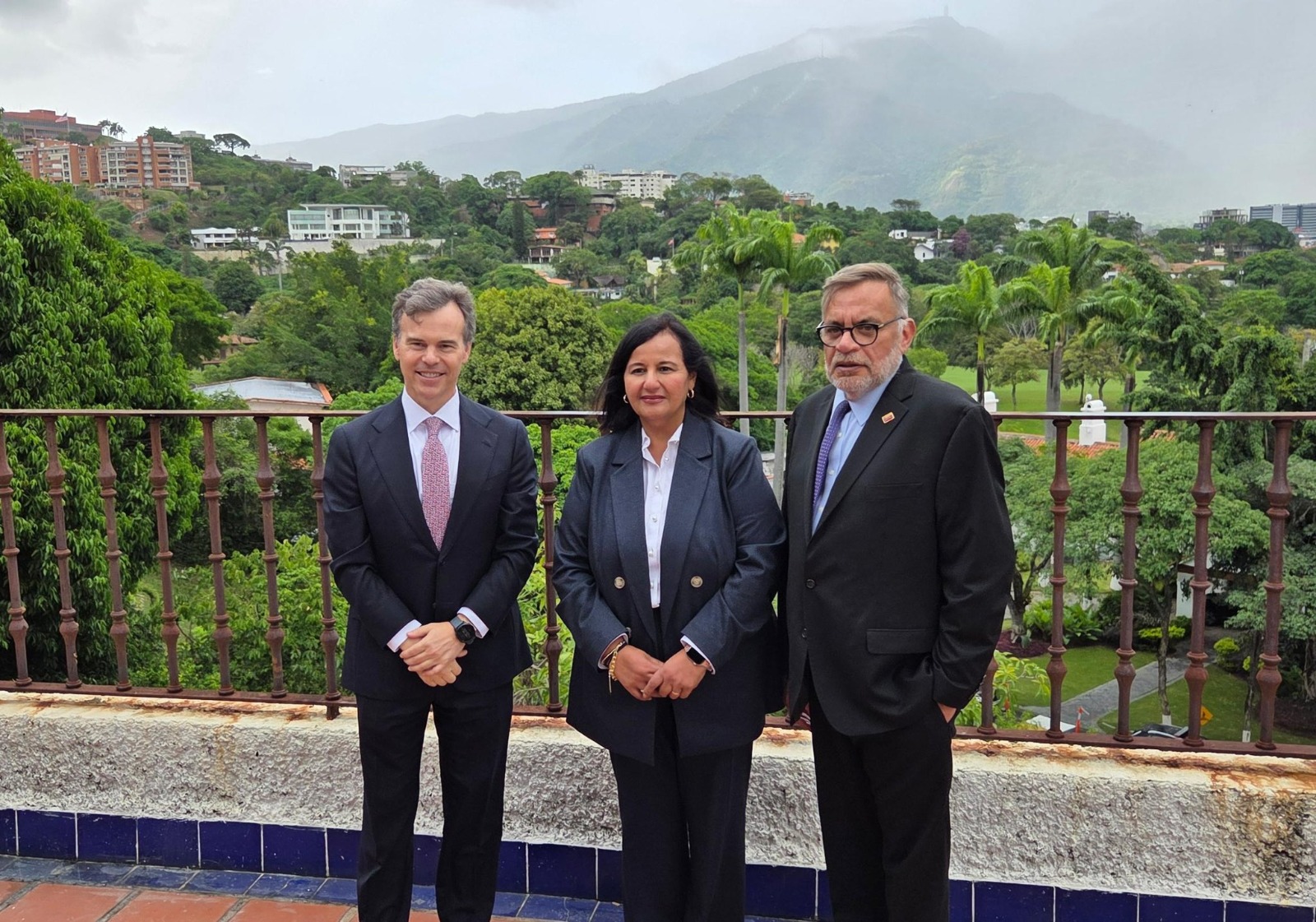
The other was the return of Dinorah Figuera, president of the 2015 National Assembly Delegated Commission, to Venezuela, at the invitation of the US, where she was received at the airport by US embassy personnel. Upon arrival, Figuera met with Chargé d’Affaires John Barrett and National Assembly president Jorge Rodríguez. In this way, the Trump administration emphasized its vision of who would be the opposition’s interlocutor.
Finally, after the earthquakes, there was a third, even clearer message: to disavow Machado’s trip to Venezuela.
At this point, it is worth remembering that at this moment in Venezuelan political history, no political actor can achieve anything significant without the support, or at least the acquiescence, of the US. Like it or not, the result of the January 3rd operation is that we find ourselves under a tutelage of both the regime and the opposition.
Given this reality, where should we push for the Venezuelan transition?
The 2015 National Assembly, with US support, could dedicate itself to building the electoral roadmap together with the 2026 National Assembly.
If the Trump administration doesn’t want Machado to lead the process toward free elections, and the last clear signal it sent was to involve the 2015 National Assembly, perhaps that’s the path we should follow.
From what we understand, the idea of involving the 2015 National Assembly, through 6 or 12 of its members, is to work with the 2026 National Assembly to build an institutional roadmap leading to elections, specifically the appointment of a new board for the CNE, and perhaps the formation of a new Supreme Court of Justice (TSJ).
It is known that this option generates deep distrust in Machado, who attempted to thwart it, apparently unsuccessfully, with the Panama Manifesto, in which she declared, among other things, that she should lead the negotiations with the interim regime. However, it seems that if a definitive break with the Trump administration is not desired, Machado and the 2015 National Assembly should reach agreements.
The first could be that the 2015 National Assembly, with the support of the US government, dedicates itself to building the electoral roadmap together with the 2026 National Assembly. Naturally, Machado’s opinion would be taken into account at all times. This should lead to the appointment of a new CNE board and a new TSJ. Then, the electoral legislation and administrative regulations would have to be reformed to create conditions that allow for truly free elections. Machado’s opinion would also be taken into account at all times.
Finally, a primary election could be held within the opposition, allowing opposition voters to express their views. It is likely that Machado will be re-elected as the opposition candidate. This way would open an acceptable option for those who control this process: an electoral path around the 2015 and 2026 National Assembly elections, and then presidential elections in which, predictably, María Corina Machado will win.
South Korean Deputy Prime Minister and Minister of Finance and Economy Koo Yun Cheol and representatives of government agencies, policy-finance institutions and major shipbuilders attend a signing ceremony for a Korea-U.S. shipbuilding cooperation investment agreement at the Export-Import Bank of Korea in Seoul on Thursday. Photo from the Ministry of Trade, Industry and Resources, used under KOGL Type 1.
June 25 (Asia Today) — South Korea launched a policy-finance framework Thursday to support $150 billion in shipbuilding cooperation with the United States, seeking to share early-stage investment risks with domestic companies expanding into the U.S. market.
The Korea-U.S. Strategic Investment Corporation, four state-backed financial institutions and three major South Korean shipbuilders signed a memorandum of understanding at the Export-Import Bank of Korea headquarters in Seoul.
The agreement is the first institutional step toward implementing the $150 billion shipbuilding cooperation package included in a bilateral strategic investment memorandum signed in November 2025.
The participating financial institutions are the Export-Import Bank of Korea, Korea Development Bank, Korea Trade Insurance Corp. and Korea Ocean Business Corp.
The three shipbuilders are HD Hyundai Heavy Industries, Samsung Heavy Industries and Hanwha Ocean.
Under the agreement, the participants will establish a Korea-U.S. Shipbuilding Cooperation Investment Council to identify U.S. investment projects, coordinate policy financing and jointly monitor their implementation.
The Export-Import Bank of Korea will serve as the council’s secretariat, coordinating communication among the institutions and overseeing the progress of individual projects.
South Korean Deputy Prime Minister and Minister of Finance and Economy Koo Yun Cheol said shipbuilding cooperation is one of the two main pillars of strategic investment between South Korea and the United States.
Koo urged the investment corporation and policy lenders to develop financing measures that can provide companies with sufficient funding when it is needed.
“The government and policy-finance institutions must actively seek ways to share the risks and uncertainty of initial investments that individual companies cannot bear alone,” Koo said.
He said the initiative should help South Korean shipbuilders support the rebuilding of the U.S. shipbuilding industry while creating new contracts and markets across South Korea’s domestic shipbuilding supply chain.
The benefits should extend beyond large shipbuilders to small and midsize shipyards and marine equipment suppliers, he said.
“We must create a path for small and midsize shipbuilders and equipment suppliers to participate together as Team Korea,” Koo said.
The government plans to use the council to develop financing for investments in U.S. shipyards, naval vessel construction, maintenance, repair and overhaul services and commercial shipbuilding.
The policy-finance structure is intended to help companies manage the large capital requirements and financial risks associated with entering the U.S. market.
Financial Services Commission Vice Chairman Kwon Dae-young described the initiative as an opportunity for South Korea’s shipbuilding industry to demonstrate its capabilities in the global market.
“We will actively support the necessary financing through close cooperation among the newly established Korea-U.S. Strategic Investment Corporation, policy-finance institutions and private financial companies,” Kwon said.
Park Dong-il, deputy minister for industrial policy at the Ministry of Trade, Industry and Resources, said the Make American Shipbuilding Great Again initiative, or MASGA, represents the first strategic overseas expansion project in the history of South Korea’s shipbuilding industry.
Park said encouraging signs were emerging in the United States, including potential orders for South Korean companies.
He called on policy lenders to coordinate closely so shipbuilders can enter the U.S. market without delays.
“The signing ceremony is expected to provide initial momentum for the MASGA project and create a new opportunity for South Korea’s shipbuilding industry to advance,” Park said.
Shipbuilding companies also pledged to identify commercially viable projects with government financial support.
HD Hyundai Heavy Industries CEO Lee Sang-kyun said producing tangible results from the bilateral cooperation was the most important objective.
“This cooperation should develop into a system that simultaneously supports the growth of South Korea’s shipbuilding industry and the rebuilding of the U.S. shipbuilding base,” Lee said.
South Korean shipbuilders will identify investment opportunities that offer profitability and can be carried out effectively using their advanced technology, he said.
Lee also urged the government to prepare a broad range of support measures to help create a turning point in bilateral shipbuilding cooperation.
The government said it will use the agreement to begin full cooperation among the investment corporation, policy-finance institutions and shipbuilders.
It also plans to expand the Team Korea framework so small and midsize shipyards and marine equipment suppliers can participate in projects entering the U.S. market.
The Trump administration asked Congress on Wednesday to pass a law allowing year-round sales of gasoline blended with 15% ethanol, marking the first formal push by his White House to enact the policy and siding with the biofuels industry against
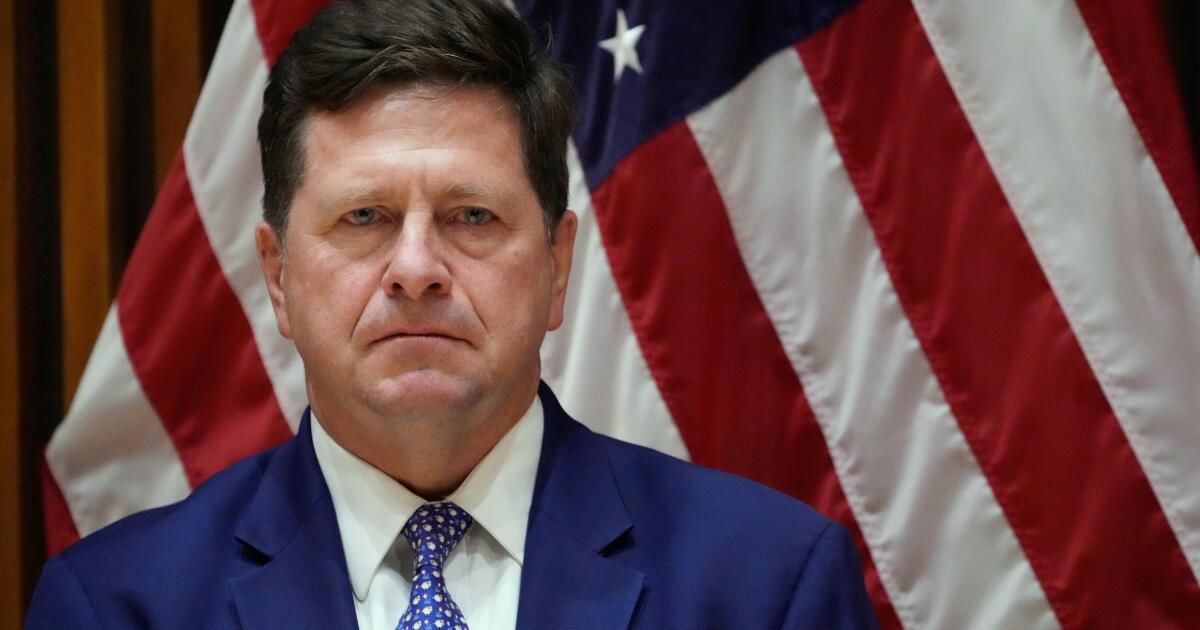
EVIAN-LES-BAINS, France — President Trump said Wednesday that he was delaying federal prosecutor Jay Clayton’s nomination to lead the U.S. intelligence community in a bid to force Congress to act on a voter ID bill that currently lacks enough support for passage.
The Republican president said in a social media post just hours before Clayton’s scheduled confirmation hearing that he will keep Bill Pulte, a top U.S. housing official, as acting director of national intelligence. Democratic and Republican lawmakers had opposed Trump’s selection of Pulte, citing his lack of known experience in intelligence and his use of his current administration perch to target perceived adversaries of the president — resistance that last week forced Trump to turn to Clayton.
The abrupt announcement creates instant uncertainty over the long-term leadership of the 18-agency intelligence community and dashes hopes for a swift renewal of a crucial surveillance program that expired in Congress last week due to bipartisan anger over Trump’s pick of Pulte.
That tool, Section 702 of the Foreign Intelligence Surveillance Act, permits spy agencies to collect without a warrant the communications of targeted foreigners located outside the United States. National security officials across both major political parties have for years described Section 702 as vital for gathering intelligence that can disrupt terror attacks and espionage operations, though some lawmakers and civil liberties advocates have raised concerns over the government’s use of information about Americans that is incidentally collected through the program.
Clayton had been set to appear on Wednesday for a Senate confirmation hearing that was fast-tracked because of the program’s lapse. Democrats had said they would not renew the expired surveillance programs until Trump withdrew the selection of Pulte.
Trump’s post suggests that debate to revive Section 702 could be indefinitely postponed. Lawmakers have sounded the alarm about the government operating without congressional authorization of the powerful spy tool.
A court order from last March certified that the program could continue for another 12 months, though it’s possible that communications companies could challenge the government’s authority to force them to cooperate and share data.
In his social media post, Trump accused Democrats of breaking a deal to renew the program after he nominated Clayton. Trump also said he does not want to remove Clayton from his current position as U.S. attorney for the Southern District of New York before his replacement, James McDonald, is approved. McDonald was named to the Justice Department post on Saturday.
And Trump added another condition: linking his approval of the surveillance program to the passage of a bill requiring people to show ID to vote.
“Therefore, to add a slight bit of intrigue but, for the Good of the Nation, and the People of our Country, I will not approve FISA without THE SAVE AMERICA ACT going along with it,” Trump said, using the acronym for the surveillance program and his name for the voter ID bill.
The Republican-controlled Congress has not acted on the voting bill because it does not have enough support in either chamber, particularly from Democrats.
Trump made the announcement in Evian-les-Bains, France, where he was participating in the final day of the Group of Seven summit of leading industrial economies.
The intelligence director position became available after Tulsi Gabbard, who had held the job, announced last month that she was resigning to spend time with her husband as he fights cancer.
Clayton, a chairman of the Securities and Exchange Commission during Trump’s first term, has spent the last 14 months as the top federal prosecutor in Manhattan, one of the Justice Department’s premier posts.
His office during that time facilitated the unsealing of thousands of pages of court records from the prosecutions of Jeffrey Epstein and Ghislaine Maxwell, documents that were made public as part of the Justice Department’s release of records related to the late sex offender and his longtime confidant.
Clayton has also overseen the prosecution of former Venezuelan President Nicolás Maduro and Maduro’s wife, Cilia Flores, on drug trafficking charges.
Epstein died by suicide in a New York jail cell in 2019 while awaiting trial on sex trafficking charges. Maxwell was convicted of luring teenage girls to be sexually abused by Epstein but insists she’s innocent. Maduro and his wife have protested their capture and said they’re not guilty.
Madhani, Superville, Tucker and Jalonick write for the Associated Press. Superville reported from Geneva. Tucker and Jalonick reported from Washington.
OpenAI is facing a fresh regulatory challenge after a group of state attorneys general demanded a wide range of documents about how ChatGPT protects the people who use it, a move that arrives at a delicate moment for the company as it lays the groundwork for a potential public listing.
ADVERTISEMENT
ADVERTISEMENT
The investigation, which arrived just days after OpenAI filed confidential paperwork for an IPO, threatens to complicate a listing that some analysts expect will value the ChatGPT maker at roughly $1 trillion (€861bn).
According to The Wall Street Journal, which first reported the matter, OpenAI received the subpoena on Friday from a group of states, with the inquiry led by New York’s attorney general.
Officials are requesting material covering the company’s advertising practices, how it keeps people using its service, its handling of consumer and health data, and its policies towards minors and older adults.
OpenAI said it would engage with the offices behind the request and stressed that protections are already built into its product.
A spokesperson stated that the company takes the concerns raised by the attorneys general “seriously” and works to bring the benefits of the technology to people responsibly. However, the firm has not confirmed which other US states are taking part.
Mounting legal pressure
The subpoena adds to a growing list of legal headaches.
Last Thursday, a Canadian woman sued OpenAI, blaming ChatGPT for her daughter’s suicide. Earlier in June, Florida Attorney General James Uthmeier filed suit against the company and CEO Sam Altman after two shootings in which the alleged attackers reportedly used the chatbot to plan their crimes.
OpenAI responded that its models repeatedly urged the individuals to seek help from mental health professionals and that it cooperated with the police in both cases.
These are not the first courtroom tests of the year for OpenAI.
In May, a federal jury in Oakland, California took less than two hours to reject Elon Musk’s lawsuit accusing Altman of abandoning the firm’s nonprofit roots, finding he had filed too late. Musk, who called the ruling a “calendar technicality”, said he would appeal.
The clampdown also extends across the industry.
European regulators have opened investigations into Musk’s rival chatbot Grok over antisemitic and sexualised content, including deepfake images.
Anthropic, also preparing an IPO, was told by the Trump administration to restrict two of its models abroad on national security grounds, illustrating how AI governance has become an increasingly fraught political battleground.
The United Arab Emirates has agreed to unlock billions of dollars for Iran, pursuing a tactical shift after weeks of Iranian attacks on the wealthy Gulf Arab state amid its ongoing war with the United States and Israel, four sources told the Reuters news agency.
The report on the move coincided with the final stages of broader negotiations between Tehran and Washington to end the war. Diplomats say those talks involve the release of tens of billions of dollars in Iranian oil revenues frozen in foreign banks under US sanctions.
Recommended Stories
list of 3 itemsend of list
Two regional sources told Reuters that the UAE had agreed to release a total of $10bn, more than $3bn of which had already been delivered.
Two other sources with knowledge of the arrangement put the total funds involved at $20bn, adding that the move had been agreed in return for a halt to Iranian attacks on the UAE.
One of the sources with knowledge of the arrangement also said a first tranche of $3bn had already been made available.
Reuters could not establish whether the funds earmarked for the transfers belong to the UAE or originate in long-blocked Iranian accounts in the UAE banking system, or elsewhere.
But a UAE official, asked to comment on the transfer, said the country was trying to ease tension and foster peace.
“The UAE’s foreign policy is guided by promoting de-escalation and reducing tensions across the region, while advancing lasting peace and stability,” the official said.
“The UAE supports efforts, including those undertaken by the United States, to protect the peoples of the region from the repercussions of conflict.”
The White House did not immediately respond to Reuters’s request for comment on the move.
‘Red line’ workaround
Earlier on Friday, Vice President JD Vance said that frozen funds would not immediately be released to Iran upon signing a deal with the US.
He said the potential deal is structured to ensure that economic benefits would flow to Tehran if it meets its obligations.
There was no immediate response from Iranian authorities to a Reuters request for comment on the move.
None of the sources cited by Reuters would agree to be identified due to the sensitivity of the matter.
The arrangement signals a striking pivot from the open animosity of UAE-Iran relations through much of the war, when Iranian attacks emptied Dubai’s hotels, drove some expatriates to flee and shook the reputation for safety that is central to the country’s position as a premier business hub.
One of the sources with knowledge of the arrangement said the move offered a way to help solve the conflict between the US and Iran without either side crossing its red line. Iran can claim it extracted compensation for war damages. Washington can insist it paid nothing.
Abu Dhabi, meanwhile, obtains its own security and protects Dubai’s hub status, while framing the move as an investment in rebuilding regional trust.
The other source with knowledge of the arrangement said that in return for the disbursement, Iran would halt missile and drone attacks on the UAE, and there would be a rebuilding of bilateral ties, including intelligence sharing and economic cooperation.
The source added that Iran had approached at least two other Gulf Arab countries to make a similar arrangement.
The last known direct attack by Iran on the UAE was more than a month ago – a May 4 strike on the Gulf state’s Fujairah port on the Gulf of Oman.
The first source with knowledge of the arrangement said talks had started several weeks ago but quickened pace when officials of Iran’s powerful Revolutionary Guard visited Abu Dhabi last week to meet Sheikh Tahnoun bin Zayed al Nahyan, the UAE’s national security adviser and deputy ruler of Abu Dhabi, and stayed at his guest house.
That trip was followed by a visit by UAE officials to Tehran to negotiate the details of the mechanism.
Frozen funds
Dubai’s banks have long held substantial Iranian-linked deposits, much of them now immobilised under US sanctions that police the global dollar-clearing system and expose any foreign bank dealing with blacklisted Iranian entities to being cut off from the US financial network.
On April 11, a senior Iranian source told Reuters that the US had agreed to release Iranian frozen assets held in Qatar and other foreign banks, although a US official swiftly denied the assertion.
The source, who declined to be named due to the sensitivity of the matter, said that unfreezing the assets was “directly linked to ensuring safe passage through the Strait of Hormuz”, a key issue in talks aimed at ending the conflict.
Since its creation more than a century ago, the Los Angeles Bureau of Street Lighting has been in the lamppost business and little else.
But in recent months, the little-known city agency has found itself pulled into a fierce debate over L.A.’s relationship with Flock Safety, a surveillance technology company that has been criticized for supplying data used to enable the Trump administration’s immigration crackdown.
In L.A., Flock operates dozens of automated license plate readers, which allow authorities to scan for vehicles that have been reported stolen or are registered to known fugitives, tracking their movements throughout the city.
The devices are often mounted on municipal light poles, which makes the Bureau of Street Lighting responsible for their installation.
Reports that Flock has shared license plate data with federal authorities, including U.S. Immigration and Customs Enforcement, have prompted dozens of mostly smaller cities across the country to end their relationship with the company. But in L.A. it still has found willing customers, including the LAPD.
Hundreds of emails obtained by The Times through public records requests reveal how LAPD boosters, homeowner associations and elected officials have engaged in a months-long campaign to pressure the Bureau of Street Lighting to speed up installations of the plate readers.
Flock, headquartered in Atlanta, said that it contracts with roughly 5,000 U.S. law enforcement agencies nationwide, and that its technology complies with a California law that limits what information can be shared with federal authorities. A company spokesperson said that Flock’s technology is “built around transparency, accountability, and local control.”
“Our customers own and control their data, which is deleted after 30 days by default,” the spokesperson, MoMo Zhou, said in a statement to The Times. “Our platform includes safeguards like audit trails to help ensure accountability at every step. Every day, Flock supports communities across the country in addressing crime and locating missing people.”
The Bureau of Street Lighting, with 177 employees and a relatively modest budget of $49.4 million, would seem an unlikely player in the broader debate over police surveillance. It is primarily tasked with repairing and fortifying the city’s more than 210,000 streetlamps — a frequent target of copper wire thieves — and maintaining its network of electrical vehicle charging stations.
The push to put up more plate readers has come amid calls for greater transparency around the Los Angeles Police Department’s dealings with Flock. In March, the Police Commission asked the department to report back on what information the company’s scanners collect and share. In recent months, the commission declined to approve donations of Flock cameras.
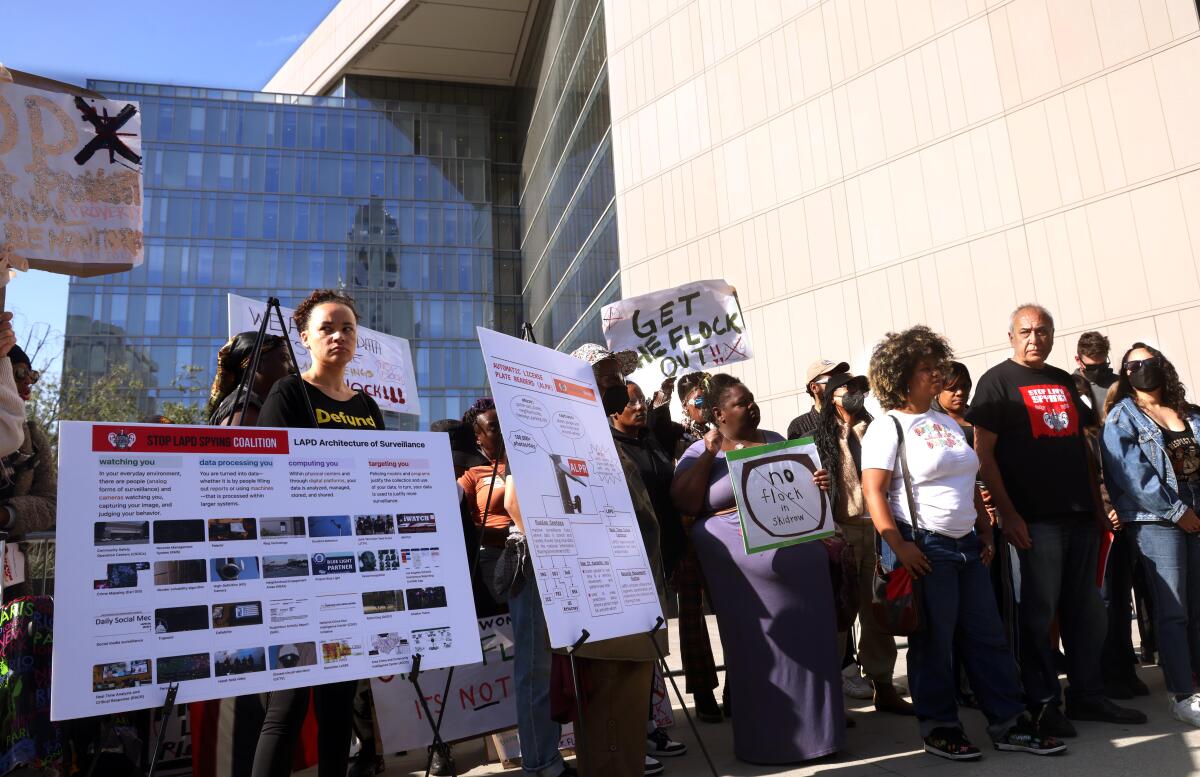
Members of the Stop LAPD Spying Coalition held a news conference to express opposition to Flock Safety, a license plate reader, ahead of a Los Angeles Board of Police Commissioners meeting on March 3, 2026.
(Genaro Molina / Los Angeles Times)
The commission ordered its inspector general to conduct an audit of the LAPD’s use of license plate reader technology, with the findings expected to be released in the summer.
Recently, Councilmember Ysabel Jurado introduced a motion urging the commission to “refrain from entering into any new Memoranda of Understanding, Contracts, or other Agreements, or implement any pilot programs with Flock Safety or its affiliates.” LAPD officials said last month that the city attorney’s office has been working on drawing up a formal contract with Flock.
Behind the scenes, though, the pressure to work with Flock has been ratcheting up from other council offices and community groups.
When a representative from Councilmember Katy Yaroslavsky’s office emailed the streetlighting bureau urging speed, she received a response that said the installation process shouldn’t be rushed because some city light poles can’t support the weight of a Flock reader, which is normally powered by a solar panel.
“The last thing we need is to have a pole fall onto someone or something if there are high winds,” the bureau’s Clinton Tsurui wrote in the June 4, 2025, email.
In another exchange, Tsurui expressed frustration with a colleague who had offered what he thought was an overly optimistic timetable for installing new plate readers.
He wrote: “smh, promising things we can’t do is going to catch up with us one day.”
The Los Angeles Police Foundation, a nonprofit group that has long bankrolled equipment for the LAPD and offered other support, has criticized delays in installing the Flock devices. Last year, the foundation facilitated the donation of dozens of Flock cameras, most of which ended up in affluent neighborhoods on the city’s Westside and in the San Fernando Valley.
Records show that in May 2025, Dana Katz, the foundation’s executive director, reached out to the mayor’s office with a request to waive permit and rental fees associated with installing the new readers. Katz wrote in an email that the extra expense of around $2,000 per device were “cost prohibitive and detrimental to public safety.”
Katz also pointed out that in some places, there are no city-owned poles on which to mount the devices — but offered a possible solution.
“Flock has its own pole that has been accepted by the County of Los Angeles for these situations, and we would like the City to accept the use of them, too,” she wrote to Robert Clark, the city’s then-deputy mayor of public safety.
A few of L.A.’s historic streetlights stand outside the Bureau of Street Lighting’s office near Virgil Avenue and Santa Monica Boulevard.
(Jason Armond / Los Angeles Times)
Katz wrote Clark again on Aug. 6 to ask why officials were estimating a six-to-12-month wait for approval of new Flock readers on public property in the neighborhoods of Cheviot Hills and Brentwood Park, where there were no existing city poles to mount them. She noted that the county’s engineering department had already approved the company’s poles, and asked Clark whether there was a way for the city to “piggyback on these other entities’ approvals in order to speed this up so that these neighborhoods don’t have to wait so long for help in preventing these home invasions?”
In the following weeks, Katz’s emails took on an increasingly urgent tone. In one of her last messages, email records show, she told an aide she expected more help than the mayor’s office was offering.
“With all due respect, the answers you have provided are completely generic and do not provide any guidance and direction as to how we can expedite this process,” she wrote.
She added: “I’ve said it before, and I will say it again — these delays are harmful to public safety.”
A spokesperson for the mayor’s office told The Times that ultimately neither Clark nor the aide intervened on the Los Angeles Police Foundation’s behalf.
Email records show Flock’s courtship of the bureau dates at least to spring 2024, when the company agreed to donate two of its plate readers to help combat copper thefts.
Tsurui emailed LAPD Capt. Celina Robles to say that the company’s executives had requested an in-person meeting with the bureau and the LAPD “to discuss the benefits of this product and how it can benefit the city moving forward.”
On June 24, 2024, a lobbyist from the D.C. firm Modern Fortis emailed Bureau of Street Lighting Executive Director Miguel Sangalang seeking to “explore a public-private partnership” between Flock and the city. Sangalang took another meeting to discuss Flock a few months later with former City Councilmember Joe Buscaino, who after leaving City Hall had gone to work for Ballard Partners, a powerful Florida-based lobbying firm.
In January 2025, after wildfires devastated Pacific Palisades, Altadena and other areas, Flock stepped in again. The company agreed to donate more than 50 plate readers, free of charge for six months, to the wealthy Palisades area, where residents and law enforcement officials were on high alert about potential theft.
A Flock Safety automated license plate reader in Costa Mesa.
(Courtesy of the city of Costa Mesa)
In the days and weeks that followed, city and police officials continued to pepper the bureau about speeding up the approval process.
On Jan. 21, 2025, records show, Cmdr. Randall “Randy” Goddard of the LAPD’s Information Technology Bureau wrote streetlighting officials to say that the Palisades community “could use a big favor from your department.”
LAPD Chief Jim McDonnell “fully supports this and has been working with the City Attorney’s office to finalize the terms,” Goddard wrote.
Mexico and Canada have backed extending the USMCA trade agreement for another 16 years as negotiations over its future continue. The proposal comes amid an ongoing trade dispute with the United States.
Malaysia has introduced new regulations preventing children under the age of 16 from registering accounts on social media platforms as part of a broader effort to improve online safety and protect minors from harmful digital content.
Under the new rules, major social media companies including Meta Platforms, TikTok, and Alphabet will be required to verify users’ ages using government issued records before allowing new account registrations.
The policy took effect on Monday and is being enforced by the Malaysian Communications and Multimedia Commission. Companies that fail to comply could face fines of up to 10 million ringgit, equivalent to approximately 2.5 million dollars.
Authorities emphasized that the measure is not intended to block children from using the internet entirely, but rather to ensure greater responsibility among technology companies, parents, and guardians in protecting young users online.
How the New Rules Will Work
The new framework requires social media platforms to implement age verification systems that cross check user information against official government records.
While the restrictions immediately apply to new account registrations, existing users will also be subject to age verification measures during a six month implementation period.
The move places greater responsibility on technology companies to ensure that underage users are not able to bypass age requirements through inaccurate information during the registration process.
Growing Concerns Over Children’s Online Safety
Malaysia’s decision reflects increasing global concern about the impact of social media on children and teenagers.
Governments around the world have raised alarms over issues including exposure to harmful content, cyberbullying, online exploitation, misinformation, and the effects of excessive social media use on mental health.
Policymakers argue that stronger safeguards are needed as digital platforms become a central part of daily life for younger generations.
Malaysia’s Wider Crackdown on Online Content
The age restrictions are part of a broader effort by Malaysian authorities to regulate online platforms more aggressively.
Officials have reported a significant increase in harmful online content in recent years and have intensified monitoring of material that could inflame racial or religious tensions. Authorities have also targeted content viewed as insulting or critical of the country’s monarchy.
The government says social media companies must play a more active role in preventing harmful content from reaching vulnerable audiences.
Why It Matters
Malaysia’s decision places it among a growing group of countries seeking stricter regulation of social media platforms and greater protections for children online.
The policy could become a model for other governments considering similar measures, particularly as concerns over digital safety continue to grow worldwide. It also increases pressure on technology companies to develop more reliable age verification systems while balancing privacy concerns and user accessibility.
The move highlights the growing debate over who should bear responsibility for protecting children online, governments, technology firms, or parents.
Key Stakeholders
Children and Teenagers
Young users will face stricter age verification requirements before being allowed to create social media accounts.
Parents and Guardians
Families are expected to play a larger role in monitoring children’s online activities and ensuring compliance with age restrictions.
Social Media Companies
Major technology platforms must implement and maintain age verification systems while ensuring compliance with Malaysian regulations.
Malaysian Government
Authorities aim to reduce children’s exposure to harmful content and strengthen oversight of online platforms.
Digital Rights and Privacy Advocates
Advocacy groups will closely monitor how age verification systems are implemented and whether they affect privacy and data protection standards.
What Happens Next
Social media companies now have six months to complete age verification checks for existing users and fully integrate compliance systems for new registrations.
Regulators are expected to monitor implementation closely and may impose penalties on platforms that fail to meet requirements. The effectiveness of the policy will likely be assessed based on whether it reduces underage access and limits exposure to harmful content.
Other countries in the region may also watch Malaysia’s experience as they consider similar online safety measures.
Analysis
Malaysia’s new restrictions reflect a broader global shift toward stronger regulation of digital platforms, particularly where children are concerned. Governments are increasingly moving away from voluntary industry guidelines and toward legally enforceable requirements that place direct responsibility on technology companies.
The success of the policy will depend largely on the effectiveness of age verification systems. If implementation is weak, underage users may still find ways to access platforms. If verification measures are too strict, however, concerns about privacy, data security, and accessibility could emerge.
The regulation also signals a growing willingness among governments to intervene in how social media platforms operate. As concerns about online safety continue to rise, Malaysia’s approach may become an important test case for balancing child protection, digital rights, and platform accountability in the years ahead.
The leading candidates for mayor fanned out across Los Angeles this weekend to make their final cases to voters ahead of Tuesday’s hotly contested primary election.
An energized Mayor Karen Bass galvanized crowds of labor union workers sporting union merch Saturday. “Four more years!” crowds chanted as a slew of local and state Democratic heavyweights joined the incumbent.
City Councilmember Nithya Raman spent the day dashing between local restaurants and bars in an old-school yellow Scout convertible to meet with business owners and her supporters.
Meanwhile, former reality TV personality Spencer Pratt hosted a block party in Baldwin Village with barbecue food, free merch and American-flag lawn chairs — although he spent much of the event off to the side, listening to the concerns of Black residents.
Recent polls have placed Pratt and Raman within striking distance of Bass, who had enjoyed a comfortable lead for much of the campaign. A recent survey, co-sponsored by The Times, had Bass at 26%, Raman at 25% and Pratt at 22% — with a roughly 3% margin of error in either direction and 10% of voters undecided.
The top two candidates in Tuesday’s jungle primary will advance to a November runoff, unless one candidate manages to garner over 50% of the vote.
Mayoral candidate Spencer Pratt speaks with Diane Waterhouse, a caregiver and Westchester native, about homelessness and drug addiction at a campaign event Saturday in Baldwin Village. “We just talk about it like, ‘oh it’s Skid Row, that’s just where the drug addicts are.’ No, there’s communities, there’s kids, there’s people that work there, businesses,” Pratt said.
(Noah Haggerty / Los Angeles Times)
“I believe God moves mountains; I believe that you can get that 51% on that Tuesday,” Diane Waterhouse, a 60-year-old caregiver, told Pratt at his Baldwin Village event.
On the lawn of Jim Gilliam Park on Saturday, supporters from across the city chanted Pratt’s name, took selfies in front of black campaign vans with his hummingbird logo and ate cookies decorated with his face as kids raced around on scooters and played with the handful of dogs attending.
But Pratt — who had spent the morning at the West Los Angeles Animal Shelter speaking with animal welfare advocates — headed toward the nearby recreation center to talk with residents away from the cameras.
“Most people that come here and want our vote — we give y’all our vote; we’re still living like this. Nothing changes,” Erica Helon, a 40-year-old bus driver, told Pratt in one of the most tense moments of the event.
Pratt, wearing a beige suit and a hat with his name stylized like the L.A. Lakers logo, emphasized he was in South Los Angeles to listen and wasn’t even asking residents for their votes. He pulled Helon aside and gave her his personal phone number so they could talk more.
“I’m here because I want to be a voice for the community,” he said at one point. “I’m here because I don’t know what I don’t know.”
Helon, who is still undecided, left the event open-minded on Pratt.
“I would love to see what he’s going to do for this city,” she said.
Los Angeles mayoral candidate Nithya Raman joins a group photograph during a campaign stop Sunday with SevaSphere volunteers after preparing meals for people experiencing homelessness at Oaks Kitchens.
(Kayla Bartkowski / Los Angeles Times)
Raman, who has made publishing detailed policy plans a staple of her campaign, spent Saturday meeting with local restaurant owners after recently dropping a policy plan for small businesses.
Around sunset, the yellow convertible pulled up to Lowboy Bar, an Echo Park staple. Raman, sporting a Japanese Dodgers hat and a rainbow City Council fanny pack, joined campaign staff for drinks at tables covered in “Nithya Raman for Mayor” pins.
A few young Angelenos, starting out their nights in trendy getups, recognized Raman and stopped by to chat and take pictures.
“I’ve lived in L.A. for 12 years. It’s a very, very important city to me,” said Ryan Bergeron, a 35-year-old who works in marketing and does art on the side.
Bergeron, who is on the Echo Park neighborhood council, hopes Los Angeles can serve as a “beacon in an otherwise scary time in the country” as it tackles affordability, the housing crisis and sustainability issues.
As for Raman, “I’ve seen her as a councilmember and been really proud of that,” Bergeron said. When she announced her candidacy for mayor, “It felt like everything really clicked.”
Mayor Karen Bass and Councilmember Monica Rodriguez attend the Los Angeles Democratic Party and Avance Democratic Club Carne Asada Tour, a community event held Saturday at the Yosemite Recreation Center. Avanceis one of the country’s largest Latino Democratic clubs.
(Karla Gachet / For The Times)
Bass, conversely, wound down after a day of union rallies by eating tacos at the Yosemite Recreation Center’s picnic tables in Eagle Rock with several local politicians, including Councilmember Monica Rodriguez and county Democratic Party Chair Mark Ramos.
California Atty. Gen. Rob Bonta and L.A. County Sheriff Robert Luna had joined Bass earlier in the day. Although Luna missed out on the picnic, he still enjoyed several tacos in his car.
Come Sunday, Raman, wearing jeans and a chartreuse cardigan, was greeting bike riders at a Sawtelle coffee shop and speaking to a phone bank group at UCLA.
“It is absolutely essential to making sure that our little campaign, without all the political machine behind us, without MAGA millions behind us, that our vision of Los Angeles still manages to get out to the people, and your work today is an essential part of that,” Raman told a group of United Auto Workers-represented graduate students from multiple nearby universities.
She had several other appearances scheduled for the rest of the day, including lunch with a group of Korean American Democrats in Koreatown, Encinofest, a block party in Silver Lake and a visit to Boyle Heights.
“There seems to be increasing awareness about the race and excitement about the issues,” Raman told The Times. “It’s been really exciting to see people engaging and feeling positive about the city’s future.”
About two dozen students spoke to potential voters associated with UAW and urged them to mark Raman’s name on their ballots by Tuesday.
Stephanie Wert, a 30-year-old psychology graduate student at UCLA and head steward for UAW, said the phone bank could determine whether Raman’s campaign would survive the week.
“This vote is going to be decided on the margins, and so I think we could really make the difference that pushes her to the runoff,” Wert said.
Bass peeked around the back doors of a supporter’s Venice home Sunday afternoon to cheers from several dozen supporters at an intimate event. Speaking over small snack plates and beverages, many said they saw real improvements in the homeless populations around their neighborhood during Bass’ tenure as mayor.
Tatiana Barhar, a Venice resident for over 30 years, said she saw in real-time an “extreme” homelessness problem get better during Bass’ term, thanks to her Inside Safe program. “I want to support her,” she said. “I think there’s a lot more she can do.”
Bass spoke of 1960s-level crime rates, thousands of unhoused people pulled off the street into housing and efforts to build up Hollywood during her time as mayor. “We got a lot to do,” Bass said. “We have such a bright future in the nation’s second-largest city, and I hope that you will continue to be there with me as we win.”
Pratt’s moves on Sunday remained more elusive. His campaign emphasized he was hoping to have intimate moments with L.A. communities, instead of a media and influencer frenzy like some of his previous, more widely publicized events.
One of those more intimate moments was a community event in a Latino neighborhood near downtown L.A. on Sunday morning. Pratt had spent Thursday in New York for some national media interviews to “get the message to as many people as possible.”
Replimune (REPL) won over the FDA to submit a marketing application for its lead asset RP1 for the third time despite previous rejections, thanks to the intervention of White House officials, The Wall Street Journal reported, citing people familiar with the matter.