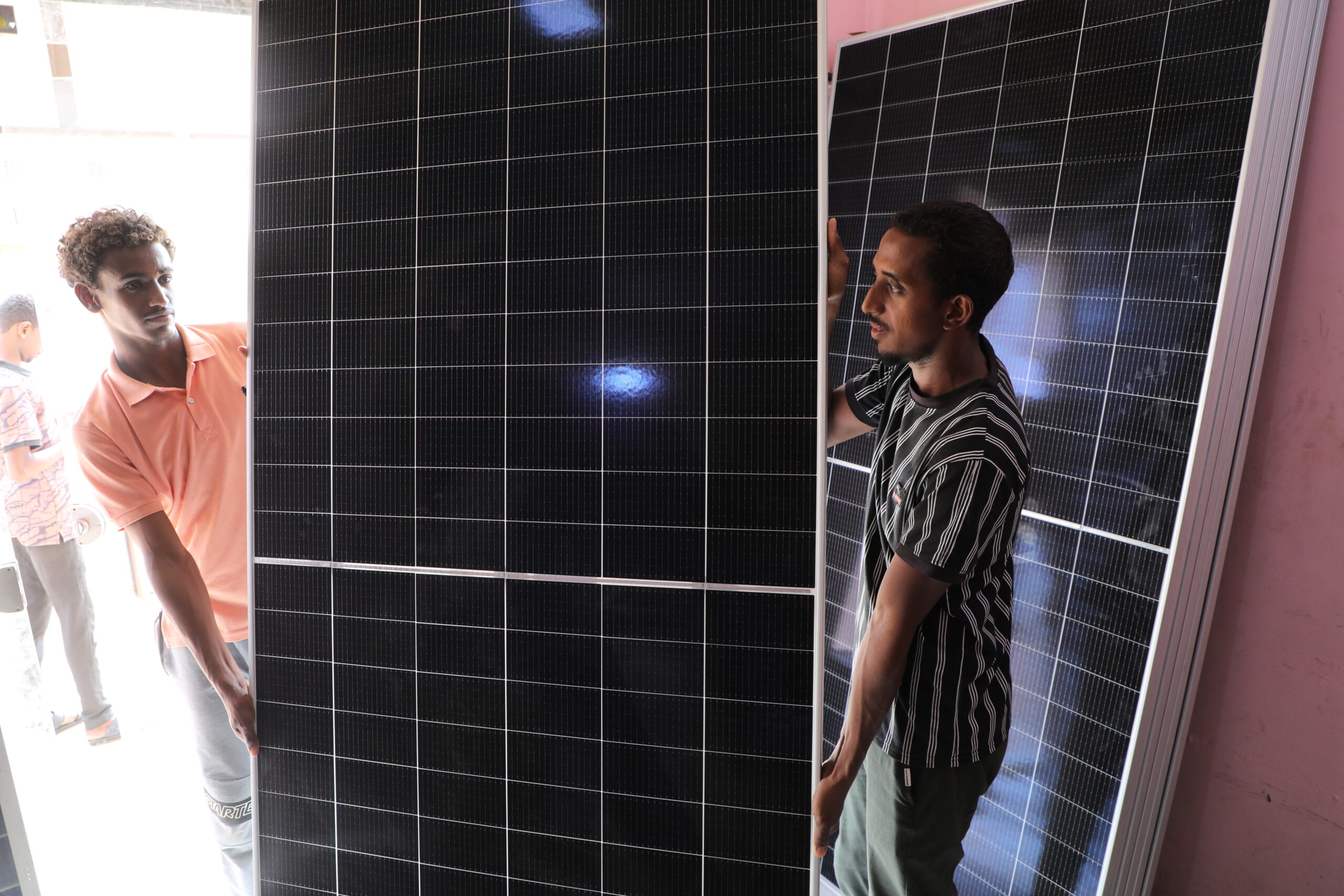
Khalid Mishain, from the Youth Citizens Observers Network, says cuts to humanitarian funding are deepening Sudan’s crisis, with famine spreading, aid groups pulling back, and hunger set to worsen without immediate action.
NEWS BRIEF President Donald Trump launched his midterm election campaign push in North Carolina on Friday, seeking to reframe the economy as a winning issue despite sagging consumer confidence and low approval ratings. In a sprawling speech, he touted stock market gains, cooling inflation, and a recent pharmaceutical pricing deal while deflecting blame for persistent […]
Qatar is trying to catch up in the artificial intelligence (AI) race in the Gulf, relying on its low-cost energy and financial resources. The country is launching Qai, supported by its sovereign wealth fund and a joint venture with Brookfield, marking a significant step into the AI sector. This move is part of a broader aim for the Gulf region to diversify its economies away from oil reliance, similar to investments made by Saudi Arabia and the United Arab Emirates (UAE).
Despite its energy advantages, Qatar faces several challenges in becoming a significant player in AI. These include the need to adopt Western data governance practices, secure advanced chips that are subject to U. S. export controls, and attract skilled talent in a competitive market. Analysts emphasize that overcoming these obstacles, rather than just having financial resources, will be crucial for success in the AI field.
The launch of Qai comes at a time of rising demand for AI infrastructure as companies seek efficiency and cost cuts. Analysts believe that Qatar’s low electricity costs could provide a competitive edge, helping to manage high energy needs in a hot climate. The region’s energy efficiency ratings show that Qatar could grow significantly in the AI market if it maintains affordable power and develops its infrastructure.
Currently, Qatar has a few data centers compared to its neighbors, with plans to increase capacity considerably. The UAE aims to build a large AI campus, while Qatar would need to reach significant milestones, such as achieving 500 megawatts by 2029, to improve its standing. Compliance with strict U. S. rules on chip usage will also be essential for Qai to obtain advanced processors.
Analysts highlight Qatar as a late entrant in the AI race compared to established players like Saudi Arabia and the UAE. While it has certain advantages, its neighbors are better positioned in terms of scale and volume.
Washington, DC – For the past two years, weekdays for Susanna have meant thumbing through picture books, organising cubby holes and leading classroom choruses of songs.
But her work as a pre-school teacher came to a screeching halt in October, when she found out her application to renew her work permit had been denied.
Recommended Stories
list of 3 itemsend of list
Susanna, who uses a pseudonym in this article for fear of reprisals, is one of the nearly 10 percent of teachers in the United States who are immigrants.
But while the US has increasingly looked abroad to fill teacher shortages, some foreign-born teachers say the deportation push under President Donald Trump has threatened their livelihoods — and risks traumatising their students.
Susanna, an asylum applicant who fled violence in Guatemala nearly a decade ago, said that losing her permit meant she had to stop working immediately.
She recalls breaking the news to her students, some of whom are only three years old. Many were too young to understand.
“In one week, I lost everything,” Susanna told Al Jazeera in Spanish. “When I told the kids goodbye, they asked me why, and I told them, ‘I can only tell you goodbye.’ There were kids that hugged me, and it hurt my heart a lot.”
Advocates warn that the sudden departure of teachers could harm the development of young children in school [Mohammed Zain Shafi Khan/Al Jazeera]
Looking abroad for teachers
Estimates vary as to how many foreign-born teachers currently work in the US. But one 2019 report from George Mason University found that there were 857,200 immigrants among the country’s 8.1 million teachers, in roles ranging from pre-school to university.
For the 2023-2024 school year alone, the US government brought 6,716 full-time teachers to the country on temporary exchange visas to fill openings in pre-kindergarten, primary and secondary school education.
Many hailed from the Philippines, as well as countries like Jamaica, Spain and Colombia.
The uncertainty for immigrants under Trump’s second term, however, has proven disruptive to schools that rely heavily on foreign-born teachers.
That is the case for the pre-school where Susanna worked, CommuniKids, which offers language immersion programmes in Washington, DC.
Cofounder and president Raul Echevarría estimates that immigrants — both citizens and non-citizens working with legal authorisation — comprise about 90 percent of CommuniKids’s staff.
But Echevarría told Al Jazeera that the push to rescind legal pathways to immigration has jeopardised the employment of several faculty members.
Five other teachers at the school have seen their ability to work affected by changes to the Temporary Protected Status (TPS) programme.
All five, Echevarría explained, were originally from Venezuela. But in October, the Trump administration ended TPS status for more than 350,000 Venezuelan citizens, including the teachers at CommuniKids.
Their authorisation to work legally in the US will expire on October 2, 2026, according to the US Citizenship and Immigration Services website.
“These teachers lost their ability to make a living,” Echevarria said, noting that his school requires educators with expertise in languages like Spanish, French and Mandarin.
CommuniKids, a language immersion school in Washington, DC, helps young children develop skills in French, Mandarin and Spanish [Mohammed Zain Shafi Khan/Al Jazeera]
‘Strong bonds’
For the schools themselves, the losses can be devastating. Every state in the US has reported teacher shortages to the federal government.
But advocates say the high stress and low pay of education make teachers difficult to recruit and keep.
That leads some states to look abroad for education workers. In North Carolina, for example, 1,063 foreign nationals worked full-time as grade-school teachers on temporary J-1 visas during the 2023-2024 school year.
The top destinations for such recruits were all southern states: North Carolina was followed by Florida with 996 teachers on J-1 visas, and Texas with 761.
But Echevarria said some of the biggest impacts of the deportation drive are felt by the students themselves.
“Our students develop strong bonds with their teachers, and all of a sudden, overnight, they lost their teachers,” said Echevarría.
“Their number one superpower”, he added, “is their ability to empathise and to create strong, effective bonds with people from any background”.
But when those bonds are broken, there can be mental health consequences and setbacks for educational achievement, particularly among younger children.
A 2024 study published by the American Educational Research Association found that, when teachers leave midyear, children’s language development takes a measurable hit.
In other words, the loss of a familiar teacher — someone who knows their routines, strengths and fears — can quietly stall a child’s progress. The consequences extend to a child’s sense of self and stability.
Mental health consequences
For parents like Michelle Howell, whose child attends CommuniKids, the loss of teachers has also made the classroom environment feel fragile.
“The teachers there aren’t just teachers for these young kids,” Howell said of CommuniKids. “They’re like extended family.
“They hug them, they hold them, they do the things a parent would do. When those people disappear, it’s not just hard for the kids. It’s hard for everyone.”
Howell, who is Chinese American, said the sudden disappearances reminded her of her own family’s history.
“I used to read about things like this happening in China, the place my family left to find safety,” she said. “It’s very disturbing to know that what we ran from back then is our reality now. People disappear.”
School psychologist Maria C, who asked to remain anonymous to protect her work in the Texas public school system, has noticed the children she works with struggling with instability caused by the deportation push.
The disappearance of a loved one or mentor — say, a favourite teacher — could flood a child’s body with cortisol, the hormone meant to protect them in moments of danger, she explained.
But when that stress becomes chronic, the same hormone starts to hurt more than it helps. It interferes with memory, attention and emotional regulation.
“For some, it looks like anxiety. For others, it’s depression or sudden outbursts,” Maria said. “They’re in fight-or-flight mode all day.”
She added that selective mutism, an anxiety disorder, is on the rise among the children she sees, who range in age from five to 12.
“It used to be rare, maybe one case per school,” she said. “Now I see it constantly. It’s a quiet symptom of fear.”
Preparing for the worst
Back at CommuniKids, Echevarría explained that he and other staff members have put together contingency plans, just in case immigration enforcement arrives at the pre-school.
The aim, he said, is to make both employees and students feel safer coming to class.
“We put those steps in writing because we wanted our staff to know they’re not alone,” he said. “We have attorneys on call. We’re partners with local police. But above all, our job is to protect our children.”
But as an added precaution, teachers are advised to carry their passports or work permits with them.
Even Echevarría, a US citizen born in Virginia, said he carries his passport wherever he goes. The fear of deportation has a way of lingering.
“I’m bilingual and of Hispanic descent,” he said. “Given how things are, I want to be able to prove I’m a citizen if anyone ever questions it.”
A new wave of Israeli policies is changing the reality and boundaries on the ground in the occupied West Bank.
The Israeli government has approved the formalisation of 19 so-called settlement outposts as independent settlements in the occupied West Bank. This is the third wave of such formalisations this year by the government, which considers settlement expansion and annexation a top priority. During an earlier ceremony of formalisation, Finance Minister Bezalel Smotrich said, “We are advancing de facto sovereignty on the ground to prevent any possibility of establishing an Arab state in [the West Bank].”
Settlement outposts, which are illegal under international law, are set up by a small group of settlers without prior government authorisation. This does not mean that the settlers, who are often more ideological and violent, do not enjoy government protection. Israeli human rights organisations say that settlers in these so-called outposts enjoy protection, electricity and other services from the Israeli army. The formalisation opens the door to additional government funds, infrastructure and expansion.
Many of the settlement outposts formalised in this latest decision are concentrated in the northeastern part of the West Bank, an area that traditionally has had very little settlement activity. They also include the formalisation of two outposts evacuated in 2005 by the government of Israeli then-Prime Minister Ariel Sharon.
While these government decisions may seem bureaucratic, they are in fact strategic in nature. They support the more ideological and often more violent settlers entrenching their presence and taking over yet more Palestinian land, and becoming more brazen in their attacks against Palestinians, which are unprecedented in scope and effect.
The Israeli human rights organisation B’Tselem estimates that settler attacks against Palestinians have forcibly displaced 44 communities across the West Bank in the past two years. These arson attacks, vandalism, physical assault and deadly shootings are done under the protection of Israeli soldiers. During these settler attacks, 34 Palestinians were killed, including three children. None of the perpetrators has been brought to justice. In fact, policing of these groups has dropped under the direction of Israel’s national security minister, Itamar Ben-Gvir, who is a settler himself.
United Nations Secretary-General Antonio Guterres recently sounded the alarm about Israel’s record-breaking expansion of illegal settlements in the West Bank and the unprecedented levels of state-backed settler violence. In a briefing to the UN Security Council, Guterres reminded states that all settlements are illegal under international law. He also warned that they erode Palestinian rights recognised under this law, including to a state of their own.
In September, United States President Donald Trump said he “will not allow” Israel to annex the West Bank, without offering details of what actions he would take to prevent such a move.
But Israel is undeterred. The government continues to pursue its agenda of land grab, territorial expansion and annexation by a myriad of measures that fragment, dispossess and isolate Palestinians in the West Bank, including East Jerusalem, and continues its genocidal violence in Gaza.
More than 32,000 Palestinians have been forcibly displaced from their homes in three refugee camps in the occupied West Bank for nearly a year. The Israeli army continues to occupy Nur Shams, Tulkarem and Jenin refugee camps and ban residents from returning. Meanwhile, Israeli forces have demolished and damaged 1,460 buildings in those camps, according to a preliminary UN estimate. This huge, destructive campaign has changed the geography of the camps and plunged more families into economic and social despair.
This is the state hundreds of thousands of Palestinians across the West Bank find themselves in because of Israeli restrictions, home demolitions and land grabs. The Israeli army has set up close to 1,000 gates across the West Bank, turning communities into open-air prisons. This has a direct and devastating effect on the social fabric, economy and vitality of these communities, which live on land that is grabbed from under them to execute the expansion of illegal settlements, roads and so-called buffer zones around them.
According to the UN Conference on Trade and Development, Israeli practices and policies over the past two years have cost the Palestinian people 69 years of development. The organisation recently reported that the Palestinian gross domestic product (GDP) has shrunk to 2010 levels. This is visible most starkly in Gaza, but it is palpable in the West Bank as well.
The results of these policies and this reality are Palestinians leaving their homes and Israel expanding. During the summer, Israeli Prime Minister Benjamin Netanyahu told a local news station he was on a “historic and spiritual mission”, in reference to the vision of the Greater Israel that he said he was “very” attached to.
On October 14, the Swedish government announced it was nominating the CEO of IKEA, Jesper Brodin, as its candidate for United Nations High Commissioner for Refugees (UNHCR). Less than a month later, as the current high commissioner, Filippo Grandi, approached the end of his mandate, Brodin resigned from his position at the Swedish furniture giant, which he had led for eight years. In January 2026, the office of the UN secretary-general is expected to present a preferred candidate to the General Assembly for what former UNHCR head of research Jeff Crisp has called a “pro forma election”. Can the former chief of an iconic multinational company become the world’s highest authority on refugees — and what will it mean if he does?
In interviews, Jesper Brodin often refers to a small pamphlet by IKEA founder Ingvar Kamprad, titled The Testament of a Furniture Dealer, as outlining the values that inspire his way of doing business: innovation, sustainability and collective effort over individualism. Does the UNHCR need to learn lessons from a “furniture dealer”? The question matters because Brodin’s appeal is often framed in terms of corporate values, yet it remains unclear how — or whether — these translate into the protection of refugees. Whether Brodin has any chance of making it to the Geneva post or not, the question is worth asking, for the role of IKEA as a donor and operational partner of the UNHCR is significant and is likely to grow.
While humanitarianism and business have historically been companions, particularly since the end of the Cold War, this is the first time a business leader has been proposed to head the UN refugee agency. The nomination comes at a time when the UNHCR faces a dramatic cash crunch, and when political pressures and anti-refugee sentiment are increasing globally. Many scholars and practitioners believe the future of the global refugee regime itself may be at stake. Understanding the implications of Sweden’s choice, then, requires examining how corporate humanitarianism now shapes refugee protection.
Many were taken aback by the nomination. Yet the move by Sweden is anything but surprising. Over the past three decades, corporations have taken on increased responsibility for responding to humanitarian crises, while traditional organisations compete for a rapidly diminishing pool of resources. Research on the commodification of compassion has shown how, increasingly, “doing good” and “doing well” have become one and the same. This kind of “brand aid” involved both promoting commercial brands (from Toms shoes to Starbucks) through their involvement in humanitarian causes, and turning aid itself into a branded activity — something most effectively done through corporate partnerships. It began around two decades ago but has now become the dominant model of humanitarian engagement. As one major humanitarian donor in Kinshasa told us, “It’s now all about collaborations between the private sector, businesses and philanthropists.” Indeed, when the desire to help becomes something you can sell, corporations such as IKEA can profit from involvement in global helping that builds their ethical branding. But can the UNHCR profit from being led by IKEA’s CEO? The question goes to the heart of a growing unease about the direction of the refugee regime.
We see three main problems here. First, UNHCR is caught between contradictory demands from donor states in the Global North and hosting states in the South. Brodin and IKEA’s brand of feel-good capitalism cannot reconcile these fundamental tensions over sovereignty. Jesper Brodin has been lauded as a businessman and touts his credibility as a leader and negotiator. “Trump likes people in the business world,” we are told. However, the challenges to the agency’s protection mandate require a vision that goes well beyond the smiling face of compassionate capitalism. While formally remaining the guardian of the 1951 Refugee Convention, UNHCR has been operating in what scholars such as Bhupinder Chimni have described as an “erosion” of the international refugee regime — a long-term weakening of asylum norms and burden-sharing commitments. Donor governments in the Global North have used their limited support for UNHCR’s humanitarian activities in the Global South as a way to deflect attention from the disregard for refugee rights within their own borders. How will Brodin fare in navigating these competing pressures — from containment agendas in the Global North to protection obligations that lie at the heart of UNHCR’s mandate?
Second, Brodin often mentions his experience as a supply chain manager in a company that has put logistical innovation at the core of its business strategy as an important asset for the job. Indeed, this aligns with UNHCR’s current focus on renewing its own supply chain strategy. He also talks about “bringing the values and the assets of refugees to the business community,” a phrase he uses to refer to refugees’ skills and labour potential. However, this endeavour has proved far more complex than he makes it sound. Almost 10 years after IKEA’s first attempt to integrate refugees into its own supply chains in Jordan, the number of people the programme involves remains small, and refugees in the country still face significant barriers to work and social security.
A study we published in 2021 highlighted that a focus on refugee logistics actually meant working towards integrating displaced people into global supply chains rather than providing them with material support or infrastructure. Whether for business or for disaster relief, logistics depend on networks of infrastructure and rules that only function through ongoing negotiation with governments.
Finally, the contradictions of IKEA’s corporate and foundation ownership structure — what makes it work well as a business — embody the paradox of mixing public needs for refugee protection with private objectives for profit. The IKEA Foundation, the company’s philanthropic arm, has been working with UNHCR since 2010, supporting its operations in 16 countries. The UN agency defines the collaboration as “transformative”, highlighting how it has become a model for all its partnerships with the private sector. Moreover, the nomination comes at a time when major donor states, including the US, the United Kingdom and Germany, are slashing their budgets. In this geopolitical context, Sweden, while facing its own economic challenges, may well be seeking to stake its position as one of the last remaining humanitarian powers in the Western world. Brodin’s bid draws on Sweden’s perceived reputation for frugality and sustainability.
However, there is an unspoken yet fundamental contradiction between Brodin’s promise to address UNHCR’s crisis by “holding the purse strings” and the position of IKEA within global economic structures that have contributed to the humanitarian funding crisis in the first place. In 2017, following calls from EU parliamentary groups, the European Commission opened an in-depth investigation into the Netherlands — where the company is headquartered — for its tax treatment of Inter IKEA, one of the two groups operating the IKEA business. The company’s ownership structure, which benefits its commercial operations, may also reduce its tax burden, thereby reducing contributions to public finances. Here, as in many other cases, big business promises to fix global inequality it has helped create.
In the present global climate of hostility to migrants and refugees, Brodin and IKEA’s brand of feel-good capitalism risks further hollowing out UNHCR’s protection mandate, reducing humanitarianism to a matter of well-managed supply chains. The stakes are high: when humanitarian priorities are shaped by corporate logic, core protections — from asylum access to basic assistance — risk being eroded. What benefits a business organisation does not necessarily serve the rights or needs of refugees.
The views expressed in this article are the authors’ own and do not necessarily reflect Al Jazeera’s editorial stance.