L.A. County officials push new sales tax to offset Trump health cuts
L.A. County voters will be asked this June to hike the sales tax rate by a half-cent to soften the blow of federal funding cuts on the region’s public health system.
The county Board of Supervisors voted 4 to 1 Tuesday to put the sales tax on the ballot. County officials estimate it would generate $1 billion per year to replenish the shrinking budgets of local hospitals and clinics. The tax, if approved by voters this summer, would last for five years.
The supervisors say the increased tax — a half-cent of every dollar spent — would offset major funding cuts in the One Big Beautiful Bill Act, which is expected to slash more than $2 billion from the county’s budget for health services over the next three years.
“Millions of people look to us to step up even when the federal government has walked away,” said Supervisor Holly Mitchell, who introduced the ballot proposal along with Supervisor Hilda Solis.
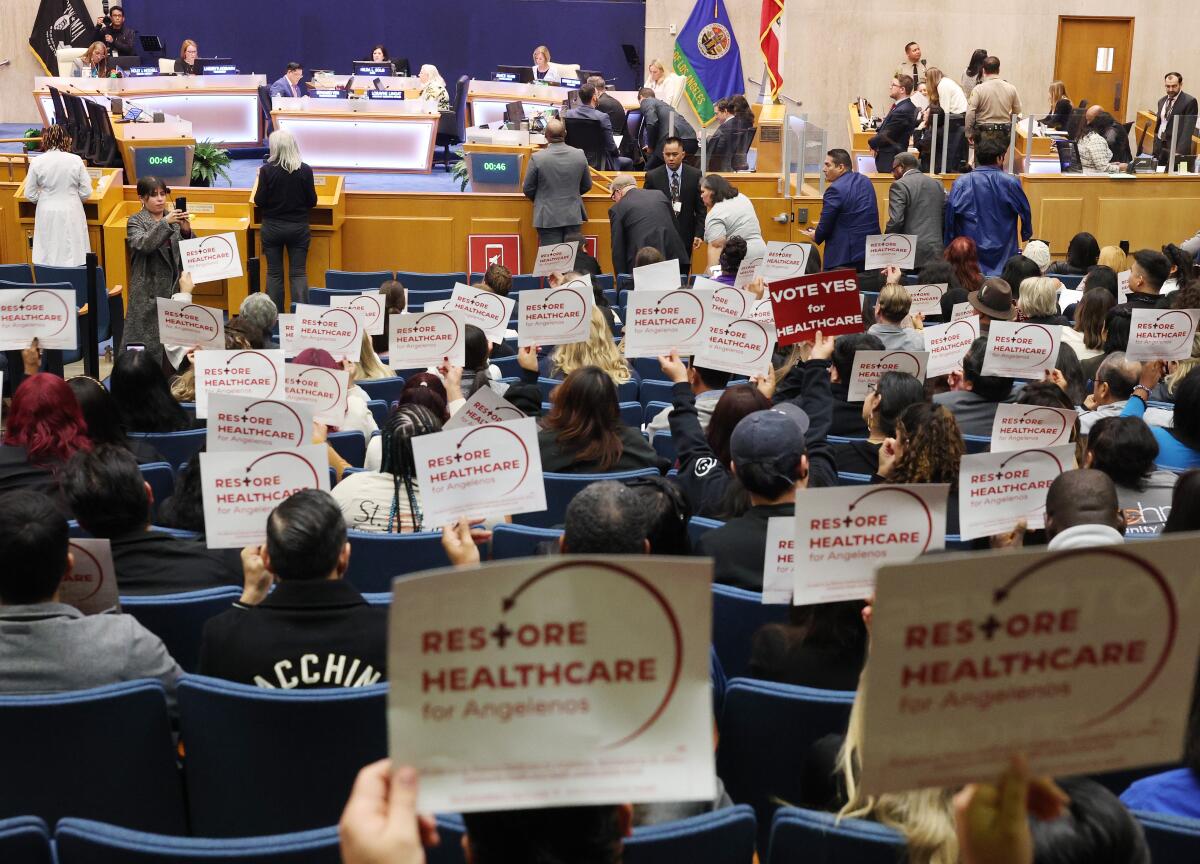
The tax was pushed by Restore Healthcare for Angelenos, a coalition of healthcare workers and advocates, who argue it is necessary to ward off mass layoffs of healthcare workers and keep emergency rooms open.
Mitchell said she was trying to make sure supervisors learned their lesson from the closure of Martin Luther King Jr./Drew Medical Center in 2007, which ripped a gaping hole in the health system for South L.A. residents who had to travel farther to more crowded emergency rooms.
“People died as a result of that,” she said. “I don’t want to go back there.”
Supervisor Kathryn Barger cast the lone no vote, saying she believed the county should look to the state for help rather than taxpayers. She also said she was concerned the tax money was not earmarked for healthcare costs but rather would go into the general fund, giving officials more discretion over how it gets spent.
“We are not, as a whole, credible when it comes to promises made, promises broken,” she said.

Members of the audience hold up signs inside the county Hall of Administration, where supervisors discussed how to replenish more than $2 billion in federal funding cuts to the county healthcare system.
(Myung J. Chun / Los Angeles Times)
As part of the tax hike, voters would be asked to also approve the creation of an oversight group to monitor how the money is spent. The supervisors also voted on a spending plan for the money, which would have the largest chunk of funds go to care for uninsured residents.
Los Angeles County currently has a sales tax of 9.75% with cities adding their own sales tax on top. If the healthcare hike passes this summer, the sales tax would be more than 11% in some cities. Palmdale and Lancaster, some of the poorest parts of the county, would potentially have the highest sales tax of 11.75%.
County public health officials painted a grim picture of what life looks like for the poorest and sickest residents if new money doesn’t flow into the system. Emergency rooms could be shuttered, they warned. Contact tracing and the daily testing of ocean water quality could slow down. Tens of thousands of health workers could lose their jobs, they said.
“The threat is real already,” said Barbara Ferrer, the head of the county Department of Public Health.
Some on Tuesday condemned the measure as well-intentioned but ill-formulated. The California Contract Cities Assn., a coalition of cities inside Los Angeles County, argued a larger sales tax would “disproportionately burden the very residents the County seeks to protect.”
“My phone has been blowing up,” said Janice Hahn, one of two supervisors who said the Citadel Outlets, a large shopping mall in City of Commerce, called to say they were worried shoppers were going to start crossing county lines.
With the effects of the federal cuts expected to be felt across the state, other California counties have already started to look to consumers to replenish government coffers. Last November, Santa Clara County voters approved a similar sales tax measure to raise money for the public health system.