LACP exhibit ‘Reservoir’ explores the visual language of loneliness
The photograph is so intimate, so vulnerable, it’s painful to look at.
It depicts a woman in her early 20s lying on a hospital bed twisted to the side, her wrists and ankles restrained. The black-and-white image — nearly five feet wide — is so crisp that bits of the woman’s toenail polish glimmer and the hair on her thigh appears to spark. Most pronounced: the loneliness and resignation on her face.
“I was 20 or 21 then. I’d had a psychotic episode and was taken to a public hospital in Massachusetts,” says Palm Springs-based artist Lisa McCord of the self-portrait she later staged. “I’m very transparent and I wanted to share my experience afterward. It was the ‘70s. I’d tell people, in school, I’d been in a psychiatric hospital and no one wanted to hang out with me — it was a very lonely time.”
McCord’s work is part of an exhibition at the Los Angeles Center of Photography addressing the idea of loneliness, now considered an epidemic in America. The exhibition, “Reservoir: Photography, Loneliness and Well Being,” was curated by LACP‘s executive director, Rotem Rozental, and includes participation from more than 40 artists representing “a wide array of geographies, approaches, ages, nationalities and lived experiences,” she says.
Rozental had been thinking about loneliness in our society — how increasingly pervasive it is — since the start of the pandemic. In late 2024 she began having conversations about it with LACP board chair and artist Jennifer Pritchard. Art reflects the world that we live in and Rozental felt that, as a photography center, LACP had an obligation to amplify “some of the larger issues” our society is grappling with.
“There’s something about photography that really brings people together around their vulnerabilities,” Rozental says. “Even if it just means you’re seeing, through an image, that someone else is experiencing what you’re experiencing.”
In this case: loneliness — “something that is looming heavy on everybody,” Rozental adds.

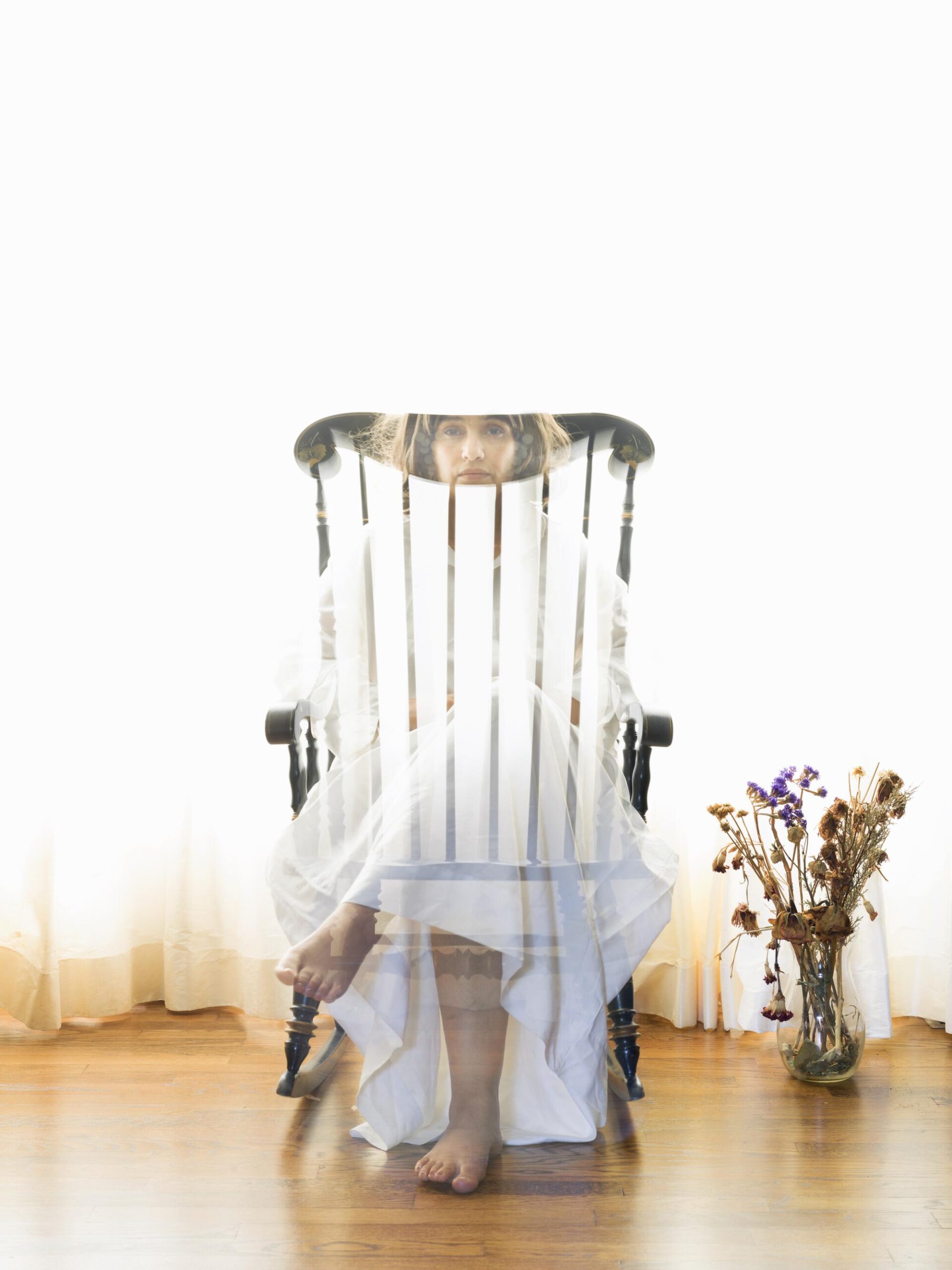
Asiya Al. Sharabi’s “Inward” (2025) addresses the uncertainty, and sometimes loneliness, of being a woman and an immigrant.
(Asiya Al. Sharabi)
Chronic loneliness is a serious, growing public health concern, says Dr. Jeremy Nobel, a professor at the Harvard T.H. Chan School of Public Health and author of the 2023 book “Project UnLonely: Healing Our Crisis of Disconnection.”
“Most recent studies indicate that 50% of Americans are often lonely,” Nobel says, adding that a December 2025 study found that “loneliness is increasing, even after the pandemic. And it’s driving a change in behavior, the big one being that people are disengaging from each other and community activities, so that also isolates them.”
What’s more, chronic loneliness has tangible, dangerous effects on our health, he says.
“Loneliness increases the risk of heart attack and stroke and general early mortality by up to 30%. Dementia risk goes up by 40%, diabetes risk goes up 35% from being chronically lonely. That’s increased the urgency to address it as a public health crisis.”
It’s important to note, Nobel says, that there’s a difference between being alone and being lonely, with the former potentially good for your health.
“Being alone means you don’t have social connection. Loneliness is the subjective feeling that you don’t have the social connections you want,” Nobel says. “You can be lonely in a crowd, you can be lonely in a racist workplace, you can be lonely in a failed relationship or marriage. But being alone can actually be quite positive — solitude. You can be in touch with thoughts and feelings and can have emotional growth.”
Nobel consulted with many of the artists during the development of “Reservoir.” It was a natural pairing as his more than 20-year-old nonprofit, the Foundation for Art & Healing, explores how creative expression helps individuals and communities heal. The experience “definitely validated ‘how do creative people use their creative orientation to further explore and reveal what’s going on with loneliness,’” he says. “That’s the power of this exhibit.”

A detail shot from Diane Meyer’s “The Empty Space of Nothing #43” (2025)
(Diane Meyer)
To create the exhibition, Rozental selected six photographic mentors, all established artists, each of whom chose a theme around loneliness — “aging,” “immigration,” “technology and hyper-consumerism” or “the solo creative process,” for example. The mentors then invited artists to create new work responding to their themes. Over nine months last year, the groups of artists met monthly on Zoom — “six countries and seven time zones,” says Rozental — along with therapists, scholars and others to plumb the topic.
The resulting exhibition features mostly two-dimensional photography but also includes multimedia works and 3D installations.
L.A.-based artist Diane Meyer sourced about 100 old black-and-white photographs from private collections. Then she hand-painted each of them, blocking out most everything in the image except select figures with white paint. The individuals in the photos appear to float in a sea of clouds or snow, disconnected.
In one image, two young boys teeter on a seesaw, as if suspended in midair; in another, a middle-aged man lies on a blanket in the fetal position, white paint spilling over onto his blanket and body, as if he is sinking into a void. The creative process — which the work speaks to — is evident here, the artist’s hand noticeable. The paint is splotchy in places and the photographs are pinned delicately to a dark surface, their edges curling, giving the overall installation a textured materiality.
Meyer’s work is in stark contrast to Jacque Rupp’s installation on the opposite wall. Rupp’s slick multimedia work speaks to both technology and societal perceptions of aging women. After recently becoming a grandmother, the Bay Area-based artist asked AI to “imagine a grandmother in 2025.” The result is a black-and-white photo grid of several hundred female faces staring blankly into the camera, mouths closed and eyes vacant. Beside it is a TV monitor on which their faces morph into one another, without audio. The overall effect is polished and high-tech, touching on the perceived invisibility of women as they age.
“I felt that these two works needed to be in conversation,” Rozental says.

Julia Buteux’s “Have We Said Hello” (2025)
(Rotem Rozental)
Nearby, Julia Buteux’s three-dimensional installation of transparent fabric panels hang from the ceiling, shimmying in the air and inviting guests to walk around it. The Rhode Island-based artist downloaded images from social media and deleted the people from them. The backgrounds are colorful but all that’s left of the subject is a transparent imprint of their face and upper body. “So you’re getting the absence of the user,” Rozental says. It speaks to how isolating online social milieus can be.
Asiya Al. Sharabi — who is Yemeni American and lives between Egypt and Virginia — created large-scale, conceptual self-portraits that she manipulated in the printing process. One is a double exposure depicting the front and side of her face. It addresses issues of duality and the uncertainty of her standing in society as both a woman and an immigrant. In another, the artist sits in a rocking chair in a home beside a vase of dead flowers — but her body is transparent. “She almost disappears within the domestic space,” Rozental says.
McCord’s photograph is part of a larger interactive installation that includes a “visual diary” guests can flip through featuring photographs of her life over the decades paired with handwritten diary entries from 1977 to 2021. McCord narrates snippets from the diary, which visitors may listen to on headphones.
“Reservoir” aims, of course, to shine a light on the condition of loneliness. But it also hopes to serve as a public health intervention by hosting creative workshops — incorporating the photography in the exhibition — to address loneliness and spark connection.
“Creative expression changes our brains,” Nobel says. “It reduces levels of the stress hormone cortisol, it increases the levels of the feel-good hormones, so you’re less anxious about the world and in a better mood. It’s then easier to engage with others. It invites us to be less lonely and more connected, not just to other people, but ourselves.”
The exhibition, which closes March 14, is planned to travel internationally, including to the Museo Arte Al Límite in Chile, the Inside Out Centre for the Arts in South Africa and to the Karuizawa Foto Fest in Japan. The goal is to use the workshop element as a model that can be replicated in community arts organizations around the world.
Rozental says photography is the perfect conduit for that, calling the medium “a language, a space for connection and communication.”
“We hope that people will walk into this space and see themselves on the walls,” she says. “Maybe their burden will ease a little bit by knowing that they might feel lonely, but they’re not alone.”