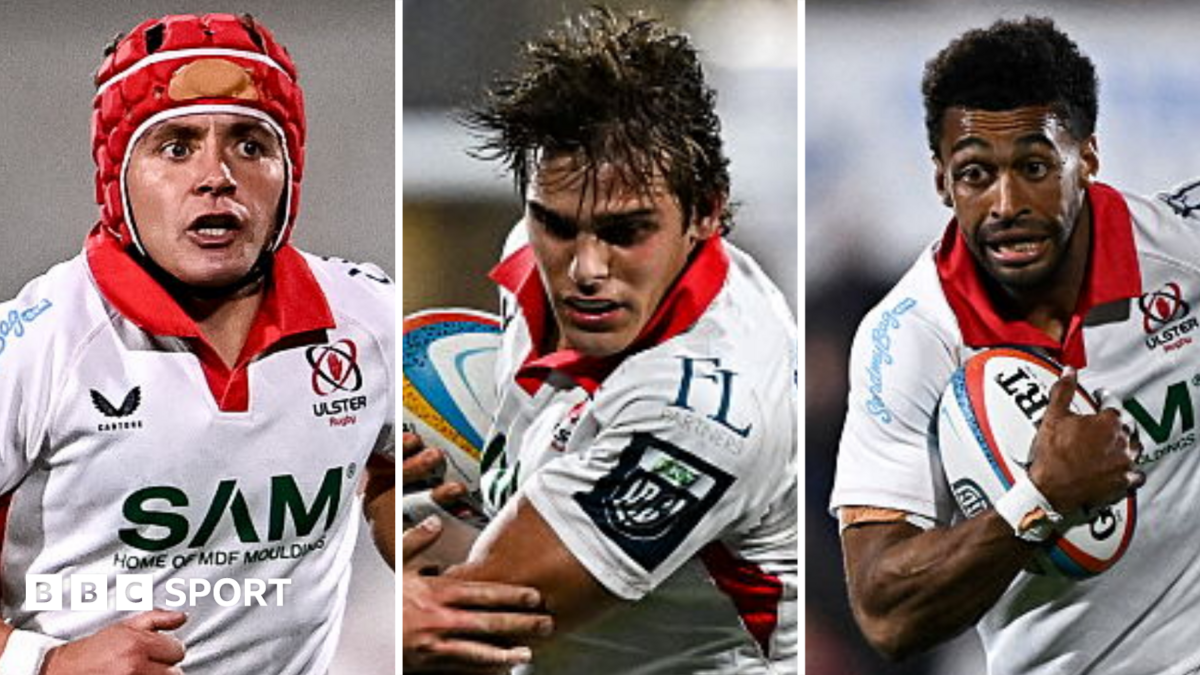
Ulster have been handed a major boost as winger Robert Baloucoune is fit enough to start Friday’s European Challenge Cup final against Montpellier.
Baloucoune was expected to be sidelined for three months after picking up an elbow injury in Ireland’s Triple Crown-sealing Six Nations win over Scotland in March.
But having returned to training ahead of schedule, the 28-year-old has been selected on the right wing by head coach Richie Murphy as Ulster bid to end a 20-year wait for silverware.
Baloucoune, who has scored six tries in seven games for Ulster this season, joins Mike Lowry and leading try-scorer Zac Ward in the back three, with Jacob Stockdale having already been ruled out.
In Stuart McCloskey’s absence, Jude Postlethwaite partners James Hume in midfield, while the first-choice half-back pairing of Jack Murphy and Nathan Doak are reinstated after starting last week’s United Rugby Championship loss to Glasgow on the bench.
In the pack, Angus Bell returns at loose-head prop for his Ulster swansong before returning to Australia, with Tom O’Toole at tight-head. A calf problem for vastly experienced hooker Rob Herring means Tom Stewart completes the front row.
Without suspended captain Iain Henderson, Harry Sheridan partners Cormac Izuchukwu in the second row, while flanker David McCann has returned to fitness to start alongside stand-in skipper Nick Timoney and Juarno Augustus in the back row.
Murphy has opted for a split of five-three split on the bench, with James McCormick, Eric O’Sullivan, Scott Wilson, Charlie Irvine and Bryn Ward providing forwards cover and Conor McKee, Jake Flannery and Ethan McIlroy as the backline replacements.
Secessionists in the western Canadian province of Alberta recently announced that they have gathered enough signatures to launch a referendum on independence from the rest of the country.
Leading secessionists said that they formally submitted about 300,000 signatures to election authorities earlier this week, far more than the 178,000 required for the province to consider a referendum.
Recommended Stories
list of 3 itemsend of list
“This day is historic in Alberta history,” secessionist leader Mitch Sylvestre said.
“It’s the first step to the next step — we’ve gotten by Round 3, and now we’re in the Stanley Cup final,” he added, referring to a hockey championship tournament.
Even if a vote were in favour of independence, an uncertain and protracted process would follow, including possible legal challenges and negotiations with the federal government.
But the possibility of a referendum has brought renewed attention to Alberta’s longstanding frustrations with federal power in Canada and calls for greater autonomy.
What is driving Alberta’s secessionist movement? What are the prospects of success for the referendum, and what could it mean for Canadian politics? Here’s what you need to know.
Secessionist leader Mitch Sylvestre speaks to reporters as he leads a rally in front of the Elections Alberta headquarters in Edmonton, Canada, on May 4, 2026 [Henry Marken/AFP]
How many signatures were collected?
Alberta secessionists said on Monday that they had submitted nearly 302,000 signatures, more than the 178,000 required to qualify for referendum consideration.
Alberta Premier Danielle Smith has said she would move forward with the vote if the petition gathered enough signatures, although she does not support independence from Canada herself.
What would the referendum ask voters?
If the proposed measure makes it to the ballot, it would ask voters: “Do you agree that the Province of Alberta should cease to be a part of Canada to become an independent state?”
Does this guarantee a referendum, and could Alberta actually separate from Canada?
Meeting the signature requirement does not in itself guarantee that a referendum will take place.
Elections Alberta, the province’s electoral authority, still needs to verify the petitioners’ names, a process that has been stalled by a court ruling.
Indigenous groups have also filed a legal challenge, stating that separation would be a violation of their treaty rights.
There are also questions about whether the referendum will gather sufficient support among voters to pass. Polls have shown that about 30 percent of residents would support such a measure.
What’s behind Alberta’s bid for separatism?
While secession has never been so close to a vote in Alberta, pro-independence sentiment has been part of the province’s political culture — home to about 5 million people — for decades.
That sentiment is driven largely by the feeling of many in Alberta that the province is distinct — culturally, economically, and politically — from the rest of Canada.
The oil-rich western province has long expressed frustration with political decision-making in Ottawa, the Canadian capital, despite what it sees as its outsized economic contribution to the national economy through its massive fossil fuel industry.
Environmental regulations and efforts to address climate change have become another flashpoint, with secessionist leaders depicting Alberta’s primary industry as hamstrung by regulatory decisions made by bureaucrats with little understanding of the province.
“We’re not like the rest of Canada,” secessionist leader Sylvestre told the news service AFP. “We’re 100 percent conservative. We’re being ruled by Liberals who don’t think like us.”
“They’re trying to shut down our industry,” he added.
Oil pumpjacks operating in a farmer’s field near Calgary, Alberta, Canada, on November 26, 2025 [File: Todd Korol/Reuters]
Have any other provinces considered separating from Canada?
Alberta is not the only region with a complicated relationship with the rest of Canada.
The French-speaking province of Quebec is home to a decades-old nationalist movement that has pushed to separate from Canada, rooted in a desire to recognise Quebec’s distinct linguistic and cultural identity.
The popularity of that movement has ebbed, with a March poll finding Quebecois secessionism at its lowest level of support since voters narrowly rejected a referendum in 1995. Still, the secessionist Parti Quebecois political party is polling high in advance of a provincial election set for later this year.
Has the push for independence attracted criticism?
As with all independence movements, the province’s bid for separation from the rest of Canada has become a source of passionate disagreement.
“It stands for something that most of us Albertans and Canadians don’t stand for,” Thomas Lukaszuk, the province’s former deputy premier and a strong supporter of federalist identity, told AFP. “It’s a form of treason.”
Expressions of support from the administration of United States President Donald Trump, who has angered Canadians by suggesting that the country should become a US state, have also sparked criticism that the secessionist movement is undermining Canadian unity.
Asked about the possibility of independence in January, US Treasury Secretary Scott Bessent said that Alberta would be a “natural partner” for the US.
“Alberta has a wealth of natural resources, but they won’t let them build a pipeline to the Pacific,” Bessent told a US right-wing commentator. “I think we should let them come down into the US, and Alberta is a natural partner for the US. They have great resources. The Albertans are very independent people.”
“The separatists are not elected members. They’re just citizens of Canada residing in Alberta, and they actually formed delegations and are received by the highest levels of US administration,” Lukaszuk said. “That must be very empowering to them.”
Regardless of whether the proposed ballot measure succeeds, the development is likely to serve as a shot in the arm for the province’s secessionist forces.
“I think this is going to be a permanent change in our political culture,” independent historian and supporter of independence Michael Wagner told AFP, adding that the movement “is not going to just disappear”.
What happens next?
A provincewide ballot could take place as soon as October, as part of a larger referendum on several questions relating to constitutional issues and other matters, such as immigration, scheduled for October 19.
Justice Shaina Leonard issued a monthlong stay on the certification of the independence petition on April 10, following a legal challenge from several First Nations groups who say separation would violate treaty rights.
That ruling did not bar the gathering of signatures, and a decision on legal challenges from Alberta First Nations is expected later this week. A decision in favour of the First Nations challengers could render the process academic.
Cullen and Leinster, who had comfortably cruised through the tournament last season, came under intense scrutiny after Northampton’s fast start saw them take a 12-point lead at half-time.
The four-time champions fought back and almost snatched the game at the death, with Cullen revisiting late refereeing decisions that cost his side in the 37-34 defeat last May.
A year on, he defended his side, who had previously never beaten three-time champions Toulon, and said he always expects a Champions Cup semi-final to “never go to script”.
“Naturally [in the last 10 minutes] you try and protect things, don’t you? Whereas the other team they don’t have protection and throw everything at it,” he added.
“We were sitting in this room this time last year. We were in that situation and we were throwing everything at Northampton. [Henry] Pollock gets a poach – it should have been a penalty.
“It’s clearly illegal, but nobody wants to report about it after. We should have had a penalty try and nobody wants to report about it. You just want to kick the boot into us, don’t you? But that’s the way it goes.
“Semi-finals come down to the tightest of margins. In 2012, Wesley Fofana knocked the ball over the tryline and that is how we [Leinster] got to the final.
“I would be kind to Toulon as they showed great spirit to the very end.”
Leinster will travel to Bilbao for the final on Saturday, 23 May, where they will face last year’s champions Bordeaux-Begles or Bath, who play on Sunday.
Cullen confirmed centre Robbie Henshaw and flanker Josh van der Flier, who left the field with head injuries, will undergo the graduated return-to-play protocol.
Flanker Jack Conan limped off and “will get checked”, with Tommy O’Brien said to be likely suffering from cramp.
All four are important players for Cullen as Leinster seek a fifth Champions Cup in three weeks’ time.
Ulster have received a boost with the news that Tom O’Toole, Nick Timoney and Jude Postlethwaite will be available after injury for Saturday’s European Challenge Cup semi-final against Exeter Chiefs at Affidea Stadium (17:30 BST).
Timoney returns after recovering from a hip injury, while O’Toole and Postlethwaite are at head coach Richie Murphy’s disposal after overcoming hand problems.
A squad update issued by Ulster Rugby on Monday confirmed that the trio have “all reintegrated fully into team training and are available for selection”.
Meanwhile, decisions on whether Angus Bell (foot), James Hume (neck) and Bryn Ward (shoulder) will be fit enough for selection for the encounter with the English Premiership side will be made later in the week.
All three have resumed elements of team training.
Callum Reid and Ben Carson will be unavailable for the last-four game as a result of foot and calf injuries respectively.
Both players sustained their injuries during Saturday’s 41-14 United Rugby Championship (URC) defeat by Munster in Limerick.
Eric O’Sullivan suffered a back injury during the match and will have his fitness monitored during the week.
Ulster are aiming to secure their first silverware for 20 years and the winner of their semi-final will face the winner of Sunday’s second semi-final between Montpellier and the Dragons in the final in Bilbao on 22 May.