Their face is gone, LeBron James getting kicked to a Philly curb.
Their voice is gone, longtime public address announcer Lawrence Tanterdying last month at age 76 after more than four decades of dulcet downtown tones.
Meet the 2026-27 Lakers, a team that will look different, sound different, feel different, play different and behave different from their recent predecessors in every way but one.
They’re still not winning a championship.
They’re still not getting to the conference finals.
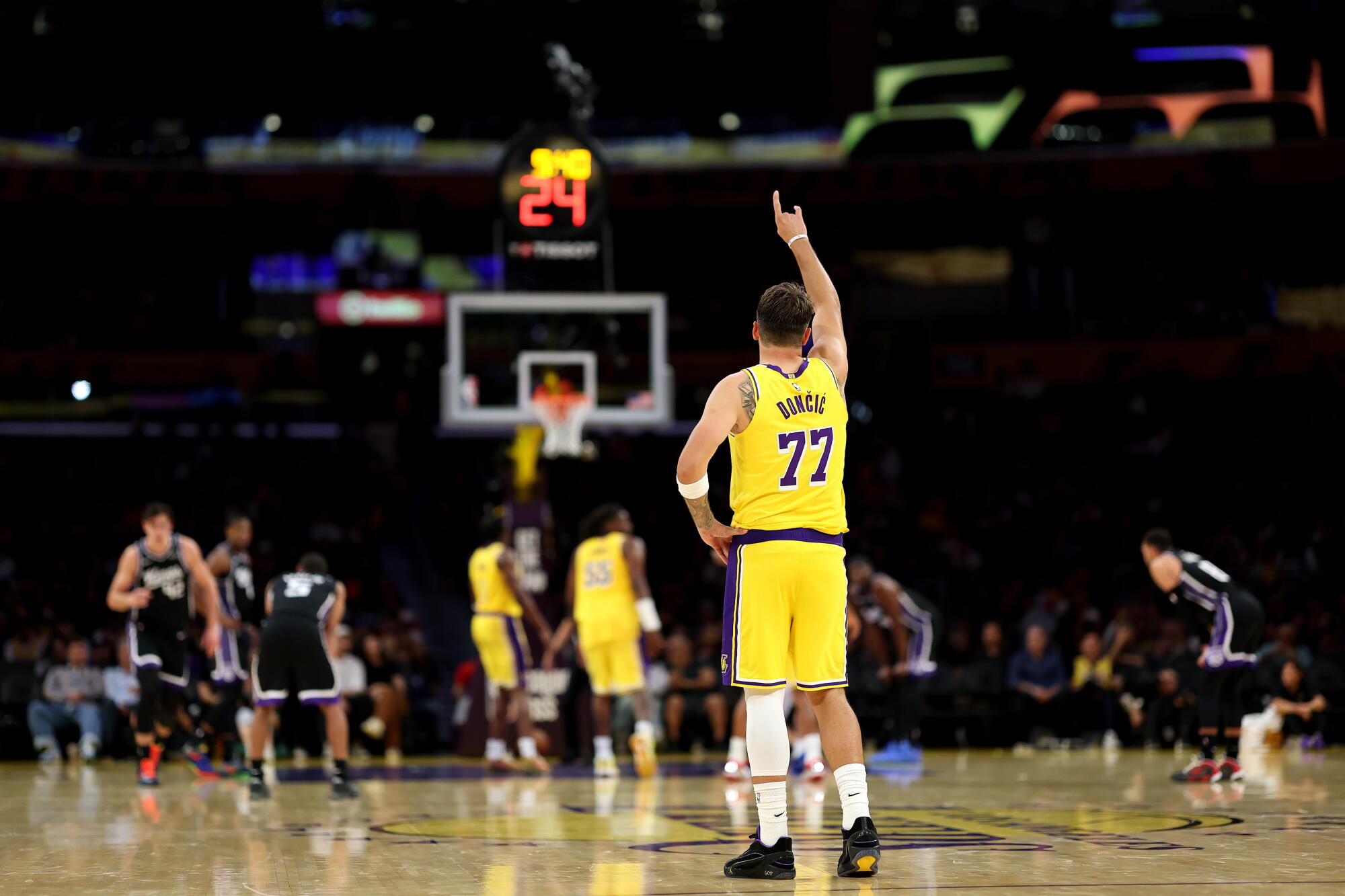
Lakers guard Luka Doncic enters this season as the face of the franchise after LeBron James’ departure.
(Luke Hales / Getty Images)
They’re still destined to a sixth seed and a first-round knockout in the impossible West, a mediocre finish that is sure to convince new ownership to make massive changes — look out Rob Pelinka and JJ Redick! — and start all over again next season.
So call this a gap year.
They’ve graduated from LeBron, but they’re still not quite sure what they want to do with the rest of their life.
They’re planning on majoring in Luka Doncic, minoring in Austin Reaves and specializing in Walker Kessler, but there are flaws in all three, and the rest of the proposed curriculum is an unknown collection of ideas that have yet to be put together in a cogent package.
For now, the league’s biggest roster overhaul includes names that are just names, the likes of Quentin Grimes, Collin Sexton, Matisse Thybulle, Ziaire Williams, Sandro Mamukelashvili and Kevon Looney. Who knows where they will fit? Who knows what they can do?
Then there’s the name Bronny James, whose future here took a nosedive when his pops moved to Philadelphia and he had a lousy training camp. Who knows how long Bronny will stick around, but at least the Lakers are out of the LeBron family drama business, which is good, because this team will create enough drama on its own.
First, there’s Doncic, and the risk in building around him, considering he’s missed an average of 20 games a season the last three years. He’s appeared in a total of five playoff games since leading the Dallas Mavericks to the Finals three years ago. He’s 27, but sometimes he trudges around the court like he’s 50.
Lakers guard Bronny James dribbles during a preseason game against the Kings at Crypto.com Arena on Oct. 8.
(Luke Hales / Getty Images)
Now that this is Doncic’s team, will he act like it?
Every centerpiece player in Laker history — from Mikan to West to Kareem to Magic to Kobe to Shaq to Pau to LeBron — has carried their group to a championship. They’ve not been considered a true Laker until they have done so. In the case of LeBron, one was not even enough.
Is Doncic prepared to shoulder this burden? He says yes. He says he’s done this before, although he’s never won an NBA title, so, um …
“It feels great,” he told reporters at media day last month. “Obviously, it’s a new challenge. I was in this position in my career a lot of times, so it’s not new to me. But I feel great. I feel excited, and like I said, I’m ready to go. It’s been a long time since I played basketball, so I’m ready.”
He got off to a good start this summer when he flew the team to his native Slovenia to spend a few days bonding. He is already acting like a captain. Now he needs to play every day like one.
“I see myself in this role, nothing new, but it’s very important,” Doncic said. “Everybody on the whole team, you know, look up to me, I have to look up to them. And it’s just, there should be many leaders, you know. You should be able to hold each other accountable.”
Lakers guard Austin Reaves dribbles past the Kings’ Nique Clifford during a preseason game at Crypto.com Arena on Oct. 8.
(Luke Hales / Getty Images)
Many leaders? Probably only two, Doncic and his newly minted $180-million running mate Reaves.
The Lakers were 30-11 when the two gunners were on the court last season, and no NBA duo averaged more points, but, again, this year is different.
Last year they both had LeBron as a safety net. This year, it’s all on them.
Just like Doncic, Reaves said he is ready to help guide his new teammates on this arduous journey.
“The expectation here of being a Laker is higher than it is anywhere in the world,” Reaves said. “The media presence, you know, every day something is going to come out about us, and just being able to know how to navigate that and help others navigate that is the main thing. One second we’re going to be the best team in the world. And the next you lose two in a row, you’re the worst team, you can’t figure it out. So, helping these guys understand that none of that really matters, it’s all about what goes on within these walls, is the main thing.”
Actually, for Reaves, the main thing is the postseason, where he has mightily struggled, even taking into account the slight guard usually enters each spring with all sorts of bumps and bruises. He’s been a lousy playoff shooter. He’s been a clumsy playoff playmaker.
But one of the greatest undrafted free agents in recent league history appreciates and embraces every chance to change the narrative, and he’ll have no greater chance than this season.
“You’re going to have failures within this long season,” he said. “But every single night you’re going to have an opportunity when you take the floor, especially for this organization, for this fan base to show the world what you’re capable of. So, you’re going to have every single opportunity to do good with the opportunities that you’re given.”
No Laker, it seems, will have a greater nightly opportunity to write his legacy than Kessler, who was acquired this summer from the Utah Jazz for the princely sum of two first-round picks and two first-round pick swaps.
He is being projected as a perfect lob and pick-and-roll partner for Doncic and a long-awaited rim protector, but let’s be real.
He played in five games last year and never started a full season in his four years in Utah and even for a perpetually tanking team, that’s not a big resume. What sort of NBA center he will be is anybody’s guess.
The Lakers are guessing huge, and at least he sounds like he’s ready for it.
Laker Walker Kessler fouls the Warriors’ Yaxel Lendeborg during a preseason game on Oct. 13 in Las Vegas, Nev.
(Ethan Miller / Getty Images)
“And as far as the belief that they’ve shown in me, I mean, it makes me excited for this year,” he said. “It makes me feel like I can run through the wall for this organization, this team, my teammates, so yeah, I’m just so excited.”
Good thing about that wall, because with this unsettled bunch, there will be plenty of them.
But, hey, at least one looming question has been answered. During media day, new power forward Mamukelashvili gracefully explained how to pronounce his last name.
“So, a lot of people think it’s hard, but I don’t think so,” he said. “It is Mamu-kela-shvili. So if you take like, I feel like, two letters at a time, and “shvili” at the end, it’s not that hard.”
If only the rest of this season would go so smooth.
The U.S. Department of Justice has ratcheted up its pressure campaign on California election officials to ferret out alleged voter fraud ahead of the Nov. 3 midterm election, demanding that officials statewide prove the U.S. citizenship of thousands of voters flagged by the federal government as potential noncitizens, or withhold or set aside their ballots.
Acting Deputy Atty. Gen. Trent McCotter made the demand — which experts called highly questionable at a time when votes are already being cast — in letters to state election officials Tuesday, including Secretary of State Shirley Weber and Dean Logan, head of the L.A. County Registrar-Recorder/County Clerk’s office.
The letters, reviewed by The Times, call on the state officials to respond to the Justice Department within 48 hours.
McCotter wrote that the Justice Department had provided Logan’s office with a “password-protected thumb drive with a list of names the Federal Government believes are likely noncitizens who were sent a vote-by-mail ballot” for the Nov. 3 election.
“We request that you review the list within 48 hours to determine whether any citizens are listed. For individuals whom you cannot independently confirm citizenship status, we request that you immediately instruct the appropriate elections officials to segregate — not cancel — those individuals’ vote-by-mail ballots until their citizenship status can be determined,” McCotter wrote to both Weber and Logan.
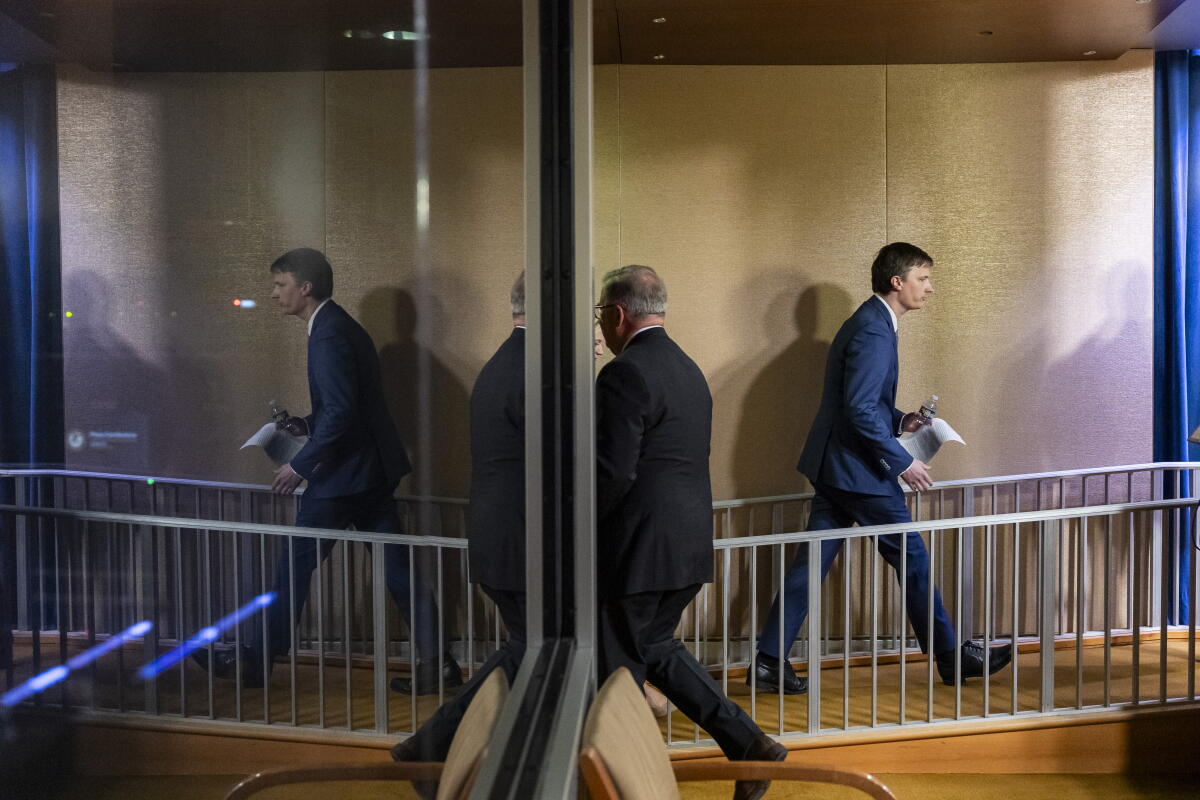
The demand letter came from U.S. Acting Deputy Atty. Gen. Trent McCotter, shown entering a news conference in September 2026 in Washington.
(Finn Gomez / Getty Images)
Voters on the federal list who haven’t already been sent a ballot should not be sent one until their citizenship is verified, while ballots already returned by voters on the list should not be counted until their citizenship is verified, McCotter wrote.
Weber’s office in a statement late Wednesday criticized the Justice Department for telling it to obtain a list of an unknown number of voters it hadn’t been given directly from Logan’s office, investigate all of those voters and “take action” all within 48 hours, based on inaccurate federal data that has led to U.S. citizens being purged from rolls in other states, and under threat of litigation despite the Justice Department providing no legal authority for the demand.
Weber said the Justice Department’s “relentless efforts to unlawfully gain access to states’ protected voter data and purge voter rolls serve only to cause chaos and fuel public distrust in our elections,” and that California already has “robust state law requirements” to ensure only U.S. citizens vote.
Logan said his office was reviewing the Justice Department letter in coordination with Weber and California Atty. Gen. Rob Bonta, but had not accessed the USB drive because state officials “do not consider the device a secure medium” and accessing its contents “would conflict with established data privacy and information security protocols.”
He said that maintaining accurate voter records is a fundamental responsibility of his office, but also that federal and state laws “are clear on how voter eligibility is established — and any action to remove a voter from eligibility must be based on verifiable information, not assertions of unconfirmed data matching.”
Weber previously questioned the basis for a claim by Homeland Security Secretary Markwayne Mullin in July that there may be more than 190,000 noncitizen voters on California rolls, and rebuffed Trump administration offers to work with her office to purge state rolls of such ineligible voters ahead of November without additional information on how it reached its conclusions.
Similar Trump administration lists have been shown in other states to be substantially inaccurate, and to include many voters who are indeed citizens. Election experts say that makes the demand on California — where ballots have already been mailed out — even more concerning.
“One must question why the DOJ would violate its own rules about investigating elections close to election day, and over a week after they knew the state had already mailed ballots out, particularly when their past claims have been full of errors,” said David Becker, executive director of the nonpartisan Center for Election Innovation & Research.
Becker noted the Trump administration alleged that there were nearly 16,000 noncitizens registered in Nevada, later reduced that number to 185 after additional scrutiny, and then determined all of them were in fact citizens.
A Justice Department spokesperson, in a statement to The Times, defended the agency’s demands to California — saying it “should not be controversial, as the criminal statute is clear: only American citizens may vote in federal elections. It is a federal crime for noncitizens to vote in U.S. elections, and the DOJ is asking California to ensure that is not occurring.”
The spokesperson said the agency could not provide the exact number of voters whose citizenship is being questioned, but that it is in the thousands.
California Secretary of State Shirley N. Weber speaks during the state Democratic Party convention in Anaheim on May 31, 2025.
(Damian Dovarganes / Associated Press)
McCotter wrote that if Weber cannot implement his demands for how to segregate ballots and verify voter citizenship for those on the federal list, the Justice Department “will have no choice but to seek emergency relief” — an apparent reference to seeking court intervention.
McCotter copied on the letters First Assistant U.S. Atty. Bill Essayli, the lead federal prosecutor in Los Angeles whose office previously sent Logan’s office a series of grand jury subpoenas for individual voter records as part of a criminal investigation into illegal voting.
Essayli’s office referred questions to the Justice Department. Bonta’s office referred questions to Weber and Logan.
Rick Hasen, director of the Safeguarding Democracy Project at UCLA School of Law, said that he is “not aware of anything like this ever happening this close to an election,” and that it may in fact be illegal under the National Voter Registration Act, which “prevents systematic purges of voters 90 days before the election.”
He said that the question of whether that preclusion against purges applies to the removal of noncitizens is an issue that is currently before the U.S. Supreme Court, in an Arizona case the high court will hear in December, but that the Justice Department’s actions strike him as “legally questionable.”
Hasen said the “whole point of that 90-day rule is to prevent the inadvertent disenfranchisement of eligible voters by mistake in the rush before the election,” and that risk is increased by the inaccuracies of similar lists presented by the Trump administration in other states. “So if there is an attempt to go to court — if DOJ tries to sue over this — they might have a hard time getting a judge to agree that this is something that the registrar must do or even can do.”
The fact that election officials are already busy receiving and preprocessing ballots would only bolster the state’s position in such a case, Hasen said.
“It’s obviously not a convenient time,” he said. “And given the fact that the lists have proven to be wildly inaccurate, at least in other states, it might be sending the registrar on a wild goose chase, when they have more relevant things to do in the election.”
But that “chaos” may be the point, Hasen said. “This is potentially another example of DOJ just making the work of state and local election administrators — which is already quite difficult and stressful — even harder,” he said.
Attorneys with the UCLA Voting Rights Project filed a lawsuit last month on behalf of the Coalition for Humane Immigrant Rights, or CHIRLA, and a California voter named Pedro Trujillo, in which they challenged the Trump administration’s use of unproven federal databases to allege registered California voters are not citizens.
On Wednesday, they told the Justice Department that they would be seeking emergency relief from such practices, given McCotter’s letters.
“The federal government’s attempt to pressure California election officials into acting on lists that may misidentify eligible voters is an alarming abuse of power as election season gets underway. This puts our communities and our fundamental rights at risk,” said Carl Bergquist, a CHIRLA attorney.
The Justice Department in recent weeks has announced scattered arrests of alleged noncitizen voters around the country, and Trump administration officials — including Essayli — have pointed to such arrests as proof that noncitizens are voting illegally.
Such voting does happen, Hasen said, but after months of the administration aggressively searching for such voters, the relatively small number of arrests “belies the contention that it’s widespread” or criminal, with many of the few cases identified the result of “administrative error or misunderstanding” rather than an intent to illegally cast ballots.
In his letters to Weber and Logan, McCotter wrote that allowing “noncitizens to vote cancels citizen votes,” and that ferreting out illegal noncitizen voters is a joint responsibility of state and federal officials.
“States are responsible for voter registration, and the Federal Government is responsible for maintaining immigration records to enable verification of citizenship,” he wrote. “Working together, we can more effectively protect against voter dilution and promote election integrity.”
A flight attendant has shared the thing that she would never wear during a flight abroad, because it can be dangerous, and could have an unexpected physical impact too
14:27, 04 Oct 2026Updated 14:27, 04 Oct 2026
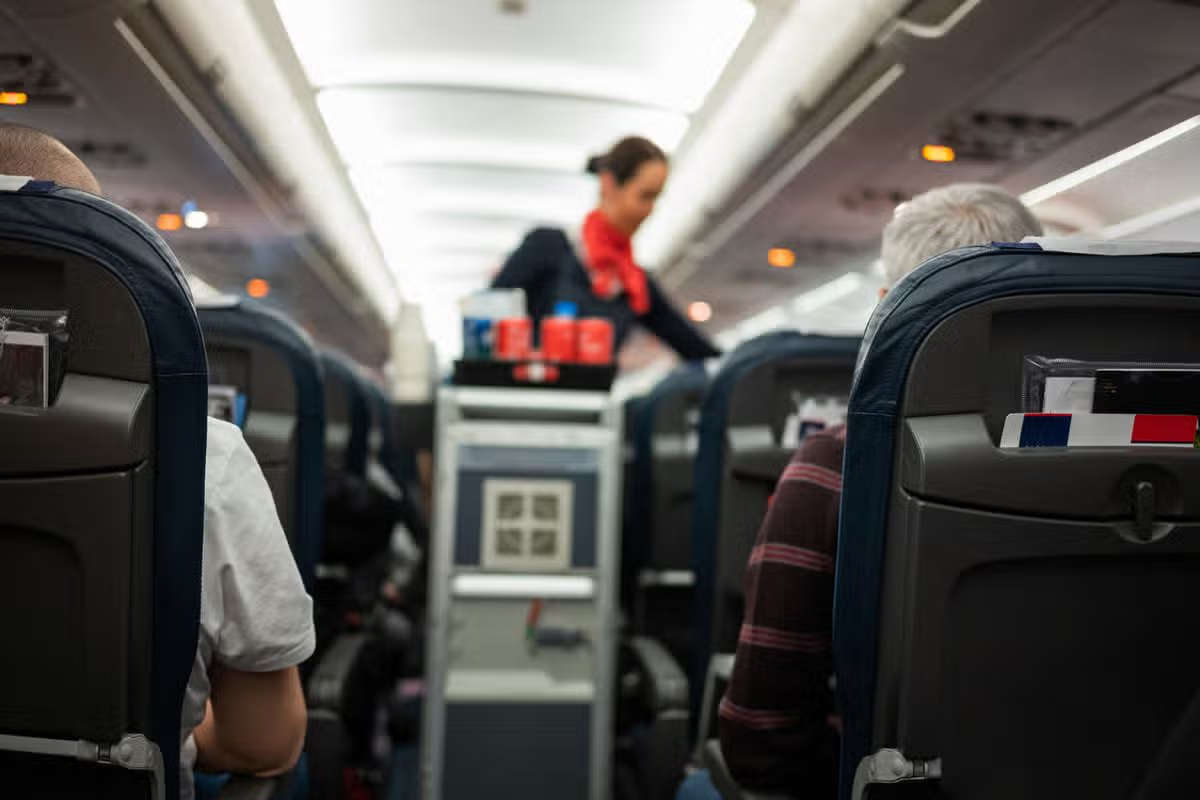
She said that there are some things passengers wear that she wishes they wouldn’t (stock image)(Image: Getty Images/iStockphoto)
Dressing up for the airport is part of the fun for many people, because as much as you want to look comfy while you travel, you also want to look chic. However, when it comes to your footwear, a flight attendant has shared that there’s something you should never wear, even though it might at first seem like the comfiest and best idea you’ve ever had.
Sille shared some advice about what’s best to avoid on a plane, and promised she didn’t intend to pass judgement on people’s clothing choices, rather that she wants everyone to be safe and happy in all potential circumstances.
On TikTok, @sillerydell wrote: “I see this on almost every flight, and I promise it’s not a judgment. Your feet and body will thank you,” as she detailed the things that she’d “skip” when travelling on a plane.
Flip flops
Footwear that could prove to be dangerous on planes are flip-flops. She wrote: “Flip-flops. Feet swell, cabins get cold. And imagine running to your gate in flip flops.”
Shorts or crop tops
“First of all, the aircon is brutal,” she said. “Secondly, you don’t ever want your naked skin near those seats.” You might want to opt for full-length trousers and a proper t-shirt, and perhaps even take a jumper with you in case you get too cold.
Content cannot be displayed without consent
Tight jeans
She warned that “your body swells at altitude,” so if you wear jeans that are too tight, you may end up feeling extremely uncomfortable, and wondering whether it was worth looking good and suffering, especially if you pair them with a crop top.
One thin layer
She shared that wearing one thin layer and hoping for the best isn’t ideal, as “planes can be freezing, even to hot destinations,” so you may want at least a jacket to keep you warm, or a jumper, and you can wear it on the journey back home.
What the flight attendant suggests you wear instead…
She suggested “Something comfy, covered and in layers,” reiterating that she “works on planes so you don’t have to learn this the hard way”.
What did people in the comments say?
In the comments, someone wrote: “Totally agree!!! Flip flops and Crocs should be banned from flights.” Responding to people asking why, they replied they’re “not appropriate footwear”.
Another defended them, however, saying: “I always wear flip flops, BUT I have specific aeroplane socks that I wear on the plane, except to the bathroom, a different pair of flip flops go on for that, and then they get put in the trash. They are throwaway ones.”
A third wrote: “People wear flip flops to make it easier at security, but honestly, that’s so disgusting! I can’t imagine my bare feet touching those floors. Always socks and sneakers when I fly!”
Somebody else shared other things that they think people should stop doing on planes.
They wrote: “Also, stop wearing strong perfumes when flying. It can trigger allergies, migraines, and respiratory issues in a confined cabin space. Wear perfume or cologne when you’re outside the plane.”
Another said that they wear “linen trousers with elastic waistband, a vest top and a long shirt for layer, but I do wear sandals.”