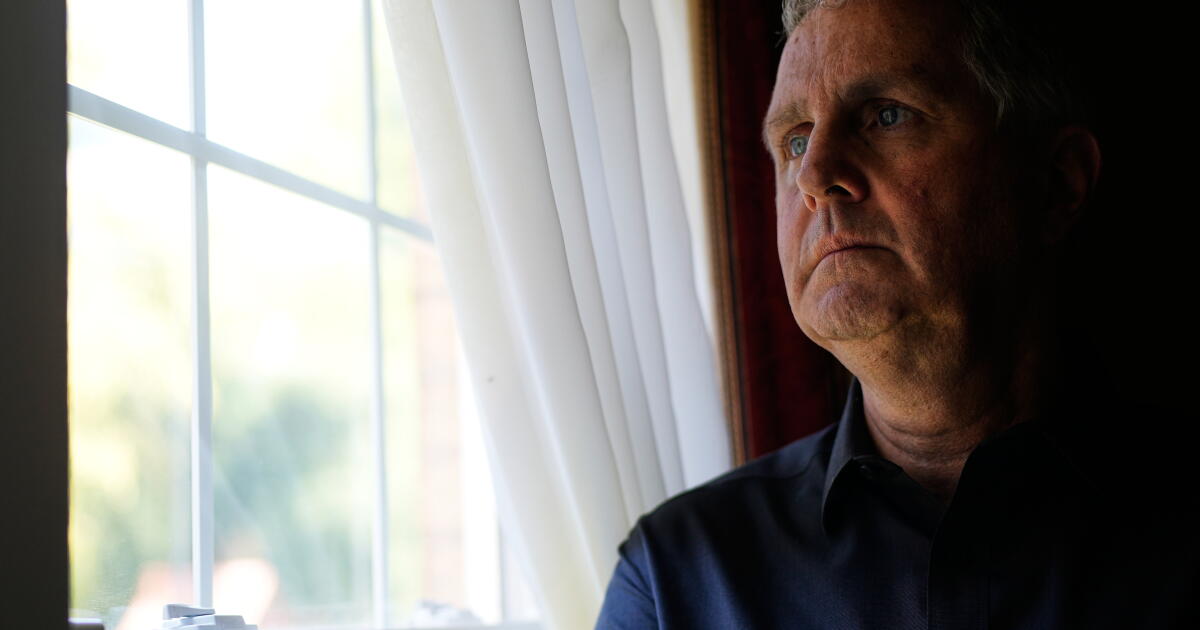
protester

Horrified by the state of the union, he’s an angry protester. But he’s also optimistic

I know a lot of people who suffer from a chronic malady that gets worse each time there’s news out of Washington. Supporters of the current president of the United States might refer to this condition as a side effect of Trump derangement syndrome, but it’s more like Trump fatigue syndrome.

Symptoms can include a desire to tune out for a spell, stick your head in an ice bucket, or find another way to numb the senses.

But some brave souls, instead of looking away, step into the fray.

Bert Voorhees, for instance.

I came upon his name while reading coverage of the Monday evening demonstration at City Hall in downtown L.A., where protesters railed against the bombing of Iran — the latest example of Trump acting as if he’s king of the world and answerable to nobody, including Congress, the courts or the American people.

On the steps of City Hall people attend the Answer Coalition rally protesting the US and Israel bombing Iran

On the steps of L.A. City Hall, people attend the March 2 Answer Coalition rally protesting the attack on Iran by the U.S. and Israel.

(Jason Armond / Los Angeles Times)

With missiles flying, civilians dying and chaos spreading, Voorhees told USA Today that the Iranian ayatollah’s violence against his own people did not justify a U.S. military assault. In Voorhees’ mind, it’s American democracy that is under attack.

“If people don’t stand up and get loud about this, all together right now, we’re not going to have a country,” the northeast San Fernando Valley resident said. “So, it’s time for people to get serious, get in the streets.”

I called Voorhees, a retired lawyer and teacher, and we had a long chat that continued the next day over lunch in Montrose. We’re both in our 70s, and we both have trouble aligning the country we’re living in with the vision we had for it as younger men. Who could have anticipated years of bullying and name-calling, pathological lying about a “stolen” election or the routing of congressional and judicial opposition?

I confessed to Voorhees that I completely misread the direction this country was heading back when the first Black president in history termed out in 2016. I would have bet that as a more diverse and tolerant population came of voting age, old divisions would fade slowly into history and the U.S. would keep pushing toward higher elevations.

Silly me.

Voorhees says he's demonstrated hundreds of times

Voorhees says he’s demonstrated hundreds of times, but with immigration raids and now the war in Iran, President Trump is keeping him extra busy. “If people don’t stand up and get loud about this, all together right now, we’re not going to have a country,” said Voorhees. “So, it’s time for people to get serious, get in the streets.”

(Genaro Molina / Los Angeles Times)

Maybe it was the naively wishful thinking of a parent wanting his kids to live in a more evolved country rather than one filled with Neanderthal notions about science, medicine, climate, and non-white immigrants.

To Voorhees, these are reasons to raise hell rather than to lose faith, and he’s not alone. The No Kings rallies in greater L.A. were massive. Home Depot civilian patrols have looked out for hard-working neighbors because “silence is violence.” The whistle brigades are defending their communities.

Denise Giardina, a Huntington Beach book seller and friend of Voorhees’, has been on Home Depot patrols in her community and said planning various political actions is practically a full-time job.

“I have daughters and wanted them to have more rights than me, and I’m not sure that’s going to happen,” Giardina said.

When Giardina needs a break, she goes for a hike, which serves as a reminder that a single protest doesn’t change the world, but small steps matter.

“Sometimes you can’t think about the end,” she said. “It’s just one foot in front of the other. It’s not government that’s going to save us. It’s going to be the people.”

A crowd gathered at Los Angeles City Hall to protest against United States and Israel bombing Iran

A crowd gathered at Los Angeles City Hall on March 2 to protest the bombing of Iran by the United States and Israel.

(Jason Armond / Los Angeles Times)

Roseanne Constantino, a Silver Lake graphic designer whose activism includes knocking on doors during election cycles, sending postcards and making phone calls, has been on the front lines with Voorhees and shares his sense of duty.

“I mean, for people to say, ‘I can’t watch the news, I’m numb, I’m overwhelmed, I have to tune out,’ is so much privilege talking, because they can tune out, because they’re safe,” Constantino said.

“I find it’s like a gateway drug,” she added, “because even people who have never done anything activist in their life eventually find themselves at a protest and are buoyed by the community and the sense of purpose and expression of opposition, but also of the love of democracy.”

To Voorhees, “democracy is a privilege,” and your participation does not end with voting. “You’ve got to make sure they do the right things,” he said, “and that requires paying attention and supervising them, if you will. Politicians are supposed to work for us.”

Voorhees told me that under President Obama, when drones were used in targeted overseas killings, he took to the streets in protest.

“I’m an equal opportunity activist, but we just haven’t had in my lifetime a person so determined to destroy democracy,” Voorhees said. “I called Reagan a fascist, and Reagan felt like a fascist until I met this man, who is the head of a fascist movement in this country.”

I wagered that the bombing of Iran by the America-first president — who promised to end rather than start wars — was Trump’s way of projecting strength at a time of weakness. Many of the president’s true believers are applauding, but it seems that nothing was learned from past Middle East meddling that ended badly, and with no thoughtful consideration of what comes next, Epic Fury could be followed by Epic Quagmire.

Voorhees insists this wasn’t just a show of might, but an act of distraction.

From the Epstein files, for instance. From the empty promises about lower prices for groceries and consumer goods, the droopy favorability ratings, midterm election fears and the mess created by tariffs that cost American merchants millions of dollars and were declared illegal.

Voorhees is mad about all of that, but made a point of clarification.

He’s not demoralized.

Over 200 people rally and protest the U.S. and Israel war against Iran

More than 200 people protest the U.S. and Israel’s war against Iran in front of City Hall in downtown Los Angeles on Saturday. Protesters carried Mexican, Palestinian and Iranian flags at the rally organized by the Answer Coalition.

(Genaro Molina / Los Angeles Times)

“The arc of the universe bends toward justice,” Voorhees said, “but it doesn’t do it steadily. There are retreats. Two steps forward, one back. One step forward, three back. We’re in one of those periods. … But we can overcome, and I believe in the long run we probably will.”

Minneapolis is the model, he said. When two innocent people were killed in immigration raids, the community came together and rose in protest, forcing a retreat of Trump’s forces and sparking a national conversation about the brutal tactics.

“Minneapolis pushed back against that with humanity, and that’s the future we want to build,” Voorhees said. “That’s the future Martin Luther King Jr. always wanted. That’s the beloved community. That’s the ticket.”

Things will change only if “we get up off the couch,” said Voorhees, who attended another antiwar protest Saturday on the steps of City Hall with a sign that asked, “Who Would Jesus Bomb?”

“You can march ahead with a heavy heart and a downcast head, or dance ahead with a smile and a tune on your lips, hand in hand with people you care about. Why not do that? All empires fall. All kings and tyrants fail in the end. Sometimes it’s fast. Sometimes it’s slow. But that day is coming and, as the Twin Cities proved, love is stronger than hate, if only just.”

steve.lopez@latimes.com

Source link

Palestinian protester Leqaa Kordia calls ICE custody ‘dehumanising’ | Protests

NewsFeed

Palestinian Columbia protester Leqaa Kordia says she was chained to a hospital bed in “dehumanising” conditions after having a seizure in ICE custody and was kept from her lawyers and family for days. Advocates say authorities are going to “extraordinary lengths” to detain her.

Source link

Who is Leqaa Kordia, the Columbia protester still in ICE detention? | Explainer News

Leqaa Kordia, a 33-year-old Palestinian woman detained in the United States by the Immigration and Customs Enforcement (ICE) agency since March, has been rushed to a hospital after a medical episode, according to media reports.

Kordia is being held in Texas after being detained as part of US President Donald Trump’s crackdown on pro-Palestine protests on college campuses across the country.

Her legal team said she was targeted for her protest against Israel’s genocidal war in Gaza near Columbia University in New York in 2024, but the federal government said she was arrested for allegedly overstaying her student visa.

Since her hospitalisation on Friday, Kordia’s legal team and family said they have not been able to speak with her and do not know her whereabouts.

Here is everything we know about Kordia and why she continues to remain in detention:

Who is Kordia?

Kordia grew up in the occupied West Bank city of Ramallah before coming to the US in 2016. She arrived on a visitor’s visa, staying with her mother, a US citizen, in Paterson, New Jersey, home to one of the largest Arab communities in the country.

She later transitioned from a tourist visa to a student visa, according to her habeas corpus petition.

After her mother applied for Kordia to remain in the US as the relative of a citizen, her green card application was approved in 2021. However, she received incorrect advice from a teacher that led to her student visa expiring in 2022, according to her lawyers.

Before her arrest, Kordia worked as a server at a Middle Eastern restaurant on Palestine Way in New Jersey and helped to care for her autistic half-brother.

Kordia was moved to protest against Israel’s war due to personal loss. Since the start of the war in October 2023, Kordia said, more than 200 of her relatives have been killed.

Israel has killed more than 71,000 Palestinians in Gaza and wounded more than 170,000 in a war that human rights groups, a United Nations commission and a growing number of scholars said amounts to genocide. Since a “ceasefire” began in October, Israel has killed more than 500 Palestinians and continues to impose curbs on the entry of aid into Gaza.

If deported, Kordia would be handed over to the Israeli government.

Columbia
Pro-Palestinian protesters take over Butler Library on the campus of Columbia University on May 7, 2025 [Ryan Murphy/Reuters]

Why was Kordia arrested?

She was first arrested in April 2024 during a protest outside the gates of Columbia University, but the case was soon dropped.

On March 13, 2025, Kordia showed up at the ICE headquarters in Newark, New Jersey, for what she believed to be routine immigration questions. She was detained there, “thrown into an unmarked van and sent 1,500 miles [more than 2,400km] away”, Kordia wrote in the USA Today newspaper last month.

Kordia was neither a student at Columbia University nor a part of political circles.

“Though I was not a student, I felt compelled to participate. After all, Israel, with the backing of the United States, has laid waste to Gaza, forcibly displacing my family, killing nearly 200 of my relatives,” she wrote in USA Today.

Today, Kordia is the only person who remains in detention from the Columbia campus demonstrations. She has been held at Prairieland Detention Center in Alvarado, Texas.

A leader of the protests, Mahmoud Khalil, a Palestinian student with Algerian citizenship and a US green card, and others have been released. Khalil, however, is still in a legal battle to remain in the US with his American wife and child. Last month, an appeals court panel dismissed a lawsuit Khalil filed challenging his detention and deportation order. The judges concluded that the federal court that ordered Khalil’s release last year lacked jurisdiction over the matter.

leqaa kordia
Lawyers for Leqaa Kordia, second from right, say she’s been targeted by US immigration enforcement because she participated in pro-Palestinian protests [File: Craig Ruttle/AP Photo]

What are the charges against Kordia?

The US government has called Kordia’s money transfers to relatives in the Middle East evidence of possible ties to “terrorists”.

Kordia’s lawyers have continuously argued for her release, saying she was targeted by federal officials for her participation in pro-Palestinian protests.

The federal government has maintained that the case against Kordia is of overstaying a student visa.

“Her arrest had nothing to do with her radical activities,” the Department of Homeland Security said in April. “Kordia was arrested for immigration violations due to having overstayed her F-1 student visa, which had been terminated on January 26, 2022, for lack of attendance.”

Writing in USA Today last month, Kordia said she does not consider herself either a leader or an activist.

“I am a devout Muslim who is deeply committed to my faith and community. I’m a Palestinian woman who enjoys playing the oud, making pottery and hiking,” Kordia wrote. “Speaking out against what rights groups and experts have called a genocide is my moral duty and – I thought – a constitutionally protected right for all in this country. Except, it seems, when that speech defends Palestinian life.”

An immigration judge has called for Kordia’s release twice. However, it has been repeatedly blocked through a series of procedural and administrative moves.

“[The] Trump administration has exploited rarely used procedural loopholes to keep me confined, a practice now being challenged in federal district courts across the country, with many finding the practice unconstitutional,” Kordia wrote.

Demonstrators hold banners as they march during a protest following the arrest by US immigration agents of Palestinian student protester Mahmoud Khalil at Columbia University, in New York City, U.S., March 10, 2025. REUTERS/Jeenah Moon
Demonstrators march after the arrest of Palestinian student protester Mahmoud Khalil at Columbia University on March 10, 2025 [Jeenah Moon/Reuters]

How has Kordia lived in ICE detention?

Since Kordia was moved to the ICE detention facility in Alvarado in March, she has been facing a range of issues, from sleeping on a bare mattress on the floor to being denied religious accommodations, including halal meals.

“Inside the ICE facility where I’m being held, conditions are filthy, overcrowded and inhumane,” Kordia wrote in her piece for USA Today. “For months, I slept in a plastic shell, known as a ‘boat,’ surrounded by cockroaches and only a thin blanket. Privacy does not exist here.”

Last year, when Kordia’s cousin Hamzah Abushaban visited her a week after her arrest, he told The Associated Press news agency in an interview that he was taken aback by the dark circles under her eyes and her state of confusion.

“One of the first things she asked me was why she was there,” Abushaban said. “She cried a lot. She looked like death.”

Rights groups and some Democratic Party leaders have called her a “political prisoner”, condemning the way her case has proceeded.

State Representative Salman Bhojani said the conditions at the detention facility were “suffocating”.

Kordia’s dorm, he said, had 60 mattresses crammed into a space designed for 20 women.

“She does not even have clothing that fully covers her body. Community organizations have tried to provide more appropriate clothing and have been turned away,” Bhojani said. “Male staff enter the dorm at any time, leaving her body exposed in violation of her religious obligations.”

Calling for her release, Amnesty International noted that ICE has “repeatedly violated” Kordia’s religious rights. “She has been served almost no halal meals, forcing her to eat food that doesn’t meet her dietary requirements and causing significant weight loss,” the human rights group said in a statement.

“During Ramadan, staff refused to let her save food for when she could break her fast, forcing her either to go hungry or to break her fast early,” Amnesty said. “She has not been provided with clothing suitable for prayer or a clean prayer space.”

ICE columbia
People participate in a protest organised by Columbia University students and professors against President Donald Trump’s immigration policies and demand that the school establish itself as a sanctuary campus [File: Amr Alfiky/Reuters]

Why was Kordia hospitalised?

On Friday, Abushaban said he heard about Kordia’s hospitalisation in the morning from a person formerly detained with his cousin.

Kordia had fallen, hit her head and suffered a seizure in a bathroom at the Prairieland Detention Center, he told The Dallas Morning News newspaper.

In a statement on Saturday, Kordia’s attorneys and family members demanded answers from the Department of Homeland Security and Prairieland Detention Center regarding her health and whereabouts.

“[Kordia] was reportedly hospitalised yesterday morning after fainting and having a seizure at the Prairieland Detention Center,” the statement said, adding: “Neither her legal team nor family have been provided answers about where she has been hospitalised, the specifics of her health status, and whether and how ICE will ensure her health upon discharge from the undisclosed, off-site hospital.”

“We have since learned that she is expected to spend another night there, but we still have not been able to speak with her directly or have any confirmation of what brought her to the hospital in the first place,” the statement said.

The family members told US media that they called all hospitals in the vicinity but could not locate Kordia.

columbia
Students protest outside Columbia University on the two-year anniversary of the October 7, 2023, Hamas-led attacks on Israel and start of Israel’s war on Gaza [File: Ryan Murphy/Reuters]

What were the Columbia protests about?

In 2024, pro-Palestinian student encampments at Columbia University helped ignite a global movement against Israel’s genocidal war on Gaza.

The protest sites, however, were broken up after Columbia University allowed hundreds of New York City police officers on campus, leading to dozens of arrests.

The student protesters demanded an end to Israel’s war in Gaza and the university’s divestment from companies linked to the Israeli military.

Columbia University imposed severe punishments, including expulsion and revocation of academic degrees, on dozens of students who participated in the protests. University President Nemat “Minouche” Shafik, who was criticised for the handling of the student protests, stepped down.

The protests also put Columbia at odds with the Trump administration, whose officials alleged anti-Semitism on campus. Campaigners said the campus crackdown violated US free speech rights.

Trump also cancelled millions of dollars in federal funding for the university, accusing it of failing to protect Jewish students. Later, Columbia settled and agreed to pay $200m to the government over three years. In exchange, the Trump administration agreed to return parts of the $400m in grants it froze or terminated.

Source link