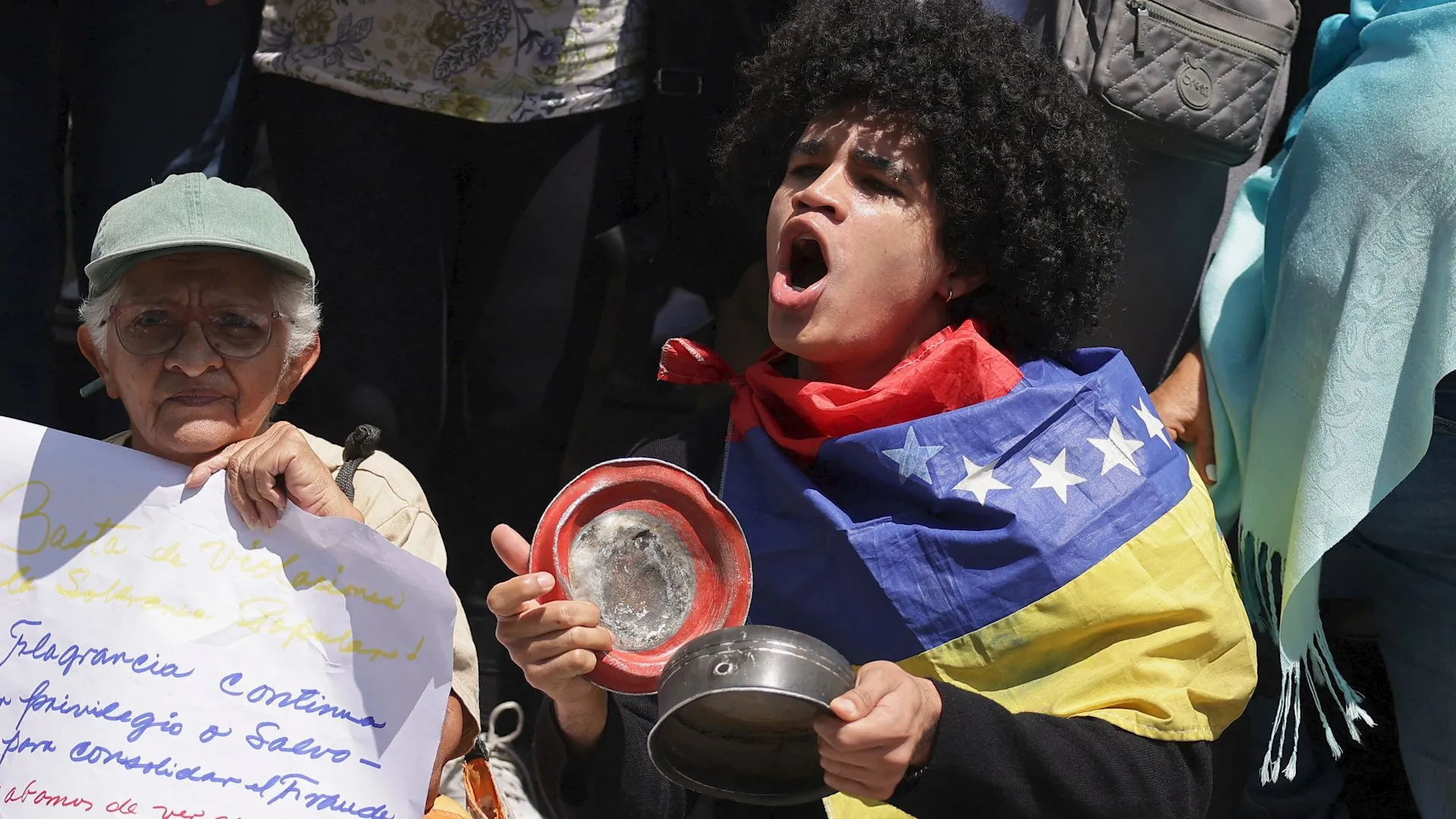
Motorcyclists wearing pirate costumes rode through Caracas in a protest against US President Donald Trump, after Washington ordered the seizure of Venezuelan oil tankers under a blockade targeting vessels linked to sanctions.
Police arrest three people outside insurer of Israeli arms maker Elbit, including Thunberg for holding placard.
British police have arrested Swedish activist Greta Thunberg and two other people at a pro-Palestine protest in central London, according to campaign group Defend Our Juries.
The group said Thunberg was arrested on Tuesday at the Prisoners for Palestine protest held in the heart of London’s Square Mile financial district outside the offices of Aspen Insurance, which provides coverage for Israeli defence contractor Elbit Systems.
Recommended Stories
list of 3 itemsend of list
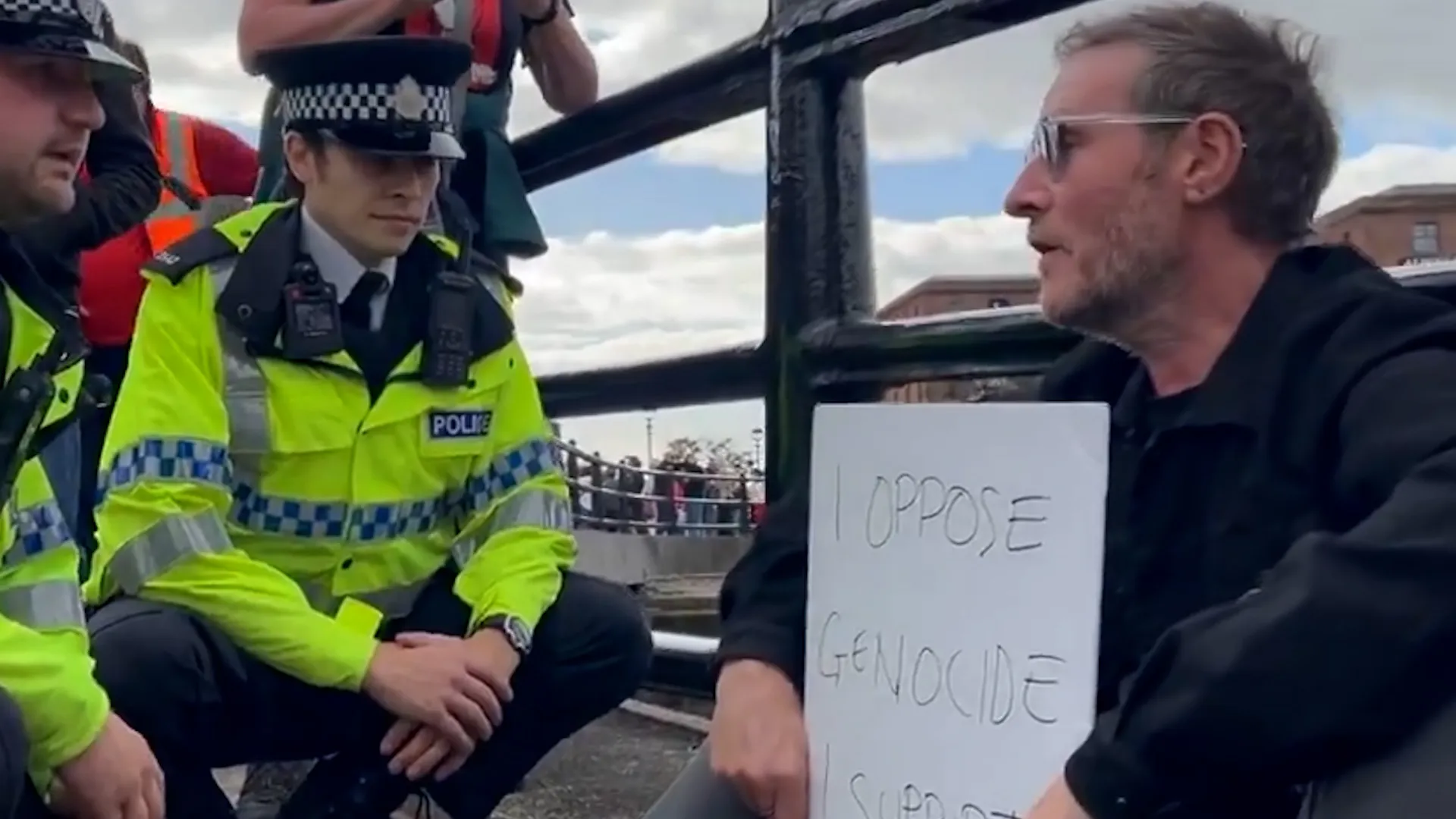
The group said Thunberg had arrived after the protest began, and it shared video footage of the activist holding a sign reading, “I support the Palestine Action prisoners. I oppose genocide.” Thunberg has called Israel’s war in Gaza a genocide and has twice joined flotilla campaigns to try to break Israel’s siege of Gaza.
The City of London Police, which polices the financial district, confirmed that a 22-year-old woman, a description corresponding to Thunberg, was arrested for displaying a placard “in support of a proscribed organisation (in this case Palestine Action) contrary to Section 13 of the Terrorism Act 2000”.
This is the latest protest in solidarity with activists from the Palestine Action group, six of whom are currently on hunger strike in British prisons with two now hospitalised. The direct action group has been proscribed as a “terrorist organisation” by the United Kingdom’s government.
Defend Our Juries said Tuesday’s protest was held to draw attention to Aspen Insurance’s “complicity in genocide” and to express solidarity with prisoners affiliated with Palestine Action.
Thunberg is seen after her arrest for holding a placard expressing support for Palestinian Action prisoners and condemnation of Israel’s genocide [Handout/Defend Our Juries]
Two others, a man and a woman, were also arrested at the protest although they had “glued themselves nearby”, according to the City of London Police, which described damage with “hammers and red paint” to “a building on Fenchurch Street”, where the offices of Aspen Insurance are located.
Defend Our Juries confirmed the damage, saying in a news release that two activists “covered the front of the building with symbolic blood-red paint, using re-purposed fire extinguishers” before attaching themselves to the front of the building in the aim of “drawing attention to Aspen’s complicity in Genocide, disrupting their business, and closing down the building”.
The group said Aspen Insurance, a global insurer and reinsurer, was targeted because of its affiliation with Elbit Systems UK, a subsidiary of Elbit Systems, which is Israel’s largest arms producer. It describes its drones as “the backbone” of the Israeli military.
Palestine Action protesters had targeted one of the UK subsidiary’s operations in Bristol last year. Among their five key demands, the group’s hunger strikers want the manufacturer, which has several UK factories, to be shut down.
Defend Our Juries said in its news release that Deputy Prime Minister and Justice Minister David Lammy has “refused to speak to legal representatives of the hunger-strikers, or their families”.
A few days earlier, Thunberg had voiced solidarity with the hunger strikers on Instagram, saying: “It is up to the state to intervene, and put an end to this by meeting these reasonable demands that pave the way for the freedom of all those who choose to use their rights trying to stop a genocide, something the British state has failed to do themselves.”
A Palestine Action spokesperson said in relation to her arrest that it was not clear whether police had “made another one of their mistakes in interpreting the crazy ban on Palestine Action” or whether they had “turned anyone expressing support for prisoners locked up beyond the legal time limit for taking action to stop a genocide into alleged terrorists”.
From a Russian air strike in Zaporizhzhia in Ukraine to demonstrations calling for the removal of US Immigration and Customs Enforcement from Minnesota, here is a look at the week in photos.
EU delays Mercosur trade deal until January amid farmer protests and opposition from France and Italy.
The European Union has delayed a massive free-trade deal with South American countries amid protests by EU farmers and as last-minute opposition by France and Italy threatened to derail the agreement.
European Commission chief spokesperson Paula Pinho confirmed on Thursday that the signing of the trade pact between the EU and South American bloc Mercosur will be postponed until January, further delaying a deal that had taken some 25 years to negotiate.
Recommended Stories
list of 4 itemsend of list
Commission President Ursula von der Leyen was expected to travel to Brazil on Saturday to sign the deal, but needed the backing of a broad majority of EU members to do so.
The Associated Press news agency reported that an agreement to delay was reached between von der Leyen, European Council President Antonio Costa and Italian Prime Minister Giorgia Meloni – who spoke at an EU summit on Thursday – on the condition that Italy would vote in favour of the agreement in January.
French President Emmanuel Macron had also pushed back against the deal as he arrived for Thursday’s summit in Brussels, calling for further concessions and more discussions in January.
Macron said he has been in discussions with Italian, Polish, Belgian, Austrian and Irish colleagues, among others, about delaying the signing.
“Farmers already face an enormous amount of challenges,″ the French leader said.
The trade pact with Argentina, Brazil, Bolivia, Paraguay and Uruguay would be the EU’s largest in terms of tariff cuts.
But critics of the deal, notably France and Italy, fear an influx of cheap commodities that could hurt European farmers, while Germany, Spain and Nordic countries say it will boost exports hit by United States tariffs and reduce reliance on China by securing access to key minerals.
Brazil’s President Lula says Italy’s PM Meloni asked for ‘patience’
The EU-Mercosur agreement would create the world’s biggest free-trade area and help the 27-nation European bloc to export more vehicles, machinery, wines and spirits to Latin America at a time of global trade tensions.
Al Jazeera’s Dominic Kane, reporting from Berlin, said Germany, Spain and the Nordic countries were “all lobbying hard in favour of this deal”. But ranged against them were the French and Italian governments because of concerns in their powerful farming sectors.
“Their worry being that their products, such as poultry and beef, could be undercut by far cheaper imports from the Mercosur countries,” Kane said.
“So no signing in December. The suggestion being maybe there will be a signing in mid-January,” he added.
“But there must now be a question about what might happen between now and mid-January, given the powerful forces ranged against each other in this debate,” he added.
Farmers wear gas masks at the Place du Luxembourg near the European Parliament, during a farmers’ protest on December 18, 2025 [Nicolas Tucat/AFP]
Mercosur nations were notified of the move, a European Commission spokeswoman said, and while initially reacting with a now-or-never ultimatum to its EU partners, Brazil opened the door on Thursday to delaying the deal’s signature to allow time to win over the holdouts.
Brazil’s President Luiz Inacio Lula da Silva said Italy’s Meloni had asked him for “patience” and had indicated that Italy would eventually be ready for the agreement.
The decision to delay also came hours after farmers in tractors blocked roads and set off fireworks in Brussels to protest the deal, prompting police to respond with tear gas and water cannon.
Protesting farmers – some travelling to the Belgian capital from as far away as Spain and Poland – brought potatoes and eggs to throw and waged a furious back-and-forth with police while demonstrators burned tyres and a faux wooden coffin bearing the word “agriculture”.
The European Parliament evacuated some staff due to damage caused by protesters.
A pair of blue and yellow earplugs dangle on Jose’s neck while waiting for work as a day laborer out of the Home Depot in Cypress Park.
They’ve been a necessity for laborers in the area since late November, when Home Depot installed three machines in the parking lot that emit a high-pitched tone. The noise, typically kept on all day, is a piercing sound that “penetrates your bones,” he said.
The Instituto de Educacion Popular del Sur de California (IDEPSCA), a nonprofit that supports day laborers, held a press conference at Home Depot Wednesday, calling for the company remove the machines and vocalize opposition to the ICE raids taking place in its parking lots, part of a growing number of protests targeting corporate cooperation with immigration enforcement.
Home Depot locations nationwide have been a prime target for ICE raids under President Donald Trump’s immigration crackdown. In early November, ICE agents detained a man at the Cypress Park location and then drove off with his toddler in the back of the vehicle.
Around 50 people have been detained at the Cypress Park location this year, said Maegan Ortiz, IDEPSCA’s executive director. The machines are an attempt to push day laborers off its lots, she said.
The machines were turned off by the company during the press conference, but were turned back on about an hour after it ended, according to workers. The noise is in earshot of the IDEPSCA’s day laborer center, one of five operated by the organization that have supported workers for over two decades.
“We have been here and remain open through global pandemics, providing services and creating community,” Ortiz said. “We’re not going to let sound machines, gates and intimidation get rid of us. Day laborers are here to stay. IDEPSCA is here to stay. The immigrant community is here to stay.”
Evelyn Fornes, a spokesperson for Home Depot, wrote to The Times that the company “has several initiatives we use to keep our stores safe, including human and technology resources.” The company did not address questions on why or when the machines were installed.
George Lane, a company spokesperson, previously told The Times that the company doesn’t coordinate with ICE or Border Patrol.
“We’re not involved in the operations. We aren’t notified that immigration enforcement activities are going to happen, and often, we don’t know operations have taken place until they’re over,” Lane wrote.
Jose’s earplugs, which IDEPSCA provided to workers, help muffle the sound, but aren’t enough to completely mask it, he said. The noise causes workers headaches, nausea and dizziness, said Jose and Andres Salazar, the center’s site coordinator.
Salazar said the noise often follows him home, still ringing in his ears long after he’s left the parking lot.
The machines were installed only days after the latest raid at the location in late November, during which day laborers were taken and IDEPSCA staff members were harmed, Ortiz said.
The machines were installed on light posts in the parking lot situated directly under the 5 freeway overpass. Hernandez and Ortiz said that portion of the parking lot is Caltrans property and not owned by Home Depot. They urged the city to look into the machine’s installations.
Home Depot also installed yellow barriers that close off access to the parking lot near IDEPSCA’s day labor center, located at the corner of the Cypress Park location.
The machines are “a deliberate choice by a multi billion dollar corporation that absolutely knew what it was doing and chose to weaponize sound literally,” said Councilwoman Eunisses Hernandez, who represents the city’s first district. “Devices like these are used as torture against our people.”
Home Depot relies on immigrant and Latino communities, Hernandez said, including customers who shop inside and day laborers, who seek work outside their storefronts.
The day laborer center is more than just a workplace, said Jose, who asked to withhold his last name for fear of retaliation by immigration agents. For many day laborers, it’s a second home, and for some, their only one. The center is bursting with greenery – plants that are cared for by the workers themselves.
“This space is something truly beautiful,” Jose said. “But, everything they’re doing with the noise and the barriers, it is affecting us…We’re here to help serve the community, not steal from the company.”
The noise is an added another layer of stress to day laborers, who are already struggling with less work opportunities and navigating lingering trauma from ICE raids. Jose was at the Home Depot when the last raid took place, only days before the company implemented the noise machines.
He watched in horror as coworkers were taken and volunteers were beaten.
“It made me angry, but I felt so impotent because, well, what do I do?” Jose said. “If I start fighting them, they’re going to knock me down, they’re going to take me.”
Protesters called on President Pellegrini, usually an ally of Prime Minister Fico, to veto the changes.
Published On 16 Dec 202516 Dec 2025
Share
Thousands of people have rallied across Slovakia to protest against changes to the judicial system that opposition politicians and critics say are destroying the rule of law, Slovak media reported.
Protesters filled much of a central square in the capital of Bratislava, and there were protests in eight other cities on Tuesday.
Recommended Stories
list of 3 itemsend of list
The biggest opposition party, Progressive Slovakia, called the protest after Prime Minister Robert Fico‘s leftist-nationalist government pushed legislative changes through parliament last week that dismantle the whistleblower protection agency and change the way the state deals with crown witnesses.
“They took a chainsaw to the rule of law,” Michal Simecka, the leader of Progressive Slovakia, told the crowd in Bratislava, according to a live video that streamed online.
“Slovakia is the only country where the government approves laws to make life easier for criminals and mafia,” he also said.
People carried Slovak and European Union flags as well as placards with slogans, such as “Fico’s government is helping Mafia”, and chanted “Enough of Fico” and “Shame!”
A protester holds a banner reading, ‘For Christmas I wish to get a reason to be proud that I live here”, at a demonstration against the abolition of the whistleblower protection office and penal code changes [AFP]
Fico’s critics claim that, under his government, Slovakia is following Hungary’s lead under Prime Minister Viktor Orban.
Fico’s administration argues that the old whistleblower agency was politically abused. The administration has also weakened criminal codes for financial crimes, revamped the public broadcaster and pushed constitutional changes asserting national sovereignty over some EU laws, which has raised European Commission scrutiny.
Fico’s government has faced several large protests since coming to power in 2023. Tuesday’s rally was one of the biggest since last February, when tens of thousands demonstrated against what critics say is an increasingly pro-Russian foreign policy.
A man holds a banner, reading ‘Gangster Fico is destroying Slovakia’, during a protest against the abolition of the whistleblower protection office and penal code changes [AFP]
Thousands of people joined demonstrations across Brazil to protest against a bill that would reduce the prison sentence of former President, Jair Bolsonaro. He was jailed for plotting a failed coup after losing the elections in 2022.
Singer’s statement follows walkout by five countries after organisers cleared Israel to participate in next year’s contest.
Published On 12 Dec 202512 Dec 2025
Share
Swiss Eurovision winner Nemo said they will return their 2024 victory trophy because Israel is being allowed to compete in the pop music competition.
The singer, who won the 2024 edition with operatic pop track, The Code, posted a video on Instagram showing them placing the trophy in a box to be sent back to the Geneva headquarters of the European Broadcasting Union (EBU).
Recommended Stories
list of 3 itemsend of list
“Eurovision says it stands for unity, for inclusion and dignity for all people,” Nemo said, adding that Israel’s participation amid its ongoing genocidal war on Gaza showed those ideals were at odds with organisers’ decisions.
The EBU, which organises Eurovision, cleared Israel last week to take part in next year’s event in Austria, prompting Spain, the Netherlands, Ireland, Slovenia and Iceland to announce they would be boycotting the contest.
“When entire countries withdraw, it should be clear that something is deeply wrong,” Nemo said on Thursday.
On Friday, contest director Martin Green said in a statement sent to The Associated Press that organisers were “saddened that Nemo wishes to return their trophy which they deservedly won in 2024”.
“We respect the deeply held views Nemo has expressed and they will always remain a valued part of the Eurovision Song Contest family,” he added.
Next year’s Eurovision is scheduled to take place in Austria’s capital, Vienna, after Austrian singer JJ won the 2025 contest in Basel, Switzerland. Traditionally, the winning country hosts the following year.
“This is not about individuals or artists. It’s about the fact that the contest was repeatedly used to soften the image of a state accused of severe wrongdoing, all while the EBU insists that this contest is non-political,” said Nemo.
“Live what you claim. If the values we celebrate on stage aren’t lived off stage, then even the most beautiful songs become meaningless,” they added.
Israel’s genocidal war on Gaza has killed at least 70,369 Palestinians, according to the territory’s health authorities.
The country’s military has continued to attack the enclave despite a ceasefire with Palestinian group Hamas reached back in October.
A federal judge ruled Wednesday that the Trump administration must immediately end the deployment of the National Guard in Los Angeles, the latest legal blow to the president’s embattled efforts to police American streets with armed soldiers.
Senior U.S. District Judge Charles R. Breyer said in his ruling that command of the remaining 300 federalized National Guard troops must return to Gov. Gavin Newsom, who sued the administration in June after it commandeered thousands of troops to quell protests over immigration enforcement in Los Angeles.
On June 12, Breyer ruled that deployment illegal — a decision that was challenged and ultimately reversed by the 9th Circuit Court of Appeals. The court said the esoteric statute Trump invoked to wrest command of the Guard from the governor afforded him “a great level of deference” to determine whether a rebellion was underway in Los Angeles, as the Justice Department claimed at the time.
The same sequence repeated this autumn in Oregon, where 200 California Guard troops were sent to help quash demonstrations outside an ICE facility.
Unlike in California, the Oregon decision was vacated amid claims the Justice Department inflated the number of federal protective personnel it said were detailed to Portland and misrepresented other facts to the court.
The decision is now under review by a larger panel of the 9th Circuit, while the Supreme Court weighs an almost identical challenge to the deployment in Illinois.
In both cases, conservative judicial appointees have signaled skepticism about the president’s authority to order boots on the ground, and to keep troops federalized indefinitely.
“States are not only owed protection by the federal government, they are owed protection from it,” Judge Jay Bybee wrote in a lengthy filing Tuesday in support of the 9th Circuit review. “There is no greater threat to the sovereignty of the states than an assertion of federal control over their domestic affairs.”
The “domestic violence” clause of the Constitution was part of a careful compromise between its framers allowing the president to deploy armed soldiers against citizens “only as a last resort,” the judge argued. The president should be compelled to provide some proof of his claims and the states should be empowered to test it — “particularly in the face of contrary evidence.”
That position earned him a sharp rebuke from the court’s newest member, Trump appointee Judge Eric Tung, who echoed the administration’s claim that its deployments were “unreviewable” by the courts.
A demonstrator interacts with U.S. Marines and National Guard troops standing in line at the entrance of the Metropolitan Detention Center following federal immigration operations in July.
(Etienne Laurent / AFP via Getty Images)
Their exchange reflects a deepening rift on the 9th Circuit, once the most liberal appellate division in the United States.
Trump remade the 9th Circuit in his first term, naming 10 judges to the bench. Those picks were largely curated by Leonard Leo of the libertarian-leaning Federalist Society.
But Leo has since lost favor to Tung’s longtime friend Mike Davis of the Article III Project, whose recommendations tack well to the right of his predecessor, experts said.
Still, infighting on the appellate bench is far from the only hurdle facing Trump’s domestic deployments.
In October, the Supreme Court ordered both the administration and the state of Illinois to address a theory by Georgetown University law professor Martin S. Lederman, who argued the statute only allows presidents to federalize the National Guard after they send in the army.
“If the court wants to rule against Trump on this, that’s the least offensive way,” said Eric J. Segall, a professor at Georgia State College of Law. “It’s a way to avoid all factual determinations for the moment.”
But such a ruling could open the door to even more aggressive military action in the future, he and others warn.
“If the Supreme Court comes in and says, ‘you have to use the active duty military before you can use the National Guard,’ it has the effect of saying everything that happened until now [was illegal],” said David Janovsky from the Project on Government Oversight. “But then you have the prospect of more active duty troops getting deployed.”
Congress, too, is taking a fine-toothed comb to Trump’s troop cases. The Senate Armed Services Committee is set to hear testimony Thursday from military top brass about repeated domestic deployments.
“Across the United States, Donald Trump has illegally deployed our nation’s servicemembers into American cities under unclear and false pretexts and despite the costs to our military and civil rights,” Sen. Tammy Duckworth (D-Ill.) said in a statement announcing the hearing. “The American people and our troops deserve answers.”
Meanwhile, the Trump administration has continued to broaden its claims of executive power in court.
In recent weeks, Department of Justice lawyers have argued that, once federalized, state Guard troops would remain under the president’s command in perpetuity. Breyer called that position “contrary to law” in his ruling Wednesday.
“Defendants’ argument for a president to hold unchecked power to control state troops would wholly upend the federalism that is at the heart of our system of government,” Breyer wrote.
California leaders cheered Wednesday’s ruling as a turning point in what until now has been an uphill legal battle to constrain the president’s use of state troops. The order was set to take effect on Monday, though it was all but certain to be appealed to the 9th Circuit.
“The President deployed these brave men and women against their own communities, removing them from essential public safety operations,” Newsom said in a statement Wednesday morning. “We look forward to all National Guard servicemembers being returned to state service.”
Atty. Gen. Rob Bonta called it “a good day for our democracy and the strength of the rule of law.”
Still, some legal scholars and civil liberties experts warn repeated deployments — and the slogging court battles that attend them — could inure the public to further politicization of the military around the midterms.
“The sense of normalization is probably part of the plan here,” Janovsky said. “Having troops trained for war on the streets of American cities puts everyone at more risk. The more we normalize the blurring of those lines, the higher the risk that troops will be used for inappropriate purposes against the American people.”
Times staff writers Kevin Rector and Jenny Jarvie contributed to this report.
A Brazilian lawmaker was removed from Congress by police on Tuesday as he staged a protest against a bill which could drastically reduce ex-President Jair Bolsonaro’s 27-year prison sentence.