Jassim al-Budaiwi calls on UN Security Council to guarantee ‘uninterrupted navigation through all strategic waterways’.
Published On 2 Apr 20262 Apr 2026
The head of the Gulf Cooperation Council (GCC) has called on the United Nations to act to immediately halt Iranian attacks across the region, condemning the strikes as a “flagrant violation” of international law and the United Nations Charter.
Speaking at the UN Security Council (UNSC) on Thursday, GCC Secretary-General Jassim al-Budaiwi urged the council to “take all necessary measures” to bring an end to Iran’s attacks on Gulf countries.
Recommended Stories
list of 3 itemsend of list
The UNSC must “take all necessary means” to “protect maritime corridors and guarantee the uninterrupted maritime navigation through all strategic waterways” in the region, al-Budaiwi said.
He also stressed that the six GCC states – Saudi Arabia, Qatar, Bahrain, Oman, Kuwait and the United Arab Emirates – must be included in any talks or deals with Iran “to enhance regional security and prevent further escalation or the repetition of such attacks in the future”.
“The GCC reaffirms the urgent need to immediately halt these attacks; restore security, stability and calm in the region, and ensure the safety of air and maritime navigation, the safety of international supply chains, and the protection of global energy markets,” al-Budaiwi said.
Iran has carried out daily missile and drone attacks across the Middle East, including in Arab Gulf nations, since the United States and Israel launched a war against the country on February 28.
While Iranian officials have said they are acting in self-defence and striking US and Israeli-linked targets, the attacks have struck civilian sites across the Gulf, including several of the region’s critical energy facilities.
Iran also has effectively closed the Strait of Hormuz, a key Gulf waterway through which about one-fifth of the world’s oil and liquified natural gas supplies transit, sending global energy prices skyrocketing.
Reporting from the Emirati city of Dubai on Thursday evening, Al Jazeera’s Zein Basravi said frustrations are growing across the Gulf as the US-Israeli war on Iran drags on.
“The GCC countries were from day one – months before this war even began – trying to keep it from happening. But it was like trying to stop a slow-moving car crash. And effectively, that crash has happened in their front yard,” Basravi said.
He noted that 85 percent of the projectiles fired by Iran have targeted Gulf countries, with the UAE the hardest hit.
“Their primary threats are the retaliatory attacks by Iran,” Basravi said of the GCC. “And their primary focus is bringing that to an immediate close – and that means ending the conflict as soon as possible.”
Whether this would be applicable beyond Ukraine is debatable, but officials in Kyiv see private sector air defense as an important move to help spread its burden of defending the skies against ceaseless Russian barrages. Russia has been taking particular aim at Ukraine’s remaining industrial capacity, especially defense-related firms that make drones, missiles and other weapons systems. The constant attacks are a large reason why the country has tried to decentralize production, but not everything can be built in a distributed fashion.
The goal of the program is to take advantage of Ukraine’s large production of counter-Shahed interceptor drones as well as its indigenous automated anti-drone machine gun turrets. By having volunteers operate these systems, it reduces the need to pull troops from the frontlines, officials say.
The Sky Sentinel air defense turret is one of the weapons being used by Ukraine’s private sector air defense units. (United24)
“The experimental project launched by the Government to involve the private sector in the air defense system is already being implemented and yielding initial results,” Ukrainian Defense Minister Mykhailo Fedorov stated on Telegram Monday morning. “One of the companies participating in the project has already prepared its own air defense group. As of today, several enemy drones have been shot down in the Kharkiv region, including Shahed and Zala models.”
Fedorov did not identify the company, but said another 13 are in various states of gearing up to take part.
“As of now, all groups are at different stages of preparation,” Fedorov wrote. “Some are already performing combat tasks, others are undergoing training, and the rest are completing their preparations and will soon strengthen the country’s air defense.”
Private air defense systems “are integrated into a single management system of the Armed Forces Air Force and are already operating within it – protecting objects and participating in the interception of Shaheds,” Fedorov explained. “This is a systemic solution that allows for quickly scaling air defense capabilities without additional burden on frontline units.”
Fedorov did not say which weapons are being used by the private companies, but a video he posted on X of claimed successful engagements shows the use of the Sky Sentinel automated air-defense turrets, equipped with a heavy machine gun and capable of 360° rotation. An official contacted by The War Zone said the Wild Hornet Sting interceptors are being used as well.
Private air defense working. First Shahed & Zala drones downed in Kharkiv by a private firm. 13 more companies joining. Integrated with Air Force command to scale protection without burdening the front. Opening the market to build a resilient, multi-layered sky. pic.twitter.com/GhXuX6a9dS
The creation of the private sector air defense program was announced earlier this month by Ukrainian Prime Minister Yulia Svyrydenko. In a media release, she explained that critical infrastructure enterprises, regardless of whether publicly or privately owned, can create air defense groups.
These groups must undergo training and certification by the MoD and will use weapons and ammunition temporarily transferred from the ministry.
“This concerns weapons that are not currently used by combat units,” Svyrydenko noted. “In the event of the use of ammunition, replenishment will be carried out according to a simplified procedure based on an act of actual expenses.”
As part of the expansion of site-specific protection for critical infrastructure facilities, the government has authorized the provision of additional weapons to strengthen their air defense capabilities.
Ukraine has been developing these weapons and programs because Russia’s launching of thousands of Shaheds and other drones and missiles has depleted its stocks of high-end interceptors like those fired by Patriot and other systems. This has not been lost on leaders of nations now under fire by Iranian drones and missiles.
Fedorov’s announcement about the private sector air defense program comes as Ukrainian President Volodymyr Zelensky wrapped up a tour of the Middle East. While there, the Ukrainian leader said he inked defense cooperation agreements with Saudi Arabia, UAE and Qatar, and had discussions with Jordan.
Zelensky did not announce specific commercial drone sales, “but said talks touched on financial support from Gulf nations that could help Ukraine bridge a delay in European funding after Hungary blocked a 90 billion euro loan package,” The New York Times noted. In addition, Zelensky told reporters that he had also discussed future Ukrainian purchases of energy from the Middle East as Ukraine’s own natural gas industry had been battered by Russian strikes.
“The agreement includes collaboration in technological fields, development of joint investments and the exchange of expertise in countering missiles and unmanned aerial systems,” Qatar’s defense ministry said in a statement during Zelensky’s visit.
Today in Jordan. Security is the top priority, and it is important that all partners make the necessary efforts toward it. Ukraine is doing its part. Important meetings ahead. pic.twitter.com/561KtqoglT
— Volodymyr Zelenskyy / Володимир Зеленський (@ZelenskyyUa) March 29, 2026
When it comes to interceptor drones like Sting, Ukraine has enough to spare should its government sign off on providing them.
Ukraine could export about $2 billion worth of weapons as a whole this year, excluding joint production ventures with allies, suggested Ihor Fedirko, CEO of the Ukrainian Council of Defence Industry, a manufacturers’ association.
Ukraine produced 40,000 interceptor drones in January, according to the government, which has made it clear the country will not export any weapons it needs to defend itself, as we noted in a story on Ukrainian laws preventing direct exports of interceptors and other weapons.
“Zelensky says that provided enough financing, Ukraine has the capacity to up its production to 2,000 interceptor drones a day and would only need 1,000 for itself, leaving plenty for export,” Reuters noted.
It is unknown whether the concept of private sector air defenses came up in Zelensky’s talks in the Middle East. However, countries in that region are facing threats similar to Ukraine, with energy infrastructure, data centers and other non-military facilities that likely have limited, if any air defenses, protecting them.
“The Ukrainian model does not surprise me,” retired Army Col. David Shank, who served as Commandant of the Air Defense Artillery School at Fort Sill, Oklahoma, told us. “Other countries have private security forces, some which possess hand-held [counter-drone] capabilities. The U.S. State Department has private security that also possesses capability (up to Stinger I am told).”
The challenge, said Shank, “is system management and command and control of all sensors and shooters.
It is possible the Gulf states could execute a system where companies provide their own air defenses, however, “it would still require strict adherence to authorities.”
Still, Shank sees several downsides, including fratricide, wasted ammunition and a lack of unity of effort from decentralized execution.
Retired Army Gen. Joseph Votel, who commanded U.S. Central Command, raised another concern.
“While it would be up to Arab nations to decide for themselves if this is a good idea, I do think it will complicate integration with partners, including the U.S,” he told us.
Regardless, the Ukrainian program is in its infancy. There is still a long way to go before it establishes its value as a valid means of protecting factories, electric generation plants and refineries against Russian drones. It could turn out to be more destructive than helpful.
However, given Ukraine’s history of battlefield innovation, there will likely be many parties looking to see how it all works out.
The President Donald Trump administration has filed suit against Harvard University, claiming it didn’t protect Jewish Students during protests against Israel starving Palestinians. File Photo CJ Gunther/EPA
March 20 (UPI) — The U.S. Justice Department sued Harvard University on Friday, accusing the Ivy League school of failing to protect Jewish students in the wake of the war in Israel and Gaza.
Filed in Boston, the lawsuit said Harvard allowed a “hostile education environment” for Jewish students who were physically assaulted and harassed. Protests sparked at Harvard and other U.S. college campuses after the start of the Oct. 7, 2023, war.
“The United States cannot and will not tolerate these failures and brings this action to compel Harvard to comply with Title VI, and to recover billions of dollars of taxpayer subsidies to a discriminatory institution,” the lawsuit read, referencing a federal law banning discrimination based on race, color or national origin in programs receiving federal funds.
Harvard denied the allegations laid out in the lawsuit, saying it has taken steps to embrace and respect Jewish and Israeli students on campus.
“Harvard has taken substantive, proactive steps to address the root causes of anti-Semitism and actively enforces anti-harassment and anti-discrimination rules and policies on campus,” a statement from the school said.
“We also have enhanced training and education on anti-Semitism for students, faculty and staff, and launched programs to promote civil dialogue and respectful disagreement inside and outside the classroom.
“Harvard’s efforts demonstrate the very opposite of deliberate indifference.”
The administration has actively targeted Harvard since President Donald Trump took office in 2025. Trump’s official grievance against the university is that he claims the school failed to protect Jewish students during protests against Israel during the war that began in 2023.
In February, the Justice Department sued Harvard for failing to hand over admissions documents for an investigation about whether the admission process discriminates against white people. Earlier in February, Secretary of Defense Pete Hegseth announced that the Pentagon would end its academic partnership with Harvard over what he called a “woke” institution that is not welcoming to the U.S. military.
On Feb. 3, Trump said he was now seeking $1 billion in damages from Harvard but didn’t explain why.
“We are now seeking One Billion Dollars in damages, and want nothing further to do, into the future, with Harvard University,” Trump said on Truth Social.
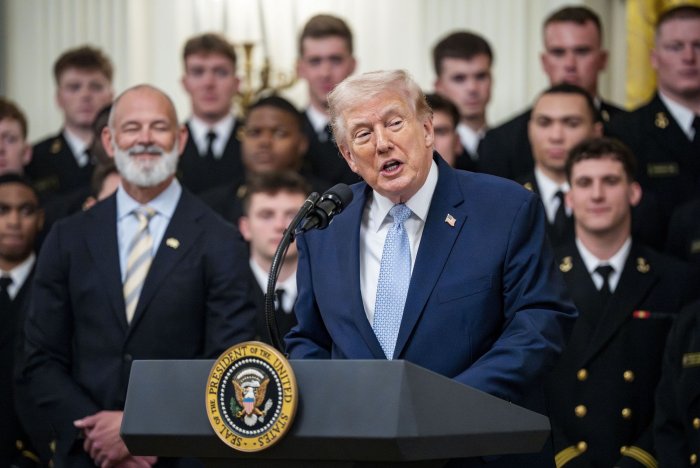
President Donald Trump presents the Commander in Chief’s Trophy to the Navy Midshipmen football team during a ceremony in the East Room of the White House on Friday. The award is presented annually to the winner of the football competition between the Navy, Air Force and Army. Navy has won the trophy back to back years and 13 times over the last 23 years. Photo by Bonnie Cash/UPI | License Photo
Farmers in northern India are dressing up in bear costumes to protect their crops from monkeys. The unconventional strategy comes as residents complain of hundreds of monkeys raiding homes and farmlands.
SANTA FE, N.M. — Democratic-led states alarmed by the prospect of federal immigration officers patrolling the polls during this year’s midterm elections are taking steps to counter what they see as a potential tactic to intimidate voters.
New Mexico this week became the first state to bar armed agents from polling locations in response to President Trump’s immigration crackdown, a step being considered in at least half a dozen other Democratic-led states.
The moves highlight a deep distrust toward the Trump administration from blue states, which have been the target of his aggressive immigration tactics while threatened with military deployments and deep cuts in federal funding. Their concerns were heightened after the president suggested he wants to nationalize U.S. elections, even though the Constitution says it’s the states that run elections.
The Trump administration said it has no plans to deploy immigration agents to polling locations. Last month, the heads of Immigration and Customs Enforcement and Border Patrol told a congressional committee “No, sir” when asked if they had any plans to guard polling places. The Department of Homeland Security’s deputy assistant secretary for election integrity, Heather Honey, recently told secretaries of state it “is simply not true” that immigration agents will be at the polls this year.
But a group of eight secretaries of state wants that in writing from the nominee to succeed Kristi Noem as secretary of the Department of Homeland Security. In a letter Monday to Trump’s new pick to lead the agency, Markwayne Mullin, the group pressed for assurances “that ICE will not have a presence at polling locations during the 2026 election cycle.”
Federal law already prohibits the deployment of armed federal forces to election locations unless “necessary to repel armed enemies of the United States,” but Democratic lawmakers, election officials and governors remain concerned.
“The fear is that the Trump administration will attempt to evoke a national emergency or execute some other deployment of federal agents or military troops in order to interfere with elections and intimidate voters,” said Connecticut Democratic state Rep. Matt Blumenthal, co-author of a state bill to establish a 250-foot buffer from federal agents at local polls and other restrictions on federal intervention. “And we’re not going to let that happen.”
A potential clash between states and the federal government
Other bills seeking to ban immigration agents at the polls are pending in Democratic-led states, large and small, from California to Rhode Island.
In Virginia, lawmakers are weighing legislation that could prevent federal civil immigration officials from making arrests within 40 feet of any polling place or courthouse. But the provision on polling sites remains under negotiation, and it’s unclear whether it will be in the final bill.
The newly signed law in New Mexico prohibits orders that put any armed person in the “civil, military or naval service of the United States” at local polling locations and related parking areas, or within 50 feet of a monitored ballot box, from the start of early voting.
Under New Mexico’s new law, which takes effect in May and will be in place for the state’s June 2 primary, people who experience intimidation or obstruction at the polls from federal agents or military personnel can file a civil lawsuit seeking relief in state courts. State prosecutors and local and state election officials also can sue, and the courts can apply fines of up to $50,000 per violation.
It also prohibits changes to voting qualifications and election rules and procedures that conflict with New Mexico law, as Trump prods the U.S. Senate to approve a bill to impose strict new proof-of-citizenship requirements in elections nationwide.
Any state measures intended to counter federal election law will face legal hurdles because of the supremacy clause in the U.S. Constitution, which says federal law supersedes state law.
“It could set up a direct clash between state governments and the federal government. We don’t know exactly how that’s going to go,” said Richard Hasen, director of the Safeguarding Democracy Project at the UCLA School of Law. “Given the supremacy clause, there’s only so much states can do.”
‘We will hold free and fair elections’
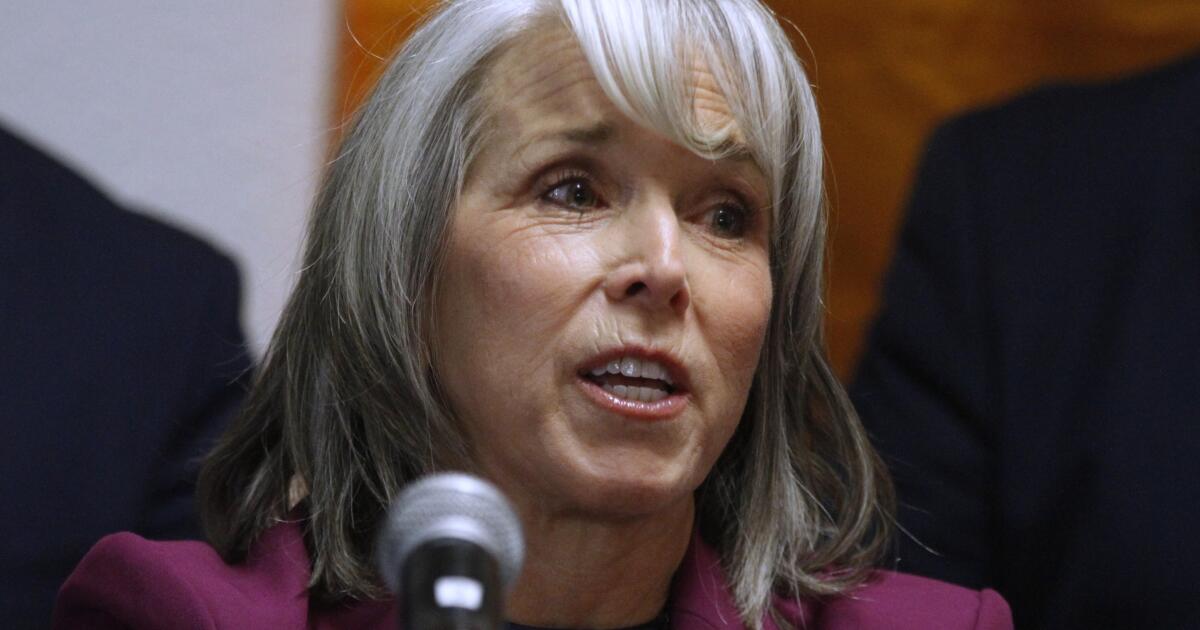
New Mexico Gov. Michelle Lujan Grisham said her own distrust of the Trump administration in election oversight stems from ongoing Department of Justice efforts to get detailed state voter data without explaining why and Trump’s continuing false claims of widespread fraud in the 2020 presidential election.
“Do I believe the federal government and people in the White House? No,” said Lujan Grisham, who terms out of office at the end of 2026.
“We are sending a message to everyone: We will hold free and fair elections, and New Mexicans will be safe in every ballot location and that’s our responsibility,” the Democrat said Tuesday during a news conference. “The Constitution says the states run their elections, and that bill makes that painfully re-clear to the federal government.”
Federal seizure of ballots and election records is a growing concern
New Mexico Republicans, who are in the minority in the legislature, voted in unison against the bill.
“I would question strongly why we have to do this other than just to have to poke the president in the eye,” state GOP Sen. Bill Sharer of Farmington said during floor debate.
State Sen. Katy Duhigg, an Albuquerque Democrat who was a co-sponsor of the legislation, said it’s “better safe than sorry with democracy.” She said she wanted to “make sure that there was some sort of tool that our local law enforcement would have at their disposal if something does happen, if the federal government does in some manner try to interfere with our elections.”
Connecticut’s bill, scheduled for a hearing later this week, also takes aim at federal attempts to seize ballots or other election material. It would require that state officials receive notification of such a move.
Blumenthal said state lawmakers can’t prevent seizures such as the January search by the FBI on an election center in Fulton County, Ga., a Democratic stronghold that includes Atlanta. But he said, “there might be an opportunity for our state attorney general’s office or the secretary of the state’s office to challenge that.”
Lee and Haigh write for the Associated Press. Haigh reported from Hartford, Conn. AP writer Oliva Diaz in Richmond, Va., and David A. Lieb in Jefferson City, Mo., contributed to this report.