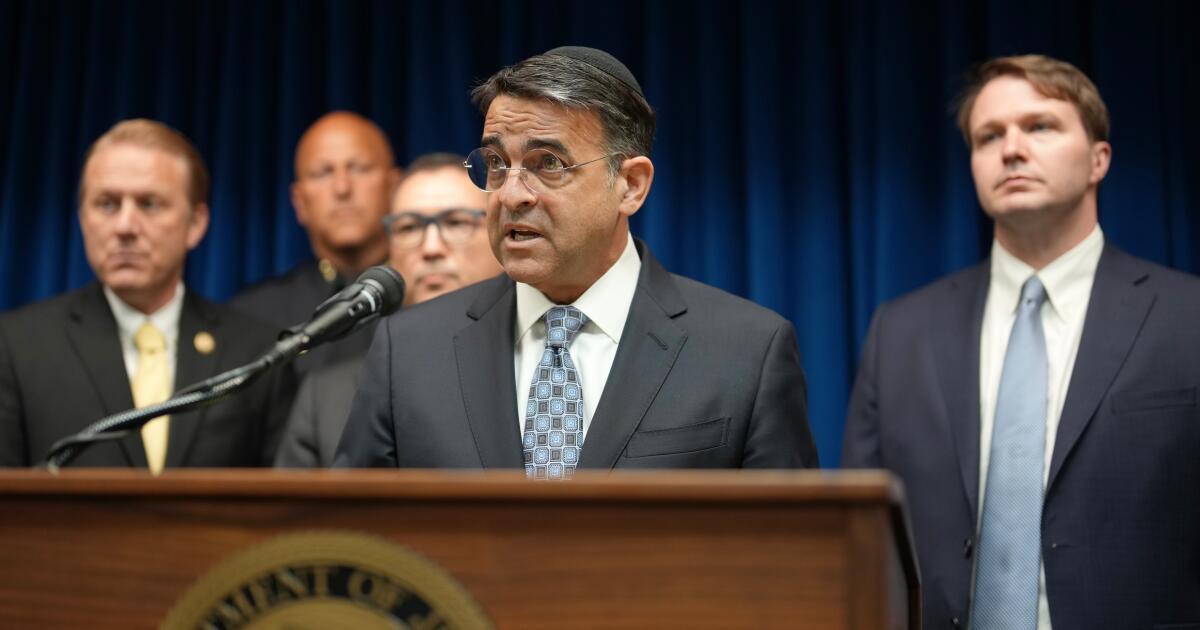
First Assistant U.S. Atty. Bill Essayli on Friday morning said his office “has multiple election fraud investigations underway,” in coordination with the FBI in Los Angeles.
Essayli’s remarks, posted to X, seemed to be in response to President Trump alleging in his own social media post late Wednesday that Democrats in California were “cheating” in the state’s primary election, and that there was an investigation underway in Essayli’s office.
Essayli’s office also confirmed that one of its prosecutors — Assistant U.S. Atty. Robert Renner — was at a Los Angeles County ballot processing center Friday “to observe the vote counting process.”
A spokesperson for Dean Logan, head of the L.A. County registrar-recorder/county clerk’s office, described the visit as in line with other routine observations of the counting process, which is open to public observation by appointment.
Democratic officials firmly rejected Trump’s claims of cheating, which they had warned he would make in advance of the election given his long record of objecting to and claiming fraud in elections he and his party lose.
Trump provided no evidence for his claims, other than to complain about California taking a long time to count ballots and criticizing its mail ballot system, suggesting it was a source of fraud. California officials have acknowledged the process takes longer than they would like, but said that is a result of a careful, accurate count of millions of ballots, many of which were mailed on election day.
“Taking the time to do this work correctly protects voters’ rights and ensures the integrity of our elections,” California Secretary of State Shirley Weber said Thursday. “California has built a strong system that expands access, empowers voters, and ensures more Californians can fully participate in our democracy.”
According to Weber’s office, about 5.6 million ballots had been processed in the state as of Thursday evening, while an estimated 3.6 million additional cast ballots remained.
Steve Hilton, a Republican who was leading in the gubernatorial race, said Friday that he expected to make it to November’s head-to-head race between the top two primary finishers — despite Trump insinuating Democrats were rigging the vote to exclude him. But Hilton also lambasted the state for counting so slowly, and said Gov. Gavin Newsom should deploy state resources to help ensure results are verified by next Thursday.
“This shambles is absolutely shameful for our state,” Hilton said, of the slow results.
Newsom’s office dismissed Hilton’s comments as uninformed. “It’s concerning that a candidate for Governor doesn’t know the Governor has nothing to do with counting ballots,” said Brandon Richards, Newsom’s deputy director for rapid response.
Essayli — a Trump loyalist the administration has kept in charge of one of the country’s largest federal prosecutor’s offices through a legal loophole, and despite his failing to be confirmed by the Senate — said he would not comment “on any specific investigation.” But he added that protecting California’s elections is “a top priority” for his office, and that “California’s election system has serious structural vulnerabilities.”
He said California’s mail ballot system, which a vast majority of voters rely on in the state, and its voter ID requirements — he said there were none, but California does have measures to ensure voters are who they say they are, including signature verification — create “conditions where fraud can go undetected and unpunished, eroding public confidence.”
“We will follow the evidence wherever it leads and prosecute any violations of federal election law to the fullest extent,” Essayli said.
He also noted that his office is working with Assistant Atty. Gen. Harmeet Dhillon, head of the Justice Department’s Civil Rights Division, to “conduct a comprehensive audit of California’s voter rolls.”
The Justice Department sued the state for its voter rolls, in a lawsuit that was thrown out by a federal judge who called the demand “unprecedented and illegal” and accused the federal government of trying to “abridge the right of many Americans to cast their ballots.”
The Justice Department appealed the ruling, and the case is now before the U.S. 9th Circuit Court of Appeals.
“The state has stonewalled every effort to verify that only eligible U.S. citizens are registered to vote,” Essayli wrote. “My office will not look the other way. We will investigate and prosecute. Every legal vote deserves to be counted. Every illegal vote cancels one out.”
Essayli’s office did not provide any additional information about Renner’s presence at the county balloting center, or about its fraud investigations. Essayli also provided no evidence of widespread fraud or acts by Democrats in the state to rig or steal the election, as Trump continued to claim Thursday.
Essayli did, however, point to a case in which a woman recently pleaded guilty to paying homeless people on Skid Row to help get initiatives on the California ballot. “Yes. There is evidence of election fraud in California. Here’s a case we charged just last month. More investigations are underway,” Essayli wrote.
Election experts say there are certainly examples of fraud in voting, but they are isolated and rare, and there is no evidence that fraud is widespread or exists in volumes large enough to sway elections. They note Trump has tried to argue such fraud in the past — including in disputing his 2020 loss to Joe Biden — but has never been able to prove it.
Michael Sanchez, Logan’s spokesperson, said Logan’s office was notified by Essayli’s office late Thursday that an assistant U.S. attorney would be visiting the ballot processing center to observe.
“The individual arrived this morning, was provided an overview of the public observation program, and participated in a walkthrough of the ballot processing operations,” Sanchez said.
Sanchez said election officials “routinely host observers representing a wide range of interests, including members of the public, candidates, political parties, advocacy organizations, and government agencies.”
California Atty. Gen. Rob Bonta’s office has also been involved in monitoring ballot processing in the state, including during last year’s vote on Proposition 50.
On Friday, Bonta acknowledged Renner’s presence at the L.A. County facility, and said his office also had a presence at the facility, was “monitoring the situation closely, and stands ready to protect voters and ensure California’s election laws are followed.”
Other Democrats in the state have also defended the state’s election process and blasted Trump for calling it into question.
“Let’s be honest about what this is: A blatant attempt to cast doubt in our election results, and a phony pretext for Trump to act illegally in the midterms,” Sen. Adam Schiff (D-Calif.) wrote on X. “California has safe and secure elections. And it takes time for every vote to count. It’s called democracy, Donald.”