The International Criminal Court in The Hague, the Netherlands, has cleared the United States of crimes against humanity against Venezuela for sanctions. File Photo by Robin Utrecht/EPA
March 12 (UPI) — The International Criminal Court Office of the Prosecutor announced Thursday that the United States did not commit crimes against humanity with its sanctions against Venezuela.
The investigation, called Venezuela II by the court, was referred to the court by Venezuela’s government in 2020, alleging that sanctions against the country had caused suffering and hardship.
The referral from now-deposed President Nicolas Maduro alleges the suffering of Venezuelans from “the application of unlawful coercive measures adopted unilaterally by the government of the United States of America against Venezuela, at least since the year 2014.”
Venezuela alleged that “murder, extermination, deportation, persecution and other inhumane acts constituting crimes against humanity” were committed, the OTP said.
The ICC prosecutor determined that the “evidential requirements of causation and intent are not met.”
The evidence “must provide a reasonable basis to believe that sanctions by the United States of America led to murder, displacement or other alleged crimes,” the OTP said.
The decision is unrelated to the January 2026 events in Venezuela, the prosecutor noted.
In January, the United States invaded Venezuela, arrested Maduro and his wife and took them to Manhattan, where they await trial on drug trafficking charges.
The ICC prosecutor said it is still investigating “Venezuela I,” a case that doesn’t involve the United States.
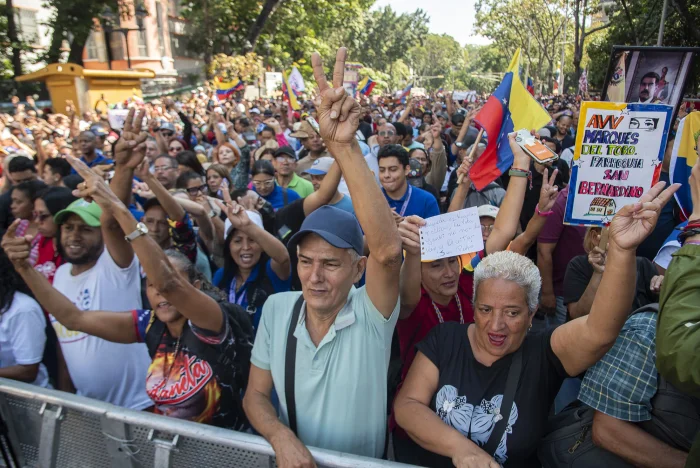
Supporters of ousted Venezuela’s President Nicolas Maduro carry his portrait during a rally outside the National Assembly in Caracas, Venezuela, on January 5, 2026. Photo by Jonathan Lanza/UPI | License Photo
MIAMI — Voting technology firm Smartmatic is seeking to dismiss a criminal indictment for money laundering, blaming President Trump and his allies for seeking its prosecution as part of a “campaign of retribution” against those they blame for his 2020 election loss.
Smartmatic’s parent company, UK-based SGO Corporation, was added to a criminal indictment last fall previously charging several executives with paying $1 million in bribes to election officials in the Philippines.
In a motion to dismiss the indictment filed Tuesday, attorneys for Smartmatic said the company had been cooperating with the Justice Department since it first learned of its investigation in 2021, including by producing millions of pages of documents and making presentations to federal agents. A trial date for the executives, including co-founder Roger Pinate, had been set and the company believed that it was in the clear.
But when Trump returned to the White House, the Justice Department reversed course and decided to press charges against Smartmatic. Attorneys for the company said the decision was prompted by Trump’s demands to prosecute his perceived enemies and his “mantra” that Smartmatic helped rig the 2020 U.S. presidential election won by Joe Biden — allegations that are at the heart of a $2.7-billion lawsuit filed by Smartmatic against the president’s allies in the media.
“The prosecution of SGO furthers their collective false narrative that President Trump did not actually lose the 2020 election,” Smartmatic said in the filing in Miami federal court.
The White House did not immediately respond to a request for comment.
Attorneys likened the prosecution to the Justice Department’s targeting of Kilmar Armando Ábrego García, a Salvadoran migrant who was criminally charged for conduct years earlier after he successfully sued the Trump administration over its decision to deport him.
In the years since the election, the filing states, “Smartmatic USA has exercised its right to hold those individuals and entities legally accountable for their deluge of defamatory statements and the attendant damage inflicts on its business, putting it squarely in the crosshairs for retribution.”
The criminal case against Smartmatic and its employees stems from payments, between 2015 and 2018, that were allegedly made to obtain a contract with the Philippine government to help run that country’s 2016 presidential election. Pinate, who no longer works for Smartmatic but remains a shareholder, has pleaded not guilty.
As part of the criminal case, prosecutors in August sought the court’s permission to introduce evidence they argue shows that revenue from a $300-million contract with Los Angeles County to help modernize its voting systems was diverted to a “ slush fund” controlled by Pinate through the use of overseas shell companies, fake invoices and other means.
They also accused Pinate of secretly bribing Venezuela’s longtime election chief by giving her a luxury home with a pool in Caracas. Prosecutors say the home was transferred to the election chief in an attempt to repair relations following Smartmatic’s abrupt exit from Venezuela in 2017 when it accused then-President Nicolas Maduro ’s government of manipulating tallied results in elections for a rubber-stamping constituent assembly.
Smartmatic was founded more than two decades ago by a group of Venezuelans who found early success running elections while the late Hugo Chavez, a devotee of electronic voting, was in power. The company later expanded globally, providing voting machines and other technology to help carry out elections in 25 countries, from Argentina to Zambia.
But Smartmatic has said its business tanked after Fox News gave Trump’s lawyers a platform to paint the company as part of a conspiracy to steal the 2020 election.
Fox said it was legitimately reporting on newsworthy events but eventually aired a piece refuting the allegations after Smartmatic’s lawyers complained. Nonetheless, it has aggressively defended itself against the defamation lawsuit in New York — arguing that the company was facing imminent collapse over its own internal misconduct, not due to any negative coverage.
Former Major League Baseball pitcher Dan Serafini was sentenced to life in prison without the possibility of parole on Friday for the 2021 first-degree murder of his father-in-law and attempted murder of his mother-in-law in Lake Tahoe.
Serafini, who pitched for six MLB teams during a 22-year professional career that ended in 2013, killed Gary Spohr, 70, and seriously injured Wendy Wood during a burglary of their home on the west shore of Lake Tahoe.
He was convicted in July after a six-week trial and made two unsuccessful appeals, denied a new trial only a week ago. During his ruling, Placer County Superior Court Judge Garen J. Horst said Serafini, 52, was a “liar, manipulator, arrogant and someone who has a loose relationship with the truth.”
The jury also found Serafini guilty of first-degree burglary and found the special circumstance allegations of lying-in-wait and felony murder, as well as related firearm allegations, to be true.
Serafini broke into the Spohr’s home while the couple was boating with their grandsons and daughter Erin Spohr — Serafini’s wife. He waited in a closet until his family left and shot them both in the head upon their return, according to prosecutors.
Wood took her own life in 2022 at age 69. After a year of rehabilitation after the shooting, she had regained her ability to read and write, as well as to hike and ride a bicycle, according to her daughter, Adrienne Spohr. But she battled disability and depression.
Samantha Scott, a nanny employed by Serafini and Erin Spohr to watch their two young children, pleaded guilty to being an accessory to the crimes. She testified in 2025 that she drove Serafini to the crime scene, believing it was for a drug deal.
Scott also testified that she saw Serafini with a gun and a silencer made of PVC pipe in his backpack. She testified that she dropped him off near the Spohr’s home and later saw him discard items from his backpack after they crossed the Nevada state line.
“When I learned that my sister’s husband Daniel Serafini and sister’s close friend Samantha Scott were arrested for the shooting of my parents, I was shaken to my core,” Adrienne Spohr said in a statement to the court. “This was a heinous, calculated crime. My parents had been incredibly generous to Daniel Serafini and Erin Spohr throughout their marriage.”
The Minnesota Twins made Serafini their first-round draft pick in 1992 out of Junipero Serra High in San Mateo, Calif., the same school that all-time home run king Barry Bonds attended. Serafini made his big-league debut in 1996 with the Twins and pitched with the Chicago Cubs, San Diego Padres, Pittsburgh Pirates, Cincinnati Reds and Colorado Rockies.
Serafini pitched in Japan from 2004 to 2007 before returning to the United States. He was suspended for 50 games in 2007 for using performance-enhancing drugs that he blamed on medication he took in Japan. He also pitched for Italy in the 2013 World Baseball Classic.
Serafini’s bar in Sparks, Nev., was featured on an episode of “Bar Rescue” in 2025. The bar’s named was changed from the Bullpen Bar to the Oak Tavern as part of the makeover, but not before Serafini’s financial woes were described: He blew through $14 million in career earnings and took a $250,000 loan from his parents.
Prosecutors said Serafini’s crimes were driven by anger and financial distress. Evidence was presented that he made threats and spoke about wanting his in-laws dead for many years. He and Gary Spohr also had disputes over a $1.3 million loan intended for Erin Spohr’s horse ranch business.
A Republican from the South Bay who raised hundreds of thousands of dollars running unsuccessfully against Rep. Maxine Waters four times while promoting QAnon conspiracy theories was sentenced to four years in federal prison for misusing campaign funds, the Department of Justice announced Monday.
Omar Navarro, 37, pleaded guilty in June to a single count of wire fraud for defrauding his own election campaign. The perennial candidate had raised hundreds of thousands of dollars over the years from prominent right-wing figures while promoting QAnon conspiracy theories but never cracked 25% of the vote.
He was sentenced by U.S. District Judge Mark C. Scarsi, who ordered Navarro immediately remanded into federal custody. A restitution hearing will be scheduled at a later date to determine how much money Navarro must pay to compensate victims.
Narvarro ran to represent Los Angeles County residents in California’s 43rd Congressional District in the 2016, 2018, 2020 and 2022 election cycles.
From July 2017 to February 2021, he funneled tens of thousands of dollars in donations to his campaign committee back to himself through his mother, Dora Asghari, and friend Zacharias Diamantides-Abel, prosecutors said. In total, his scheme diverted around $266,00 in campaign funds, more than $100,000 of which went directly into his pocket, prosecutors said.
“Defendant could have used that money to buy radio advertisements, purchase billboard space, or send a mailer to aid him in the election,” prosecutors wrote in their sentencing memorandum. “He chose instead to steal his donors’ dollars and fund his lavish lifestyle, including using it to pay for Las Vegas trips, fancy dinners, and even criminal defense attorneys for his criminal stalking charge after he had the audacity to use his campaign money to pay a private investigator to stalk her.”
He set up a sham charity called the United Latino Foundation to embezzle additional funds for his personal use. He also wrote thousands of dollars’ worth of checks to Brava Consulting, a company owned by his mother. This money was allegedly payment for campaign work, but the bulk of it was simply funneled back to him.
Initially, Navarro denied the allegations publicly, writing on X last year that the claims were “baseless” and suggested Waters herself was behind the investigation. He pleaded guilty months later.
Prosecutors argued that a significant sentence was necessary given the “prolonged and pervasive” nature of his fraud and to discourage others from engaging in similar behavior “that undermines the very fabric of the campaign finance system, a system designed to promote trust in government.”
The other two people connected to the case were also criminally charged.
Navarro’s mother pleaded guilty in June 2025 to one count of making false statements after lying to the FBI when questioned about receiving funds from her son’s campaign. She will face up to five years in federal prison at her April 13 sentencing hearing.
Diamantides-Abel pleaded guilty in May 2025 to one count of conspiracy and awaits sentencing.
Seven California Highway Patrol officers who piled atop a man screaming “I can’t breathe” as he died following a drunk driving stop.
All three cases had similar outcomes: charges dropped or reduced to no time behind bars after a plea deal.
After a year in office, a pattern has emerged for L.A. County Dist. Atty. Nathan Hochman, who found himself saddled with a number of misconduct and abuse cases against police officers filed by his predecessor, George Gascón.
During his 2024 campaign, Hochman often chastised Gascón for filing cases he claimed wouldn’t hold up before a jury — while also promising to continue bringing prosecutions against police when warranted.
In recent months, Hochman has downgraded or outright dismissed charges in many high-profile cases that Gascón filed. In the two misconduct cases Hochman’s prosecutors have brought to trial, the district attorney’s office failed to win a conviction.
Those outcomes have infuriated the loved ones of victims of police violence, local activists and even former prosecutors, who say Hochman’s backslide on the issue was predictable after he received millions in campaign contributions from police unions.
Greg Apt, a former public defender who served under Gascón as second-in-command of the unit that prosecutes police cases, said he quit last year out of frustration with the new leadership.
“I had concerns that the cases were not going to be treated the same way under Hochman that they were under Gascón, that alleged police wrongdoing would not be given the same level of oversight,” he said.
Hochman has scoffed at the idea that he’s too cozy with cops to hold their feet to the fire, saying his campaign’s war chest reflected bipartisan support that included Democrats who have been critical of police.
The district attorney said he’s made decisions based on what he can actually prove in court, and argued case reviews within the Justice Systems Integrity Division have become even more rigorous under his leadership.
“I’m going to look at the facts and the law of any case. I don’t believe in the spaghetti against the wall approach where you throw the spaghetti against the wall, and see if anything sticks, and let the jury figure it out,” he said. “That would be me abdicating my responsibility.”
Hochman’s supporters argue he has restored balance to an office that was often filing cases against police that were either legally dubious or flat out unwinnable.
Tom Yu, a defense attorney who often represents cops accused of wrongdoing, said Hochman is handling things in a more fair and objective manner.
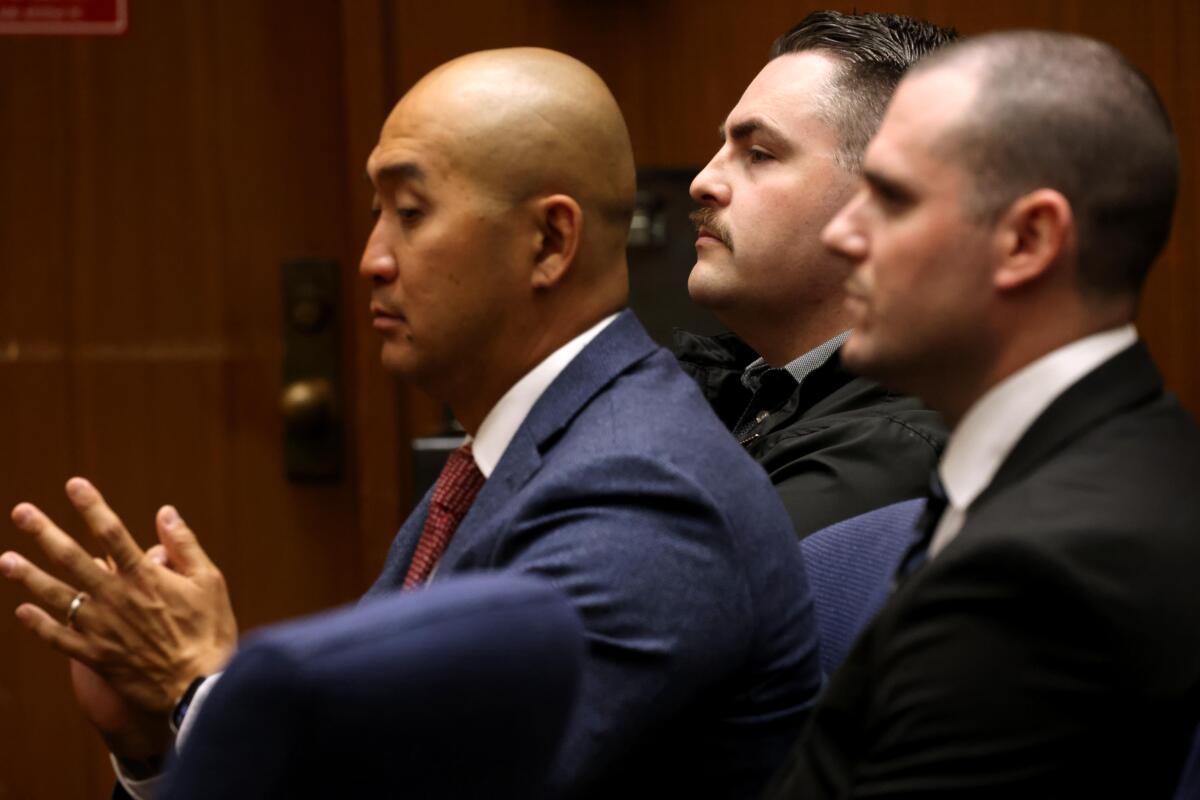
Former Torrance Police Officers Cody Weldin, center, and Christopher Tomsic, right, pleaded guilty last year in a conspiracy and vandalism case in which they allegedly spray painted a swastika on a car. Attorney Tom Yu, defense for Weldin, is seen listening to the proceedings.
(Genaro Molina / Los Angeles Times)
“By and large, he’s not going after the cops. But he didn’t dismiss all the cases either. I’m OK with that,” Yu said. “On a personal level, I think he’s doing a very difficult job in the police cases, because someone is always going to be unhappy with the decisions he made.”
It is difficult to win a guilty verdict for an on-duty shooting, with no such convictions in Los Angeles County since 2000. Laws governing use-of-force give officers great latitude, often protecting them even when they shoot someone who is later found to be unarmed or in situations where video evidence shows no apparent threat.
Hochman questioned why he is being criticized when the California attorney general’s office has reviewed dozens of fatal shootings of unarmed persons throughout the state since 2020 and filed no criminal cases.
“If you bring weak cases and you lose, it undercuts your credibility of being any good at your job,” Hochman said. “It undercuts your credibility in saying that we believe in the facts and the law and bringing righteous cases.”
Hochman brought 15 cases against police officers in 2025, according to documents provided to The Times in response to a public records request, compared with 17 filed by Gascón in his final year in office.
But while Gascón had a strong focus on the kinds of excessive force cases the public was clamoring to see charged when he was elected in 2020, Hochman has more often filed charges for offenses such as fraud and evidence tampering.
Hochman’s recent dismissal of charges against most of the officers involved in the death of Edward Bronstein has drawn outcry from his family and at least one former prosecutor.
Bronstein died after screaming in agony as six California Highway Patrol officers piled on top of him in Altadena in 2020. The officers were trying to get a court-ordered blood draw after Bronstein was pulled over on suspicion of drunk driving.
Video from the scene shows Bronstein arguing with the officers while handcuffed and on his knees.
The officers warn Bronstein they’re going to force him down to get a sample. Right before they do, Bronstein mumbles that he’ll “do it willingly,” but they shove him face down while a seventh officer, Sgt. Michael Little, films the encounter. A minute passes. Then Bronstein’s body goes limp.
Officers can be seen trying to revive Bronstein, calling his name and slapping the side of his head, according to the video. But several minutes elapse before officers attempt to deliver oxygen or CPR. He was pronounced dead at the scene.
Los Angeles County Dist. Atty. George Gascón announces he will ask a judge to resentence Erik and Lyle Menendez for the killing of their parents in 1989, a decision that could free the brothers.
(Allen J. Schaben / Los Angeles Times)
In 2023, Gascón filed manslaughter charges against the seven officers, as well as the nurse who carried out the blood draw. But late last year, Hochman dismissed charges against all except Little, whose case was reduced to a misdemeanor, for which he received 12 months of probation. Little is no longer a CHP officer, according to an agency spokesman.
Prosecutors are still pursuing manslaughter charges against the nurse at the scene, Arbi Baghalian. His defense attorney, Joe Weimortz, said Baghalian had no control over the officers’ actions or the decision to pursue the blood draw. Weimortz also said he believed the officers were innocent.
Bronstein’s daughter, Brianna Ortega, 26, said in a recent interview that Hochman’s decision to drop the charges felt like a betrayal.
“It just seems like because they’re cops … they must get away with it,” Ortega said. “How are you going to put the blame on one person when all of you are grown men who know better? You have common sense. You have human decency. He is literally telling you he can’t breathe.”
The Los Angeles County coroner’s office could not conclusively determine Bronstein’s cause of death but attributed it to “acute methamphetamine intoxication during restraint by law enforcement.” Bronstein’s family was paid $24 million to settle a wrongful death suit in the case.
Hochman said his office reviewed depositions from the civil case — which he said Gascón did not do before filing a case — and did not believe he could win a manslaughter case because it was impossible to say any officer specifically caused Bronstein’s death. Hochman said the officers had no intent to harm the man and were following orders of a superior officer.
“We looked at each officer, what they knew, what their state of mind was at the time. Understanding that there was both a sergeant there and a nurse, who was in charge of not only taking the blood draw but obviously doing it in a safe manner, and then deciding whether or not we could meet the legal standard of involuntary manslaughter for each officer,” he said.
Edward Tapia, the father of Edward Bronstein, speaks at a news conference about his son, a 38-year-old Burbank man who died while being restrained by California Highway Patrol officers in 2020 after refusing to have his blood drawn after a traffic stop. The family received a $24-million civil rights settlement in 2023 after filing a lawsuit against the state.
(Jason Armond / Los Angeles Times)
Bronstein’s killing was one of three cases in which Hochman assigned new prosecutors in the months before a trial started or a plea deal was reached. Aside from the Bronstein case, the others ended in an acquittal or a hung jury. All three prosecutors who were removed from the unit that handles police misconduct cases had either been appointed by Gascón or had a political connection to the former district attorney.
“When somebody’s lived that case for years, and then you take them off, it suggests that you’re less than serious about winning that case,” said Apt, the former prosecutor on the Bronstein case.
Hochman said he was simply bringing in staff with more trial experience on each case, insisting politics had nothing to do with the transfers. One of the cases, which involved allegations of perjury against L.A. County sheriff’s deputies Jonathan Miramontes and Woodrow Kim, ended with a lightning fast acquittal. Records show jurors deliberated less than an hour before coming back with a not guilty verdict.
In the other case, Hochman’s staff came closer to convicting a cop for an on-duty shooting than anyone else has in L.A. County in a quarter-century.
Former Whittier police officers Salvador Murillo, left, and Cynthia Lopez during their arraignment at the Clara Shortridge Foltz Criminal Justice Center in Los Angeles. Murillo was charged in a 2020 shooting that left an unarmed man paralyzed. Murillo’s trial ended with a deadlocked jury in November 2025.
(Mel Melcon / Los Angeles Times)
Former Whittier Det. Salvador Murillo stood trial in November for shooting an unarmed man in the back as he fled down an alley in 2023. Nicholas Carrillo ran away on foot from a vehicle stop and was leaping over a fence — unarmed — when Murillo squeezed off four rounds. Two severed Carillo’s spine, paralyzing him.
The jury came back deadlocked, although a majority of the panel was leaning toward a conviction. Hochman said it is likely he will ask prosecutors to take Murillo to trial a second time, though a final decision has not been made.
This year, Hochman will have to weigh in on a pair of politically charged police killings.
The Department of Homeland Security said the off-duty ICE agent was responding to an “active shooter.” Porter’s family has said he was firing a rifle into the air as a celebration to ring in the new year.
Melina Abdullah, the co-founder of Black Lives Matter L.A., was part of a group that met with Hochman about Porter’s killing and other cases last month in South L.A.
She described the encounter as confrontational — and a disaster.
“I don’t know how we can expect any safety and accountability with this man in office,” Abdullah said.
Hochman must also decide how to proceed with the case of Clifford Proctor, a former LAPD officer charged for shooting an unarmed homeless man in the back in 2015.
Proctor left the LAPD in 2017 and was not indicted on murder charges until 2024. Gascón reopened the case in 2021, after prosecutors previously declined to file charges.
Hochman has not said if he intends to take Proctor to trial.
Hochman said that while he knows cases of police violence drive emotional reactions, he has to constrain himself to a cold analysis of the facts in front of him.
Reflecting on his confrontational meeting with Black Lives Matter activists, which centered on his recent move to dismiss charges in the 2018 killing of Christopher Deandre Mitchell by Torrance police officers, Hochman said he can’t pursue cases just because people are upset.
“They couldn’t point out anything in that analysis that they disagreed with,” he said. “Other than the result.”
WASHINGTON — A grand jury in Washington refused Tuesday to indict Democratic lawmakers in connection with a video in which they urged U.S. military members to resist “illegal orders,” according to a person familiar with the matter.
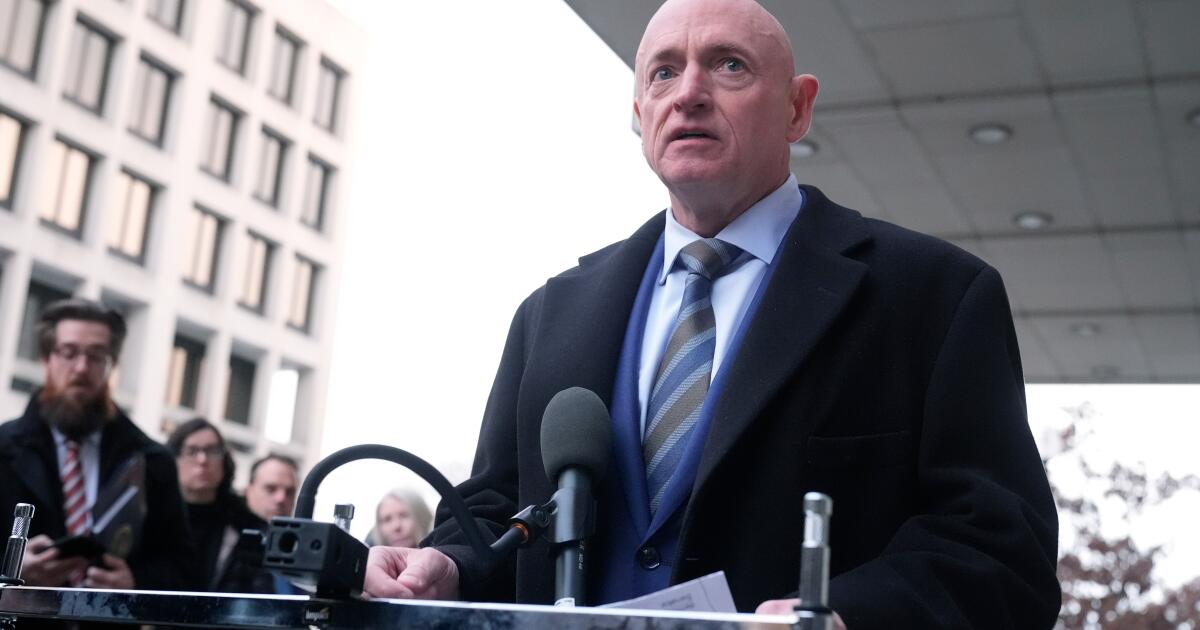
The Justice Department opened an investigation into the video featuring Democratic Sens. Mark Kelly and Elissa Slotkin and four other Democratic lawmakers urging U.S. service members to follow established military protocols and reject orders they believe to be unlawful. All the lawmakers previously served in the military or at intelligence agencies.
Grand jurors in Washington declined to sign off on charges in the latest of a series of rebukes of prosecutors by citizens in the nation’s capital, according to the person, who spoke on the condition of anonymity because they were not authorized to publicly discuss the matter. It wasn’t immediately clear whether prosecutors had sought indictments against all six lawmakers or what charge or charges prosecutors attempted to bring.
Grand jury rejections are extraordinarily unusual, but have happened repeatedly in recent months in Washington as citizens who have heard the government’s evidence have come away underwhelmed in a number of cases. Prosecutors could try again to secure an indictment.
Spokespeople for the U.S. attorney’s office and the Justice Department didn’t immediately respond to requests for comment Tuesday.
The FBI in November began contacting the lawmakers to schedule interviews, outreach that came against the backdrop of broader Justice Department efforts to punish political opponents of the president. President Trump and his aides labeled the lawmakers’ video as “seditious” — and Trump said on his social media account that the offense was “punishable by death.”
Besides Slotkin and Kelly, the other Democrats who appeared in the video include Reps. Jason Crow of Colorado, Chrissy Houlahan of Pennsylvania, Maggie Goodlander of New Hampshire and Chris Deluzio of Pennsylvania.
Slotkin, a former CIA analyst who represents Michigan, said late Tuesday that she hopes this ends the Justice Department’s probe.
“Tonight we can score one for the Constitution, our freedom of speech, and the rule of law,” Slotkin said in a statement. “But today wasn’t just an embarrassing day for the Administration. It was another sad day for our country,” she said.
Kelly, a former Navy pilot who represents Arizona, called the attempt to bring charges an “outrageous abuse of power by Donald Trump and his lackies.”
“Donald Trump wants every American to be too scared to speak out against him,” Kelly said in a post on X. “The most patriotic thing any of us can do is not back down.”
In November, the Pentagon opened an investigation into Kelly, citing a federal law that allows retired service members to be recalled to active duty on orders of the defense secretary for possible court-martial or other punishment. Defense Secretary Pete Hegseth has censured Kelly for participating in the video and is trying to retroactively demote Kelly from his retired rank of captain.
The senator is suing Hegseth to block those proceedings, calling them an unconstitutional act of retribution. During a hearing last week, the judge appeared to be skeptical of key arguments that a government attorney made in defense of Kelly’s Jan. 5 censure by Hegseth.