Voters in California may get a chance to remake the state’s open primary system in two years.
Political consultant Steve Maviglio filed an application Friday with state officials that seeks to alter California’s voting system by reverting to a traditional primary. Under the proposal, the top candidates from each party would advance to the general election in November.
The current system allows the top two candidates, regardless of party, to move on to the runoff. That has led to instances in which two Democrats or two Republicans have faced off in the general election.
The state’s gubernatorial election, for example, has prompted concern that two Republicans could shut out the Democratic candidates. Riverside County Sheriff Chad Bianco and former Fox News commentator Steve Hilton have polled high in various surveys and are facing a large field of Democrats.
Democratic voters vastly outnumber Republicans in California, yet some political consultants said they feared there were so many Democrats running that voters wouldn’t coalesce around one candidate and the field would be split. Those fears have eased somewhat in recent months as some Democratic candidates advance from the pack.
The state’s top-two primary system has been in place since California voters passed Proposition 14 in 2010. The goal was to help end partisan gridlock in Sacramento and force candidates in primaries to appeal to a wider range of voters, rather than just those in their own party.
Proposition 14, as well as the state’s once-a-decade redistricting process, has led to some dramatic races, including the 2012 face-off between Democratic Reps. Brad Sherman and Howard Berman for a congressional seat in Los Angeles’ San Fernando Valley. Amid aspersions and attack ads, the pair nearly came to blows at a community debate.
Maviglio described the ballot measure as a simple repeal of Proposition 14, and said he was inspired by the governor’s race.
“It was extremely scary to envision the November ballot for governor with Republicans on it,” Maviglio said.
The New York Times first reported on the ballot measure proposal.
A news release from Maviglio states that the proposed repeal of Prop. 14 “is fueled by concerns that California’s primaries are disenfranchising a majority of California voters by limiting choice to candidates from one party.”
A website for the effort includes criticisms of the current primary system by Democratic Party Chair Rusty Hicks and Ron Nehring, former chairman of the California Republican Party.
Maviglio’s ballot initiative proposes to appear on the 2028 ballot and take effect in 2030.
Talk of changing Proposition 14 has been swirling in Sacramento for months.
Secretary of State Shirley Weber told reporters at an unrelated news conference last week that she had voted years ago against Proposition 14. She questioned whether it had actually succeeded in creating more diversity.
“I did not like the open primary,” Weber said. “I didn’t think it would solve any problems. They had a list of problems it would solve, and none of those have been solved.”
WASHINGTON — When the U.S. Supreme Court sharply curtailed a key provision of the Voting Rights Act last week, Democrats in Washington had a message: The rules of redistricting have changed, and California — the nation’s biggest blue bastion — may have a further role to play.
Rep. Alexandria Ocasio-Cortez (D-N.Y.) said Democrats should “play by the same set of rules” as Republicans. House Minority Leader Hakeem Jeffries (D-N.Y.) vowed to fight in “the Deep South and all over the country.” And Rep. Terri Sewell, an Alabama Democrat, was blunt: “I’ll take 52 seats from California, I sure would. And 17 seats from Illinois.”
The calls for action came as Republican governors in Louisiana,Alabama, Mississipppi and Tennessee called special legislative sessions to redraw congressional maps ahead of this year’s midterm elections. Florida has also approved new maps that could give the GOP four more seats in the House, and President Trump urged other Republican states to follow suit.
The Republican response has intensified the pressure on Democrats to act, including those in California — where the ruling could upend not just congressional maps, but also legislative and local races.
“We can’t allow this national gerrymandering effort of Republicans to go unanswered,” said Rep. Robert Garcia (D-Long Beach). “If Republicans go for it, I think we have to leave all options on the table.”
For now, California’s response is far from settled.
Rep. Sydney Kamlager-Dove (D-Los Angeles) cautioned against “accelerating a race to the bottom.”
(J. Scott Applewhite / Associated Press)
The chair of the California Democratic Party said there are no current plans to redraw maps — just months after voters approved a constitutional amendment authorizing a mid-decade redistricting backed by Gov. Gavin Newsom.
The Democratic consultant who drew the state’s current congressional district boundaries says an all-blue map, while possible to create, would probably hurt Democrats more than help them in the long run. And some of the state’s congressional Democrats are worried the impulse to match Republican partisan efforts would be bad for the American electorate.
“Rather than accelerating a race to the bottom, the next step is to dial it down because you can reach a point of no return,” said Rep. Sydney Kamlager-Dove (D-Los Angeles), one of the state’s most prominent Black lawmakers. “And that’s where we’re headed.”
What California decides — and when — will matter at the national level. With 52 congressional seats, no state has more to offer Democrats in a redistricting war. But experts, lawmakers and party officials say the path forward is more complicated than the calls from Washington suggest.
California could see 48 blue seats, out of 52
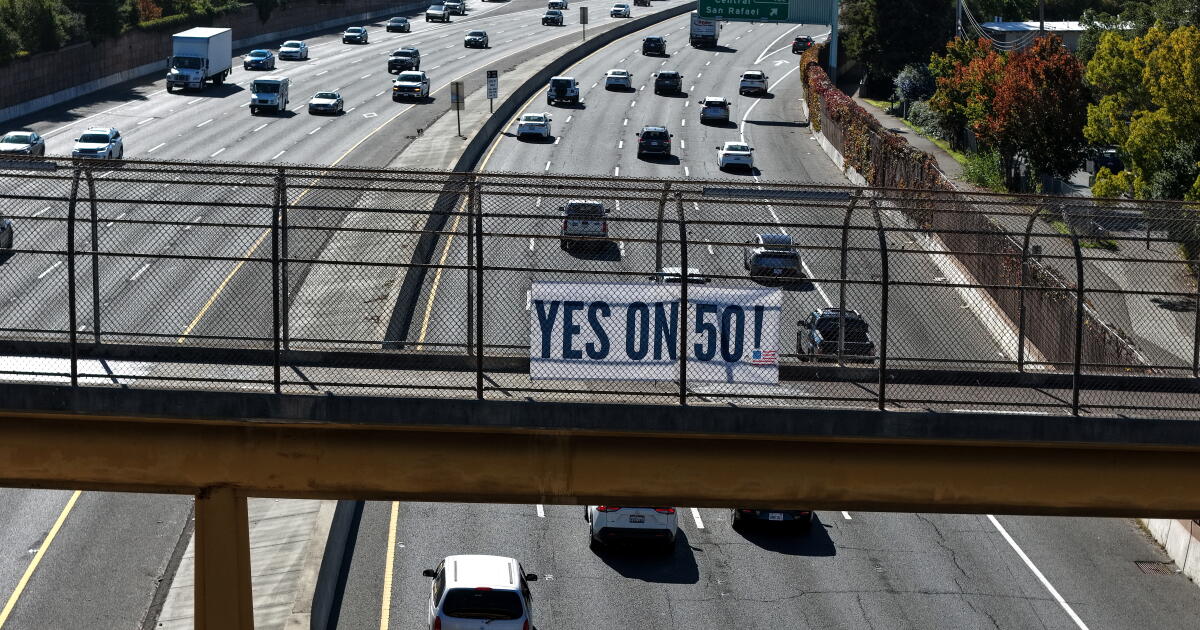
That’s in part because California already acted. In 2025, voters approved Proposition 50, which drew new congressional district lines designed to favor Democrats for the 2026, 2028 and 2030 elections. The new maps, which could yield as many as 48 Democratic seats out of 52, are already in effect, and voters have begun receiving their mail-in ballots.
Going farther is not currently on the table — at least not yet.
“We have yet to fully win the seats in the map that was drawn in 2025. It seems a step too far to say we’re going to go back to the drawing board and redraw the map,” said Rusty Hicks, the chair of the California Democratic Party.
Hicks said it doesn’t mean the issue could not become part of a future discussion, but he said Democrats in other states should not look past what California has already done.
“We’re trying to pick up 48 of them. How much more do you want us to pick up? You want us to make it 52 blue? Well, you all should get into the fight,” Hicks said. “You all should pick up some seats. Let’s all do this together, because California cannot do it alone, it will take the rest of the country.”
Others are not convinced the most aggressive option makes the strategic sense in California.
Paul Mitchell, the Democratic redistricting consultant who drew California’s Proposition 50 congressional maps, said the push for a 52-0 delegation reflects a fundamental misunderstanding of how a partisan map would perform in the state over time.
“A 52-to-zero map would have the potential of backfiring,” Mitchell said. “In 2026, we could pick up 52 seats. But then in 2028 or 2030 — a bad year for Democrats, let’s say — Democrats lose 11 of those seats. You’ve drawn these districts so demonically to a Democratic advantage in a good year that in a bad Democratic year, they don’t have the ability to withstand the challenge.”
Ruling could jeopardize state’s voting rights law
The political debate over congressional maps has so far dominated the conversation in Washington. But legal scholars and redistricting experts say the ruling could also have consequences in California’s city hall, school board and county supervisor races.
The justices’ ruling, decided by the court’s conservative majority, says states cannot consider race to create majority-minority electoral districts while allowing them take partisan interests into account.
“A purely partisan map is actually more defensible now than one drawn with racial considerations,” said Rick Hasen, an election law professor at UCLA. “It turns the world on its head.”
The ruling now puts at risk any district drawn at any level of government that relied on the Voting Rights Act to justify its boundaries, Hasen said.
And in California, that uncertainty extends to districts drawn under the state Voting Rights Act, which extends protections for minority voters beyond the federal law, he said. The state law was not directly at issue in the Supreme Court ruling, but Hasen argues the court’s reasoning could provide new legal grounds to challenge the state law as potentially unconstitutional.
Cities including Santa Monica and Palmdale have faced lawsuits alleging their at-large City Council elections diluted the Latino vote. Palmdale settled its case and agreed to switch to district-based elections; Santa Monica’s case is ongoing. Hasen argued that the cities, as well as other bodies, such as school boards, could now return to court to challenge whether district maps drawn as a result of the California Voting Rights Act are unconstitutional.
“That has not been tested yet,” he said, but he fears the same arguments made to challenge the federal Voting Rights Act could be made against the state law.
At the state level, Republican strategist Matt Rexroad sees the ruling affecting the California Legislature as well. He argues the boundaries drawn for the state Assembly and Senate districts are racial gerrymanders.
“Those legislative lines, I would argue, are unconstitutional,” Rexroad said. “And those lines are probably going to change by 2028.”
But Rexroad’s biggest concern goes beyond any single set of maps: It is the future of California’s independent redistricting commission, the nonpartisan body he has spent years defending.
A threat to independent redistricting
Rexroad sees a scenario in which the national political environment gives California Democrats little incentive to return the map-making power to the commission. If Republican states continue to aggressively redraw maps, Democrats will have another justification to keep power in the Legislature’s hands, the same argument made to pass Proposition 50, he said.
“I don’t think the California redistricting commission has ever been in greater jeopardy than it is right now,” he said.
J. Morgan Kousser, a historian who has testified as an expert witness in voting rights cases for 47 years, said California’s commitment to the commission may depend on how aggressive Republican states act in redistricting.
“If we go back to an all-white South in Congress, California may not go back to a fairness standard,” Kousser said. “It may not disarm. It may rearm.”
Mitchell, the redistricting consultant, said that he hopes California and other states choose the path of disarmament and that there is a national push for independent commissions in every state.
“This isn’t good for anybody,” he said. “This was all basically a nerd war over lines that didn’t actually improve any districts anywhere.”
The Humboldt County Office of Elections made an unnerving discovery Monday: a stack of 596 sealed ballots from the most recent election left at the bottom of a locked voting drop box.
The uncounted ballots would not have affected the outcome of the November statewide special election for Proposition 50, the county office said in a news release Wednesday. However, officials said they’re working hard to have all the votes legally counted.
The office discovered that the ballots were uncounted because of a staff error. When workers checked the drop box, there was a miscommunication about whether it had been fully emptied, the office said.
“That outcome is unacceptable and runs counter to the core of what this office stands for,” Juan Pablo Cervantes, county clerk-recorder and registrar of voters, said in a statement. “While the mistake occurred after an election worker did not follow proper procedures, the responsibility for what happened ultimately sits with me.”
After the ballots were discovered, elections staff confirmed that the sealed ballots had not been tampered with, and they worked with the California secretary of state to determine next steps. Under California law, the ballots should have been counted before the election was certified on Dec. 5 and destroyed six months later.
The Office of Elections said it had altered its protocols to ensure such a mistake does not take place again, implementing a new “lock out, tag out” procedure to ensure each drop box is empty and secured before election results are finalized.
“I promise you that we are taking this seriously,” Cervantes said. “We will strengthen our processes and continue pushing toward the standard our community expects and deserves.”
The discovery comes as California continues to be under a microscope for allegations of voter fraud.
Within minutes of polls opening for California’s special election in November, President Trump took to Truth Social to claim that the Proposition 50 vote — which redrew several congressional districts to favor Democratic candidates — was rigged.
“The Unconstitutional Redistricting Vote in California is a GIANT SCAM in that the entire process, in particular the Voting itself, is RIGGED,” Trump wrote.
When asked later that day to explain Trump’s claims on how the election was allegedly rigged, White House Press Secretary Karoline Leavitt said California has “a universal mail-in voting system, which we know is ripe for fraud.” She also accused the state of counting ballots from undocumented immigrants.
Elections officials and Democratic leaders including Gov. Gavin Newsom decried those claims as baseless. “The bottom line is California elections have been validated by the courts,” California Secretary of State Shirley Weber said in a November statement.
More recently, Republican gubernatorial candidate Chad Bianco has drawn scrutiny for using his position as Riverside County sheriff to seize some 650,000 ballots in the county to determine whether they were fraudulently counted. Critics decried the move as another attempt by Republican election deniers to disenfranchise voters.
Humboldt County, which encompasses 4,052 square miles of rural California below the Oregon border, has largely avoided election-related turmoil in recent years. In 2008, however, Humboldt election officials discovered that software they used to tally votes had failed to count 197 ballots from one precinct.
Chad Bianco, the Riverside County sheriff and a leading Republican candidate for governor, has seized more than 650,000 ballots from last November’s election as part of an investigation that he called a “fact-finding mission” to determine if they were fraudulently counted.
Atty. Gen. Rob Bonta, the state’s top law enforcement official, has sharply criticized the probe, which he called “unprecedented in both scope and scale.”
In a March 4 letter to the sheriff, Bonta said the seizure of the ballots “sets a dangerous precedent and will only sow distrust in our elections.” He threatened to seek legal recourse if Bianco does not halt his investigation.
Bianco said Friday that his investigators are looking into allegations by a local citizens group that “did their own audit” and found that the county’s tally was falsely inflated by more than 45,000 votes — a claim that local election officials have emphatically rejected.
Here is what we know.
Why were ballots taken?
According to Bonta’s office, Bianco’s department on Feb. 26 took about 1,000 boxes of ballot materials in Riverside County related to the November election for Proposition 50, which temporarily redrew the state’s congressional districts to favor Democrats in response to partisan redistricting in Republican states, including Texas.
Bianco said that it’s his “constitutional duty” to investigate a potential crime and that he is not trying to change the election results.
The investigation includes all of the ballots cast in the county, where Proposition 50 passed with 56% of the vote, a margin of more than 82,000 ballots. Statewide, it passed with 64% of the vote, a margin of more than 3.3 million ballots.
Bianco said he had been contacted by “a group of citizen volunteers” that said it performed an audit finding that 45,896 more ballots were counted than were cast. He did not name the group, but the allegations match those made by a group called the Riverside Election Integrity Team.
In a February presentation to the Riverside County Board of Supervisors, Registrar of Voters Art Tinoco disputed the group’s allegations and said they were based on a misunderstanding of raw data that had not been fully processed.
The actual discrepancy, Tinoco said, was 103 votes — a variance of 0.016%.
How did the sheriff get the ballots?
Bianco said his department served the registrar with a warrant “approved and signed by a judge” on Feb. 9.
According to Bonta’s office, an additional warrant was issued on Feb. 23. Bianco said the warrants are now sealed.
In the March 4 letter to Bianco, the attorney general said he had “serious concerns” about whether the sheriff had probable cause to seize the election materials.
Bonta questioned whether Bianco had concealed information from the magistrate judge who approved the warrants, including details from the registrar’s analysis of the citizen group’s allegations.
An official from Bonta’s office told The Times that the attorney general “found out in the middle of the week that [Bianco] was going to execute the warrants on a Friday.” Bonta’s office asked the sheriff to slow down and share information about the investigation, but “instead of waiting, he actually moved it up” and seized the ballots sooner than planned, said the official, who would only speak on background.
Bianco said a Riverside County Superior Court judge ordered the appointment of a special master to oversee the ballot count. His investigators had already begun counting, but the tally would start over under the court’s guidance, Bianco said.
The ballots would have soon been destroyed
California law requires county officials to keep election materials — including ballots and voter identification envelopes — for 22 months for elections involving a federal office and for six months for all other contests.
The materials must be sealed and then destroyed at the end of the retention period.
The Proposition 50 election took place on Nov. 4, so the ballots are scheduled to be destroyed in May.
Why investigate now?
Political observers say that Bianco — a leading gubernatorial candidate — appears to be vying for attention from President Trump and his supporters.
Kim Nalder, a political science professor and director of the Project for an Informed Electorate at Sacramento State, said the investigation appears to be “an electoral ploy.”
“At this stage in the election, most voters haven’t really tuned into the gubernatorial race, and there are a ton of candidates,” she said. “People who don’t know his background will know now. This is clear signaling.”
Trump has repeatedly called on the federal government to “nationalize” state-run elections. He remains fixated on his 2020 election loss and has falsely claimed widespread fraud.
In January, the FBI raided the elections office in Fulton County, Ga., seizing 2020 presidential election records. And this month, the Republican leader of Arizona’s state Senate said he had handed over 2020 election records to the FBI, complying with a federal grand jury subpoena for records related to a controversial audit of the election in Maricopa County.
Bianco is an outspoken Trump supporter.
A poll released last week by UC Berkeley’s Institute of Governmental Studies and co-sponsored by The Times showed Bianco and conservative commentator Steve Hilton leading the crowded field of gubernatorial candidates by slim margins, with the Democratic vote split among multiple candidates in a left-leaning state.
The top two vote getters, regardless of party, will advance to the November election.
Bianco said the investigation was “not a recount” for Proposition 50 and had nothing to do with his campaign for governor.