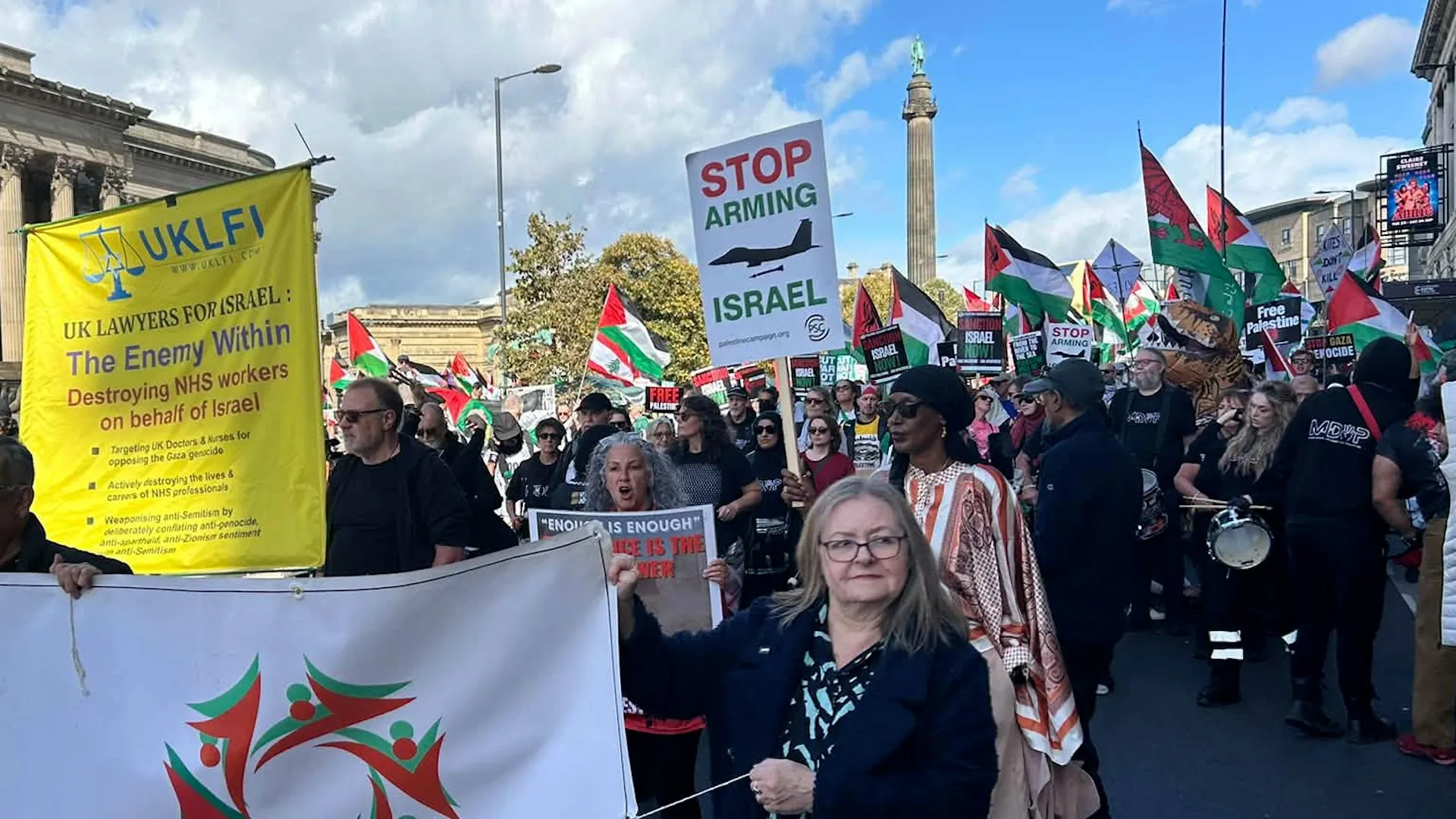
proPalestine

UK’s Starmer eyes banning some pro-Palestine protests | Israel-Palestine conflict News

PM Keir Starmer says the phrase ‘globalise the Intifada’ should be ‘completely off limits’.

British Prime Minister Keir Starmer says some pro-Palestine marches could be banned and people who use the phrase “globalise the Intifada” could be prosecuted.

In an interview broadcast by the BBC on Saturday, Starmer advocated for tighter language restrictions at pro-Palestine marches, adding that in some cases, rallies could be prohibited altogether.

Recommended Stories

list of 4 itemsend of list

“I’m a big defender of freedom of expression, peaceful protests,” he told the BBC. “But when there are chants like ‘globalise the Intifada’, that’s completely off limits.”

“Clearly, there should be tougher action in relation to that,” he added.

Discussions had been taking place with the police for some time about what further action could be taken, he added. Asked whether he sought to completely bar some rallies, Starmer said he thought that would be appropriate in some cases.

‘Likely to be arrested’

Starmer’s comments come after he earlier this week called the chant “globalise the Intifada” a case of “extreme racism” and said those who use it “should be prosecuted”.

Metropolitan Police Commissioner Sir Mark Rowley also told the BBC that people who use the phrase are “likely to be arrested”.

Supporters of the slogan say it reflects a call to expand the pro-Palestine movement into a global campaign.

Starmer has come under pressure after a spate of anti-Semitic incidents, including this week, when two men were stabbed in the north London suburb of Golders Green, which is home to a large Jewish community.

A 45-year-old British national who was born in Somalia was remanded in custody when he made his first appearance in court on Friday, accused of attempted murder.

Starmer visited the scene of the attacks and a Jewish volunteer ambulance service on Thursday and was booed by some locals, who accused him of not doing enough to protect them. They also denounced pro-Palestinian activists holding marches in British cities.

On Thursday, the UK increased its security alert level to “severe” – the second highest – in part because of the attack in Golders Green.

British authorities have repeatedly faced criticism for cracking down on pro-Palestine activism during Israel’s genocidal war on Gaza.

Last month, British police arrested more than 500 people during a mass vigil in central London to oppose the ban on campaign group Palestine Action.

“I think Britain has now descended into a non-democratic situation and I think that is very dangerous [for] free speech,” one demonstrator taking part in the vigil told Al Jazeera.

Source link

US professors sue university over arrest during pro-Palestine protest | Israel-Palestine conflict News

Three professors at Atlanta’s Emory University in the United States have filed a lawsuit over their arrests during a 2024 campus protest over Israel’s genocidal war on Gaza.

Their lawsuit on Thursday argued that the university broke its own free-speech policies when it called in police and state troopers to aggressively disband the protest, making 28 arrests.

Recommended Stories

list of 3 itemsend of list

“The judicial system would find that Emory failed to protect its students, to protect its staff, to protect the educational mission of the university,” said philosophy professor Noelle McAfee, one of the plaintiffs.

“So this isn’t just about people’s individual rights. It’s our educational mission to train people in free and critical inquiry, to be able to learn how to engage with others, to be fearless.”

Laura Diamond, a spokesperson for Emory, responded that the university believes “this lawsuit is without merit”.

“Emory acts appropriately and responsibly to keep our community safe from threats of harm,” Diamond said in a statement. “We regret this issue is being litigated, but we have confidence in the legal process.”

The suit is just one example of how the nationwide wave of protests from 2023 and 2024 continues to reverberate on elite campuses.

There have been multiple instances where students and faculty have filed lawsuits against universities, arguing they were discriminated against because of the protests.

But the Emory suit is unusual. McAfee and her fellow plaintiffs — English and Indigenous studies professor Emilio Del Valle-Escalante and economics professor Caroline Fohlin — all remain tenured faculty members. None were convicted of any charges.

The civil lawsuit in DeKalb County State Court demands that the private university repay money the three spent defending themselves against misdemeanour charges that were later dismissed, along with punitive damages.

McAfee said she’s suing her employer “to try to get them to be accountable and to change”.

All three say they were observers on April 25, 2024, when some students and others set up tents on the university’s main quad to protest the war. They say Emory broke its own policies by calling in Atlanta police and Georgia state troopers without seeking alternatives.

McAfee was charged with disorderly conduct after she said she yelled “Stop!” at an officer roughly arresting a protester. Del Valle-Escalante said he was trying to help an older woman when he was arrested and charged with disorderly conduct.

Fohlin said that, when she protested against officers pinning a protester to the ground, she herself was thrown face-first to the ground and arrested, suffering a concussion and a spine injury. Fohlin was charged with misdemeanour battery of an officer.

Emory claimed that those arrested that day were outsiders who trespassed on school property. But 20 of the 28 people arrested were affiliated with the university.

The professors said that, after their arrests, they were targeted by threats and harassment, part of a pushback by conservatives who said universities were failing to protect Jewish students from anti-Semitism and allowing lawlessness.

Nationwide, however, advocates say there is a “Palestine exception” in which universities are willing to curb pro-Palestine speech and protest. Palestine Legal, a legal aid group supporting such speech, said Tuesday that it received 300 percent more legal requests in 2025 than its annual average before 2023, mostly from college students and faculty.

McAfee served as president of the Emory University Senate after her arrest. The body makes policy recommendations and has helped draft the university’s open expression policy.

She said she asked then-President Gregory Fenves in fall 2024 why Emory police weren’t dropping the charges against her and others. McAfee said Fenves told her that he wanted “to see justice”.

The open expression policy was revised after 2024 to clearly prohibit tents, camping, the occupation of university buildings and demonstrations between midnight and 7am.

Whatever the policy, McAfee said students are afraid to protest at Emory, saying the university has turned its back on what Atlanta civil rights icon John Lewis called “good trouble”.

“Students know right now that any trouble is not going to be good trouble at Emory, that they could get arrested,” she said. “So students are afraid.”

Source link

Did UK universities pay to ‘spy’ on pro‑Palestine students? | News

UK universities allegedly hired a security firm with military intelligence ties to monitor pro-Palestine students.

Twelve elite British universities are accused of hiring a private security firm with military intelligence ties to track pro-Palestine student protests. Students were reportedly flagged through social media monitoring without their awareness, sparking debate over surveillance and free speech in UK higher education.

Learn more about the campus accountability mapping project.

In this episode: 

  • Aaron Walawalkar (@AaronWala), Investigative Reporter, Liberty Investigations

Episode credits:

This episode was produced by Chloe K. Li and Sarí el-Khalili with Spencer Cline, Catherine Nouhan, Tuleen Barakat and our host, Malika Bilal. It was edited by Tamara Khandaker and Noor Wazwaz. 

Our sound designer is Alex Roldan. Rick Rush mixed this episode. Our video editors are Hisham Abu Salah and Mohannad al-Melhemm. Alexandra Locke is The Take’s executive producer. 

Connect with us:

@AJEPodcasts on X, Instagram, Facebook, and YouTube


Source link

Pro-Palestine legal aid requests stay high in 2025 amid US campus pressure | Donald Trump News

Washington, DC – Requests for legal support related to pro-Palestine advocacy remained high in the United States last year, as President Donald Trump threatened activists and universities with penalties.

In an annual report released on Tuesday, Palestine Legal, an organisation that “supports the movement for Palestinian freedom in the US”, said it received 1,131 queries for legal support in 2025.

Recommended Stories

list of 3 itemsend of list

The figure is below the record 2,184 requests the group received in 2024, when pro-Palestine protests swept US campuses — and were regularly met with crackdowns from both school administrators and law enforcement.

Despite universities enacting new restrictions on protests across the country, the figures from 2025 show that pro-Palestine advocacy has persisted, according to Dima Khalidi, the executive director of Palestine Legal.

“Our 2025 year-end report shows that while universities have largely cowered and caved to coercive pressure from the Trump administration and its pro-Israel supporters, student activists for Palestinian and collective freedom remain a model of moral conviction and courage,” Khalidi said.

“Even when facing punitive consequences for speaking out, they are holding the line of dissent against injustice from the US to Palestine, because they understand the cost of surrender for all of us.”

Palestine Legal said that the “overwhelming majority of requests” for legal support came from university students and faculty in 2025, but a growing number, 122, were categorised as “immigration and border-related”.

The group received 851 requests from people or organisations targeted for their Palestine-related advocacy, as well as 280 more asking for legal guidance on conducting advocacy.

Despite the drop from 2024, the rate of complaints last year remained 300 percent higher than in 2022, the year before Israel began its genocidal war in Gaza on October 7, 2023.

Since then, at least 72,560 Palestinians have been killed in Gaza.

Pressure campaigns

In 2024, Trump campaigned for a second term in the White House in part on a pledge to crack down on the pro-Palestinian protest movement, which sought to shine a light on the human rights abuses unfolding during the war.

He has framed such protests as anti-Semitic, and since his inauguration in 2025, he has led a campaign to penalise schools that played host to pro-Palestinian activism.

To date, five universities have struck deals with Trump after he threatened to withhold billions in federal funding. They include Columbia University, where a pro-Palestine encampment and resulting police crackdown drew international attention.

Columbia eventually reached a $200m settlement with the Trump administration and moved to make several policy changes it said were aimed at combatting anti-Semitism.

Rights groups have condemned such policies as conflating pro-Palestine advocacy with anti-Jewish sentiment. They also warn that Trump’s actions risk dampening free speech, a protected right under the First Amendment of the US Constitution.

All told, nearly 80 of the students who took part in Columbia’s protests faced serious academic discipline, including expulsions, suspensions, and degree revocations, as of July 2025.

Meanwhile, the Trump administration used immigration enforcement to target pro-Palestine protesters and advocates, including scholars like Rumeysa Ozturk, Mohsen Mahdawi, Badar Khan Suri and Mahmoud Khalil.

To date, the deportation proceedings against Ozturk, who was in the US on a student visa, and Mahdawi, a US permanent resident detained at his citizenship hearing, have been abandoned.

Ozturk has since voluntarily returned to her native Turkiye after completing her doctoral studies at Tufts University.

The government is still proceeding with deportation efforts against Khan Suri, a Georgetown University researcher, and Mahmoud Khalil, a Columbia University graduate and permanent US resident.

Separately, the Federal Bureau of Investigation (FBI) raided five homes connected to pro-Palestine activists at the University of Michigan in April 2025, sparking outrage. Federal authorities seized properties, but no arrests were made.

Despite the restrictive climate across the country, Palestine Legal hailed a string of legal victories in 2025 that upheld the right to pro-Palestinian protest.

Last August, for instance, a federal court dismissed a complaint that sought to penalise UNRWA USA, a non-profit that supports the United Nations Relief and Works Agency for Palestine Refugees (UNRWA), under the Antiterrorism Act of 1990.

A separate lawsuit launched by Palestine Legal and the Council on American-Islamic Relations (CAIR) charged that the University of Maryland had tread on the free speech rights of students by banning Students for Justice in Palestine (UMD SJP). That case resulted in a $100,000 settlement.

Meanwhile, federal judges have sided with Harvard University and the University of California, Los Angeles (UCLA), in their challenges to the Trump administration’s defunding efforts.

“The fights that Palestine Legal and our partners have waged affirm that the Trump administration, universities, and Israel advocacy groups cannot, without consequence, run roughshod over growing demands to respect and protect Palestinian rights,” Palestine Legal said at the conclusion of its report.

“The developments throughout 2025 made crystal clear that if we allow our right to stand for Palestinian freedom to be trampled, all of our fundamental rights will be in jeopardy in the face of an authoritarian slide.”

Source link

Iran citizen held in France over pro-Palestine comments returns home | Prison News

Release of Mahdieh Esfandiari comes a week after Iran released two French citizens held on espionage charges.

Iranian national Mahdieh Esfandiari has returned home after being held in France for more than a year as part of what appears to be an exchange of detainees between the countries.

Iran’s state television reported on Wednesday that the “rights activist”, sentenced to one year in prison after making online comments supportive of Palestine and the 2023 Hamas attack on Israel that prompted the genocidal war on Gaza, had returned to Iran.

Recommended Stories

list of 2 itemsend of list

The University of Lyon graduate, who had been living in France since 2018, where she worked as a translator, was arrested in February last year on charges of promoting “terrorism”, and released on bail in October.

“I think it’s clear for everyone that there is no freedom of speech, at least not in France where I was. The court’s ruling was very unjust,” Esfandiari told state television in a Wednesday broadcast.

Esfandiari’s release comes a week after French citizens Cecile Kohler, 41, and Jacques Paris, 72, arrived in France after being held for more than three years in Iran.

Kohler and Paris were arrested by Iranian authorities in May 2022 but were freed in November last year, after more than three years in prison on espionage charges that their families vehemently deny.

They were taken by French diplomats to France’s mission in Tehran, where they lived under house arrest until their full release on April 7. Upon their release, they were driven from Iran to neighbouring Azerbaijan before taking a flight to Paris.

President Emmanuel Macron’s office said their release was the outcome of a “long-term effort”, but talks accelerated in recent weeks due to pressure from the US-Israel war on Iran, giving a sense of urgency to the situation.

While an exchange was not explicitly acknowledged by France, Iran’s state-run agency IRNA had previously said Tehran reached an agreement with Paris for the release of the French citizens in exchange for Esfandiari.

Source link

UK accused of ‘intimidation tactics’ against bailed pro-Palestine activists | Israel-Palestine conflict News

London, United Kingdom – Civil rights groups and Palestine solidarity campaigners are accusing the United Kingdom of “intimidation tactics” after two young pro-Palestinian activists were recently arrested while on bail.

On Monday, 21-year-old Qesser Zuhrah was detained after sharing a social media post calling on people to take “direct action”.

Recommended Stories

list of 4 itemsend of list

Masked officers handcuffed Zuhrah at her home in Watford at dawn. Just a month ago, she was released on bail following 15 months in prison awaiting trial, during which she participated in a lengthy hunger strike.

Four days earlier, on Thursday, plainclothes police officers in south London also arrested Audrey Corno, 23, accusing her of tampering with her electronic tag in breach of bail conditions – a charge she denies.

“They just grabbed me,” Corno told Al Jazeera. “I broke down into tears. This was a complete shock and very re-traumatising.”

She was told that a month earlier, her tag had been offline for 20 minutes.

The police surprised her as they emerged from “an undercover car” that was parked “right outside my home address”, Corno said.

“I don’t know how long they had been waiting there for. I was just back from a walk with my friends,” she said. “I would have no idea how to tamper with my tag for it to stop working and then work again.”

Before their latest arrests, both Zuhrah and Corno were imprisoned over their alleged participation in separate raids on military hardware manufacturers in 2024 that were claimed by Palestine Action, the direct action group whose stated mission is to target companies associated with the Israeli war machine.

Although the High Court ruled in February that the UK’s ban on Palestine Action as a “terrorist” organisation was unlawful, it is still illegal to show support for the group as the government prepares for an appeal due to take place later this month.

‘Charges in connection with social media post’

Counterterrorism police on Monday said that Zuhrah’s latest charge was “encouraging or assisting” the commission of an offence, “namely criminal damage”.

“The charges are in connection with posts made on social media,” the force said.

Zuhrah was granted bail again on Tuesday. She is due to appear in court on April 17.

She is a member of the so-called “Filton 24” collective, accused of breaking into a weapons factory in Filton, Bristol belonging to Elbit Systems UK, a subsidiary of Israel’s largest weapons manufacturer, in August 2024.

In Corno’s latest case, she was also released hours after being arrested for a second time.

Naila Ahmed, head of campaigns at CAGE International, said, Zuhrah’s “rearrest” is a continuation of the “active repression” targeting pro-Palestine activists across the UK.

“These laws were not misapplied or stretched beyond their intent – they were designed precisely to criminalise political speech and dissent, and that is exactly what they are doing here,” she said. “Terrorism legislation should be abolished in its entirety. It has never been a tool of public protection – it is and has always been a tool of political control, used to police those who challenge state power and silence those who speak out against injustice.”

Corno was previously accused of offences related to a June 2024 break-in at the Wooburn Green, Buckinghamshire facility of GRiD Defence Systems, which Palestine Action said supplies the Israeli military – a charge denied by the company.

She believes officials are using “intimidation tactics” because several charges against Palestine Action-linked activists have been dropped and dozens of them have been released on bail. All Filton 24 activists, for example, have been acquitted of aggravated burglary, and 23 have been freed from prison.

“This is a reaction to the acquittals and zero convictions in the Filton 24 case so far,” Corno said. “Take direct action” is not a contentious thing to say, she argued.

“Direct actionists who either are released on bail as they should be, or found not guilty, are still being heavily surveilled and heavily repressed by the state as a reminder, that although the public may find us not guilty, the state does.”

Last week, Zuhrah and other Filton 24 defendants spoke about alleged prison mistreatment and said they were planning to take legal action over medical neglect.

Campaigners supporting the group said, “We believe this is a coordinated campaign by the state to retaliate [after failing] to secure a single conviction at the first trial of the Filton 24. There is no doubt that this arrest was politically motivated, as it is unprecedented to charge people under the Serious Crime Act”.

The detentions come at a time of increasing friction between the police and Britain’s significant Palestine solidarity movement – and ahead of a march that could bring new tensions.

On Saturday, crowds of protesters are expected to gather again in London to demonstrate their support for Palestine Action as the genocide in Gaza continues. To date, thousands of peaceful protesters have been arrested for signs reading: “I oppose genocide, I support Palestine Action”.

While London’s Met Police refrained from detaining protesters following the High Court’s ruling, the force recently reversed that policy, meaning mass arrests are once again likely.

Meanwhile, a court is expected on Wednesday to rule in the case of Palestine Solidarity Campaign’s Ben Jamal and Stop the War Coalition’s Chris Nineham, who are accused of breaching protest restrictions in January 2025.

Since Israel’s onslaught on Gaza began in October 2023, tens of thousands of Britons have rallied in support of Palestine.

According to YouGov polling, one in three Britons has “no sympathy at all for the Israeli side in the conflict” after Israel killed more than 72,000 people in two years and decimated the Gaza Strip.

The government, led by Labour leader Keir Starmer, has long been accused of cracking down on pro-Palestine solidarity because of a wave of arrests during demonstrations and due to its proscription of Palestine Action.

Human Rights Watch has said that its research found a “disproportionate targeting of certain groups, including climate change activists and Palestine protesters, undermining the right to protest freely and without fear of harassment”.

Source link

Pro-Palestine protester Leqaa Kordia freed from US immigration detention | Donald Trump News

The 33-year-old Columbia University protester had been held in immigration detention centre for a year.

Leqaa Kordia, a Palestinian woman detained in the United States after taking part in pro-Palestine demonstrations in 2024, has been released after a year in custody.

The 33-year-old, who grew up in the occupied West Bank before moving to the US in 2016, was held at a detention facility in the state of Texas since March last year.

“I don’t know what to say. I’m free! I’m free! Finally, after one year,” a smiling Kordia told reporters after leaving the detention centre on Monday.

An immigration judge had ruled Kordia was eligible to be released on bond three times. Immigration officials appealed the first two rulings but Kordia was freed on $100,000 bond after government lawyers did not challenge the third.

After her release, Kordia said she was looking forward to going home and hugging her mother “so hard.” But she also said she would keep fighting on behalf of people still being held at the detention centre

“There is a lot of injustice in this place,” she said. “There is a lot of people that shouldn’t be here the first place.”

Kordia, who lost nearly 200 members of his family during Israel’s genocidal war against Palestinians in the Gaza Strip, was among several protesters targeted by immigration officials for taking part in pro-Palestine demonstrations at Columbia University in 2024.

Until Monday, she was the only person targeted in connection with the demonstration who was still in immigration detention after the release of others, including Mahmoud Khalil and Mohsen Mahdawi.

Kordia, who was held at Prairieland Detention Center in Alvarado, was recently hospitalised for three days following a seizure after fainting and hitting her head at the privately run detention facility.

At a hearing on Friday, Kordia’s lawyers said she had a neurological condition that had worsened while in custody, putting her at an elevated risk of seizure. They reiterated that she could stay with US citizen family members and did not pose a flight risk.

The immigration judge, Tara Naslow, agreed.

“I’ve heard testimony. I’ve seen thousands of pages of evidence presented by the respondent, and very little evidence presented by the government in any of this,” Naslow said.

Source link