proof

President Lee calls remains repatriation proof of U.S.-South Korea alliance

South Korea President Lee Jae Myung attends the ROK and the U.S. repatriation ceremony for Korean remains at Seoul Military Air Base in Seongnam, South Korea, 05 June 2026. The remains of ten South Koreans and the three U.S. soldiers killed in the Korean War were sent back to their homeland. Photo by JEON HEON-KYUN / EPA

June 5 (Asia Today) — South Korean President Lee Jae-myung said Friday that the mutual repatriation of Korean War remains by South Korea and the United States is “the most compelling evidence” of an alliance forged in blood.

Lee made the remarks at Seoul Air Base in Seongnam, where South Korea and the United States held a mutual repatriation ceremony for Korean War remains. It was the first time the ceremony was held in South Korea. Previous mutual repatriation ceremonies had been held in Hawaii.

“Today’s repatriation is a meaningful milestone that deepens and strengthens the South Korea-U.S. alliance, which was built on the blood and dedication of veterans,” Lee said.

“The effort to find not only one’s own warriors but also those of an ally and return them to their families is the most compelling evidence of an alliance forged in blood,” he said.

The ceremony returned the remains of 10 South Korean service members from Hawaii to South Korea. The remains of three U.S. service members were returned to the United States.

Lee said the repatriation was a promise by both countries to remember the heroes who devoted themselves to freedom and peace, calling it “the most noble tribute to their sacrifice.”

“More than 70 years ago, we were able to defend freedom and peace because of the noble sacrifice of heroes who gave their most precious lives to protect the freedom and peace of the Republic of Korea,” Lee said.

“But there are heroes who, long after the war ended, have still not returned to their hometowns,” he said. “Returning them fully is the historical duty of those of us who survived.”

Lee said trust built through battlefield promises has sustained the U.S.-South Korea alliance for decades.

“The trust that keeps promises made on the battlefield, even after decades have passed, is the strong root that has supported the South Korea-U.S. alliance,” Lee said. “With the firm South Korea-U.S. alliance as nourishment, the Republic of Korea is writing a new history of prosperity that amazes the world.”

Lee said the two allies should continue working together for peace and mutual prosperity.

“If South Korea and the United States join hands and move unwaveringly toward the future, complete peace will take root on this land and the flower of mutual prosperity will bloom,” Lee said. “We will continue to carry forward, with future generations, the noble history of solidarity for freedom and peace.”

— Reported by Asia Today; translated by UPI

© Asia Today. Unauthorized reproduction or redistribution prohibited.

Original Korean report: https://www.asiatoday.co.kr/kn/view.php?key=20260605010001908

Source link

Trump, without proof, claims ‘cheating’ in California vote, says federal probe underway

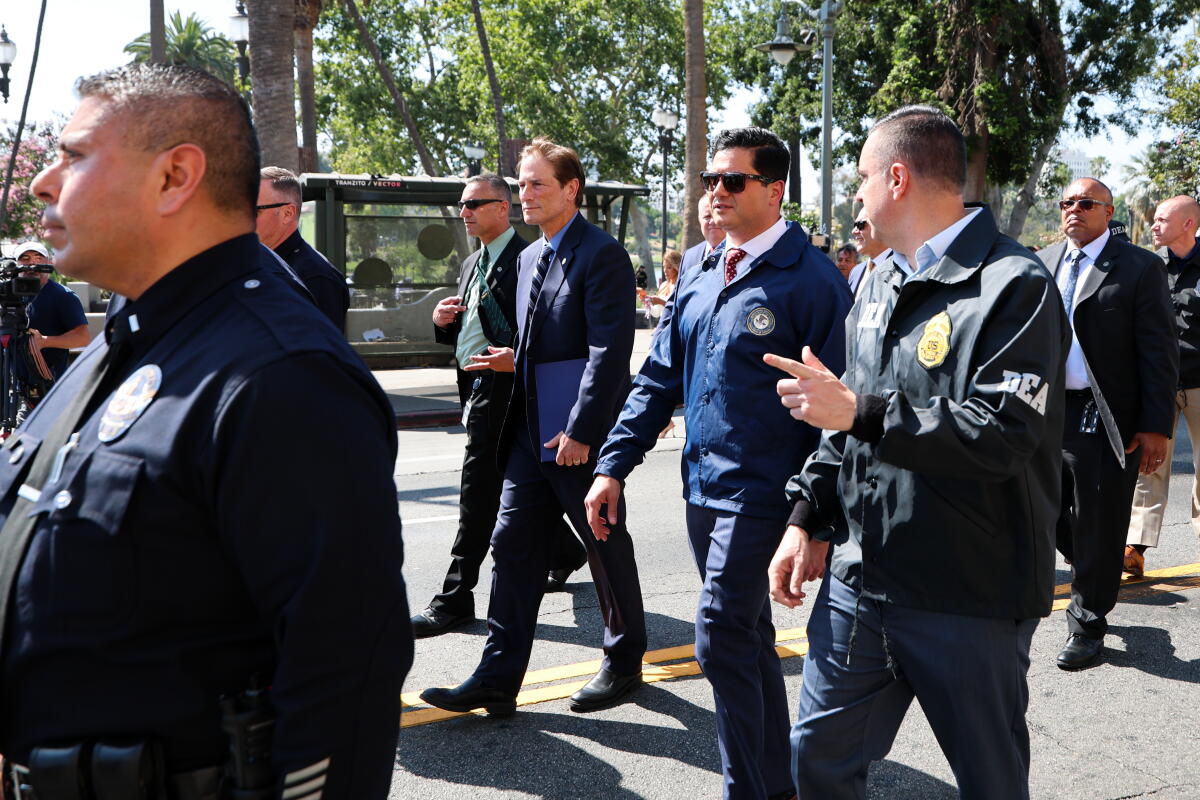
To the surprise of few, President Trump has once again claimed without evidence that Democrats are somehow cheating to win California’s primary elections — writing on social media late Wednesday that federal prosecutors in Los Angeles are investigating the matter.

“The Dumocrats are at it again! They are trying to STEAL THE GOVERNOR OF CALIFORNIA PRIMARY, AND THE MAYOR OF LOS ANGELES, PRIMARY, AWAY FROM TWO GREAT REPUBLICAN CANDIDATES. Here we go with the very late and massive numbers of MAIL IN BALLOTS,” Trump posted to his social media platform Truth Social.

“There’s BIG cheating by the Dumocrats in California. Votes are all tied up. May not be in for weeks. Under investigation by the U.S. Attorney’s Office in Los Angeles,” he wrote in a second post. “Why the vote counting DELAY???”

A spokesperson for the U.S. attorney’s office in Los Angeles — run by Trump loyalist First Assistant U.S. Atty. Bill Essayli — declined to comment Thursday morning on Trump’s claims of an investigation.

California Secretary of State Shirley Weber’s office also did not immediately respond to a request for comment.

Gov. Gavin Newsom’s office responded directly to Trump late Wednesday with its own social media post, writing, “Trump is lying about California again — time to take the phone away from grandpa and put him to sleep.”

On Thursday morning, Newsom’s office wrote that there “is a lot of misinformation floating around about California’s election — including from the President,” and recommended people watch a CNN video about California’s election process. It concluded that delays in vote counting in the state are essentially a result of state leaders deciding that providing voters with “last minute options” for casting ballots is more important than a quick count.

“And yes, for the record: we wish the votes were counted faster, too,” Newsom’s office wrote — a nod to the fact that the issue isn’t new.

In an email, Brandon Richards, Newsom’s deputy director for rapid response, said Trump’s claims are part of “a tinfoil hat level conspiracy theory that has been debunked repeatedly.”

The president’s claims of cheating were predicted before the election by both elections experts and Democratic leaders in California, who dismissed them in advance as more baseless bluster from a president beset by low approval ratings.

A worker counts ballots

A worker puts ballots in a counting machine at the Los Angeles County Ballot Processing Center on Wednesdayin City of Industry.

(Kayla Bartkowski/Los Angeles Times)

Those same experts and Democratic leaders acknowledge that California’s system for counting votes takes a long time and should be quickened, but stress that is not because of anything nefarious. Rather, it is because California allows voters to cast ballots by mail up until election day — and then has to count those ballots, which can number in the millions and are subject to manual signature verification.

Trump has long dismissed such explanations. An election denier since he first entered politics more than a decade ago, Trump has pushed skepticism about elections he and his party lose time and again since — most notably when he claimed, again without evidence, that the 2020 election he lost to Joe Biden was stolen.

Trump even challenged Biden’s victory in court, but his claims were rejected completely because neither he nor his attorneys could produce any evidence substantiating them.

He has combined his tactic of targeting undocumented immigrants for political gain with his skepticism of election integrity by claiming, again without evidence, that such immigrants somehow vote in large numbers, particularly in big blue states such as California, despite experts saying there is no evidence of that.

He has alleged that mail ballots — such as those used by the majority of California voters — are a particularly rich source of voter fraud, despite again having no basis for the claim and it being disputed by experts.

A consistent feature of his election fraud claims is that they arise and target races only when Republicans lose or lose ground.

And, he has tried to use the power of his administration to make sweeping changes to election laws to bar mail ballots and require strict voter ID and proof of citizenship measures, despite the control of elections and their rules being constitutionally given to the states.

Those efforts have prompted a wave of litigation between the Trump administration and California and other blue states, with multiple cases pending in the courts over voter ID, proof of citizenship, mail balloting and the role that the U.S. Postal Service may be allowed to play in processing such ballots.

Trump’s latest remarks came as additional vote counting on Wednesday narrowed the advantage of Republican Steve Hilton over his Democratic challengers in the California governor’s race and closed the gap in the L.A. mayoral race between the MAGA-aligned candidate Spencer Pratt, currently running second, and City Councilmember Nithya Raman, who is running third.

The trend was anticipated. Elections experts warned before vote counting began of the potential for a “red mirage,” wherein earlier voting among Republicans and late voting among Democrats — many of whom were unsure of whom to vote for in the two high-profile races — would create an early illusion of Republican victories despite large volumes of liberal votes from major population centers still to be counted.

It is a trend that has played out repeatedly in past elections, and one that does not come as a surprise to careful elections watchers.

Elections officials in California knew such claims were going to be made, as they’ve been made in the past. Some local elections officials made a point of preparing their staffs for baseless claims of election fraud in advance of this year’s primaries. State officials made repeated efforts to explain the reasons why California elections take time, precisely to undercut claims amid counting that the delays were the result of fraud.

But those claims have come regardless, and not just from Trump.

Above an X post Wednesday suggesting Pratt was losing ground to Raman as more counts came in, Florida Gov. Ron DeSantis wrote, “California keeps dumping votes. Odds are shifting because the vote dumps always seem to go one way. Count until you get the result you want?”

Above another X post Wednesday noting that the California count would take time, Katie Miller, a former Trump administration official and conservative podcaster married to Trump’s top advisor Stephen Miller, wrote, “The Democrats are about to steal the LA mayoral race once again using mail-in voting.”

Both of the posts that DeSantis and Miller were responding to were from Polymarket, a prediction market where people can bet on the outcomes of political races, pop culture events and a slew of other subjects.

Such emerging financial markets, which process billions of dollars in bets, are causing rising concerns about political meddling for profit — including by campaign staffers and other individuals with insider knowledge of polling and other campaign information, or by politicians and their operatives, whose public remarks about politics can swing those markets.

Source link

Millions of Americans may now also be considered Canadian under new law

Millions more Americans might qualify for dual Canadian citizenship under a recent change to Canada’s requirements that has led to a surge in applications from its southern neighbor.

For people like Zack Loud of Farmington, Minn., it was a surprise to learn that under a new law, Canada already considered him and his siblings citizens because their grandmother is Canadian.

“My wife and I were already talking about potentially looking at jobs outside the country, but citizenship pushed Canada way up on our list,” he said.

Since the new law took effect Dec. 15, immigration lawyers in the United States and Canada say they have been overwhelmed by clients seeking help submitting proof of citizenship applications. Driven by politics, family heritage, job opportunities and other factors, thousands of Americans are exploring whether the easier process makes now the right time to gain dual citizenship.

Nicholas Berning, an immigration attorney at Boundary Bay Law in Bellingham, Wash., said his practice is “pretty much flooded with this.”

“We’ve kind of shifted a lot of other work away in order to push these cases through,” he said.

Immigration attorney Amandeep Hayer said his Vancouver, British Columbia-area practice went from about 200 citizenship cases a year to more than 20 consultations per day.

How the new law works

Canada has been changing its citizenship laws for decades, whether to update historic interpretations of law or to address discrimination issues.

Previously, Canadian citizenship by descent could only be passed down to one generation, from a parent to a child. But the new law opened up citizenship to anyone born before that date who could prove they have a direct Canadian ancestor — a grandparent, great-grandparent or even more distant ancestor.

Those born on or after Dec. 15 need to show that their Canadian parent lived in Canada for 1,095 days.

Under the new law, descendants of Canadians are already considered citizens but must provide proof to obtain a certificate of citizenship. Hayer estimated that there are millions of Americans who are Canadian descendants.

“You are Canadian, and you’re considered to be one your whole life,” said Hayer, who advocated for the new law in parliament. “That’s really what you’re applying for, the recognition of a right you already have vested.”

“The best way I can put it is like, if a baby’s born tomorrow in Canada, the baby’s Canadian even though they don’t have the birth certificate,” he said.

Americans interested in dual citizenship

American applicants have different motivations, but many say President Donald Trump’s immigration crackdown and other topics have led them to seek dual citizenship.

Michelle Cunha, of Bedford, Mass., said she decided to move to Canada after reflecting on decades of political activism and deciding she had “nothing left to give.”

“I put in my best effort for 30 years. I have done everything that I possibly can to make the United States what it promises the world to be, a place of freedom, a place of equality,” Cunha said. “But clearly we’re not there and we’re not going to get there anytime soon.”

Troy Hicks, who had a great-grandfather born in Canada, said he was spurred by an international trip.

“I recently went to Australia and you know, first words out of the first person I talked to in Australia was basically an expletive about Trump and the U.S.,” said Hicks, of Pahrump, Nev. “It was just like, whoa, I walked off a 20-hour flight and literally the first words of somebody’s mouth to me were that. … So the idea of doing that with a Canadian passport just seemed easier, better, more palatable.”

Maureen Sullivan, of Naples, Fla., said she was motivated by the immigration crackdown in Minnesota, which hit home when her teenage nephew encountered federal officers near his high school in St. Paul. Sullivan, whose grandmother was Canadian, said she sees citizenship in Canada as an option in case things in the U.S. “really go south.”

“When I first heard about the bill, I couldn’t believe it. It was like this little gift that fell in my lap,” Sullivan said. “There was kind of this collective excitement amongst the (family) who just felt like, we wanted to feel like we were doing something to take care of our security in the future if needed.”

How much will Canadian citizenship cost?

For those with documentation ready at hand, the proof of citizenship application fee is a relatively inexpensive 75 Canadian dollars ($55).

But costs will climb for those seeking help from an attorney or genealogist to locate records like birth, death and marriage certificates that can establish the lineage to a Canadian ancestor.

Cunha said she used an attorney and estimates the cost will be about $6,500.

However, Mary Mangan, of Somerville, Mass., filed her application in January using advice from online forums.

“There are some situations where a lawyer might be the right thing, but for many people, I would guess 90% of people can probably do this on their own,” Mangan said.

The website for the Immigration, Refugees and Citizenship Canada office, which processes applications, says processing times for a certificate is around 10 months, with more 56,000 people awaiting a decision.

The agency said that from Dec. 15 to Jan. 31, it confirmed citizenship by descent for 1,480 people, though not all were Americans. Last year, 24,500 Americans gained dual U.S.-Canada citizenship.

What’s the reaction in Canada?

Fen Hampson, professor of international affairs at Carleton University in Ottawa, said Canadians are generally a “welcoming people.”

Hampson said some also worry a surge of interest from Americans could delay efforts by refugees and asylum-seekers fleeing vulnerable situations.

“I think where people start looking askance is someone who’s never been to Canada, who has very thin ties. They can get a passport, becoming Canadians of convenience. People don’t like that,” he said.

Raza writes for the Associated Press.

Source link