promise

Justice Kennedy reflects on his time deciding the Constitution’s promise of liberty and equality

Justice Anthony M. Kennedy, the Supreme Court’s most influential member prior to his retirement, has watched quietly for eight years as a new conservative majority took charge.

He was troubled by partisan gerrymandering, but a year after he stepped down, a 5-4 ruling closed the federal courts to challenges to state voting maps that allow one party to rig the elections in its favor.

Though he believed abortion was a moral wrong, he cast the crucial vote in 1992 to uphold Roe vs. Wade and the principle that a woman, not the government, had the right to decide on ending an early pregnancy.

Four years ago, that decision was overturned on a 5-4 vote.

While Kennedy has refrained from commenting on the current court or President Trump, he has written a memoir that tells his life story and explains the reasoning behind the major decisions of his era.

It has become common for the justices to write books, but they steer clear of writing about the work of the court. Kennedy’s book, “Life, Law & Liberty,” is, like the justice, the exception to that rule.

An Irish Catholic from Sacramento and a Reagan Republican, Kennedy had a generally conservative voting record over 30 years on the high court. But he had a distinct view of liberty and justice.

“The nature of injustice is that we may not always see it in our own times,” he wrote in 2015.

Kennedy rejected the “rigid” view that the Constitution’s promises of liberty and equal protection of the law, as well as the protection against cruel and unusual punishment, were limited to their “original” meaning in the Bill of Rights of 1791 or the 14th Amendment of 1868.

After all, slavery and segregation were legal for much of American history, and women were not protected from discrimination by the promise of “equal protection” in the 14th Amendment.

Kennedy remained open to new rights and liberties. The goal, he wrote, was “a decent society in which the Constitution and the rule of law treat all with dignity and equality.”

He was the justice who made the difference in several areas of law, none more significant than in LGBTQ+ rights.

He wrote the court’s four major rulings rejecting discrimination based on sexual orientation. In 2015, he spoke for the 5-4 majority to uphold same-sex marriages nationwide.

“No union is more profound than marriage, for it embodies the highest ideals of love, fidelity, devotion, sacrifice, and family,” he wrote. “Many same-sex couples provide loving and nurturing homes to their children, whether biological or adopted. And hundreds of thousands of children are presently being raised by such couples.”

They “ask for equal dignity in the eyes of the law. The Constitution grants them that right,” he concluded in Obergefell vs. Hodges.

He also believed that teenagers who commit crimes are not as culpable as adults. He wrote a court opinion in 2005 ending executions for murderers who were under age 18 at the time of their crime.

Five years later, he wrote the court’s opinion holding it was cruel and unusual punishment for judges to impose a sentence of life in prison with no chance for parole for a teenager’s crime that did not involve homicide. In the case before the court, a Florida teen was given a life term for committing an armed robbery and a home burglary prior to his 18th birthday.

Kennedy marked his 90th birthday on Thursday and says his favorite topic of conversation is not the nine justices but his nine grandchildren. He still goes to the court some days and says he is worried by the tone in Washington and around the country.

“It is too partisan and confrontational,” he said in a recent interview with The Times. “I’m concerned that the divisiveness may be reflected at the court.”

Democracy requires “reasoned and respectful debate,” he said, not personal attacks and name calling.

Kennedy may be the last justice of his kind, said Washington University law professor Daniel Epps, a former Kennedy clerk.

“I don’t think we’ll see another justice who is so ideologically unpredictable and who votes against his party of appointment in some of the hugest cases in our lifetimes,” he said. Kennedy emerged from “an appointments process that was less polarized, where there were conservative Democrats and liberal Republicans and a Senate filibuster, which all made it possible for moderates to be appointed.”

While Kennedy describes himself at times as a small-town lawyer from Sacramento, he knew the two California governors, both Republicans, who reshaped the Supreme Court.

Kennedy’s father was a friend of Gov. Earl Warren, and young Tony played with Warren’s children. He also worked as a young page in the state Capitol when Warren was governor.

He was a high school senior in 1954 when Warren, the new chief justice, spoke for a unanimous court to strike down racial segregation in the case of Brown vs. Board of Education.

He and his father agreed the ruling was long overdue. It also provided an early lesson in how justices can uphold the fundamental principles of the Constitution despite intense opposition in much of the nation.

He said he later learned a second lesson. The Brown decision was “a historic step forward” but it “just a beginning” in the fight against entrenched racial injustice.

In writing the same-sex marriage case, Kennedy cited Warren’s opinion in the 1967 case of Loving vs. Virginia which struck down the bans on interracial marriages in 16 states.

As as young lawyer, Kennedy worked on special projects for Gov. Ronald Reagan and admired him greatly. He was just 38 years old when, at Reagan’s behest, he was appointed to the U.S. 9th Circuit Court of Appeals.

As president a decade later, Reagan had appointed Justices Sandra Day O’Connor and Antonin Scalia to the Supreme Court and elevated William Rehnquist to be the chief justice. But his third nominee — Judge Robert Bork — was voted down as too conservative by the Senate.

Reagan invited Kennedy to the White House and offered him the nomination. Kennedy recalled telling Reagan that he and his wife Mary were happy in Sacramento where all their friends and family lived. We don’t know anyone in Washington, he said.

President Reagan gestures toward Judge Anthony M. Kennedy's family after nominating Kennedy to the Supreme Court in 1987.

President Reagan gestures toward Judge Anthony M. Kennedy’s family after nominating Kennedy to the Supreme Court in 1987.

(Dennis Cook / Associated Press)

In his best imitation of Reagan’s voice, he recounted the president’s response: “You know me. And you know Nancy.”

Kennedy accepted the nomination and was confirmed in February 1988 by a 97-0 vote, the last justice to win unanimous approval from the Senate.

His three decades on the court were shaped in part by his relationship with Scalia.

Kennedy and his wife bought a house in the same northern Virginia neighborhood where Scalia lived. In their early years on the court, they appeared to be friends and allies.

They broadly supported freedom of speech. To the surprise of many, they cast the deciding votes in 1989 to rule that the 1st Amendment protects the right to burn an American flag in protest.

A year later, Kennedy and Scalia dissented vehemently when the court ruled the Michigan Chamber of Commerce and its corporate supporters could be barred from advertising their support for state candidates.

The decision triggered a decades-long dispute that ended with the Citizens United ruling in 2010. Kennedy spoke for a 5-4 conservative majority to rule that corporations, unions and other groups were free to spend money independently to oppose or support candidates.

But when the court was closely split in major cases, Kennedy was likely to be in majority while Scalia wrote scathing and increasingly personal dissents.

“I would hide my head in a bag,” Scalia wrote in dissent in the same-sex marriage case, rather than join an opinion “couched in a style that is as pretentious as its content is egotistic.”

Kennedy was put off by a different jab. Scalia said the justices do not represent the full country. For example, the court lacks a “genuine Westerner (California does not count),” he wrote.

Since Scalia’s death, his influence has grown especially with the younger generation of conservatives.

Two of Trump’s appointees — Justices Neil M. Gorsuch and Brett M. Kavanaugh — were clerks for Kennedy in 1993, but they are far more likely to cite Scalia and his views on interpreting laws or the Constitution. Justice Amy Coney Barrett, Trump’s third appointee, was a clerk for Scalia.

While Kennedy did not respond to Scalia’s harsh dissents, they hung over their last year together on the court.

One day in early February of 2016, Scalia stopped by Kennedy’s office to talk.

“Nino said he had come to regret deeply the tone of his Obergefell dissent and its personal references. He apologized for being intemperate,” Kennedy wrote. “Neither of us is big on hugging, but we hugged, both of us smiling.”

They agreed to get together for dinner with their wives when he returned from a hunting trip to Texas.

A week later, Scalia’s wife Maureen called to tell them of his death.

“Nino and I spent 28 years on the court together,” Kennedy wrote. “We sometimes agreed and sometimes disagreed, but I respected him and miss him very much.”

Source link

Biden will publish ‘Promise Me, America’ memoir after the November midterm elections

Former President Biden will publish a memoir, “Promise Me, America,” which he says will touch upon everything from the economy to his decision to drop his bid for reelection.

The memoir is scheduled to come out Nov. 17, publisher Little, Brown and Company told The Associated Press. The timing of the book — two weeks after midterm elections in which Democrats seek to regain control of Congress — could raise concerns within Biden’s party by putting him back into the spotlight.

Democrats remain divided on Biden’s legacy, with many blaming his ill-fated determination to seek a second term for Republican President Trump’s return to the White House. Leaders hope to keep the fall campaign focused on Trump and his record, and any leaks or promotional efforts before votes are cast could draw frustration.

“‘Promise Me, America’ is about the challenges we faced as a nation. It’s about the decisions I made and why I made them,” Biden said in a video statement accompanying Wednesday’s announcement. “It’s about why I chose to run for reelection and why I chose to step aside.”

Reports of Biden’s book have circulated for more than a year, and the former president himself has referred to it during public remarks, appearing to suggest it would be released before November’s election.

Biden, who will turn 84 three days after the publication of “Promise Me, America,” has long presented himself as an upholder of standards and traditions; presidential memoirs are one of them. With a handful of exceptions, modern presidents since Harry Truman in the 1950s have published books about their White House years. Little, Brown declined to release financial details for ”Promise Me, America,” although presidents have usually reached deals worth at least seven figures.

The book’s title echoes a 2017 memoir by Biden, “Promise Me, Dad,” which centered on the death of his son, Beau Biden.

Vowing as a candidate to “restore the soul” of his country, Biden was sworn into office in the midst of the COVID-19 pandemic and in the aftermath of the Jan. 6, 2021, attack on the U.S. Capitol by Trump supporters seeking to stop his certification as president. Biden’s term was defined by a wide range of conflicts and achievements, from his handling of wars in Ukraine and the Middle East to the passage of ambitious infrastructure and economic aid bills. But many readers will likely want to know more about his health while president, including the disastrous debate in June 2024 against Trump that led to his giving up his reelection bid. Then-Vice President Kamala Harris, who ran instead, lost decisively to Trump.

Former first lady Jill Biden wrote in her own book that her husband seemed so weak and disoriented during the debate that she feared he was having a stroke. In “View from the East Wing,” published in June, she noted that the White House had initially said he was suffering from a cold.

“The biggest lesson for us, I think, was that if you don’t explain something well enough then the question won’t go away,” she wrote. “There was never a satisfying enough explanation offered for Joe’s debate performance, and a lot of people never got over it.”

Biden was the oldest man to serve as president and his health was a source of speculation for much of his term; Biden and his White House advisers have faced intense criticism from Democrats and Republicans for allegedly concealing the extent of his problems. A notable book release from 2025, Jake Tapper’s and Alex Thompson’s “Original Sin,” was subtitled “President Biden’s Decline, Its Cover-Up, and His Disastrous Choice to Run Again.”

That year, Biden announced he had been diagnosed with prostate cancer.

Biden’s previous books also include “Promises to Keep,” a campaign work published to boost his run for president in 2008, when Barack Obama was the eventual nominee and Biden his running mate. ”Promise Me, America” comes out during a year when nonfiction sales have declined and few political books have caught on, although recent bestsellers have included Vice President JD Vance’s “Communion” and an inside account of Trump’s second term, by New York Times reporters Maggie Haberman and Jonathan Swan, “Regime Change.”

A Little, Brown spokesperson said that Biden plans to tour on behalf of the book and give interviews. In his video announcement, Biden said that many people had been asking him how he was doing.

“I’ve been spending a lot of time with my family. I’m dealing with a cancer diagnosis, been getting treatment, and it’s going really well,” he said. “I want to thank all those who have offered their prayers and support and well-wishes. It’s meant the world to me and to Jill.”

Italie writes for the Associated Press.

Source link

Seoul mayor begins 5th term with promise of more opportunities for young people

Seoul Mayor Oh Se-hoon takes the oath of office during his inauguration ceremony at Seoul City Hall on Wednesday. Pool Photo by Yonhap

Seoul Mayor Oh Se-hoon promised Wednesday to provide more opportunities for the younger generation, who are facing severe economic threats, including drastic changes in the job market, as he began his fifth term at the helm of the city government.

Oh was reelected for a fifth term in the June 3 local elections — the first such case in South Korea’s political history. During his inauguration ceremony held at Seoul City Hall, he delivered five pledges, including providing Seoul’s youth with education and housing.

“Today’s youths are facing great pressure to survive more than ever before amid rapid job transformations, technological shifts and high housing prices,” the newly inaugurated mayor said.

Oh said he would ensure that every young citizen can learn and utilize artificial intelligence (AI) so that no one gets isolated from ongoing technological developments.

“I will make a Seoul where people can grow as much as they work and be recognized solely for their skills,” he emphasized.

Oh also promised to supply 310,000 newly built housing units by 2031 and complete urban railway projects to open an era where “a subway station is within a 10-minute walk of every home.”

He further pledged to create a city where residents can find a place to exercise within a 10-minute walk from their homes and vowed to revitalize local commercial districts by providing comprehensive support for small business owners.

“Making Seoul a global top three city is not just about raising its international ranking,” Oh said. “It means transforming it into a city where global citizens want to visit and where our residents want to live for a lifetime.”

Oh previously served his first two terms as the capital’s mayor from 2006 to 2011, when he voluntarily stepped down after losing a municipal referendum on a citywide free lunch program.

Following a decadelong hiatus from public office, Oh made a dramatic comeback by winning the 2021 mayoral by-election, stepping into his third term. After finishing his third term and winning reelection in 2022, he served his full fourth term until this year.

“I will work with the mindset that true achievements are only those felt by the citizens,” Oh said.

Copyright (c) Yonhap News Agency prohibits its content from being redistributed or reprinted without consent, and forbids the content from being learned and used by artificial intelligence systems.

Source link

Democrats keep Proposition 50 promise alive through primary

California Democrats made it out of last week’s primary election having kept the promise of Proposition 50 alive — advancing candidates to November runoffs in all five Republican-held Congressional districts that last year’s redistricting measure targeted.

They now head into November bullish about turning those districts blue, wresting control of the U.S. House from Republicans and delivering their party important leverage to challenge President Trump through the remainder of his second term.

“As Democrats, we are united in our fight to flip this seat and to take back the House for Democrats here in ‘26,” progressive college professor Randy Villegas told The Times on Wednesday after besting his Democratic challenger to advance and take on Rep. David Valadao (R-Hanford) in the redrawn 22nd Congressional District. “We know the path to taking back the House runs through the Central Valley.”

Robert Jones, a Valadao campaign strategist, said Valadao “is always humbled to receive the support of Democrats, independents and Republicans across the Central Valley,” and that his “brand of independent, bipartisan leadership is all too rare in Congress and California.”

“We look forward to a campaign that puts the Central Valley ahead of any political party and wins again in November,” Jones said.

In a social media post Wednesday, former state Sen. Richard Pan, who advanced in the redrawn 6th Congressional District in the Sacramento suburbs to take on Rep. Kevin Kiley (I-Rocklin), cheered his race being added to the Democratic Congressional Campaign Committee’s “Red to Blue” program highlighting winnable seats. He said his race is “one of the top chances to flip a House seat and take back the majority.”

Kiley did not respond to a request for comment, but wrote on X that the November race between him and Pan “will be a choice between the extreme partisan policies that have made California the most unaffordable state in the country, and the independent leadership that allows our local communities to thrive in spite of the state’s failures.”

The two races are considered among the most competitive in California in November, but primary results to date show substantial momentum in the Democrats’ favor, experts said.

In the 22nd Congressional District race, Valadao had received substantially less than half of the vote as of Wednesday, while Villegas and his Democratic rival, moderate Assemblymember Jasmeet Kaur Bains (D-Delano), had together received well over half the vote.

In the 6th Congressional District race, Kiley and the leading Republican candidate had together received well under half the vote as of Wednesday, while Pan and four other Democratic candidates had collectively won well over half the vote.

Those results are not final, nor do they necessarily reflect how voters will break in November’s head-to-head competitions. Just because a voter cast a ballot for a Democrat or Republican in the primary doesn’t mean they will back another candidate of the same party or partisan alignment in the general, experts said.

Still, the Democratic candidates clearly have an advantage in a year when the electorate — facing high gas prices and other economic headwinds — appear to be shifting against the president’s party, said Mike Madrid, a Republican political consultant in the state.

“We’re in an anti-Republican moment,” Madrid said. “Is there time to turn it around? I guess. But there’s also time for it to get worse — and that’s the way it seems to be heading.”

Bob Shrum, a longtime Democratic strategist and director of the Dornsife Center for the Political Future at USC, said Democrats stand to perform even better in November based on historical trends that show much larger Democratic turnout in general elections.

“I would not be surprised if Democrats won all five targeted seats, and the primary certainly increases the possibility that happens when you look at the results,” he said. “Maybe one of these places will surprise us, but right now, just looking at the numbers, I don’t think Republicans are in good shape.”

In the redrawn 1st Congressional District in Northern California, where incumbent Rep. Doug LaMalfa (R-Richvale) died in January, Republican Assemblymember James Gallagher handily won a special election — using the old district lines — for the remainder of LaMalfa’s term.

However, in the primary race for the next full term using the newly drawn district, state Sen. Mike McGuire and other Democrats collectively outperformed Gallagher by a substantial margin as of Wednesday — giving McGuire the momentum heading into the November runoff with Gallagher.

In the redrawn 41st Congressional District in Los Angeles and Riverside counties, Rep. Linda Sánchez (D-Whittier) and Republican Mitch Clemmons advanced. As of Wednesday, Sánchez and her fellow Democratic candidates had collectively outperformed Clemmons by a wide margin.

In the redrawn 48th Congressional District in San Diego and Riverside counties, where Rep. Darrell Issa (R-Bonsall) retired rather than run for reelection, moderate Republican San Diego County Supervisor Jim Desmond advanced alongside Democratic San Diego Councilwoman Marni von Wilpert. Results as of Wednesday showed Von Wilpert and other Democrats in the race collectively outpacing Desmond and the other Republican in the race.

Republicans have long held on to hope that Valadao might be able to hold on to his San Joaquin Valley district, spoiling Democratic hopes for a flip there. They also seemed buoyed by early results in the Kiley race. But neither race went as Republicans hoped — and both Kiley and Valadao face a tough road ahead, experts said.

Having abandoned the Republican Party to run as an independent in a district that was designed to favor a Democrat, Kiley “now has to work all three lanes,” Madrid said. “He has to get a consolidation of the Republican vote, he has to communicate directly to independents, and he’s going to have to get crossover Democrats.”

That’ll be extremely difficult, especially given that any move he makes back toward Trump, to woo Republican voters, risks alienating moderate voters he also needs to win, Madrid said.

Shrum blamed Trump for the difficult spot in which the GOP now finds itself, referring to the president calling on Texas Republicans to redistrict in favor of Republicans.

“These California Republicans are paying the price for Trump starting this mess in Texas,” Shrum said.

“Kiley in his old district probably would have been easily reelected. This new district is a whole different story.”

Shrum also said it “doesn’t look good” for Valadao, despite the political argument picked up by GOP leaders that Villegas is too progressive for the Central Valley.

“Randy Villegas endorses every far-left policy that would destroy any hope for Central Valley residents looking for relief from Gavin Newsom’s high-tax, high-fraud system,” Republican National Committee Chairman Joe Gruters said in a recent statement.

Shrum said he doubts that message will resonate with enough voters to sway the race to Valadao “in an environment where the things people are worried about are the cost of living, the war.”

Madrid had even less confidence in a Valadao victory, saying that “in an environment like this, a tree stump could beat Valadao” given how frustrated voters are with the economy and the president’s party.

Villegas, who racked up endorsements Wednesday from a raft of Democratic leaders in the state, said the district’s primary results were “rooted in the reality that Central Valley residents are fed up with David Valadao” — not just Trump — and want a change.

Source link

Real Madrid president Florentino Perez makes €150m election promise

Real Madrid is owned entirely by members who decide its president. Each pay an annual fee of around £130 and nearly 100,000 of them will vote on Sunday.

Following his first election in 2000, Perez pursued a ‘Galacticos’ policy of signing expensive world-class players including Luis Figo, David Beckham and Zinedine Zidane.

Real Madrid won two La Liga titles and a Champions League before Perez resigned in 2006 amid disappointing results.

In 2009, he successfully stood for the presidency again unopposed and has done so a further four times in his 17-year second term.

Trailing La Liga champions Barcelona by eight points, Real Madrid ended the 2025-26 season with no major trophies for the second season in a row.

As the season drew to a close, Perez called a news conference in which he railed against the club’s enemies and urged those unhappy with his leadership to run against him for president.

Renewable energy magnate Riquelme stepped forward, leaving Perez to compete with another candidate to retain his role for the first time in 20 years.

On Wednesday, Perez promised voters he would initiate a Galacticos-style transfer bid days after he hopes to be re-elected.

“I have some news for you,” he told Spanish TV show Horizonte.

“On Tuesday or so, I’m going to make an offer to a major Champions League club for a great player. It would be the largest transfer fee Real Madrid has ever paid in its history.”

Perez was asked the identity of his target and the scale of the fee.

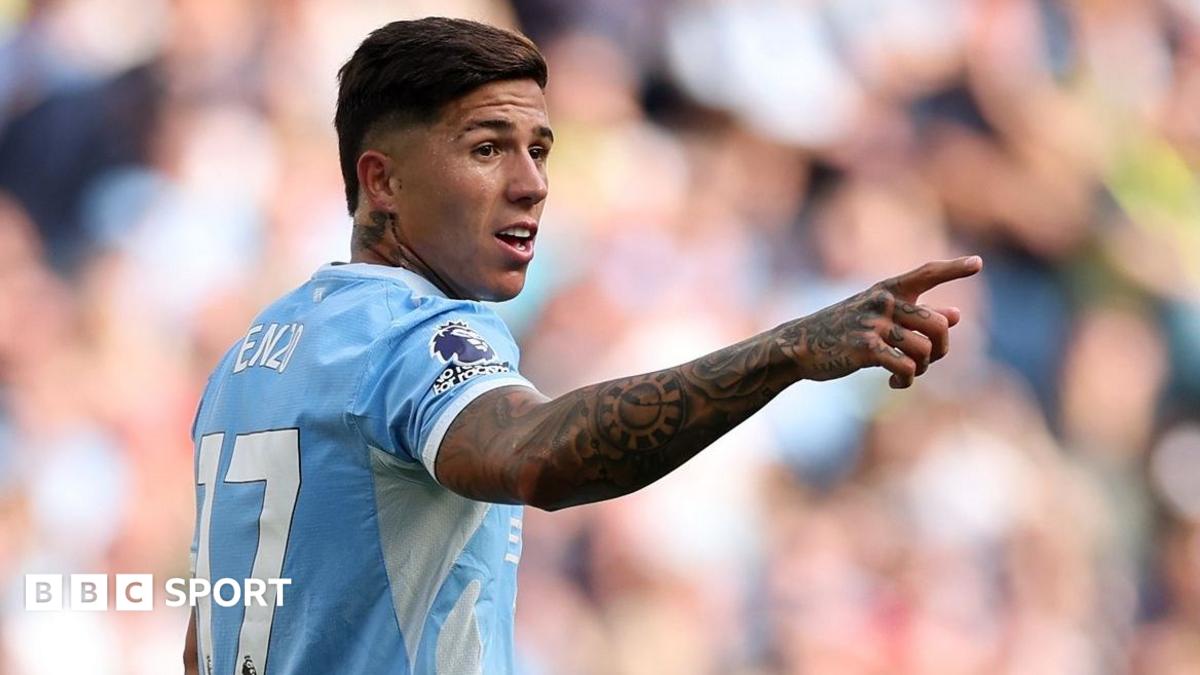
“Olise is a great player but it’s not Olise,” Perez said. “It’s not Doku either.

“We’re going to make a significant offer, at least around 150m.

“He needs to be a player from midfield who can go forward. And it’s not Haaland.

“The player is not from the Premier League. And the first thing we’ll do is talk to the club.

“It’s a signing meant to generate excitement because that’s what it’s all about, generating excitement.”

He also reminded voters his re-election would activate already-agreed deals for manager Jose Mourinho, Inter Milan defender Denzel Dumfries and Ibrahima Konate, whose contract at Liverpool won’t be renewed.

Source link