A voter participates in the March 8 consultation. (Archive)
Mérida, March 9, 2026 (venezuelanalysis.com) – Millions of Venezuelans participated on Sunday in the first National Popular Consultation of 2026, a direct democracy mechanism designed to transfer state resources directly to organized communities for the execution of self-managed projects.
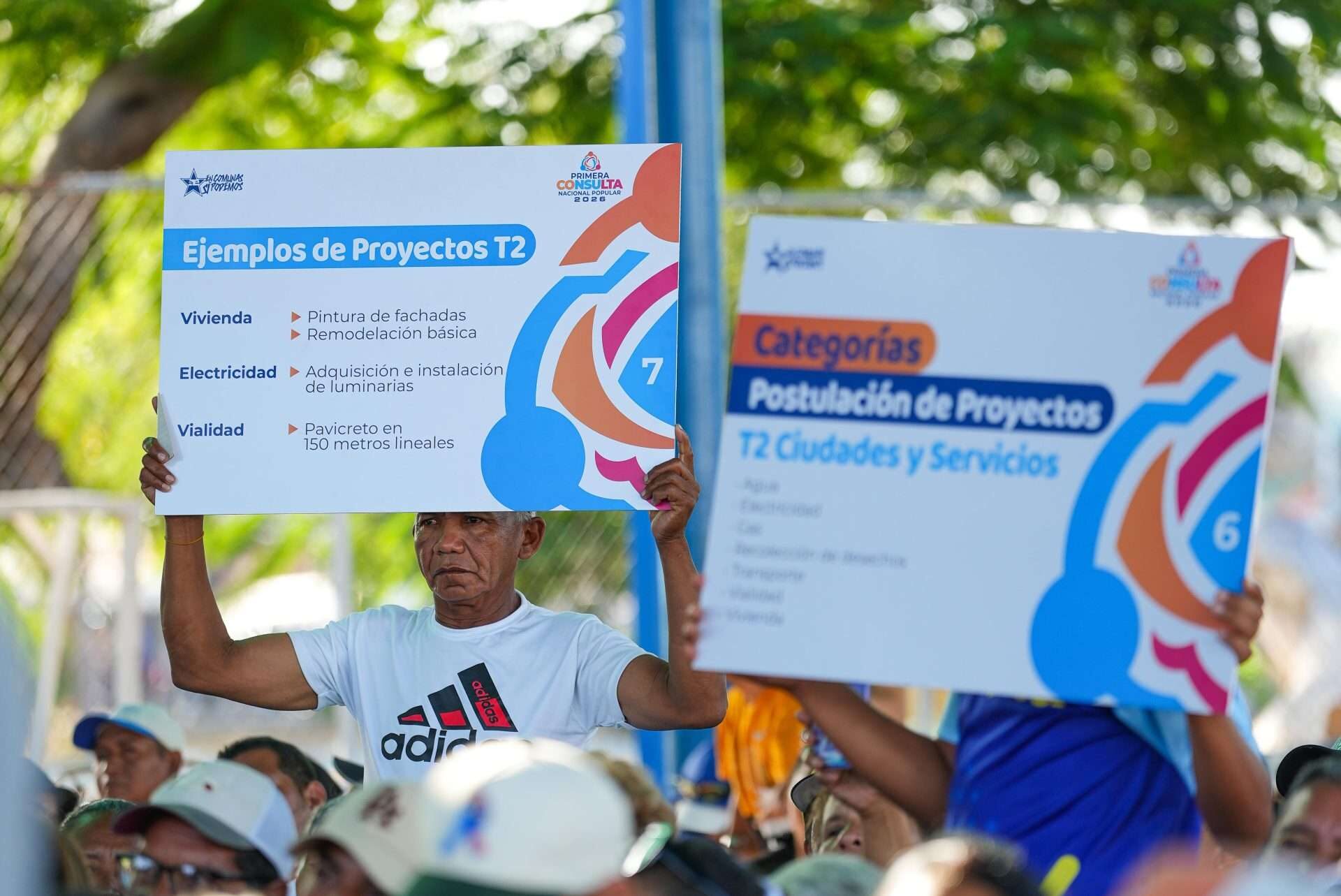
The process took place in 5,336 communal circuits nationwide. Residents over the age of 15 were eligible to vote for one of up to seven projects previously proposed and debated in local citizens’ assemblies. The initiatives mostly focus on urgent territorial priorities such as water distribution, electrical grid repairs, and infrastructure renovations.
Once a project is selected by the majority of voters in a communal circuit, the government transfers US $10,000, in local currency. The community then manages the resources and oversees the execution of the work.
Communes Minister Ángel Prado visited several voting centers on Sunday, hailing the turnout and the efficiency of the communal model.
“This is an extraordinary result and a demonstration of the great participation registered in this 2026 Popular Consultation,” Prado stated to national media. “The organized people are showing that they have the capacity to manage their own resources and solve their problems with transparency and commitment.”
The winning proposal in the Lanceros Atures Commune in Lara state was the purchase of equipment for the local healthcare center. In rural Cojedes state, residents of the Zamora Vive Communal Circuit chose to fund the production of cereals and legumes.
In 5 de Marzo Comandante Eterno Commune in southwest Caracas the community selected a project to replace 10 kg liquefied gas (LPG) cylinders used mostly for cooking. For many families, this was a critical priority as existing cylinders were in poor condition or insufficient for daily needs.
Anaís Márquez, a spokesperson for the commune, explained to Venezuelanalysis the transformative impact of the winning project.
“The winning project is the replacement of the cooking gas cylinders, which will transform our realities,” Márquez said. Six of the seven community councils here rely on these cylinders. Many were in poor condition, or people only had one. Selecting this project means guaranteeing a better quality of life and safety for our families.”
Márquez highlighted that the consultation’s timing on March 8, International Working Women’s Day, added a layer of historical significance to the process.
“I believe this consultation is one of those demands we have fought for. What better way to commemorate International Working Women’s Day than through participation, since 80% of communal spokespeople in Venezuela are women,” she noted.
The local activist added that the projects chosen in the consultations “create a sense of belonging and joint responsibility for the transformation of our territory.”
The concept of the commune was central to former President Hugo Chávez’s vision of the path toward socialism. Chávez envisioned communes as the “unit cells” of a new state, where social property and self-governance would eventually replace the old “bourgeois” structures.
Starting in 2024, the Nicolás Maduro government implemented the consultations as the main mechanism to support grassroots organizations. By empowering local communities to execute projects identified through their own “concrete agenda of action,” the state bypassed the local governorships and mayoralties to deliver funds directly.
Sunday’s vote was the first of several planned for 2026.
Communards hold signs with information on possible projects. (Archive)
Four years ago, Boyle Heights and Skid Row had something to celebrate: state grants to build new sidewalks and protected bike lanes.
But now, more than $100 million from the state for the transportation projects in some of the neediest parts of Los Angeles is in jeopardy because city officials say they don’t have enough staff to complete the projects.
The issue is part of the continuing fallout from a $1-billion budget shortfall the city faced last year. Officials avoided mass layoffs but closed the gap with budget cuts to city departments, including the Bureau of Engineering, Department of Transportation, Bureau of Street Lighting and Bureau of Street Services. Those cuts included eliminating open positions, resulting in smaller staffs.
“To know that the funding is there and that we have to give it back because the city says it can’t find the bodies to do the work is a scandal,” said Estela Lopez, executive director for the L.A. Downtown Industrial District Business Improvement District. She has long advocated for more resources on Skid Row, including improved accessibility for pedestrians.
“It would be transformative in a way that wasn’t just in spirit,” she said.
On Monday, the Bureau of Street Services confirmed that it will apply with the state for a two-year extension to allow more time to begin the transportation projects in Boyle Heights, Skid Row and Wilmington.
The move came after L.A. City Councilmembers Ysabel Jurado and Tim McOsker introduced a motion to cancel the state funds, citing “staffing, funding, and implementation constraints.” Jurado said that plan is “now on hold.” McOsker, whose district includes the Wilmington project, also confirmed his support for an extension.
“After hearing directly from my constituents, I urged the Bureau of Street Services to explore every option to keep these projects moving forward,” Jurado said in a statement this week.
TheBoyle Heights project would enhance bike lanes and pedestrian-level lighting, as well as extend street curbs and plant more than 300 shade trees. OnSkid Row, existing bike and pedestrian pathways would be connected through downtown L.A. to schools, health facilities and job centers. InWilmington, near the busiest port in the country, crumbling sidewalks would be fixed and a new traffic signal and high-visibility crosswalks would be added.
The city must contribute about $23 million in matching funds.
Jurado, whose district includes Boyle Heights and Skid Row, said the two areas “have waited too long for these investments for them to slip away.” Her predecessor, Kevin de León, and his staff pitched the projects and spent about $250,000 in discretionary funds to hire consultants to put together the applications for both projects.
Dan Halden, director of external relations for the Bureau of Street Services, said in a statement that the agency acknowledges the challenges ahead, including resources, cost and timeliness, and would work to identify a path forward.
De León said in an interview this week that now is not the time for the city to return state dollars.
“It would be at best, political malpractice, at worst, criminal, if the city made the decision to return the money in a time when we need every imaginable dollar for the well-being of Angelenos,” De León said. “This is not the moment to return dollars back to the state government, especially for historically under-served and under-invested communities.”
Michael Schneider, founder and chief executive of the bicyclist and pedestrian advocacy group Streets for All, said that losing the projects would be “heartbreaking.” He said he was involved in one of the grant applications two years ago and saw the amount of resources that went into it.
“This is that times three. It’s beyond the pale,” Schneider said. “This is a lot of money for those projects that are not that complicated, already designed.”
Schneider said he is concerned that if L.A. backs out this time, the state would prioritize other jurisdictions for future funding. An extension could be putting off the inevitable unless something changes and the projects become a priority for the city, he said.
“If it goes away, all it means is that some of the most dangerous streets that we’re aware of in the city are going to remain dangerous for decades,” he said. “The projects have merit. They were chosen for a reason.”
In a video posted online last week, City Controller Kenneth Mejia highlighted the budget cuts that are jeopardizing the state grants, including a 26% cut, or $61 million, to the Bureau of Street Services, the lead agency for the projects.
“The city is actually very successful in securing these large grants,” Mejia said in the video. “However, departments are constrained by the budget and staffing cuts, which makes the city unable to deliver all of them within the deadline required by the grants.”
Lopez of the business improvement district said the state money would fund a crosswalk in front of the Union Rescue Mission on Skid Row, where pedestrians now resort to jaywalking and where she has witnessed accidents.
She said she has been in touch with Jurado’s office to offer her help in keeping the projects alive.
“The city of Los Angeles can do more than one thing at a time,” she said. “We can figure this out.”
Times staff writer David Zahniser contributed to this report.
Audi team principal Jonathan Wheatley, who joined from his former position of sporting director at Red Bull last March, said at the team’s launch this year: “We’re not here to mess around. It’s an ambitious project. We’re humble. We know where we’re starting from and we know where we want to go.
“We want to make Audi the most successful F1 team in history. There are milestones on that journey and we are starting it today.”
No pressure, then.
Audi won the Le Mans 24 Hours 13 times in 18 years from 1999 to 2016. And in rallying they were famous for introducing four-wheel drive with the iconic Quattro in the early 1980s.
They might not have taken part in F1 before, but they did compete in its forerunner, the European grand prix championship, in the 1930s.
In a battle with arch-rivals Mercedes, Auto Union won the title with the great Bernd Rosemeyer in 1936, won five races against Mercedes’ seven in 1937, while the legendary Tazio Nuvolari won races for them in 1938 and 1939 before the Second World War brought racing to a halt.
Audi’s entry this year rekindles that old rivalry with Mercedes, and battle lines have already been drawn in a pre-season row over the rules governing the engines’ compression ratio. Audi are said to have been prime among those pushing for a rule change because of a fear Mercedes had found a way of exploiting a loophole to their advantage.
Rivals on track with Mercedes, though, Audi are unlikely to be for a while.
While Mercedes start the season as championship favourites, Audi have a lot of work to do to transform Sauber into a winning proposition.
Following the announcement of Audi’s entry in August 2022, the first steps of the programme did not augur well. Audi did not invest anywhere near enough money anywhere near soon enough.
Sauber made no progress through 2023 and into the following year. With the clock ticking on its entry in 2026, Audi axed chief executive officer Andreas Seidl, who had left his previous role as team principal of McLaren to join them, in mid-2024.
He was replaced with a dual management team of former Ferrari team principal Mattia Binotto, who was tasked with running the factories – Hinwil in Switzerland for Sauber, and Neuberg in Germany for the engine programme – and Wheatley, in charge at the track.
Even then, the management changes were not finished. Binotto had initially joined as chief operating and technical officer. Less than a year later, he was made head of the Audi F1 project, and chief executive officer Adam Baker left the company.
The appointment of Binotto and Wheatley had a relatively quick impact, as Sauber finally began to move forward in 2025.
Having been marooned at the back, Sauber became more respectable performers, and their veteran German driver Nico Hulkenberg even finally scored a podium after 16 years of trying in last year’s British Grand Prix.
This year, the driver line-up of Hulkenberg and Brazilian Gabriel Bortoleto, who is heading into his second season, continues, and the new Audi engine makes its debut.
So far the team have made a promising start.
They ran their car early in January, the first team to do so built to this year’s new rules, and put a first aerodynamic upgrade on it in the final pre-season test in Bahrain last week.
Pace-wise, the belief is that Audi are in the midfield mix with Haas, Alpine and Racing Bulls, and ahead of Williams. A solid effort so far, although Hulkenberg is not getting carried away.
“It’s just speculation right now still,” the German said last week. “We really don’t know until Melbourne and even a few races in, because I feel at the moment it can be quite track dependent on how your package feels on different circuits.
“So we’ll have to wait and see until everybody really pulls their pants down in qualifying and we’ll find out. Early days. I hope we’re competitive somewhere in the midfield right now.
“But, yeah, the team’s been working hard over the winter, pushing all the areas, doing the power-unit side for the first time. It’s been busy and a challenge, and I think we’re OK. But there’s still a lot of work and a lot of room for improvement on that side and a lot to come.”
“If I love you, I have to make you conscious of the things you don’t see.”
James Baldwin’s quote about the artist’s role in society is emblazoned on billboards across Los Angeles this winter. Created by artist Patrick Martinez, the purpose of the signage is two-fold: to promote Frieze Los Angeles and, in the case of neon signs at the art fair’s entrance, to stand as a discrete work of art on its own.
Martinez, an East Los Angeles-based artist, has long translated protest language into storefront-style neon, a strategy he now extends into a broader campaign tied to Frieze, which runs Feb. 26 through March 1 at the Santa Monica Airport and features more than 100 galleries.
This year, however, some of the fair’s most compelling work may be happening outside the tent. Frieze Projects’ “Body & Soul” features eight installations staged across Santa Monica’s Airport Park and beyond. The initiative is intended, organizers say, to broaden the fair’s reach beyond its art world audience — positioning Frieze as a civic platform rather than a purely commercial event.
In addition to Martinez’s creations, “Body & Soul” brings together site-specific works including Amanda Ross-Ho’s durational performance rolling a 16-foot inflatable Earth around the perimeter of a nearby soccer field; Cosmas & Damian Brown’s interactive fountain installation incorporating ceramic heads, incense and water; and Shana Hoehn’s first large-scale public sculpture, fabricated from a fallen tree sourced through Santa Monica’s Urban Forest program. Off campus, Kelly Wall extends the program to a former Westwood Village newsstand, where glass “magazines” will be displayed — 136 in all, priced at $300, with 15 given away.
Martinez’s billboards bearing 2024’s “If I Love You (James Baldwin)” serve as the most highly visible part of the fair’s public outreach. His neon installations respond to ICE raids and immigrant rights, placing protest at the literal threshold of one of Los Angeles’ most visible art events.
L.A. artist Patrick Martinez’s work is featured on billboards around the city, as well as at the entrance to Frieze Los Angeles.
(David Butow / For The Times)
The public art program acts as “a way that we can bring in people who may not be just the ticket goers or the VIP,” said Christine Messineo, Frieze’s director of Americas.
It also serves to amplify the city’s cultural temperature.
“Our job is to represent what’s happening in our community,” Messineo said, adding that immigration and social impact are not anomalies at the fair but part of its foundation.
Some of Martinez’s neon entrance signs — including “Abolish ICE” (2018), “No Body Is Illegal” (2021) and “Then They Came for Me 2” (2025) — predate the current political moment. Instead, they emerge from years of observation and protest.
The artist credits Messineo with approaching him last summer to utilize what he calls his “urgent warning signs” as the face of the fair. Demonstrators also carried signs bearing Martinez’s imagery last June during protests against ongoing federal immigration crackdowns in downtown Los Angeles.
Those events, Martinez says, are not experienced evenly across the city — particularly by the well-heeled audience that attends Frieze and spends $85 to $106 for weekend general admission tickets.
Patrick Martinez, “If I Love You (James Baldwin),” 2024.
(artwork Patrick Martinez / photo Paul Salveson)
Martinez wants his signs to unsettle viewers who are insulated from the city’s unrest.
“The Westside people aren’t even going to see any of that, right? So it’s bringing that kind of mindfulness to that space.”
“It felt prescient then,” Messineo said of engaging Martinez last year, “and I think even more so now.”
Frieze has integrated public art into its Los Angeles fair since its 2019 debut. But the works in “Body & Soul,” produced with the nonprofit Art Production Fund, lean into the particular conditions of public space.
The exhibition brings together Los Angeles artists exploring ideas of memory, community and collective experience — often in quieter ways than Martinez’s overt messaging.
Additional participants include Dan John Anderson, Polly Borland and Kohshin Finley.
Casey Fremont, Art Production Fund’s executive director, said most of the works are newly commissioned.
The program is designed to prioritize innovation over sales. “It isn’t transactional. It’s really just about experimenting and giving the public the opportunity to experience art like they’ve never experienced before.”
Artists scale up — and slow down
“Body & Soul” marks several participants’ first ventures into public work, including Hollywood artist Finley, whose “The Piano Player” will be installed near the corner of Airport Avenue and Donald Douglas Loop. Finley’s piece arranges ceramic vessels inside shadow-box shelving that the artist describes as containers for memory — some “you love to take out and peek into,” others that “should just stay shut forever.”
Kohshin Finley’s “The Piano Player” arranges ceramic vessels inside shadow-box shelving that the artist describes as containers for memory.
(Micaiah Carter)
The title references the film “Casablanca,” and its piano player, Sam, whose music stirs up memories of the central love story.
Finley said the public setting creates an unusually direct encounter as he, like many of his fellow artists, will be standing with his work.
“A lot of people have never seen a living artist,” he said.
Ross-Ho takes visibility even further with her inflatable soccer ball Earth, which weighs 78 pounds. The familiar “blue marble” image will no doubt draw spectators at the Airport Park Soccer Field outside the Frieze tent.
Amanda Ross-Ho is creating a durational performance on a soccer field by Frieze Los Angeles.
(Jennelle Fong for ILY2)
Ross-Ho’s performance, “Untitled Orbit (MANUAL MODE),” functions as an endurance test that is a response to what she calls “the temporal container of the art fair” — and to the pressures of contemporary life.
“Gesture and duration are the ways that I could achieve scale rather than something that was materially constrained like a giant sculpture,” she said.
Designing for gathering
Brown’s installation, “Fountain: Sources of Light,” invites guests to congregate. Positioned between the Airport Park playground and dog park, it combines running water, ceramic vessels, incense and sound.
“I really wanted to make a fountain because I thought that [it’s] something that … people tend to gravitate to,” he said.
The work will incorporate metal plates and bowls created by participants in the youth workshop Art Sundae, taking place Feb. 28 at Airport Park.
Near Brown’s fountain, Echo Park artist Hoehn will present “Deadfall,” a massive fallen fig tree embedded with carved cheerleader legs and skirts — imagery drawn from her Texas upbringing.
Shana Hoehn with one of her carved wooden sculptures.
(Josh Cohen)
“I’ve been working with cheerleading iconography for the past few years,” she said, linking the imagery to what she calls an omnipresent football culture layered with “American patriotism and militaristic qualities.”
Hoehn acknowledged that the fair’s four-day window and limited nearby parking may keep the audience closer to fair-goers than the broader public the program aims to reach.
Beyond the airport fence
A few miles away in Westwood Village, Mar Vista artist Wall will extend the program beyond the airport campus with “Everything Must Go,” installed at a defunct newsstand and on view from 5:48 p.m. (sunset) to 8 p.m. during the fair.
Where magazines and newspapers once were, glass stand-ins bearing skyline imagery will occupy illuminated lightbox shelves. As the glass “magazines” are removed, glowing silhouettes mark their absence.
Kelly Wall, ‘Everything Must Go’.
(Kelly Wall)
Wall’s related project will appear on the Frieze campus with found newspaper boxes transformed into lightbox displays for her glass publication.
“In things coming to an end, there is no real end … there’s transformation,” she said. “How you might see [the piece] may differ depending on different times — or where you’re personally at in your life.”
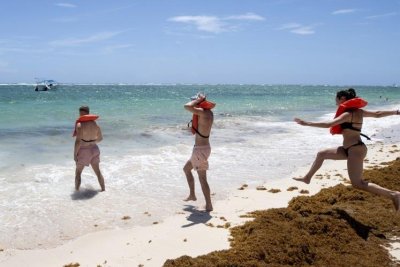
People walk past sargassum clumps on the sand in Punta Cana, Dominican Republic, in July. File Photo by Orlando Barria/EPA
Feb. 20 (UPI) — The Dominican Republic opened the year with 1.22 million tourists in January, a 5.5% increase compared with the same month last year. The increase was driven by growth in air arrivals and sustained demand from the United States.
Tourist arrivals to the island by air surpassed the 800,000-passenger mark for the first time in a single month, posting year-over-year growth of 8.7%, according to the Ministry of Tourism,. The figure exceeds pre-pandemic levels and is 61% higher than recorded in January 2019.
“Receiving 1,219,606 visitors for the first time in the history of Dominican tourism tells us how extraordinary this year will be for the sector,” Dominican Republic Tourism Minister David Collado said.
Collado held meetings in New York with representatives of JPMorgan, Bank of America, Standard & Poor’s and American Express, as well as other key players in the international financial system, as part of a strategic agenda to position tourism as the country’s leading productive sector.
According to information released Thursday by the presidency, Collado presented projections for Dominican tourism for this year, highlighting the sector’s sustained growth and predicting that if the current trend continues, 2026 could close with new record figures for the industry.
Dominican tourism continues to position itself as a reliable destination for investment, authorities said, backed by what they describe as “a vision of sustainable development that inspires confidence in international markets.”
According to information from the Ministry of Tourism, North America is the main source market for tourists to the island, accounting for 59% of air arrivals, led by the United States and Canada. Latin America also showed solid performance and expanded its share of total visitors.
Punta Cana accounted for the largest share of the country’s air traffic during the month. The cruise segment recorded a slight decline compared with the same period last year, while hotel occupancy averaged 82% nationwide during peak season.
Tourism is one of the main generators of foreign exchange and employment. In 2025, the country received more than 11.6 million visitors, consolidating its position as the Caribbean’s leading tourist destination.
As part of its international promotion strategy, the Ministry of Tourism signed a strategic alliance with Visa Inc., making the Dominican Republic the first country in the Caribbean to finalize an agreement of this kind with the global payments company.
The alliance includes joint campaigns, targeted promotions and exclusive benefits for international travelers, with emphasis on key markets such as the United States, Canada, Europe and Latin America.
The Dominican Republic is projected to be the fastest-growing economy in Latin America and the Caribbean in the coming years, according to the most recent forecasts by the World Bank and the International Monetary Fund.
Growth projections for 2026 place real GDP expansion between 4.0% and 4.5%, positioning the country as one of the economic leaders in the Caribbean region.
In that scenario, tourism is a strategic engine and the backbone of the Dominican economy. Its role is not only to generate revenue, but also to act as a catalyst for other key sectors, such as construction, commerce and transportation.
In 2025, the sector contributed approximately $21.1 billion, representing about 16% of the gross domestic product.
Spending on AI is forecast to skyrocket to $2.5 trillion in 2026, dwarfing even the largest scientific and infrastructure projects.
World leaders and tech executives are convening in New Delhi for the India-AI Impact Summit 2026, focusing on the role of artificial intelligence in governance, job disruption and global collaboration.
However, behind these discussions lies the financial reality. Over the past decade, AI has drawn one of the largest waves of private investment in modern history, totalling trillions of dollars.
According to Gartner, a United States-based business and technology insights company, worldwide spending on AI is forecast to total $2.5 trillion in 2026, a 44 percent increase over 2025.
To understand the magnitude of these investments, Al Jazeera visualises the staggering amounts by comparing them with some of the largest projects ever created by humanity. We also highlight which countries are spending the most on AI and provide insights into expenditures on data centres, models, services, and security.
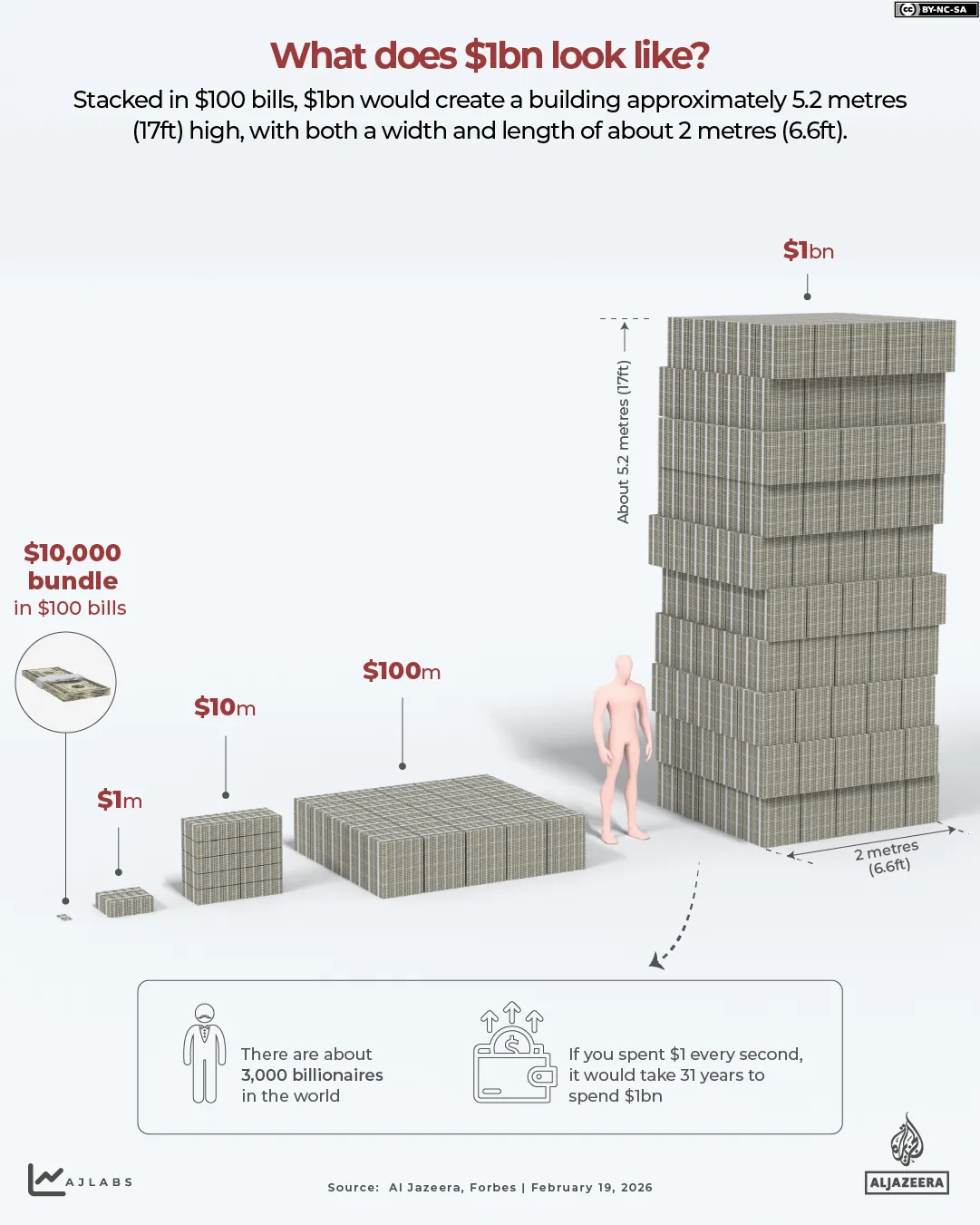
What does $1bn look like?
To help understand a trillion dollars, it is useful to first visualise what millions and billions of dollars look like by using a stack of US dollar bills.
If you break these amounts down using $100 bills, here is how they stack up:
$1,000 would form a stack about 1cm (0.393-inch) high.
$10,000 would form a stack approximately 10cm (3.93-inch) high.
$1m would fit inside a briefcase.
$10m would fit inside a very large suitcase.
$100m would fit on an industrial pallet stacked waist-high.
$1bn would create a building approximately 5.2 metres (17 feet) high, with a width and a length of about 2 metres (6.6 feet) each.
Another way to think of it is if you spent $1 every second, it would take:
11.5 days to spend $1m
31 years to spend $1bn
31,000 years to spend $1 trillion
In more tangible terms, $1bn is roughly equivalent to:
The estimated cost of the Grand Egyptian Museum in Giza, one of the largest archaeological museums in the world
The cost of constructing two to three modern football stadiums, depending on size and design
Buying 10 luxury private jets (at $100m each)
Buying 6.3 tonnes of gold (at $5,000 per ounce)
Buying 1 million high-end iPhones at retail price
$1.6 trillion already spent on AI
Over the past decade, AI-related investments have surged nearly 13-fold.
According to the 2025 AI Index Report by Stanford University, between 2013 and 2024, total global corporate investment in AI reached $1.6 trillion. This substantial expenditure dwarfs even the largest scientific and infrastructure projects of the 20th and 21st centuries.
To put the scale of AI investment into perspective, consider how it compares with some of the most ambitious and expensive projects in modern history. All figures are adjusted to 2024 US dollars:
The Manhattan Project (1942-46): $36bn
The International Space Station (1984-2011): $150bn
The Apollo Program (1960-73): $250bn
The US Interstate Highway System (1956-92): $620bn
In just over a decade, investment in AI has surpassed the cost of developing the first atomic bomb, landing humans on the moon and the decades-long effort to build the 75,440km (46,876-mile) US interstate highway network.
Unlike these landmark projects, AI funding has not been driven by a single government or wartime urgency. It has flowed through private markets, venture capital, corporate research and development, and global investors, making it one of the largest privately financed technological waves in history.
Global corporate investments in AI cover a vast array of operations, including mergers and acquisitions, minority stakes, private investments, and public offerings. These monumental expenditures highlight the extensive financial commitment to advance AI.
Which countries are spending the most on AI?
The AI investment surge is concentrated in just a few countries, where private capital has fuelled thousands of startups and shaped global innovation hubs.
The US has dominated AI spending, accounting for roughly 62 percent of total private AI funding since 2013. Between 2013 and 2024, US companies spent $471bn on AI. Chinese companies are the second-largest spenders at $119bn, followed by the United Kingdom at $28bn.
These figures exclude government spending, such as the US CHIPS Act or European national AI subsidies.
Global private investment in AI by country, 2013-24:
US: $471bn, supporting 6,956 newly funded AI companies
China: $119bn, 1,605 startups
UK: $28bn, 885 startups
Canada: $15bn, 481 startups
Israel: $15bn, 492 startups
Germany: $13bn, 394 startups
India: $11bn, 434 startups
France: $11bn, 468 startups
South Korea: $9bn, 270 startups
Singapore: $7bn, 239 startups
Others: $58bn
AI spending to total $2.5 trillion in 2026
AI spending is forecast to skyrocket to $2.5 trillion in 2026, driven by a massive global build-out of data centres and services, according to Gartner.
The bulk of the spending is expected to go towards:
AI infrastructure: $1.37 trillion
AI services: $589bn
AI software: $452bn
AI cybersecurity: $51bn
AI platforms for data science and machine learning: $31bn
AI models: $26bn
AI application development platforms: $8.4bn
AI data: $3bn
By 2027, Gartner is forecasting that AI spending will surpass $3.3 trillion.
“Do you mind if I smoke?” asks German photographer Wolfgang Tillmans with a laugh during a recent video call from his home in Berlin.
As he lights his cigarette, he looks every bit the renegade artist he is known for being. At 57, Tillmans is in the midst of staging his 10th exhibition in Los Angeles since the mid-1990s at Regen Projects. He is one of the most celebrated photographers of his era, with a practice that collapses the distance between fine art and the pulse of street culture, spanning epic abstractions and the familiar textures of contemporary life.
At the same time, Tillmans has another life as a serious electronic musician, recording a series of experimental albums, including his most recent, 2021’s “Build From Here.” He is deeply connected to the music world, and photographed the cover for Frank Ocean’s acclaimed “Blonde,” making him a rare artist to be in major museums while genuinely engaged with popular music and the club scene — a bit of a rock star in his own right.
The official opening of his Regen show, “Keep Movin’,” attracted a line that wrapped around the building. Fans are drawn to his varied strands of work, which move instinctively between disparate approaches and subject matter, from famous faces to images sensitive to light and shape, in subjects as simple as the curve of paper folded softly over itself.
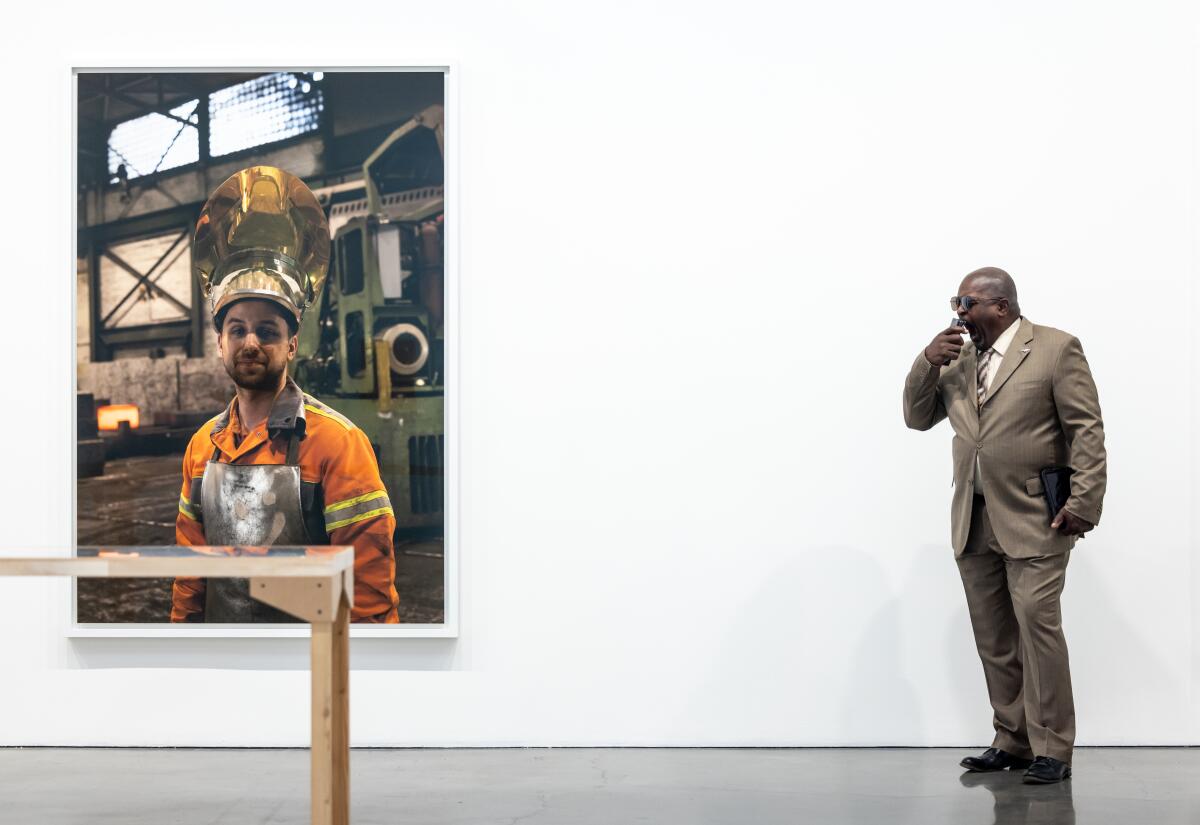
A security guard, right, stands near the work “Robin Fischer, Dirostahl, Remscheid 2024” in German-based photographer Wolfgang Tillmans’ current exhibition, “Keep Movin’,” at Regen Projects.
(Christina House / Los Angeles Times)
During an early walk-through for a few dozen invited guests, Tillmans held forth on his personal cosmos, surveying pictures from the experimental to the deeply intimate. Portraits, politically charged tabletop collages and quiet photographs that capture the simple vibrance of daily life are strewn across Regen’s 20,000 square feet of gallery space.
“I see my work evolve more in evolutions, rather than in revolutions,” Tillmans said, gesturing to a conceptual wall-sized image created with a photocopier.
His Regen show, through March 1, also features short video works and the abstractions of camera-less images he considers “pure photography,” created in the darkroom by shining light directly onto photosensitive paper. There are pictures relating to human sexuality and images from nature. Each subject and approach is an ongoing concern left intentionally open-ended, and never contained within a single project, title or grouping. They are all inseparable in his own mind, free from categories or a finite series of pictures.
“I am aware that these art historical categories exist in my oeuvre, but I’m not seeking them out,” Tillmans explained after the walk-through. His practice is not about “working through one series or genre and then moving on to another.”
Installation view of Wolfgang Tillmans’ “Keep Movin’” at Regen Projects.
(Evan Bedford / Regen Projects)
On his trip to Los Angeles, Tillmans made a long-planned visit to the Mt. Wilson Observatory to satisfy his lifelong interest in astronomy. He used the giant telescope to capture the twinkling of Sirius, the brightest star in the night sky. This preoccupation resurfaces at Regen in a large-scale print of 2023’s “Flight Honolulu to Guam,” revealing a star field above the clouds.
Tillmans’ interest in stargazing goes back to his adolescence, and images of the moon and cosmos recur in his work. “It gave me a sense of not being lonely, seeing the infinite sky and universe,” he says. “I always felt it was a very grounding experience that all humans share. I always got something from this — besides the beauty and the formal marvel of it all — this sense of location and locating myself.”
His depiction of the heavens is just one of many threads and themes that run through his decades of work.
A piece of work personally hung by photographer Wolfgang Tillmans in his current exhibition, “Keep Movin’” at Regen Projects.
(Christina House / Los Angeles Times)
Early in his career, Tillmans began shooting for the British street style magazine i-D, creating portraits of the famous and unfamous, while also documenting club life and gay culture. In 1995, Taschen published his first book, which made a stir with portraits of soft, indirect illumination, emphasizing naturalness. By avoiding the dramatic lighting and exaggerated special effects often seen in pictures of youth culture, he landed on a distinctive visual style.
“I felt the heaviness of life and the joy of life,” Tillmans says. “I saw myself as a multifaceted complex being, not just as young. So I experimented with lighting and film — how can I photograph my contemporaries in a way that approximates the way that I see through my eyes? And that was stripping back anything effectful, almost taking away the camera.”
He continues to do assignment work for magazines, which he considers part of his artistic practice. Several recent portraits are at Regen, including a foundry worker in Tillmans’ hometown of Remscheid and another of actor Jodie Foster. The editorial work brings him into contact with people and places he might not otherwise meet.
In 2000 Tillmans became the first photographer and first non-British artist to win the prestigious Turner Award. Tate Britain staged his mid-career retrospective in 2003 and the Hammer Museum in Westwood mounted his first major U.S. retrospective that same year, which traveled to Chicago’s Museum of Contemporary Art and the Hirshhorn Museum and Sculpture Garden in Washington, D.C.
Coming after major retrospectives at the Pompidou Centre in Paris last year and the Museum of Modern Art, New York City, in 2022, the Regen show dispenses with the retrospective frame while quietly performing a similar task — taking in the main currents of Tillmans’ work over the past two decades, and a few images dating to the late ‘80s. His relationship with the gallery began with his first Los Angeles exhibition.
Visitors walk through photographer Wolfgang Tillmans’ exhibition, “Keep Movin’,” at Regen Projects in Los Angeles.
(Christina House / Los Angeles Times)
As ever, the images are displayed in a startling range of shapes and sizes: framed and unframed, huge wall-size prints hang alongside tiny, snapshot-scale pictures. One of the largest, “Panorama, left” (2006), spans nearly 20 feet and hangs only from bulldog clips. Smaller pictures are simply taped to the wall, but nothing is meant to indicate hierarchy.
“The biggest may not be the most important, and the smallest might be overlooked,” he explains. “It’s a little bit like projecting the way that I look at the world.”
In his first decade of exhibitions, he had no frames at all. “I taped those photographs to the wall, not as a gesture of disrespectful grunginess, but as a gesture of purity,” he adds. “That sense of immediacy — and not imbuing something with outside signifiers of value — lets the fragile piece of paper speak for itself.”
One of the current show’s larger conceptual pieces, “Memorial for the Victims of Organized Religion II,” fills a corner with 48 rectangular portrait-sized photographs, all of them solid black or dark blue. It’s a near-replica of a work shown at the Pompidou with the same solemn title, created to recognize those “physically maimed or mentally harmed” by doctrine and intolerance.
“I myself have a spiritual side,” says Tillmans, still grateful for positive experiences attending a Lutheran church in his youth. “But over the years I’ve become ever more distrustful of organized religions and seeing the role of religion in government. I find it incredibly immodest for humans to tell other humans what God wants.”
When he’s not exploring his spirituality and creativity visually, he focuses his energy on the music world. It’s a natural setting for Tillmans, who is increasingly active releasing his own electronic-based pop music. He’s occasionally worked as a DJ, and has been involved in acid house, techno and other electronic music. Despite his notoriety in the art world, he has no concern about hitting the charts.
“This is part of my work. I’m doing it the same way that I’m doing a photograph. I’m not doing a photograph to be peak popular in two months’ time,” Tillmans said. “It’s there and it’s still there in 24 years.”
Wolfgang Tillmans, “Keep Movin’”
Where: Regen Projects, 6750 Santa Monica Blvd., Los Angeles