progressives

Michigan Senate victory boosts progressives as Democrats wrestle with party’s direction

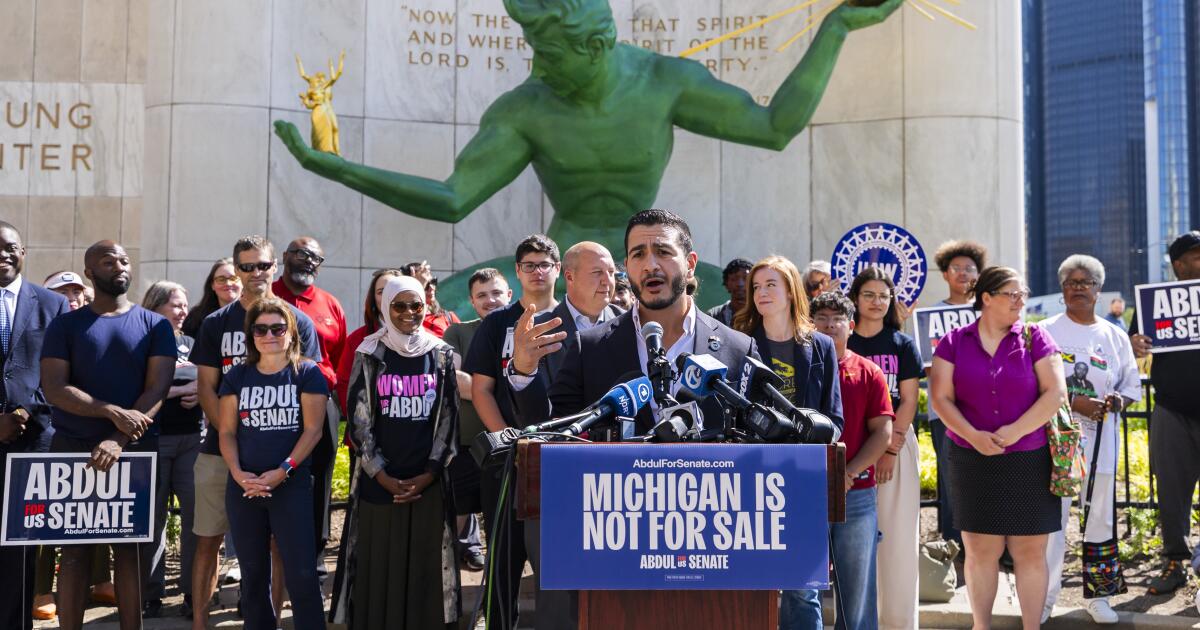
The narrow victory of progressive doctor Abdul El-Sayed in Michigan’s bitterly fought Democratic Senate primary sets up a defining test of the party’s progressive wing in one of the highest-stakes U.S. Senate contests of the midterms.

Whether El-Sayed, a former public health official, can carry swing voters in a battleground state could both determine the outcome of a Senate seat viewed as crucial to determining control of Congress and have broader ramifications on the Democratic Party’s struggle for its identity.

El-Sayed, a 41-year-old epidemiologist, defeated U.S. Rep. Haley Stevens, a moderate Democrat, by a narrow margin Wednesday after a long and intense campaign that was seen as a proxy for the party’s fissures.

The race was far closer than some polls had indicated. El-Sayed was leading Stevens by 15,000 votes, about 1 percentage point, with 99% of votes counted Wednesday, according to the Associated Press.

El-Sayed will face former Rep. Mike Rogers, a Republican, in the general election. The winner will succeed retiring Democratic Sen. Gary Peters, whose seat Democrats see as critical to retain for the party to have a chance at flipping the Senate.

“We’ve got an opportunity to bring ourselves back together, to come together around a movement, to take our democracy back,” El-Sayed said Wednesday on MS NOW’s “Morning Joe.”

El-Sayed’s victory will put to the test in a swing state the broader strength of the progressive movement, which has found success in deep-blue places like New York City, where Zohran Mamdani was elected mayor last year, and Los Angeles, where City Councilmember Nithya Raman is locked in a tight race mayoral contest with incumbent Karen Bass. Both Mamdani and Raman are democratic socialists.

As Democrats struggle over the party’s post-2024 identity and grapple with how to win back voters, the divide between the party’s progressive and centrist wings has been on display in primary fights. Both camps have notched victories: Many of the leftist wins have come in intensely blue districts, such as in New York, while more moderate districts have chosen centrists, as in Iowa.

On Tuesday, two progressive congressional candidates in Michigan beat out establishment Democrats in House races — in one case, ousting an incumbent. But in Missouri, democratic socialist and former Rep. Cori Bush lost to incumbent Rep. Wesley Bell, a moderate, for a key House seat.

In California, a handful of progressive candidates are on the November ballot, including the challengers to Rep. Doris Matsui (D-Sacramento) and Rep. David Valadao (R-Hanford). In the Aug. 18 runoff to fill the vacant seat of former Democratic Rep. Eric Swalwell, progressive state Sen. Aisha Wahab is battling it out with fellow Democrat and BART board president Melissa Hernandez.

Progressive leaders celebrated El-Sayed’s win on Wednesday. Sen. Bernie Sanders (I-Vt.), who backed El-Sayed, argue that his working-class-centered politics are more likely to have mass appeal.

“If you’re a working-class Republican in Michigan, I think you’re going to listen to what El-Sayed says,” Sanders told NBC’s “Meet the Press” on Sunday. “I think many of them will end up voting for him, independents as well, of course.”

Throughout the campaign, Stevens argued that El-Sayed would not be able to defeat Rogers, a refrain some moderates repeated Wednesday. El-Sayed vowed to unite Democrats around defeating Rogers, who previously served seven terms in Congress, saying that he and Stevens would be focused on “bringing the party back together.”

Rogers on Wednesday portrayed El-Sayed as an “extremist,” saying in a statement that the election is “about deciding whether Michigan has a future built on common sense — or whether we hand the keys to the most fringe extremists in the nation.”

El-Sayed, a former city and county health official, focused on opposing money in politics and pushing for Medicare for All, among other issues. His opposition to Israel’s war in Gaza and Stevens’ support for Israel became a major issue in the campaign. AIPAC, the pro-Israel lobbying group, spent millions in support of Stevens.

Early in the primary race, El-Sayed sought to temper some of the concerns around his progressive agenda by presenting himself as a Michigan-first, working-class-focused candidate, said John Barry Ryan, a University of Michigan professor of political science.

But as excitement over his campaign began to mount among progressives on a national level, Ryan said, El-Sayed’s public posture swung to a middle ground.

“The signal he’s trying to send is, I’m not a moderate, but I’m also not an extremist,” Ryan said.

Whether El-Sayed can effectively sell his message to undecided voters against Rogers now becomes a key question of the general election, said Corwin Smidt, a politics professor at Michigan State University.

“[Rogers] has experience. He has credentials,” Smidt said. “El-Sayed doesn’t have that. But I do think he’s got the skill and the right language to get him over.”

At least two key Michigan Democrats signaled a desire to move past the primary’s fights. Late Tuesday, Mallory McMorrow, a Michigan state senator who launched her own bid for the seat but suspended her campaign in early July, released an endorsement of El-Sayed.

“Whatever differences there were between the candidates in this race, those differences are nothing compared to the contrast in November,” McMorrow wrote on X. “The only way we get there is together.”

After conceding, Stevens sent a similar signal in a statement:

“We need to win this Senate race,” she said.
Source link

Mamdani-backed progressives win in N.Y. as states hold primaries

June 23 (UPI) — Mamdani-backed progressives scored big wins Tuesday night in New York state’s Democratic primary, as voters cast ballots across the Empire State, Maryland, Utah and South Carolina.

New York State

Of the four states holding primaries, New York state’s was being closely watched to gauge the influence of New York City Mayor Zohran Mamdani, who had endorsed three progressive candidates in competitive Democratic races — all of whom appeared poised late Tuesday to win their races.

Brad Lander, a former city comptroller, was running against Goldman in New York District 10 with the endorsements of other big-name progressives, including Sen. Bernie Sanders, I-Vt., and Rep. Alexandria Ocasio-Cortez, D-N.Y.

Lander said he was drawn to challenge Goldman because Goldman had called for increasing U.S. support for Israel. Their differing views on support for Israel have been a key issue in the race. Goldman and Lander are both Jewish.

Preliminary results showed Lander with an overwhelming 65.3% vote share, compared to Goldman’s 33.7%, with all 417 districts reporting.

Lander claimed victory Tuesday night.

After being introduced by Mamdani, Lander told supporters that he believes he and Goldman have more in common than they have differences. And to Goldman’s supporters, he said he knows that they want to “rescue our country back from Trumpism,” renew U.S. democracy and find a humane path for the country on the world stage.

“Solidarity is the force that we need to vanquish Trump’s fascism, to abolish ICE and to stand up to the billionaires who are rigging our economy against us,” he said.

“This campaign here was born out of solidarity.”

In New York District 7, Mamdani-endorsed Claire Valdez appeared poised to succeed outgoing Rep. Nydia Velazquez, who backed Brooklyn Borough President Antonio Reynoso.

With all 393 election districts reporting, preliminary election results showed Valdez had secured 55.5% of the vote to Reynoso’s 35.4%.

And in New York District 13, Mamdani endorsed Darializa Avila Chevalier, who late Tuesday appeared to be edging out incumbent Rep. Adriano Espaillat.

Chevalier, who was a field organizer for Mamdani, had secured 48.59% of the vote to Espaillat’s 45.2%, according to preliminary results.

Mamdani did not endorse a candidate in District 12 in a stacked field that consisted of state lawmakers Alex Bores and Micah Lasher, Lincoln Project co-founder George Conway, President John F. Kennedy‘s grandson Jack Schlossberg, attorney Laura Dunn and health researcher Nina Schwalbe.

Former House Speaker Nancy Pelosi had endorsed Schlossberg and former New York City Mayor Michael Bloomberg had endorsed Lasher.

Artificial intelligence has been a central topic in the District 12 race. The Leading the Future super PAC, funded by the heads of OpenAI and venture capital firms supporting the AI industry, funneled more than $10 million to a super PAC opposing Bores’ campaign. Bores has been supportive of establishing regulations on AI.

With all 410 precincts reporting, Lasher had secured nearly 39% of the vote, followed by Bores with 34.82% and Schlossberg with 10.7%.

South Carolina

The big race in South Carolina was the GOP gubernatorial runoff between notable candidates, South Carolina Lt. Gov. Pamela Evette and state Attorney General Alan Wilson.

Preliminary results indicate Wilson stormed his way to the nomination and likely the South Carolina governor’s mansion.

With all counties reporting, Wilson netted 68.5% of the vote to Evette’s 31.44%.

Wilson has claimed victory, and Evette has conceded defeat.

The runoff followed a dramatic turnaround by President Donald Trump, who had initially endorsed Evette, before rescinding his support.

Trump gave his “Complete and Total Endorsement” to Evette ahead of the state’s primary earlier this month. But after it was determined to be a runoff between Evette and Wilson, Trump, rather than continue his support for Evette, told voters that they “can’t go wrong” with either candidate.

Evette finished less than two percentage points ahead of Wilson in the Republican primary but neither candidate cracked 30% of the vote, let alone 50%. While Trump endorsed Evette, the other candidates who ran in the primary — Reps. Ralph Norman and Nancy Mace — have endorsed Wilson. Sen. Tim Scott, R-S.C., also gave Wilson his endorsement on Friday.

“I’ve proudly stood with President Trump from the very beginning, defended him when others would not, and fought alongside him against the radical left,” Wilson said in a news release after Trump posted his support on social media. “I am deeply honored to have his support because he understands I am focused on making South Carolina more affordable for families and profitable for businesses.”

Evette’s campaign had highlighted her receiving Trump’s endorsement.

Wilson will face Democratic state Rep. Jermaine Johnson in November.

Maryland

In Maryland, Adrian Boafo was poised to succeed Rep. Steny Hoyer in the Democratic primary for District 5.

From among the two dozen candidates in the running, Boafo, Hoyer’s former field director, had nearly 32% of the vote, according to preliminary results, far exceeding healthcare CEO Quincy Bareebe, who was sitting second with 18% and former police officer Harry Dunn in third with 13.4%.

Dunn was among those defending the U.S. Capitol from attacks by pro-Trump rioters on Jan. 6, 2021. He is also a co-plaintiff in a lawsuit seeking to stop the Trump administration from establishing an “anti-weaponization fund” to pay rioters for being “targeted” by the Department of Justice.

Boafo had received Hoyer’s endorsement.

Utah

Former Rep. Ben McAdams appeared poised Tuesday night to win the Democratic nomination for Utah’s new District 1, created under Utah’s new congressional map.

Largely made up of Salt Lake City, the district went to Vice President Kamala Harris in the 2024 presidential election.

Preliminary results show McAdams with 60.2% of the vote, state Sen. Nate Blouin with 24.04% and Utah Democratic convention winner Liban Mohamed with nearly 12%.

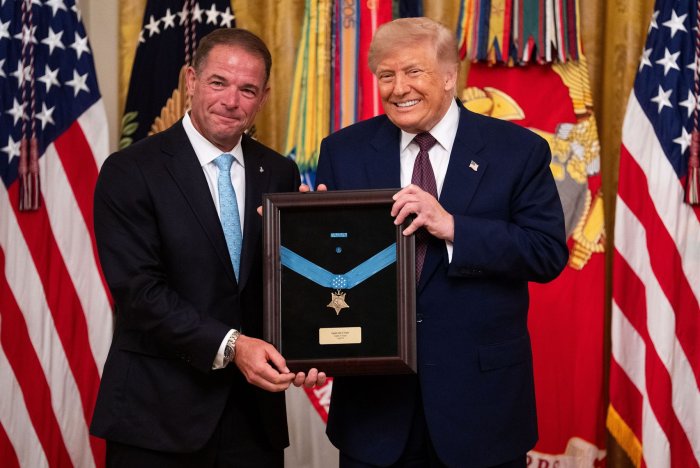
President Donald Trump presents a Medal of Honor to Tom Ripley on behalf of his father, John W. Ripley, during a Medal of Honor award ceremony in the East Room of the White House on Thursday. Photo by Aaron Schwartz/UPI | License Photo

Source link