product

‘Maybe you’re in the wrong business.’ Blake Treinen fires back at Dodgers’ critics

p]:text-cms-story-body-color-text clearfix”>

Much has been made of the Dodgers’ exorbitant spending, magnified by a pair of World Series titles for the franchise, as Major League Baseball enters the final year of the current collective bargaining agreement.

The Dodgers open 2026 with a record $381 million payroll, while having over $1 billion in deferrals. As if signing Shohei Ohtani, Teoscar Hernández and Blake Snell, and extending Tyler Glasnow and Will Smith weren’t enough, the club once again opened up its wallet this winter, spending a combined $309 million on four-time All-Star outfielder Kyle Tucker and three-time reliever of the year Edwin Díaz.

Relief pitcher Blake Treinen, one of the longest-tenured players on the Dodgers heading into his seventh season with the team, did not mince words when asked about how outsiders view the organization.

“Perception is built from the media and maybe owners that don’t like what the Dodgers are doing because they would have to do something similar,” Treinen said earlier this week. “And I say to that, ‘Maybe you’re in the wrong business.’”

Treinen thinks more teams should spend the way that the Dodgers do.

“Is it a bad thing that the people who pay our checks and our salaries want a winning product?” Treinen said. “If you’re going to complain about a team willing to do what it takes to win, then I think you’re in the wrong business. And, if you win, to say that you lose money by winning is a wild statement, so I think the perception is more or less if you don’t like what the Dodgers are doing, either take a look in the mirror or look at the people who aren’t putting a product on the field.”

Treinen went on to say that teams don’t necessarily need to be lavish spenders in order to compete, pointing to how the Milwaukee Brewers posted baseball’s best record a season ago, with the 22nd-highest payroll. The Brewers bested the Chicago Cubs in the NL Central by five games, despite having a payroll nearly $100 million lower than their rival, and reached the National League Championship Series.

“You don’t always have to spend money to be great, look at the Brewers,” Treinen said. “But to say that you can’t compete — like they did — is a wild thing, because [they had] the best record in baseball last year. Draft and development is a big deal, a lot of teams have leaned into it. So, if you either invest heavily in one or the other, and the Dodgers have done a great job of doing both and that’s why players sign here. If you don’t like it, then maybe find a new business model.”

How the Dodgers operate has garnered some praise — the Padres’ Manny Machado and the Phillies’ Bryce Harper weighed in on the subject early in spring training — but the front office wasn’t really seeking it out.

“We’re not looking externally for validation,” Dodgers general manager Brandon Gomes said earlier this month at Camelback Ranch. “The validation is winning championships and putting out as good a team as we can each and every year, and all we’re trying to do is get a little bit better each and every season, with the goal of winning championships. [Our] coaching staff, our players I think view it as that. Good, bad or indifferent, the external stuff is something we can’t worry about.”

Dodgers manager Dave Roberts, speaking at Cactus League media day earlier this month, said the fixation on the money spent makes people miss the things they do well.

“It does get lost, the things that we do well,” Roberts said. “Scouting and player development, I think we do as well as anybody in baseball … to get superstars to play well every night, to put out a good product every single night, I think we do a good job at that.”

“That’s why the biggest conversation should be that instead of a payroll question,” Roberts added. “Why are we good for baseball? Because our players play the game the right way.”

Source link

Casey Means faces the Senate health committee in a confirmation hearing to be U.S. surgeon general

Wellness influencer, author and entrepreneur Dr. Casey Means on Wednesday shared a vision for addressing the root causes of chronic disease instead of feeding into “reactive sick care” during her confirmation hearing to become the nation’s next surgeon general.

“Our nation is angry, exhausted, and hurting from preventable diseases,” the 38-year-old said in Washington before the Senate health committee Wednesday. “If we’re addressing shared root causes, we’re going to be able to stop the whack-a-mole medicine that’s not working for us and that is so costly.”

It’s a message that dovetails closely with that of Means’ ally Health Secretary Robert F. Kennedy Jr. and his “Make America Healthy Again” movement. It also has some bipartisan support, with a wide swath of both Democrats and Republicans agreeing that the rise in chronic disease is a problem that needs solving.

But Means also faced tough questions from senators about more inflammatory topics, such as vaccines and hormonal birth control, as well as about her qualifications and potential conflicts. The Stanford-educated physician’s disillusionment with traditional medicine drove her to a career in which she has promoted a wide range of products, at times without disclosing how she could benefit financially. She has no government experience, and her license to practice as a physician is not currently active.

“I have very serious questions about the ability of Dr. Means to be the kind of surgeon general this country needs,” Vermont independent Sen. Bernie Sanders, the ranking member of the Senate health committee, said Wednesday.

Senators grill Means on vaccines, birth control

As the nation’s doctor, the surgeon general is a leader for Americans and health officials on public health issues. If confirmed, Means would be empowered to issue advisories that warn of public health threats. She also would be tasked with promoting Kennedy’s sprawling MAHA agenda, which calls for removing thousands of additives from U.S. foods, rooting out conflicts of interest at federal agencies and promoting healthier foods in school lunches and other nutrition programs.

Surgeons general also have sometimes used the office to advocate on issues related to vaccination — though the office has no role in creating vaccine policy. Though Means has largely steered clear of Kennedy’s debunked views on vaccines, senators from both parties sought clear answers from her on how she would approach the issue if confirmed.

Sen. Bill Cassidy, the Louisiana Republican who chairs the Senate health committee, asked Means whether she would encourage Americans to vaccinate against flu and measles amid outbreaks across the U.S. She declined to make such a commitment, instead emphasizing the importance of informed consent between patients and their personal physicians.

Cassidy also asked Means whether she believes that vaccines may contribute to autism, a claim that Kennedy has embraced despite overwhelming research to the contrary.

““I do accept that evidence,” she said. “I also think that science is never settled.” She said she looked forward to seeing the results of the federal health department’s effort to study environmental contributors to the disorder.

Sen. Patty Murray, a Democrat from Washington, asked Means to address past comments on a podcast in which she said birth control pills were being prescribed “like candy” and showed a “disrespect of things that create life.”

Means said she thinks oral contraceptives should be available to all women but raised concerns about what she called “horrifying side effects” that can occur in certain populations.

“Doctors do not have enough time for a thorough informed consent conversation,” she said.

Means isn’t a traditional candidate for the role

Means in her hearing said her goal is to “get more whole, healthy foods on American plates.” It’s a worldview that she got from her own unconventional path in the medical field.

After graduating from medical school at Stanford University with a doctor of medicine degree, Means dropped out of her surgical residency program at Oregon Health and Science University in 2018. She has cited her belief that the health care system was broken and exploitative as the reason for her withdrawal.

Means then turned to alternative approaches to address what she has described as widespread metabolic dysfunction driven largely by poor nutrition and an overabundance of ultraprocessed foods. Because she had completed enough postgraduate training to obtain a medical license, she did so and started her own functional medicine practice in Oregon, which later closed. She co-founded Levels, a nutrition-, sleep- and exercise-tracking app that also can give users insights from blood tests and continuous glucose monitoring.

Financial disclosures show she made hundreds of thousands of dollars promoting health and wellness products, including specialty basil seed supplements, teas and elixirs, probiotic products and a prepared meal delivery service. An Associated Press investigation found that while recommending these products, she at times failed to disclose that she could profit or benefit from the sales.

Senators on Wednesday questioned Means about several specific incidents in which they said she didn’t disclose a financial relationship while promoting a product. She said such claims were incorrect, and that she takes conflicts of interest seriously.

In an ethics filing, Means said that if she is confirmed for the post by the full Senate, she will resign from her position with Levels and forfeit or divest stock options and stock in the company. She also pledged to stop working for Rupa, a specialty lab work company for which she developed an online course. While she may continue receiving royalty payments from her book “Good Energy,” she will not promote it, the filing said.

The filing also noted she will “not acquire any direct financial interest in entities listed on the Food and Drug Administration’s prohibited holdings list.”

At least two previous surgeons general have publicly suggested Means is not fit for the job.

In an op-ed in The Hill last May, former Bush administration surgeon general Dr. Rich Carmona wrote that Means’ professional qualifications “raise significant concerns.” Later that month, President Donald Trump’s first-term surgeon general, Dr. Jerome Adams, wrote on the social platform X that the surgeon general’s traditional leadership of the U.S. Public Health Service Commissioned Corps requires a medical license.

Means is seeking to join an administration for which her brother, Calley Means, already works. As a senior adviser to the U.S. Department of Health and Human Services, he has helped promote the Republican administration’s message about the dangers of ultraprocessed foods.

The nomination for Trump’s first pick for surgeon general, former Fox News Channel medical contributor Janette Nesheiwat, was withdrawn after she came under criticism from the president’s allies.

Means was nominated to the role last May. Her confirmation hearing was rescheduled from last October, when she went into labor the day she was set to appear.

Swenson writes for the Associated Press.

Source link

Hiltzik: Why consumers won’t see a tariff refund

The Supreme Court just declared most of Trump’s tariffs to be unconstitutional. But consumers probably won’t be getting any money back

Treasury Secretary Scott Bessent, who has a way of saying the quiet parts out loud in defending President Trump’s economic policies, told the truth again Friday, during a public appearance a few hours after the Supreme Court threw out most of Trump’s tariffs.

Asked about the prospects that Americans would be receiving refunds of the illegal tariffs paid since Trump imposed them in April, Bessent replied with a condescending smirk: “I get a feeling the American people won’t see it.”

A couple of things about that. One is that there doesn’t seem to be any legal question that those who paid the tariffs are entitled to refunds. In his 6-3 ruling invalidating levies imposed on imports under the International Emergency Economic Powers Act of 1977, or IEEPA, Chief Justice John Roberts made clear that those tariffs were unconstitutional and illegal from their inception.

The refund process is likely to be a ‘mess.’

— Supreme Court Justice Brett Kavanaugh

Therefore, there’s no excuse for the government to hold on to the money it has collected — estimated at somewhere between $135 billion and $170 billion. But Roberts didn’t state whether refunds are warranted or, if so, how they should be calculated and distributed.

Trump has dangled the prospect of tariff refunds — actually, tariff “dividend” checks of $2,000 — in front of taxpayers for months. In effect, that would mean returning to taxpayers the money that his tariffs have cost them. Bessent’s comments put paid to that promise.

Get the latest from Michael Hiltzik

Today, no one is arguing seriously that checks should be cut for taxpayers — except Illinois Gov. JB Pritzer, who demanded refund checks totalling $8.7 billion for his constituents. But that has the aroma of a campaign stunt for Pritzker, who is running for a third term and may be positioning himself for a presidential run.

By not specifying a refund process, the Supreme Court decision left a vacuum that Bessent tried to fill. In his comments, he explained why refunds will be nothing but a dream for the average American — and those comments were chilling.

First, he said, Trump has the authority to reimpose the same tariffs under different laws. Indeed, Trump has already announced that he will be imposing 15% tariffs across the board.

He also signaled that although Roberts pushed refund decisions down to the Court of International Trade, the government is poised to challenge importers’ applications for reimbursement, generating litigation that “can be dragged out for weeks, months, years.”

In other words, Bessent implied that, far from resolving the economic confusion Trump has generated through his on-again-off-again tariff policies during 2025, the court’s decision provoked Trump to inject even more uncertainty into U.S. trade relations and domestic business decisions.

That dime appeared to drop for stock market investors Monday. The markets rose modestly in a relief rally Friday after the Supreme Court released its decision, but tumbled Monday as Trump doubled down on tariffs. At the close, the Dow Jones industrial average was down by 821.91 points, or nearly 1.7%, and the Nasdaq and Standard & Poor’s 500 indices both fell by more than 1%.

Bessent didn’t mention the most important reason why American consumers are unlikely to see anything resembling a tariff refund.

Tariffs on imported products are, by any measure, a tax on domestic consumers. Economic opinion is virtually unanimous on that point. As I reported in January, the Kiel Institute for the World Economy, a German think tank, concluded that 96% of the 2025 Trump tariffs were paid by American importers and their domestic clients.

“The tariffs are, in the most literal sense, an own goal,” Kiel’s researchers wrote. “Americans are footing the bill.” Their conclusion was largely echoed earlier this month by the Federal Reserve Bank of New York, which placed the burden on American importers and consumers at “nearly 90%.”

That said, the specifics of tariff payments are in the hands of importers and retailers, which keep records of how much they’ve paid and on what products or parts. Consumers don’t normally know the numbers. (I actually received an invoice last year breaking out the tariffs charged by a Japanese retailer on a set of pens I had bought for a birthday present, but since the sum came to $12 I’m not sure that demanding a refund from the government would be worth it.)

So far, about 1,500 businesses have filed claims for refunds through the Court of International Trade. Most filed these claims to secure for themselves a position in the scrum for refunds, like music fans lining up overnight for tickets to a star’s upcoming concert.

Many of these businesses may not actually have put a number on their claim. Costco, perhaps the biggest retailer to file with the CIT, didn’t say in its Nov. 28 filing how much it thought it was owed, possibly because it was still bound to pay the tariffs until the Supreme Court issued a final decision.

U.S. Customs and Border Protection, which actually computes and collects the tariffs, says it will cease collecting the invalidated levies when the clock strikes 12:01 a.m. Tuesday morning.

What consumers don’t know is how much of the tariffs have been passed down to them. Some sellers decided to eat some or all of the tariffs to keep consumer prices steady. Some may have stocked up on tariff-eligible products ahead of the formal imposition of the levies.

Will retailers seek out customers who paid higher prices on products that were tariffed to hand them refunds? None has said that such an eventuality is in the cards, though it might not be surprising to see some businesses use the end of tariffs as a marketing device — you know, “We’re cutting prices on Toyotas during ‘tariff freedom month!’” etc., etc.

It’s also conceivable that retailers passed imaginary tariff costs on to their customers, putting through price increases that had nothing to do with the levies but could be blamed on them anyway.

That’s what happened after Trump imposed tariffs on washing machines, which were almost all foreign-made, in 2018. According to a 2020 survey by Federal Reserve and University of Chicago economists, the tariffs forced washing machine prices up by nearly 12%, or about $86 each. The researchers discovered, however, that prices on clothes dryers increased by about the same amount, even though they weren’t subject to the tariffs at all.

What happened? The researchers conjectured that because washers and dryers are typically sold as pairs, retailers may have simply spread the washing machine cost increase between the two products to keep their prices similar. It’s also possible that retailers, figuring that consumers would expect to pay more for tariffed washing machines and would assume the same effect held for dryers, charged more for the latter to fatten their profits. One wouldn’t expect consumer refunds in those cases.

Another imponderable is the effect of Trump’s tariffs on the U.S. consumer economy generally. The Trump tariffs cost the average American household the equivalent of a tax increase of about $1,000, the Tax Foundation has calculated.

About $600 of that sum was due to the IEEPA tariffs now struck down. But the new tariffs Trump announced after the Supreme Court ruling will raise the tariff tax for American families by $300 to $700, the Foundation reported — potentially a greater total burden than existed before the court’s action.

All of Trump’s tariffs increased the average tariff rate to 13.8%, the Foundation reckoned. The Supreme Court’s ruling reduced that to about 6% — still the highest U.S. tariff rate since 1971 — but the new 15% tariff Trump announced would raise the applied rate back to 12.1%. By law, the new tariff can remain in effect for only five months unless it’s extended by Congress. In 2022, America’s applied tariff rate was 1.5%.

Perhaps the most immediate question facing businesses is how refund claims will be administered. In his dissent to Roberts’ IEEPA decision, Justice Brett Kavanaugh wrote that “the refund process is likely to be a ‘mess.’”

Possibly Kavanaugh’s concern was that the Court of International Trade will have to adjudicate 1,500 claims one by one. But it need not be so.

In 1998, the Supreme Court declared a Harbor Maintenance Tax on exports, based on the constitutional provision that exports can’t be taxed. Responsibility for those refunds also fell to the Court of International Trade, which established a standardized procedure for claims. Even under the streamlined system, however, the resolution of all those claims took until 2005, or seven years. And that involved only about $1 billion in claims, not the more than $130 billion at stake today.

What remains unexplained in the miasma created by Trump’s tariff policies is why he is doing this. None of his rationales has been borne out. The tariffs haven’t restored manufacturing employment in the U.S., which have fallen throughout Trump’s current term. They haven’t eliminated America’s trade deficit with the rest of the world, which has persisted since 1975 and — despite Trump’s assertions — isn’t anywhere close to an economic crisis.

As it happens, while the overall trade deficit fell modestly last year by less than $3 billion, or about one-third of 1%, most of the reduction was in services; the deficit in goods rose by $25.5 billion to a record $1.24 trillion.

All that’s left is Trump’s inclination to wield tariffs as tools of geopolitical bullying. He has raised or threatened to raise tariffs on Brazil because of that country’s criminal pursuit of former President Jair Bolsonaro for leading a coup attempt; on Switzerland because he felt dissed by a Swiss government leader; and on several European countries for thwarting his effort to annex Greenland.

None of those actions bore fruit (Bolsonaro was convicted and is currently serving a 27-year prison sentence). America’s trading partners plainly recognize that the new tariffs must expire within 150 days and can’t be renewed without action by a Congress plainly queasy about giving Trump his tariffs back after the Supreme Court took them away. They don’t seem to be taking Trump seriously.

They can tell that on tariffs, as on many other things, Trump is increasingly behaving like a lame duck, albeit one with a whim of iron. But as the stock market seemed to be telling us Monday, even a whim of iron can be very, very costly.

Source link

Government shutdown slowed quarter 4 gross domestic product growth

Feb. 20 (UPI) — The 43-day government shutdown in the fall stymied U.S. gross domestic product growth in the fourth quarter, the Bureau of Economic Analysis reported Friday.

GDP for the fourth quarter of 2025 grew by 1.4% on an annual basis, more than a full point below the Dow Jones estimate of 2.5%. Consumer spending climbed more slowly than expected, while government spending lagged behind greatly.

The slowdown in growth is significant when compared to the 4.4% growth recorded in the third quarter.

While economic growth slowed, inflation continued to apply pressure. The personal consumption expenditures price index, the key measurement of inflation used by the Federal Reserve, increased by 2.9%, well above the Fed’s 2% target.

The price index for GDP purchases rose 3.7%, accelerating from 3.4% in quarter three.

The BEA report says the full effects of the record government shutdown “cannot be quantified” as the data cannot be separated. It still estimated the effects of reduced labor services by government employees.

Hundreds of thousands of government employees were furloughed during the shutdown.

“BEA estimates that this reduction in services provided by the federal government subtracted about 1.0 percentage point from real GDP growth in the fourth quarter,” the report says.

Government spending in defense and nondefense declined, as did spending on exports.

Health care services were a leading source of growth in consumer spending. Decreased spending on goods offset this growth.

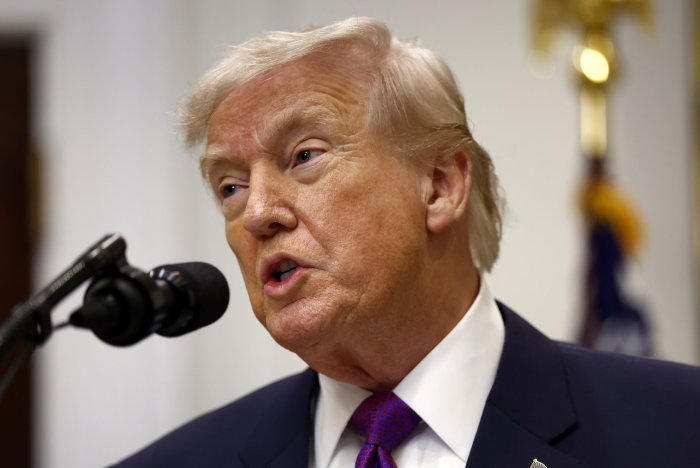
President Donald Trump speaks alongside Administrator of the Environmental Protection Agency Lee Zeldin in the Roosevelt Room of the White House on Thursday. The Trump administration has announced the finalization of rules that revoke the EPA’s ability to regulate climate pollution by ending the endangerment finding that determined six greenhouse gases could be categorized as dangerous to human health. Photo by Will Oliver/UPI | License Photo

Source link