South Korean team uses brain oxidant to activate Alzheimer’s prodrug

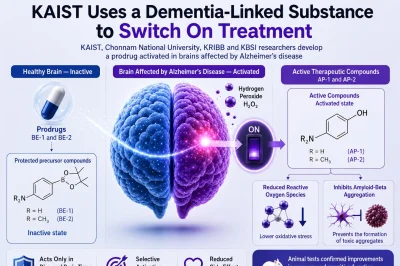
An AI-generated illustration depicts research into a disease-activated prodrug for Alzheimer’s disease. Data from KAIST. Graphic by Asia Today and translated by UPI
July 2 (Asia Today) — South Korean researchers have developed an experimental prodrug that uses elevated hydrogen peroxide in brains affected by Alzheimer’s disease as a signal to activate treatment, KAIST said Thursday.
The compounds remained largely inactive under healthy brain conditions but became active therapeutic agents after encountering hydrogen peroxide associated with Alzheimer’s pathology. The researchers confirmed their effects in animal experiments.
The research was led by Mi Hee Lim, a professor in KAIST’s Department of Chemistry. The university worked with research teams led by Min Geun Kim of Chonnam National University, Chul Ho Lee and Kyung Sim Kim of the Korea Research Institute of Bioscience and Biotechnology and Young Ho Lee of the Korea Basic Science Institute.
A prodrug is an initially inactive compound that converts into an active treatment only under specific conditions in the body.
The research team designed its prodrugs to activate only when exposed to hydrogen peroxide, a reactive oxygen species found at elevated levels in brains affected by Alzheimer’s disease.
Hydrogen peroxide has generally been treated as a harmful substance that should be removed because it can damage cells. The researchers instead used it as a biological signal to switch on the treatment.
The two prodrugs, called BE-1 and BE-2, showed little reaction under healthy brain conditions. When exposed to hydrogen peroxide in an Alzheimer’s-like environment, they converted into active compounds known as AP-1 and AP-2.
The activation process reduced hydrogen peroxide and other reactive oxygen species. It also interfered with the aggregation of amyloid beta, a protein that can accumulate in the brain and form toxic clumps associated with Alzheimer’s disease.
Advanced analytical tests showed that the activated compounds altered the structure of amyloid beta and prevented it from developing into larger aggregates, the researchers said.
Tests using mice with Alzheimer’s-like conditions showed that the prodrugs crossed the blood-brain barrier, which regulates which substances in the bloodstream can enter the brain.
The compounds then converted into their active forms inside the animals’ brains. The findings demonstrated that the prodrugs could reach their intended target and respond to the disease-related environment.
The approach differs from treatments designed to act continuously against a single protein. Instead, the KAIST-led strategy uses conditions within diseased tissue to activate treatment only where it is needed.
Researchers said this targeted activation could provide a strategy for increasing therapeutic effects while limiting unnecessary activity in healthy tissue. KAIST said the technology could also have potential applications in treatments for Parkinson’s disease and other neurodegenerative disorders.
“This study is significant because it uses hydrogen peroxide, which had previously been regarded only as something that should be removed, as a signal that activates the drug,” Lim said.
“The technology, which activates drugs only in diseased tissue, could become a new platform for treating complex diseases such as Alzheimer’s more safely and effectively,” she said.
— Reported by Asia Today; translated by UPI
© Asia Today. Unauthorized reproduction or redistribution prohibited.
Original Korean report: https://www.asiatoday.co.kr/kn/view.php?key=20260702010001077