Private Equity

Bending Spoons’ Playbook: Buy Low—and Hold

How Luca Ferrari’s permanent-capital model is transforming distressed digital brands.

Is it a private equity group with a twist? An “emergency room for critically injured tech companies,” as it was described by the Financial Times? Or is it simply a modern tech conglomerate?

How do you categorize a company that buys aging technology and digital brands—brand names like AOL, Vimeo, Eventbrite, WeTransfer, and more recently, Airtable—far below their peak value, overhauls and radically transforms them with a drastic turnaround, and then keeps them under the same umbrella to invest their profits in new acquisitions?

What it is, is a buy-and-hold investment and management company.

Bending Spoons SpA, an Italian company created in 2013 and recently listed on the Nasdaq, raised $1.68 billion with a total valuation of $18.4 billion and a current market value of $23 billion, and marked a 40% pop on its trading debut. For the second quarter, it reported $704 million in revenue and $177 million in net income, up 126% and 171%, respectively, from the second quarter of 2025.

It follows a highly unusual business model: buying distressed tech companies—or tattered internet businesses—at relatively low valuations, fixing them up through layoffs and reorganization, and then holding them rather than spinning them off or selling them separately to the market, as private equity groups typically do.

Bending Spoons has executed this strategy some 50 times since its creation. Funding for its activities comes from debt and from the profits of the acquired companies: the same ones it bought at low valuations, with seemingly no competition to acquire the brand.

All this was achieved as revenues increased fourfold from $387 million in 2023 to $1.3 billion last year, during which period it made 70% of its acquisitions. Ownership’s financial goal is an annualized return of 25% on invested capital, built on operational earnings alone rather than divestments, synergies between different acquisitions, or headcount reductions.

Meanwhile, debt, which financed 70% of the acquisitions that Bending Spoons made in the first quarter of this year, continues to pile up. In the last reported quarter, total debt was more than four times annualized EBITDA: hovering, in other words, between $4.3 billion and $4.4 billion, with a net debt of nearly $3.7 billion. The Canadian company Constellation Software Inc. has a similar business model, but carries less debt on its books, while Barry Diller’s People Inc.—formerly IAC Inc.—has followed a similar business model.

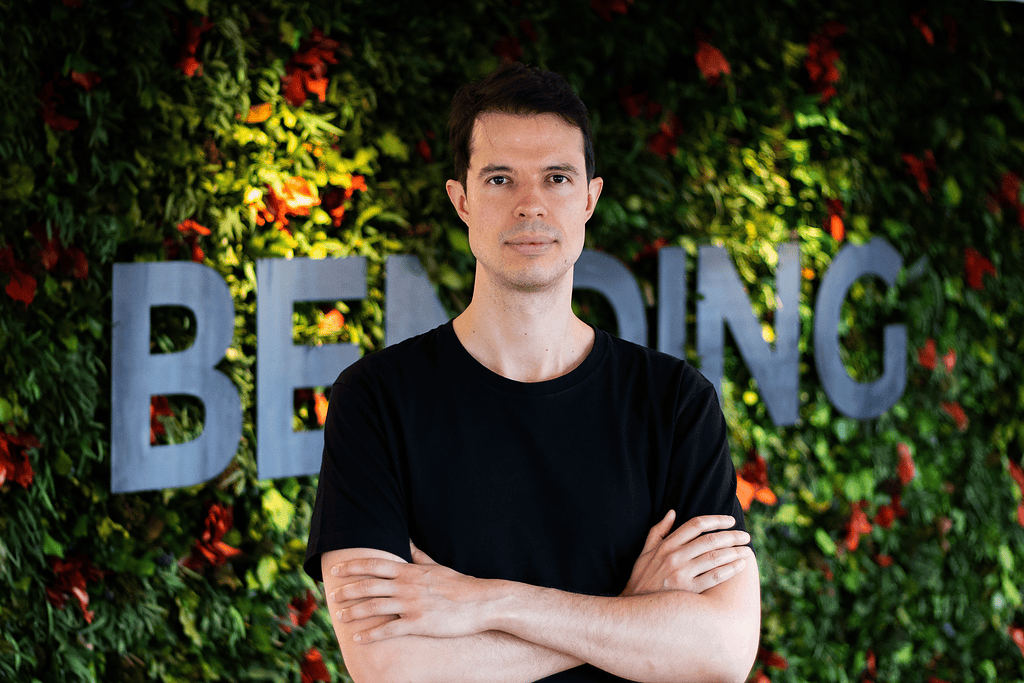
Luca Ferrari, CEO and one of four co-founders of Bending Spoons, described the model as a “deep transformation” because the acquired brands do not just go through layoffs but undergo radical structural reconstruction. The company’s name, an homage to the movie The Matrix, reflects the founders’ belief that mindset can transform reality, fueling their goal to achieve milestones that others might deem impossible.

In the prospectus for its Nasdaq listing, Bending Spoons mentions 1,000 potential targets. Its latest acquisition, announced this month, is Airtable, a “collaborative work management” software company, for $1.29 billion in cash. That represents a nearly 90% discount over Airtable’s highest valuation in 2021.

“The thesis of what we do,” Ferrari said, “is to integrate these companies very deeply onto our platform and rebuild them almost from the ground up: the technology, the product, the monetization, and big parts of the team. If we don’t see that we can make a big difference, we don’t expect to be able to make an appealing offer.”

A ‘Permanent-Capital Operator In A Tech Wrapper

Bending Spoons is not really a tech company, said Chelsea Michelle, founder of Elevated Business Advisors, who advises founders and family offices on capital strategy and acquisitions: “It is a permanent-capital operator wearing a tech wrapper, and the refusal to sell is the most important line in the model.

“Traditional private equity must manage every acquisition toward an exit multiple, which means dressing assets up for the next buyer. When you never plan to sell, you can optimize purely for cash generation and ignore the story entirely. That is a structural advantage, not a stylistic one.

“The model works because aging digital brands are systematically mispriced; sellers value them on declining top-line while a buyer at Bending Spoons’ scale values durable user bases that cost almost nothing to serve. The real risk is not the buying; it is the integrating. Most acquisitions fail to deliver expected value, and a serial acquirer that holds everything forever has nowhere to hide a bad integration. The integration discipline, not their deal flow, is what investors should watch after the Nasdaq listing.”

In a recent article in Barron’s, Henry Ellenbogen, CIO and managing partner of Durable Capital Partners and an investor in Bending Spoons before the IPO, pointed out an interesting angle on the company’s performance.

“When we first invested, Bending Spoons was making under $500,000 of EBITDA per Spooner, or employee,” he wrote. “Today, EBITDA is more than $1 million per Spooner. That speaks to the investment the company is making in the technology businesses it buys.

“Bending Spoons is centralized. Evernote [a company it acquired in 2023] has fewer than 20 people at the application level. We believe Bending Spoons’ revenue and EBITDA per employee will continue to compound, allowing the company to drive better organic growth and strong operating leverage. The market’s concern about software companies should allow management to buy higher-quality companies that fit its model at attractive prices.”

Currently, only 9% of shares in the company are available for trading, and the owners control the rest with a dual-class share mechanism.

On Wall Street these days, Bending Spoons’ stock gets four hold recommendations from analysts, one overweight, and six buy, but most of the banks it works with were involved in the IPO. Job applications are also strong; 99.9% of the 800,000 applicants for jobs as Spooners—the people running the acquired companies—were rejected.

Beyond the optimism about the stock’s performance and the company’s unusual business model, the future of Bending Spoons is tied to its long-term performance rather than its short- and medium-term performance, and whether its business model can and will be replicated. Time will tell.

Andrea Fiano is the editor-at-large. Contact him at afiano@gfmag.com.

Source link

PIK: The Hidden Risks of Payment-in-Kind

Liquidity relief today, balance-sheet strain tomorrow: The very structures that make private credit nimble—PIK loans—could also mask risk until it’s too late.

When GoHealth Inc. filed for Chapter 11 bankruptcy protection on June 7, the writing had been on the wall for two years. The Chicago-based health insurance marketplace had inked a payment-in-kind (PIK) deal to preserve liquidity only to collapse under the weight of more than $1 billion in debt.

For GoHealth’s lenders, including Blue Owl Capital, one of the largest private credit managers, it was a familiar scenario — allow a portfolio company to defer cash interest payments and roll them into its debt balance. This preserves liquidity during uncertain times. For GoHealth, the PIK agreement preceded a critical Medicare enrollment cycle.

Ultimately, it only bought time.

Liquidity deteriorated, Medicare Advantage pressures persisted, and GoHealth—once valued at $6.6 billion—ran out of runway. By late last year, lenders had placed the company’s loans on nonaccrual status. By the time GoHealth filed for bankruptcy protection, the PIK arrangement had become just another case study in a growing private-credit risk: debt structures that postpone distress while quietly deepening it.

“PIK is like a double-edged sword,” said Lakshmi Ganapathi, founder of Unicus Research in Ridgefield, Connecticut. “Borrowers seem to love PIK toggles in good times because it preserves the cash, but under stress, the accruing principal at a compounding rate becomes a balance-sheet problem. It’s attractive until it’s not.”

GoHealth and Blue Owl did not respond to requests for comment.

Borrower, Beware

Lakshmi Ganapathi
Lakshmi Ganapathi,
Unicus Research

GoHealth is hardly alone. P3 Health Partners restructured its term loan last year into a cash-and-PIK arrangement, requiring borrowers to pay a portion of interest in cash while adding the remainder to principal. This preserved liquidity but increased leverage over time. The Henderson, Nevada-based healthcare provider now has $380 million in long-term debt at double-digit interest rates.

In some cases, the outcome is more dramatic. Software company Pluralsight, owned by Vista Equity Partners, was ultimately handed over to a consortium of private credit lenders, including Blue Owl, Ares, Golub, Oaktree, Goldman Sachs, and BlackRock. Efforts to manage Pluralsight’s debt burden proved insufficient, and Vista wrote off roughly $4 billion in equity.

“There’s a through-line across all of them,” Ganapathi told Global Finance. “A borrower under cash-flow strain defers an obligation, whether through PIK, an amendment, or a liability-management exercise.”

The deferral increases the debt burden or postpones the reckoning, and the resolution is a lender-led restructuring in which the equity is wiped out or impaired and the debt holders take control.

“The 2026 cluster is concentrated in healthcare and software, where higher-for-longer rates met business models underwritten on cheaper money,” she added.

In a post-bank-crisis world of high interest rates and tightened underwriting standards, private credit has stepped into the void. But the very perks that make it nimble — like PIK loans — can be foreshadowing: a bankruptcy filing that simply formalizes what the PIK plan already implied.

Firms like Blue Owl Capital have exposure across a range of heavily leveraged software, technology, and financial borrowers, some of which have recently faced bankruptcies, insolvencies, or out-of-court restructurings. It’s enough to turn certain dealmakers off completely.

“Our firm doesn’t do any pay-in-kind,” Scott Stevens, CEO of Grays Peak Capital, a New York-based global investment firm, said. “We only do cash pay, and that is, I think, why we’ve had no defaults.”

One need only look to the September bankruptcy of auto parts supplier First Brands Group. The filing came after a PIK-based option had been introduced — highlighting how quickly deferred-interest arrangements can become embedded in stressed credits. Fortified by the “cockroach” imagery used by JPMorgan Chase CEO Jamie Dimon, headlines about the collapse of private credit began circulating.

But the evidence isn’t just anecdotal.

Poorly PIK-ed

An analysis by Lincoln International found that 11% of loans in its private credit database carried some form of PIK interest in 2025, up from 7% in 2021. While the increase appears gradual, the composition of these loans is what’s striking: 58% are now classified as “bad PIK.”

That means the borrowers couldn’t keep up with payments and later had to switch to PIK. The shift matters because it reflects weakening credit quality rather than a pre-planned financing option.

In other words, the loans migrated into PIK status as borrowers faced deteriorating cash flows and required relief. The share of “bad PIK” loans has more than doubled since late 2021, Lincoln notes, effectively turning the metric into a proxy for underlying problems.

The implications are significant. In many cases, borrowers use PIK not because business conditions are improving or because growth is being reinvested, but because cash generation is insufficient to service debt. Lincoln describes this as a potential “shadow default rate,” capturing companies that might otherwise have defaulted absent lender forbearance.

The deterioration in the balance sheet is equally stark. Within the bad PIK group, average loan-to-value ratios have risen from 39.4% at origination to 76.1% today, underscoring how quickly leverage can escalate when earnings weaken and enterprise values compress.

Private credit proponents highlight flexibility and speed as advantages that outweigh the drawbacks. Unlike traditional banks, direct lenders can close deals in weeks, tailor covenants, and even hold entire loan books. Borrowers pay a premium for certainty and confidentiality: a trade-off that often, though not always, takes the form of a PIK arrangement. But Grays Peak Capital’s Stevens sees 2026 as an inflection point.

“A lot of people tightened their lending standards over the last three to six months,” he says. Stevens attributes the stress to a combination of rate resets and companies failing to grow in line with underwriting assumptions. Some defaults are to be expected, especially those that are tech and venture related. “But I don’t think it’s systemic in terms of the economy.”

A Bank-Like Game, Sans the Rules

Scott Stevens, CEO, Grays Peak Capital
Scott Stevens,
Grays Peak Capital

Not everyone is so optimistic. After all, the sector’s flexibility comes with a cost: opacity. Critics point to the tangled web of interconnections between private lenders and banks as a source of potential systemic risk.

The very features that make private credit attractive — speed, flexibility, confidentiality — also make it difficult to monitor. And as PIK loans accumulate on balance sheets with limited public disclosure, a broader question is taking shape. If private credit is playing a bank-like game, should it play by the same rules?

Regulating private credit providers like banks would be too stifling, Stevens argues. “If they would go too far down the regulatory path, I think this will skirt innovation and growth,” he said, pointing to defense sector financing as an area where private credit needs room to maneuver.

Todd Holleman, a partner at King & Spalding, draws a distinction between the two. Bank regulations exist for a reason, he argued. Deposits are primarily individuals’ money, and the global financial crisis showed how quickly bad investments could put that money at risk. Private credit is different. Its capital comes primarily from sovereign wealth funds, pension plans and insurance companies — sophisticated investors who are already regulated and understand what they’re buying. Applying bank regulations to private credit, Holleman said, would be an apples-to-oranges comparison. “They just wouldn’t work.”

Ganapathi sees it differently, citing the case of Market Financial Solutions (MFS). The UK bridge lender collapsed into administration in February following allegations of fraud and asset double-pledging. HSBC wasn’t directly exposed to MFS — it was exposed to Apollo, which was. The $400 million loss traveled up the chain.

“It cascades,” Ganapathi said, drawing a parallel to Japan’s lost decade, when banks extended credit to insolvent borrowers while avoiding mark-to-market accounting — papering over losses until the system buckled. “They were extending and pretending like nothing happened, not marking to market. That derailed the system. Regulations stopped it. Now, if you take regulation out of the picture, what will stop this? Without a trigger, this could continue for a long time.”

Anthony Noto covers corporate finance and private credit. Contact him at anoto@gfmag.com.

Source link