primary

California Congressional District 27 primary election voter guide

p]:text-cms-story-body-color-text clearfix”>

  • Jason Gibbs: Republican, Santa Clarita City Council member, mechanical engineer

Gibbs has been a member of the Santa Clarita City Council since 2020 and was chosen by his peers to serve as the city’s mayor in 2023. He earned his bachelor’s and master’s degrees in mechanical engineering at Cal Poly and went on to work in the aerospace industry, according to his campaign website. He has lived in Santa Clarita for nearly a decade while raising two young children, his bio says, and has served on the local boards of the Boys and Girls Club, the Valley Industry Assn. and the Salvation Army.

  • George Whitesides: Democrat, incumbent

Whitesides defeated Republican incumbent Mike Garcia to represent the 27th Congressional District in 2024. Whitesides worked on President Obama’s transition team in 2008 and served as NASA chief of staff during the Obama administration, according to his campaign bio. He was the first chief executive of Virgin Galactic, co-founded Megafire Action, a nonprofit that advocates for legislation to address the growing problem of massive wildfires, and was a board member for the Antelope Valley Economic Development and Growth Enterprise, his bio says.

Others:

  • Roberto Ramos: Democrat, Marine veteran, UCLA master’s student
  • Caleb Norwood: Democrat, college student

A representative for David Neidhart, a Republican candidate, said he has withdrawn from the race. His name still will appear on the ballot.

Source link

How to vote in California’s June 2026 primary election

p]:text-cms-story-body-color-text clearfix”>

Vote-by-mail ballots will not be forwarded to a new address, so your ballot will be returned to your local county election office if you haven’t updated your voter registration.

The Los Angeles Registrar-Recorder/County Clerk recommends voters who have been impacted or displaced by wildfires update their mailing address or request a replacement ballot be sent to their temporary address or new permanent address. Los Angeles County residents can follow a guide created for Pacific Palisades and Altadena fire survivors online. Residents can also make updates by phone by calling the Registrar-Recorder/County Clerk’s office at (800) 815-2666, Option 2.

You also can update your mailing address by re-registering to vote online. In the “residential address” section, enter your former place of residence and in the “mailing address” section, check the box that says your mailing address is different from your home address and then enter your temporary mailing address.

Source link

Louisiana congressional primaries are suspended as a result of Supreme Court ruling

Louisiana’s congressional primaries won’t be going forward as scheduled in May, as a result of a U.S. Supreme Court ruling that struck down a majority-Black congressional district, the state’s top elected officials said Thursday.

Gov. Jeff Landry and Atty. Gen. Liz Murrill, both Republicans, said in a joint statement that Wednesday’s high court ruling effectively prohibits the state from carrying out the primaries under the current districts. Early voting had been scheduled to begin Saturday in advance of the May 16 primary.

“The State is currently enjoined from carrying out congressional elections under the current map,” Landry and Murrill said in the statement posted to social media. “We are working together with the Legislature and the Secretary of State’s office to develop a path forward.”

That path is likely to lead to a new U.S. House map benefiting Republican candidates in Louisiana.

President Trump, in a series of social media posts Thursday, praised Landry for moving quickly to revise the state’s congressional districts and urged Republican Tennessee Gov. Bill Lee to do likewise in light of the Supreme Court’s decision.

While civil rights activists denounced the potential for diminished minority representation in Congress, top Republicans cited the Supreme Court’s decision as justification to spur an already intense national redistricting battle among states before the November elections.

“I think all states who have unconstitutional maps should look at that very carefully, and I think they should do it before the midterm,” House Speaker Mike Johnson told reporters in Washington.

Questions persist about election postponement

Louisiana’s election suspension was denounced by some Democrats and questioned by some legal experts.

“This is going to cause mass confusion among voters — Democrats, Republicans, white, Black, everybody,” said Louisiana state Sen. Royce Duplessis, a Democrat who represents the New Orleans area. “What they’re effectively doing is changing the rules of the game in the middle of the game. It’s rigging the system.”

Although Louisiana officials may legally be able to move the primary, it’s not accurate to assert that it was blocked by the Supreme Court’s decision, said Ruth Greenwood, director of the Election Law Clinic at Harvard Law School.

State Rep. Kyle Green, a former assistant state attorney general who is chair of the House Democratic caucus, also cast doubt on the legal justification for postponing the congressional primary.

“The Court’s decision does not halt the election process on its own,” Green said. “And any attempt to suspend or disrupt an ongoing election at this stage would raise serious constitutional concerns.”

Delaying an election is unusual but not unprecedented.

During the onset of the COVID-19 pandemic in 2020, several states pushed back elections because of health concerns. Democratic Gov. John Bel Edwards, who led Louisiana at the time, postponed Louisiana’s April 4 presidential primary three weeks before it was supposed to occur — then delayed it again until July 11.

Louisiana could join a national redistricting wave

Louisiana currently is represented in the U.S. House by four Republicans and two Democrats. A revised map could give Republicans a chance to pick up at least one more seat in the November midterms — adding to Republican gains elsewhere from redistricting.

Voting districts typically are redrawn once a decade, after each census. But Trump last year urged Texas Republicans to redraw House districts to give the GOP an edge in the midterms. California Democrats reciprocated, and redistricting efforts soon cascaded across states.

On Wednesday, Florida became the latest state to redraw its U.S. House districts, adopting a new map backed by Republican Gov. Ron DeSantis that could give the GOP a chance at winning several additional seats.

The Florida vote occurred just hours after the U.S. Supreme Court’s conservative majority issued a ruling that significantly weakened minority protections under the federal Voting Rights Act. The court said Louisiana officials had relied too heavily on race when drawing a congressional district that is represented by Democrat Cleo Fields.

Trump wants Tennessee to also take up redistricting in response to the court’s ruling. The president posted on social media that he had spoken with Lee, who he said would work hard for a new map that could help Republicans gain an additional seat. Democrats currently hold only one of the state’s nine House seats — a district centered in Memphis, which is majority-Black.

Tennessee House Speaker Cameron Sexton, a Republican, said he is in conversations with the White House and others while reviewing the court’s decision.

Louisiana has a history of redistricting challenges

After the 2020 census, Louisiana officials had drawn House voting district boundaries that maintained one Black-majority district and five mostly white districts, in a state with a population that is about one-third Black.

A federal judge later struck down the map for violating the Voting Rights Act. And the following year the Supreme Court found that Alabama had to create its own second majority-Black congressional district.

In response, Louisiana’s Legislature and governor adopted a new House map in 2024 that created a second Black-majority district. But that map also was subsequently challenged in court, leading to the most recent Supreme Court ruling.

After the ruling, Landry called U.S. House candidates on Wednesday and told them that primaries would probably be stalled, according to Misti Cordell, a Republican running in a crowded race to fill U.S. Rep. Julia Letlow’s vacated seat.

“It’s an inconvenience for a candidate for sure, but you know they want to do it right versus having to go through all this again,” Cordell said. She added that she appreciated the heads-up before she and other candidates began “spending their war chest” during the final weeks leading up to election day.

Republican state lawmakers are reviewing which pending bills could be used to alter primaries and reconfigure congressional maps, said Louisiana state Rep. Beau Beaullieu, chair of the House committee overseeing redistricting efforts.

Cline, Brook and Lieb write for the Associated Press. Brook reported from New Orleans and Lieb reported from Jefferson City, Mo. AP reporter Travis Loller contributed to this report from Nashville.

Source link

How Massie’s Kentucky primary may test Trump’s hold on the Republican Party | US Midterm Elections 2026 News

‘The great puzzle’

While Massie has long dominated elections in Kentucky’s 4th district, polling this year shows a tighter race than expected.

A Quantus Insights survey conducted from April 6 to 7 showed Massie leading Gallrein 46.8 percent to 37.7 percent.

Another survey conducted by Big Data Poll in early April had Massie ahead with 52.4 percent to Gallrein’s 47.6 percent.

The relatively close primary could be a bellwether for Republican voting trends nationwide, according to Stephen Voss, a political science professor at the University of Kentucky.

“Massie is an early opportunity to see what Republican voters will do when their pro-Trump leanings clash with their conservative leanings,” Voss said. “That is the great puzzle of this race.”

This is not the first time Trump has turned against Massie, though. In 2020, another election year, Trump famously petitioned to “throw Massie out of the Republican Party”.

But by 2022, Trump had reversed course, endorsing Massie over a challenger who questioned the congressman’s commitment to the president.

Still, the past year has widened the rift between Trump and Massie, leading the president to make his most aggressive moves yet to unseat the congressman.

The two Republicans clashed on a range of issues in 2025. Massie, for example, opposed the president on his tax and spending measures, fearing increases to the national debt.

That meant voting against Trump’s signature piece of legislation, the One Big Beautiful Bill Act, last July.

The Kentucky Republican also denounced Trump’s campaign of foreign intervention. Last June, NBC News reported that it was after Massie criticised Trump’s strikes on Iran that the president’s allies began laying the groundwork for a primary challenge.

Massie also led the charge to compel the Department of Justice to release all the files related to the investigation into Jeffrey Epstein, the late financier and convicted child sex offender.

Shortly thereafter, Trump gave his stamp of approval to Gallrein, posting on his Truth Social site, “RUN, ED, RUN.”

By that point, Gallrein, a military veteran and fifth-generation farmer, had yet to enter the race. Four days later, on October 21, he launched his bid.

Critics argue Gallrein’s platform does not offer much of a distinction from Massie’s. His campaign website lists his priorities as cutting taxes, reducing government spending, protecting gun rights and opposing abortion — issues Massie also supports.

“I don’t think he’s offering any kind of alternative, except for being the selection of Donald Trump,” Kahne said. “I think that’s it. That’s the only thing he has to offer.”

But Gallrein has drawn heavily from Trump’s endorsement, using it as a badge of loyalty and authenticity.

“You deserve an authentic, true Republican conservative that stands shoulder to shoulder with our president and the Republican Party,” Gallrein declared at the Trump rally in March.

Trump, meanwhile, told the crowd he had grown so frustrated that he just wanted “somebody with a warm body to beat Massie”.

Source link

Park leads challenger Malik in fundraising for L.A.’s coastal council seat

Los Angeles City Council member Traci Park has raised more than $1.2 million for her reelection campaign in the city’s June 2 primary, more than double the amount collected by challenger Faizah Malik, according to finance reports filed this week.

Malik, a civil rights attorney, reported raising roughly $454,000 in her bid for the District 11 seat that skirts along the Westside, including Mar Vista, Pacific Palisades, Venice and Westchester, the reports show.

At nearly $1.7 million, the money raised in the race is the highest for the eight council seats, out of 15 total, on the ballot in the June 2 primary. Any candidate who wins a majority in the election will win the seat outright, otherwise the top two vote-getters will compete in the Nov. 3 general election.

Two of the eight races are open seats to replace termed-out incumbents, and in five other races, incumbents Eunisses Hernandez, Park, Hugo Soto-Martínez, Tim McOsker and Katy Yaroslavsky posted large fundraising leads against their challengers. One incumbent, Councilmember Monica Rodriguez, is running unopposed.

In the west San Fernando Valley’s 3rd District, three candidates are seeking to replace termed-out Councilmember Bob Blumenfield.

Insurance company founder Tim Gaspar was leading the pack in fundraising, reporting nearly $430,000. Barri Worth Girvan, an aide to Los Angeles County Supervisor Lindsay Horvath, has raised about $235,000. Tech entrepreneur Christopher Robert “CR” Celona was far behind with about $12,300.

In Council District 1, which includes Highland Park and Pico-Union, incumbent Hernandez topped the field with about $319,000 in contributions. Challenger Maria Lou Calanche, a former Los Angeles police commissioner, reported raising about $182,000.

Among other challengers in the race, Sylvia Robledo, a small-business owner and longtime City Council aide, reported about $75,000 in contributions. Raul Claros, founder of a nonprofit called California Rising, listed $70,500 in contributions and entrepreneur Nelson Grande reported raising about $55,000.

There are six candidates vying to replace incumbent Curren Price in the 9th District, which includes USC and communities along the Harbor Freeway corridor.

Jose Ugarte, a former deputy chief of staff for Price, led the field in reported financial contributions, amassing $477,000.

Estuardo Mazariegos, head of the Alliance of Californians for Community Empowerment Los Angeles, reported roughly $200,000 in contributions and Elmer Roldan, director of a nonprofit, has raised about $114,000.

Entrepreneur Jorge Nuño and therapist Martha Sanchez trailed with about $25,000 and $13,000, respectively. Educator Jorge Hernandez Rosas did not report any contributions.

In the other races:

  • Yaroslavsky reported raising about $431,000 for her 5th District seat, which includes Westwood, Palms and Hancock Park. None of her opponents, Henry Mantel and Morgan Oyler, reported raising more than $35,000.
  • McOsker reported raising 242,000 for his 15th District seat in San Pedro. Challenger Jordan Rivers, a community organizer, told The Times he did not raise any funds.
  • Soto-Martínez reported raising more than $170,000. The three challengers in the race — Colter Carlisle, Dylan Kendall and Rich Sarian — reported a combined $152,000.

The outcome of the Park-Malik contest in District 11 will be determined in the June 2 primary because there are only two candidates in the race.

In a statement, Councilmember Park credited her fundraising lead to her efforts to clear homeless encampments.

“I raised an historic number of donations from local Westside residents because I’ve been on the ground since Day One solving our number one priority: getting people off the streets into housing and treatment and removing dangerous encampments from our neighborhoods,” Park said. “Residents, workers and visitors all see the difference.”

Kendall Mayhew, communications director for Malik’s campaign, said in a statement that Park and her supporters are spending unprecedented money because “we are winning and they simply don’t know what else to do.”

“What our campaign has demonstrated so far, and what we will demonstrate at the ballot box in just a few weeks, is that corporate money cannot defeat an honest, people-powered campaign,” Mayhew said.

The fundraising totals reported this week represent money given by individual donors, who are limited to contributions of no more than $1,000 in this election cycle. While the reports offer a glance at fundraising, money is also coming in through independent expenditures, which have no limit on how much can be given.

For example, in District 1, the L.A. County Federation of Labor has reportedly spent more than $226,000 in support of Hernandez. Calanche is also receiving supporting funds: the Fix Los Angeles PAC Supporting Calanche, Ugarte and Park for City Council 2026 has spent about $46,000 on her campaign to unseat Hernandez.

Source link

As primary election nears, top candidates for California governor debate tonight

With the California governor’s race quickly approaching, six candidates will face off Wednesday evening in the first debate since former Rep. Eric Swalwell dropped out of the race in the aftermath of sexual assault and misconduct allegations.

The debate takes place at a critical moment in the turbulent contest to replace termed-out Gov. Gavin Newsom. Ballots will start landing in Californians’ mailboxes in less than two weeks, and voters are split by a crowded field of eight prominent candidates. The debate also takes place after former state Controller Betty Yee ended her campaign because of a lack of resources and support in the polls.

Two Republicans — Riverside County Sheriff Chad Bianco and conservative commentator Steve Hilton — and four Democrats — billionaire Tom Steyer, former Biden administration Secretary Xavier Becerra, former Orange County Rep. Katie Porter and San Jose Mayor Matt Mahan — will take the stage at Nexstar’s KRON4 studios in San Francisco. Former Los Angeles Mayor Antonio Villaraigosa and state Supt. of Public Instruction Tony Thurmond, both Democrats, were not invited to participate because of their low polling numbers.

As the candidates strive to distinguish themselves in a crowded field, the debate could include fiery exchanges about the role of money in politics and potential heightened attacks on Becerra, who has surged in the polls since Swalwell dropped out. With the debate taking place on Earth Day, environmental issues are also likely to be raised.

The Wednesday night gathering is the first televised debate in the gubernatorial contest since early February. Last month, USC canceled a debate hours before it was set to begin over mounting criticism that its criteria excluded all major candidates of color.

The 7 p.m. debate is hosted by Nexstar and will be moderated by KTXL FOX40 anchor Nikki Laurenzo and KTLA anchor Frank Buckley. It can be viewed on KRON4 (San Francisco), KTLA5 (Los Angeles), KSWB/KUSI (San Diego), KTXL (Sacramento), KGET (Bakersfield) and KSEE (Fresno). NewsNation will also air the debate.

Source link

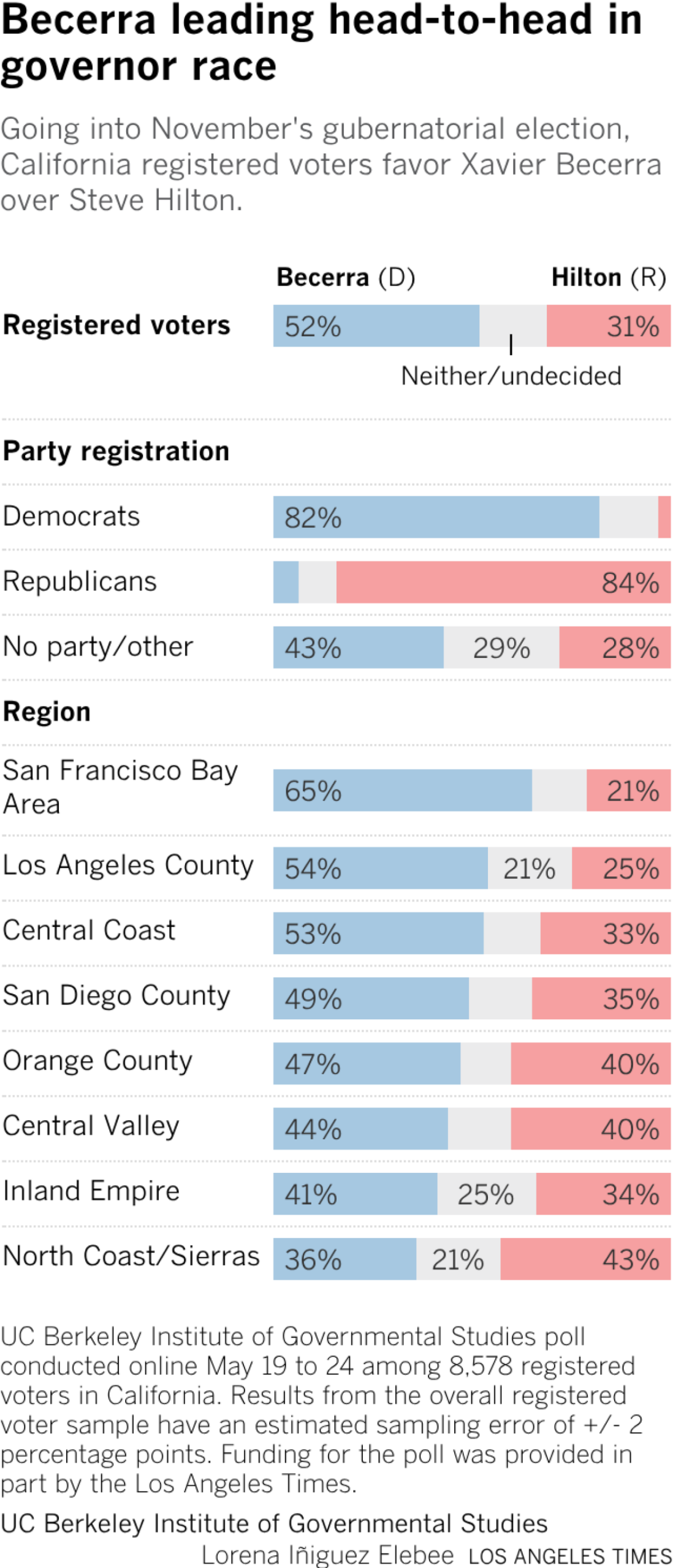
Becerra sees momentum, money and movement in the polls in governor’s race

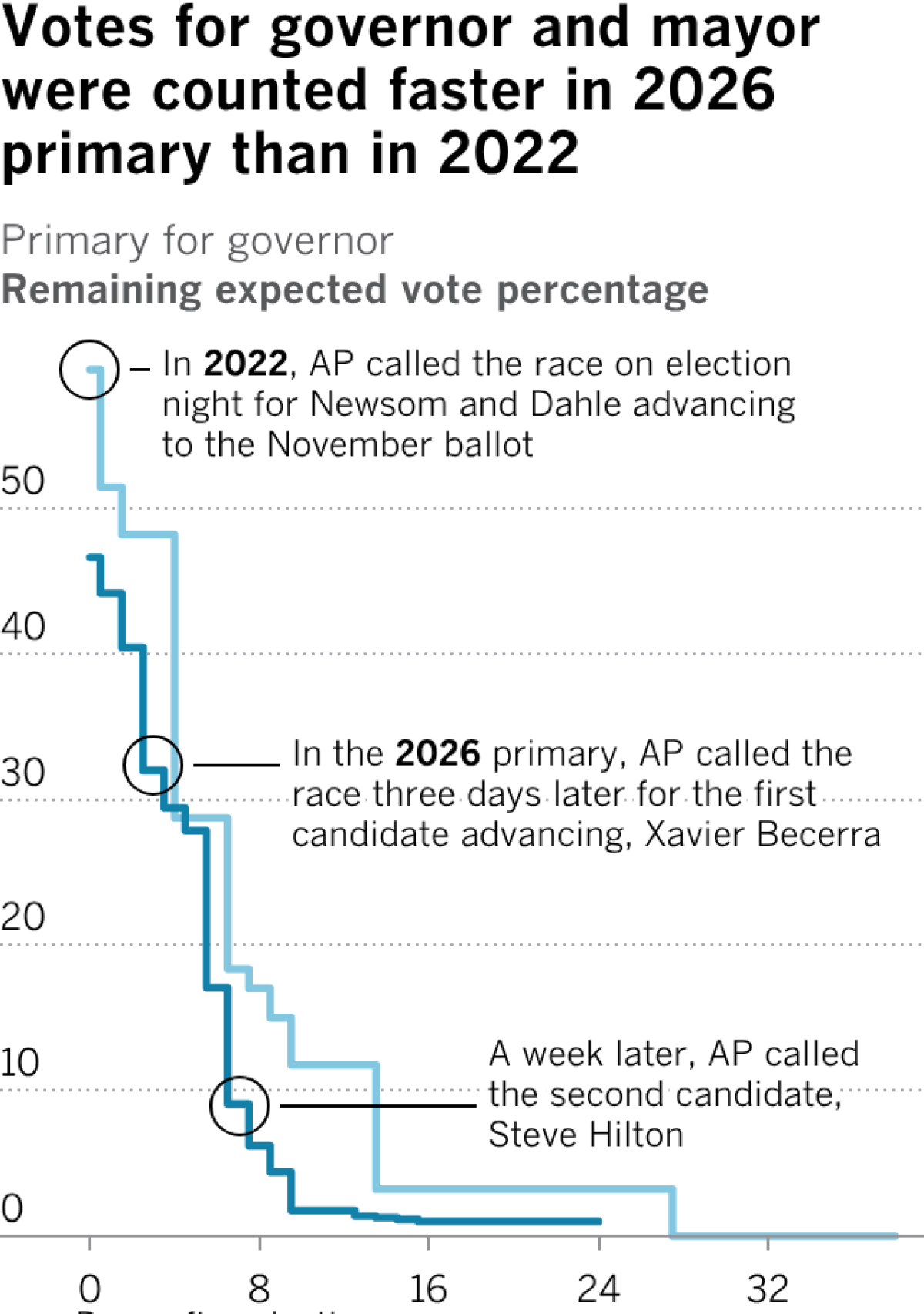
Xavier Becerra, a former cabinet secretary in President Biden’s administration, appears to be surging in the curiously unsettled California governor’s race.

Until recently, the former U.S. Health and Human Services secretary had been mired in the single digits in polling to replace termed-out Gov. Gavin Newsom and lead the nation’s most populous state.

But after former Rep. Eric Swalwell, (D-Dublin) dropped out of the race earlier this month amid accusations ofsexual assault and other misconduct Becerra has seen a boost in polls, fundraising and endorsements.

On Tuesday, Assembly Speaker Robert Rivas endorsed Becerra alongside 14 Democratic members of the legislative body.

Arguing that Californians are under constant threat from President Trump’s policies, Rivas cited Becerra’s decades-long record in public office, including defending Obamacare and young immigrants, or dreamers, to argue that Becerra is best positioned to lead the state.

“There’s no time to learn on the job — we need a governor who’s ready to fight back on day one,” Rivas said in a statement, noting that Becerra sued the Trump administration 122 times while he was California’s attorney general. “We have a strong Democratic field for governor. But right now, we need someone ready on day one. Xavier Becerra is that leader.”

Becerra said he was honored to receive the legislators’ backing.

“I look forward to working with the Speaker and legislators on Day One to tackle the problems Californians care about most — from the skyrocketing cost of groceries and housing to our unyielding fight against the Trump Administration’s disastrous policies,” he said in a prepared statement. “Californians need an experienced and trusted leader who doesn’t need on-the-job training.”

Despite Becerra’s long tenure in state and federal office, the unflashy politician is not well-known among California voters. He was among the underdogs in the 2026 gubernatorial race. Swalwell, by contrast, was among the leading Democratic candidates.

Amy Thoma, a former Republican strategist who is no longer affiliated with a political party, noted that Becerra’s surge comes at a critical moment in the election, shortly before ballots land in Californians’ mailboxes.

“Voters are starting to tune into the race. Yes, they want someone who will stand up to Trump, but it also seems they want someone with experience who can address the very real issues facing the state,” Thoma said.

She added that Becerra’s life story is “incredibly compelling.”

“The word authentic is overused, but every time he talks about his love for this state, for his family and wanting to make California work for everyone, it comes across incredibly sincere,” Thoma said. “Voters can see through candidates who fake it.”

Becerra was respected by colleagues across the aisle, including former GOP legislative leader and state Republican party chairman Jim Brulte. Both men were elected to the state Assembly in 1990 and though their politics often sharply differed. However, they had a warm relationship.

“He was progressive and I am a conservative,” Brulte said. “We never agreed much on policy, but he is a good man with a great heart.”

The 2026 governor’s race has been unlike any in recent memory, with no clear front-runner in a crowded field of candidates and voters just beginning to pay attention to the contest shortly before the June 2 primary.

There were two prominent Republicans and eight prominent Democrats in the race, leading to fears among Democratic leaders in the state that their party’s candidates could be shut out of the governor’s race in the general election because of California’s unique primary system. The two candidates who win the most votes in the June 2 primary will move onto the November general election, regardless of party affiliation.

Democratic leaders remain concerned that despite California’s sapphire-blue tilt, the number of their party’s candidates in the race could lead to a splintering of Democratic voters that results in two Republicans advancing to the November ballot.

Six prominent Democrats remain in the race, after Swalwell and former state Controller Betty Yee dropped out.

The race — lacking a global superstar such as Arnold Schwarzenegger or the scion of a storied political family and former governor like Jerry Brown — is ephemeral. Anything can happen before the June 2 primary.

But Becerra is having a moment. In addition to the new endorsements, he has seen notable movement in polls, most recently in a survey released Monday by the state Democratic party. Becerra jumped nine points from the party’s last poll, tying with billionaire Tom Steyer at 13%.

While Becerra will never be able to match Steyer’s deep pockets, he raised more than $1 million on ActBlue, the top Democratic fundraising platform, in the week ending on April 18, making him the biggest fundraiser on the site in the nation.

“Ninety-seven percent were first-time donors,” Becerra’s campaign said in a statement. “This is not a donor base being recycled. It is a movement being born.”

Source link

Column: Swalwell scandal exposed flaws in top-two primary

California Democrats caught a huge break with Eric Swalwell’s sexual assault scandal. It surfaced in early spring rather than midsummer.

Just think of the Democratic debacle that could have occurred.

What if the accusations of sexual misconduct, including alleged rape, had come to light after the gubernatorial candidate had triumphed in the June 2 primary and qualified for the November ballot?

Under California law, it would have been impossible to remove him from the ballot and insert a Democratic replacement.

“It would have been pretty devastating,” notes Assemblywoman Gail Pellerin (D-Santa Cruz), who heads the Assembly Elections Committee.

“It has given us a lot to think about.”

There’s a glaring flaw in California’s election system that should be fixed for the future. But exactly how is trickier than it might seem.

Here’s what I’m talking about:

Prior to April 10 — doomsday for Swalwell — the then-congressman from the East San Francisco Bay was leading the large field of Democratic candidates for governor. Just barely. But he was starting to pull away, based on polling and endorsements.

A survey conducted by the independent Public Policy Institute of California just before Swalwell’s accusers went public showed him leading all candidates — Democrats and Republicans — with 18% support among likely voters.

He was closely trailed by Republican Steve Hilton, a former Fox News host, with 17%. Another Republican and a Democrat — Riverside County Sheriff Chad Bianco and billionaire climate activist Tom Steyer respectively — were tied for third at 14% each. Democratic former Orange County Rep. Katie Porter followed at 10%.

You can now toss all those numbers in the trash. But the point is that Swalwell was headed for victory in the primary. His next stop was the governor’s mansion because no Republican has won a statewide race in California in two decades.

The Democratic front-runner was raking in endorsements from interest groups and democratic politicians. He was considered the safest bet in a generally unimpressive field, a regular middle-class guy — and a white male, the only ethnicity and gender that has ever been elected governor in California.

Former state Controller Betty Yee, a Democratic darkhorse candidate for governor, was pretty much on target when she observed after Swalwell’s campaign collapsed:

“The obsession with who looks the part [of governor] almost got us an alleged sexual predator in Sacramento — ignoring the reality we need to actually fix our fraught state.”

But what if the victims of Swalwell’s alleged sexual improprieties — five women at last count — had waited a few more months to go public? And that’s conceivable. After all, they had remained silent for years. Apparently the nightmare of their alleged assailant becoming governor inspired them to talk now.

Although Swalwell quickly dropped out of the race, there’s no way to erase his name from the primary ballot. But at least voters can choose among seven other “major” Democratic contenders.

If he had already won in the top-two primary, however, and a Republican had also qualified for the November ballot, Democratic voters would have been left high and dry.

Presumably no sane person, no matter how partisan, would vote to elect an alleged rapist as governor. But the only other choice would have been a Republican lackey of President Trump. He’d undoubtedly win by default in a landslide.

“If Democrats had been stupid enough to nominate Swalwell, they’d have been stuck with him,” says Tony Quinn, a Republican elections analyst.

“Even dying doesn’t get you off the ballot. You don’t want to be the party nominee? So what, you are.”

No write-in candidacies are allowed in California’s general elections, although they are in the primary. That’s an inexplicable flaw.

“I’ve thought for years there should be a write-in option to deal with such a problem,” says UCLA law professor Rick Hasen, an expert on elections law.

Also, he points out, California’s top-two primary system — which advances only the top two vote-getters regardless of party — “cuts out minor parties from being relevant. You ought to be able to write in a minor party candidate.”

One reason a candidate can’t be removed from the ballot, election officials claim, is that tens of millions ballots have to be printed early enough to mail to every registered voter one month before election day.

Nonsense. In this era of rapidly expanding technology, you’d think that dilemma could be resolved even within snail-paced government bureaucracies. If nothing else, mail out a supplemental ballot just for the governor’s race.

But a bigger question is exactly who would choose the replacement for a departed candidate.

In a presidential election, the party hierarchy — a convention or national committee — would choose another nominee.

But there are no party nominees in California’s top-two open primary system. Parties don’t choose candidates for the November election. Voters regardless of their party do. So, in Swalwell’s case, the Democratic Party alone wouldn’t be entitled to select his substitute — unless the law were changed.

Or, perhaps the No. 3 vote-getter in the primary could automatically be elevated to the general election. We then could wind up with two candidates from the same party. But at least there’d be a better choice than an alleged sexual predator.

“I kind of miss those days” when parties nominated, says Pellerin, who was Santa Cruz County’s chief elections official for 27 years. “It’s something I’ve been thinking about — whether this is the best primary system.”

As I recently wrote, my vote would be to junk the top-two system and return to pre-”reform” party-nominating primaries.

Advocates of the top two primary — including myself — thought it would produce more centrist officeholders. It really hasn’t. It has just caused additional problems — like occasionally sending two candidates of the same party to the November runoff.

Meanwhile, all California voters should be grateful that Swalwell’s accusers courageously went public in April, not August.

You’re reading the L.A. Times Politics newsletter

George Skelton and Michael Wilner cover the insights, legislation, players and politics you need to know. In your inbox Monday and Thursday mornings.

What else you should be reading

The must-read: Swalwell supporters scramble after he drops out of governor’s race. Who will benefit?
California love: Californians are pouring money into Democrats’ Senate races in other states
The L.A. Times Special: There’s a wide gap between rumor and fact. That’s where Eric Swalwell lurked

Until next week,
George Skelton


Was this newsletter forwarded to you? Sign up here to get it in your inbox.

Source link