Primaries on the West Coast are complete. Here are November races to watch
WASHINGTON — Midterm battle lines have been drawn across the Western states, as attention turns to general election campaigning with three months until November’s election day.
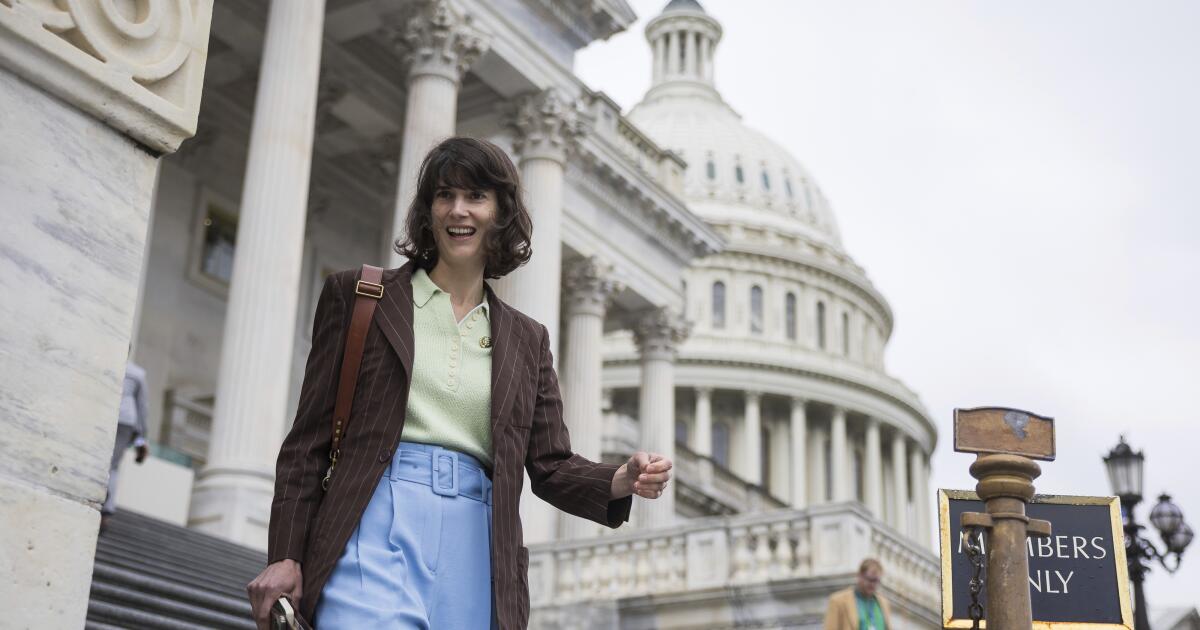
Washington state completed its primary Tuesday, the last mainland state west of the Rocky Mountains to do so. A national spotlight is on the state’s 3rd District, just over the border from Portland, Ore., where Democratic Rep. Marie Gluesenkamp Perez is now set to face state Senate Minority Leader John Braun, a Republican.
Democrats see defending that vulnerable seat as key to the party’s attempt to win a House majority. It is one of a handful of competitive races across the West that will help decide which party controls the House during the second half of President Trump’s term.
Attention and money is set to pour into those races over the coming months, along with some key statewide races. Here are ones to watch in California, Oregon, Washington, Arizona, Nevada and beyond.
Washington’s big race
Washington’s battleground 3rd District is a high priority for both parties. The district went for President Trump in 2024 while reelecting Gluesenkamp Perez.
Gluesenkamp Perez, a centrist who was first elected narrowly in 2022 and has made a name for herself by sometimes breaking with her party, successfully fended off primary challengers on Tuesday to advance to the November ballot. Braun, a retired Navy captain, won the other spot on the ballot.
The race with Braun will test Gluesenkamp Perez against a more moderate opponent than she had in conservative former CIA officer Joe Kent, who ran against her in both her previous elections. It will also test loyalty from her progressive base, some members of which were unhappy after Gluesenkamp Perez voted to fund the Department of Homeland Security in January, one of seven Democrats who helped it pass.
A competitive primary also unfolded Tuesday in the conservative central Washington district held by longtime Rep. Dan Newhouse, who is retiring. Republican Amanda McKinney, a county commissioner who was endorsed by Trump, and Democrat John Duresky, a retired Air Force major, advanced to the general election.
Newhouse was one of the last two House Republicans remaining in Congress who voted to impeach Trump following the Jan. 6, 2021, attack on the U.S. Capitol. Rep. David Valadao (R-Hanford), who is seeking reelection in what is shaping up to be California’s most competitive House race, is the other.
The West’s other battlegrounds
The Western states hold four of the nation’s 18 toss-up races as rated by the nonpartisan Cook Political Report.
Two are for Republican-held seats in Arizona, both in districts that Trump carried narrowly in 2024, and both top targets of Democrats.
In an open Phoenix-area district, Democrat Amish Shah, a physician and former state lawmaker, faces Republican Jay Feely, a Trump-endorsed former NFL player.
In a suburban Tucson district, Republican Rep. Juan Ciscomani is seeking reelection, challenged by Democrat JoAnna Mendoza, a former Marine.
California has one toss-up race: in the 22nd District, where Valadao hopes to fend off Democratic newcomer Randy Villegas for his Central Valley swing seat.
The region’s fourth toss-up is Colorado’s 8th District, which extends north from the Denver suburbs and has the largest Latino population of the state’s congressional districts. Republican Rep. Gabe Evans is defending his seat against Democrat Manny Rutinel, a state lawmaker.
In Nevada, Republicans are seeking to flip a southern Clark County district that covers part of Las Vegas. Democratic Rep. Susie Lee, who won reelection in 2024 as Trump carried the district, faces Republican Marty O’Donnell, who won Trump’s backing.
The race is rated as competitive by Cook, with a “lean Democratic” rating that very slightly favors Lee; Republicans hope strong turnout in support of Nevada GOP Gov. Joe Lombardo, who is up for reelection, could help them carry the district, Cook noted.
In California, two lean-Democratic seats are ranked as competitive: the 13th District in the Central Valley seat held by Democrat Adam Gray and the 48th District seat being vacated by retiring Republican Darrell Issa in the San Diego area.
New Mexico also has one competitive seat that Republicans hope to flip. Utah has one new seat that will likely give Democrats a chance for congressional representation in the state’s otherwise reliably red delegation. Montana, Idaho, and Wyoming have five congressional seats between them, all of which are Republican strongholds.
Key statewide offices up for grabs
Consequential statewide races are also on the ballot across the West.
In Arizona, election denialism is in the spotlight as voters face choosing a new governor, secretary of state and attorney general. The Republican candidates for all three positions have played roles in President Trump’s effort to dispute Arizona’s 2020 presidential election results. Analysts are watching how the broader electorate will react to candidates chosen by Republican primary voters, and how intensely the contests could inflame ongoing tensions in the state over the 2020 election.
In Nevada, a tight gubernatorial race is unfolding between Lombardo and the state attorney general, Democrat Aaron Ford. Oregon’s governor, Democrat Tina Kotek, is also up for reelection, facing Republican Christine Drazan, a state senator, in a race that Republicans hope will be more competitive than expected in the blue state.
Colorado has an open gubernatorial seat, where state attorney general Phil Weiser, a Democrat, faces Republican Victor Marx, a Christian ministry leader and former Marine. The seat is currently held by Democrat Jared Polis, who was term-limited from seeking reelection.
Marx has drawn attention to the race with sensational claims, including that he was forced to kill a man as a child, and his refusal in an interview to directly answer whether he had killed people as an adult.
Senate races
Oregon is the only West Coast state with a U.S. senator up for reelection this year, Democrat Jeff Merkley, who is seeking a fourth term. He faces Republican state Sen. David Brock Smith in a sleepy blue-state race that Merkley is favored to win.
Senate races are also on the ballot in Idaho, Montana and Wyoming, where Republican incumbents are defending their seats, and in Colorado and New Mexico, where Democrats hold the incumbency.
In Idaho, the Democratic nominee dropped out of the race last week, effectively clearing a path for the independent candidate, Todd Achilles, a former Democratic state lawmaker who has denounced both parties, to compete seriously with Republican incumbent Sen. Jim Risch.
Pressure to force similar dropouts in Montana and South Dakota has been mounting by Democrats who fear having both Democratic and independent candidates on the ballot will split the left-leaning vote and hand the races to Republican incumbents. The Democratic nominees in both states told Politico last week they did not plan to drop out.