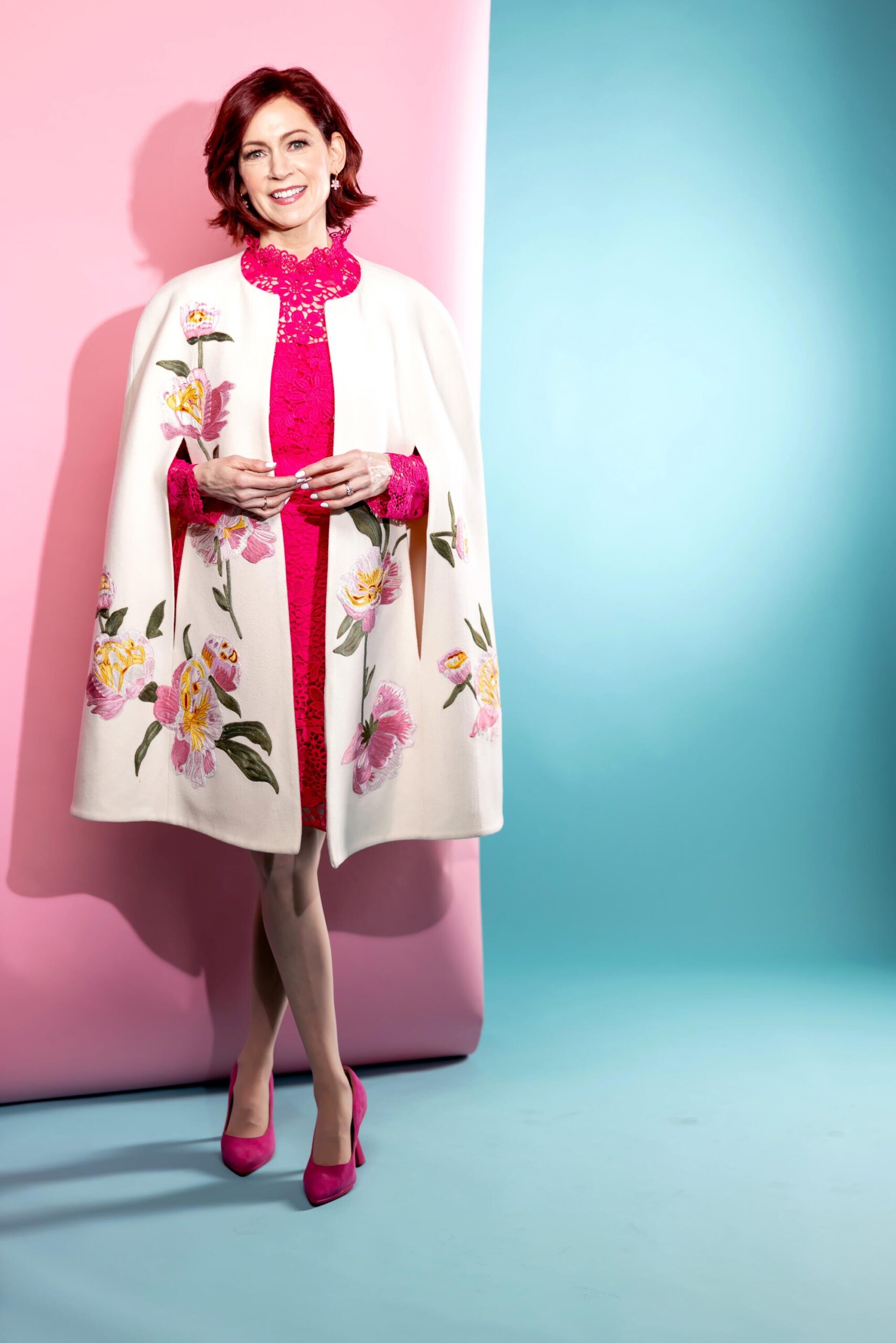
Carrie Preston on ‘Elsbeth’ guest stars, Season 4 plans and more
In this week’s episode of The Envelope podcast, we kick off Emmy season with Carrie Preston, who plays an offbeat investigator in Robert and Michelle King’s “Columbo”-inspired comedy “Elsbeth.”
Kelvin Washington: Welcome back to The Envelope. I’m Kelvin Washington, alongside the usual suspects, Yvonne Villarreal, also Mark Olsen. It’s good to have you all here. Everybody doing well?
Mark Olsen: Yeah, I’m doing great.
Yvonne Villarreal: Good to see you.
Washington: Well, first of all, I didn’t get the green [wardrobe] memo. It’s OK. Leave me out.
Villarreal: I’m trying to blend in with the chair.
Olsen: That’s why you pop
Villarreal: You do pop.
Washington: Well, you took what I was going to say. You don’t blend in. You always stand out.
Villarreal: Thank you.
Washington: That’s true. All right, so we’re kicking off Emmy season in here. And there’s obviously a million different things to have seen. We’ll start it off with Yvonne — I’ll go to you. What have you seen? Give me a couple of things that stand out to you that you’re enjoying.
Villarreal: Look, I’m always gonna mention “The Pitt.” Season 2 really captivated me. Also, there’s “Pluribus.” Can never go wrong with Rhea Seehorn. Also, one that — surprisingly for me, just given the subject matter — I really enjoyed this season, is “The Testaments.” And I think it’s because of, you know, the young cast and feeling that sense of hope that these young teenage girls are gonna get us out of this. Those are my picks so far.
Washington: Did you say that we need that?
Villarreal: We do need that.
Washington: OK, I just wanted to make sure.
Villarreal: I won’t mention reality TV, because I know it makes Mark a little…
Washington: Let’s make him a little squirmy.
Olsen: Maybe one of these days, I’ll try!
Villarreal: “One of these days”?
Washington: Twenty-five years into it.
Villarreal: “Real Housewives of Rhode Island” is all I’m going to say. I’ll just leave it there.
Olsen: Rhode Island?
Villarreal: Rhode Island.
Washington: Mark, I’ll go to you next, but just to your point there, Yvonne, I haven’t seen much of it, but I did have some guests at the morning show that I anchor from “Love on the Spectrum.”
Villarreal: Oh yeah.
Washington: Folks love that show. I mean, when I tell you that we had a couple of the guests come in and they’re walking around, people were screaming, “Can I get their picture?” So you’re talking about reality TV, just that, that’s a big one there.
Villarreal: They’re stars. And hearing who’s broken up already. I won’t spoil it, because you should watch that one.
Olsen: Wait a minute, how do people on your morning show rate “The Morning Show”?
Washington: Oh, that’s a good question. Some of the [story] lines or the feel hits a little too real, too close to home at times, that’s for sure. But I think it’s run its course a little bit as far as the watercooler [chatter] around the job a little. You know, it’s had some seasons here. But there are some things that, you know, some us look at each other like, “Clearly someone in the business is on there writing that show because that was too close to home.”
Villarreal: Lots of conniving.
Washington: But that’s all sensationalized. We’re just an ordinary morning show. None of that going on.
Villarreal: There’s no Billy Crudups out there.
Washington: Watch how I turn over here to Mark and we switch subjects. What about you, Mark? What are you watching? What do you enjoy?
Olsen: You know, it’s funny, I find as we’re in sort of like post-peak TV, I definitely find that I’m liking my TV to just feel like TV. And so I definitely like the Bill Lawrence universe, [that] kind of comfort watch — the new show “Rooster” with Steve Carell and Danielle Deadwyler, who’s just like so charming, so good on that show. I have really grown to like that show. I really enjoy the week-to-week. Even as I’ve maybe fallen off with some of his other shows, it’s funny how he’s always giving you a new show, like, “Oh I like this one!” And again [with] the week-to-week, “Oh it’s my day to watch ‘Your Friends and Neighbors’! Let me see what my good friends Jon Hamm and Olivia Munn are all up to.”
Washington: Are your neighbors like that?
Olsen: I have not had any disputes over dogs with my neighbors, no.
Washington: By the way, have you been, you mentioned Steve Carell, like he’s in his ‘zaddy’ era. It’s amazing what a beard does for a lot of people. No one ever necessarily thought of him as a heartthrob and all of a sudden I’ve heard, I’ve seen some things on Threads or whatnot, and they’re like, “Oh girl, I didn’t know Steve Carell…”
Villarreal: Some of us have known all along, OK?
Washington: I digress.
You guys mentioned a couple for me. “The Pitt” is unexpected — I was going to say every episode, really every 10 minutes. So that’s always a wild ride. And in “Paradise,” the shift from the previous season for me, because, you know, it’s not that I’m spoiling it, but just the shift into the outside and prior to, that dynamic to me was interesting. Almost like two different shows between Season 1 and Season 2. That for me is interesting to see how folks do and Sterling K. Brown, where’s he in all of this? So those are the ones that I’m looking at there.
I swing to you, [Yvonne]. You had a chance to speak with Carrie Preston, of course, in “Elsbeth.” Kind of a “Columbo”-style of a show, if you will. Tell us a little bit more about that.
Villarreal: This is the thing. We should never discount what’s happening on broadcast TV.
Washington: Good point.
Villarreal: “Elsbeth” is one of those shows that is so compelling. It really expanded, Robert and Michelle King’s “Good Wife” universe. They’ve had the spin-off, “The Good Fight,” and “Elsbeth” is in that universe, but it feels totally different. It’s this comedy procedural that follows Elsbeth, who we were introduced to as this eccentric lawyer, and in “Elsbeth” she’s moved from Chicago to New York as this NYPD consultant and de facto detective. And she has these really unconventional, unorthodox, eccentric methods to solving cases. And it’s really fun to watch and it was really fun to have this conversation with her.
Washington: All right, well, let’s get into it. Here’s Yvonne and Carrie now.

Carrie Preston, star of CBS’ “Columbo”-esque hit “Elsbeth.”
(Christina House / Los Angeles Times)
Yvonne Villarreal: I’m always very eager to talk about this character that I’ve spent 15 years tracking. You made your debut as Elsbeth Tascioni in “The Good Wife,” and she leaves a memorable impression early on, with just three minutes [of screen time]. I did time it. What do you remember about the call about this character and what [creators Robert and Michelle King] told you about who she was?
Carrie Preston: They had offered me the role, and I was working on some other things and I had just dyed my hair red, but they didn’t know this yet. And so they all knew me as a blond and I thought, “Oh my gosh, I hope they’re going to be OK with this character being a redhead because in their minds I’m not that.”
But [Robert] called and he said, “We’re thinking about this character like a female Columbo.” I didn’t really watch a lot of “Columbo,” but I understood what he meant, which was, this is a person who is going to be coming at things in an unexpected and unorthodox way and people are going to underestimate her. I took that to heart. But nonetheless, I was going in as a guest. As a guest, you’re going into somebody else’s house, you wanna follow their rules, you don’t wanna jump in their pool and start swimming around without asking permission. So I was a little tentative with it, but I took myself to the set before we started shooting just to show them, “This is what I look like now, are we still good? Because I can’t change the hair right now ’cause I’m doing this other thing.” Luckily, they were like, “Oh I think that actually works really well for the character.” And little did I know, I was gonna then be the redheaded actor for a good 16 years now, or whatever it is. I look back at that time, I was just finding my way with this character and figuring out, “How can I make her something different but not too different that I don’t fit in with the world of the show and the landscape of that universe?” And so looking back, you can see how I was tiptoeing around and it took a little moment before they really let me just let what my instincts were telling me to do, fly.
Villarreal: Because you knew she would be coming back in some capacity.
Preston: I didn’t know. I did two episodes at the end of their first season. Did not get a call at all in Season 2. And I thought, “OK, well, I guess I was a little too weird or I wasn’t really what they were thinking.” You kind of start talking to yourself and then you go, “I can’t read their minds. I’m just gonna keep doing what I’m doing.” And that was a really fun time. Then they called in Season 3 and that was when they said, “OK, we’re gonna do a little arc; we want this to flesh this character out.”
Villarreal: She went on to appear in many episodes of “The Good Wife” and also [its spin-off] “The Good Fight.” Then they have the idea during the pandemic of, “We want to do a show centered around Elsbeth.” And I imagine that’s a thrilling call to get, just like that first call that you received. As an actor in this sort of fickle industry, where you’ve put in the time, when you get a call like that from these prolific TV producers that are really respected, and they say, “We see you as being able to lead a network series.” How do you wrap your brain around that?
Preston: It was kind of a slow buildup to that because even when I was doing “The Good Wife, “ at the end of that series they were talking about, “How can we spin off the show?” And some people like yourself and people who are in the industry, fans, et cetera, were saying, “Why don’t you spin it off with Elsbeth Tascioni?” And Robert King reached out and said, “Would you be interested in this?” And so I said, “Of course, I would do anything to be be doing that.” Then I heard they’re doing this spin-off and it’s starring Christine Baranski and Rose Leslie and Cush Jumbo — pretty much everybody but me. And I was like, “OK, well, I guess that’s what they’re gonna do.” But I did reach out again and said, “I’d love to be a part of this.” And they said, “Yes, we’re definitely gonna bring you on and have you continue as a guest.” I went and did other things. I did “Claws.” I had already been working on “True Blood.” So I was doing all these other shows and thinking, “OK, I guess this is their spin-off. I’ll just be a guest again, and that’ll be that.”
And again, people would keep calling and saying, “Hey, what if you did a spin-off of the spin-off?” And still I dared not dream. It really wasn’t until 2020 that it felt like it was more plausible, possible. They were coming to the end of “The Good Fight.” They had this idea. And it seemed like a good one, and it seemed like a good business model, frankly, to have Elsbeth Tascioni, maybe one or two other series regulars, and then bring in all these amazing guests. It still took another three years before we actually did a pilot that, then, got picked up. So it was just these many, many steps before we actually got to this. So each time, I tried not to hold on to that dream too much, but at the same time, treasure every moment, even treasuring just the thought that they pitched me as the center of a show to a network that hired them to write a script. Even that, I was like, “Wow, this is incredible.” When we finished the pilot, I looked at the crew and I said, “We need to really honor this moment because this might be it. This might be the last time [I’m] ever playing this character. And we came together, and we made something really special. Whether or not it’s going to go to series, we all know we did something really wonderful.” And I burst into tears. I was so grateful for that opportunity. So every moment is a moment of gratitude and humility, to be honest.
Villarreal: Was there any part of you that thought, “I don’t know if I can do this”? Or because you were reaching for it for that length of time, when it finally happened, you’re like, “I can do this.”
Preston: There is this sense of wanting to make sure that I am doing everything I can to make this situation collaborative, to lead in a way that is not overbearing, to be a part of an ensemble, not just with the cast but with the crew. All of these things that I’ve been meditating on for decades. And I direct as well, so I know what it’s like to lead, and I’ve learned from watching really great leads, and not-so-great ones that get caught up in certain things, that rob them of an opportunity of creating something in a collective way. So I was excited to take all of these things that I’ve learned along the way and funnel them and channel them into this opportunity. Every day is a blessing, every day is challenge, and every day I feel like I do something that I know I can do better the next day. I try to meditate on that, because I want this opportunity that I’m having to be as special for the 300 people that are around me who are doing this with me. That’s really my goal.
Villarreal: In the series, obviously, we’ve come to know Elsbeth as this Chicago lawyer; here she’s a New York City police consultant. I really want to know what Elsbeth would be like in Los Angeles. What do you think that looks like?
Preston: Elsbeth finds beauty wherever she goes. I think it would be tough for her because she so likes to be right in the middle of all of humanity and [in] L.A., you’re isolated a lot in your cars — having to kind of keep yourself sequestered from other people just because that’s how people get around. I bet she’d be on the subway, she’d be on transit, she’d be on buses, she‘d be out in the malls, she would be out on the beaches, meeting people, talking to people, learning about Venice Beach as compared to Sherman Oaks. She would be all about finding all the different vibes and how she fits in.
Villarreal: You’re known for being a scene-stealer supporting player. This role in particular sort of encapsulates that. Is playing a lead rather than a supporting player a particular kind of challenge? Do you have to learn how to have your character take up space differently?
Preston: I approach it the same way that I approach anything I do as a co-star, a supporting actor, a guest star, whatever. I’m there to serve the script and to work with the people who are around me to elevate a scene and make it work. And to make the the job of everyone around me easy. I really feel like when you come at it with that collaborative spirit, you don’t think about, “Oh, I’m the lead.” You don’t think about where you fall into that hierarchy. You’re just there to make the scene work. And I like that. Because then I don’t feel pressure to be something more than what that is. You’re building a house every day, and you’ve got to start with foundation and then move all the way up. You can’t just come in and the house is already built. That takes more than one person. And I like that, and I feel like Elsbeth is like that too. She’s very much about the other person. For me, if you’re ever stuck in an acting scene and you don’t know what you’re doing, you need to just focus on the other person, and then all of that other stuff starts taking care of itself. What does this person need? What am I giving this person? What am trying to get from this person? Just all the like the basic building blocks of acting and then you can get out of your own head and let the choices happen.
Villarreal: Something that’s so striking about the character is her physicality. She sort of darts into frame, or she’s crouching, even the movement of her hands as she’s reenacting what might have happened. What was that like, finding the movement of Elsbeth?
Preston: It started from the beginning. The scripts, at the beginning, would write in these pauses. They would just say “pause” in the middle of a sentence. And I was like, “Huh, what is that?” That became the most fascinating thing to me. “What’s happening there? What’s happening with this woman when she’s not speaking?” And, so, that’s where the physical stuff started coming. And in “The Good Wife” and “The Good Fight,” there was a little bit of an evolution of that. The tote bags were brought in very early on by Brooke Kennedy, who was the producing director and one of the main directors on “The Good Wife.” She said, “I want her to always have something going on.” And I was like, “Great, I love that.” That’s a gift for an actor. I’m someone who, if you give me a prop, I’m gonna do something with it. I just like that. It’s fun. I’ve trained for the theater. So I love that idea. There’s a term that sometimes we use — I don’t know if it’s OK to say it — but sometimes we call each other “props-titutes.” If you get a prop, you can’t help it; you’re gonna have to do a thing with a thing. And so the bags and all that stuff — I started thinking, “Oh, I guess [with] this woman, her mouth is saying one thing, her mind is thinking another and her body’s doing a third thing.” As soon as I came up with that little weird math equation, things started locking into place.
Robert King directed the pilot. He created the show with Michelle King. Robert loves any kind of physical comedy. Marx Brothers, Three Stooges, Lucille Ball, all of that stuff. He just loves it. He worships that stuff. We were doing a scene and he said, “I don’t want you to just walk up. Let’s have you like lean in like Charlie Chaplin or something.” And I was like, “Great!” So he had me lean into frame and wouldn’t you know, that just became then the signature thing for this new iteration of this character. And it became kind of a metaphor for the whole show. This woman is not ever gonna approach things straight. She’s always gonna approach things at an angle. That’s another fun, creative thing that you can run with. Then the writers and the directors and the other actors, we all just started playing with that. And I have to do these scenes where I sum up the entire crime. Sometimes it’s like a five-page monologue. Well, you don’t have that much time to memorize that stuff because you get the script and I’m learning 50 pages of dialogue every eight or 10 days. So the physicality helps me remember it. And I imagine it helps Elsbeth piece it together.
Villarreal: Are you like at home just [mimics exaggerated movements]?
Preston: Yes, I’m coming up with things.
Villarreal: Is Michael [Emerson, the actor], your husband, like, “What’s going on here?”
Preston: He lets me do my thing. What I’ll say to him is, “I’m gonna go close the door and talk to myself for a while.” And he’ll go, “OK.” I learn my lines by myself. I record my own cue lines. It all has to happen alone. Because I know I have to go back over and over and over again. And when somebody is running lines with me, I’m very concerned about how bored they must be. So I just have to do all that on my own. The funny thing is I learn my lines a lot when I’m on the train. I go back and forth between New York City and the Hudson Valley a lot. It’s like an hour and 20 minutes. So the people on those trains are seeing this crazy lady, because I’ve got my ear things in and I’m looking at my [script].
Villarreal: Do you have your own bags?
Preston: I’ve go my own bags, and I am sure if they don’t recognize me as Elsbeth, they just think I’m another insane person who lives in New York City and no one cares. The kooky redheaded lady on the train.
Villarreal: Let’s talk about that other element that’s so crucial to Elsbeth, which is the hair and the wardrobe. You talked earlier about how you dyed your hair for another role, and you didn’t know you’d be locked in for this long with it, but it’s such a feature of her. Obviously we’ve seen her wear wigs in the show.
Preston: Which was fun, to go back to my original blond look.
Villarreal: And you mentioned Lucy earlier, Elsbeth in the tutu this season was so, so good —
Preston: One of the best compliments that Jon Tolins, our showrunner, ever gave me was when he saw the dailies from that day of the tutu and dancing with the little 6-year-olds. Oh, my God, I was in heaven. He just wrote, “Lucy level.” And I was like [playfully belts a note], “This is a dream.” Because I decided this woman would really want to be trying to do her absolute best. She would really be wanting to try to dance the best way that she knew how, but her body doesn’t know how to do that. But her mind wants to. Plus, I like to entertain the crew. They often don’t laugh because the crew has seen everything and they’ve seen me do a million things. But if I can get them to laugh, that’s a win.
Villarreal: Her style is so intriguing — sometimes I’m like, this is what “And Just Like That” should have had, some of these wardrobe pieces.
Preston: Well, that’s Dan Lawson, our costume designer.
Villarreal: What does that do for you? And please tell me there is a bag closet. I’m obsessed with the bags.
Preston: Oh yes. If you were to walk into the costume shop and see my section, it’s like a circus had a party under a rainbow. There’s four or five racks of clothes, and they go on what seems like a mile. And then there’s [a] whole wall of the totes. And Dan finds special totes that he’ll shop for, but then he also has some of the totes made because he wants them — we decided early on it would be totes, of course, but like after the opera episode, she would then have an opera tote. We had to make very specific totes that would do callbacks to previous cases and things like that. Dan thinks about everything.
Villarreal: Do they put things in the totes?
Preston: They do, but early on there were a lot of things in the totes, and I was starting to have to go to physical therapy because people don’t understand when you’re working on a scene, it takes six hours to shoot a scene, and if I’m coming running in with totes on my shoulders a hundred times it’s gonna take a toll on my body.
Villarreal: But you also need things in them so they don’t fall down easily.
Preston: Carol [McLennan], who’s my on-set costumer, she’s constantly putting top sticks so that they’ll stay. She’s finding creative ways to safety-pin them on. The continuity of the bags, you have to make sure that they’re exactly the way they were for every take. It’s like I have a child — three children, my totes.
Villarreal: Such a feature of the show is obviously the sort of revolving door of guest stars. This season you’ve had Stephen Colbert, Griffin Dunne, Beanie Feldstein and Patti LuPone, who was in the finale. Are you ever just lost in the fact that you’re acting opposite these people? Is there a moment that stands out from that?
Preston: Dianne Wiest. I’m a huge, lifelong fan of Dianne Wiest, like top five. And when I found out she was gonna be in the episode where she plays a nun, a murderous nun, I just thought, “I’m not gonna be able to contain myself.” I usually reach out to everybody before to send them an email or a text or something and just tell them how thrilled I am that they’ve said yes. So I wrote her a thank-you for saying yes/stalker-level fan email. And she wrote back. And she’s like, “Oh, Carrie, I’m so happy to hear that.” It was just like, “Oh, my God, I could just hear her voice.” When she showed up — I mean, she’s Dianne Wiest. And she is wearing a nun’s habit, and I couldn’t stop staring at her face. She would catch me staring at her and then she would just smile, with that sweet gorgeous face of hers and I would say, “I’m sorry, I’m sorry. I know that it’s probably making you uncomfortable. I just am absolutely honored. I do not even understand how I got to be so lucky to have someone like you doing this.” And you could say that for every single person on the show. I fangirl on them in the way that the character fangirls on Diane Lockhart. You know what I mean? The same little spirit lives inside me that is Elsbeth. I have wonder and appreciation. And it’s become more infectious. She has become more infectious the more I play her.
Villarreal: There was the moment where, in the Griffin Dunne episode, where he’s threatening towards her. I’m trying to remember if there’s been a moment like that where I felt threatened for your character. What was that like filming with him?
Preston: It was wonderful. Robin Givens, who was our director, [and] who, as we know, is an actor as well, she was really directing us to reach a pretty scary place. I like it when our show gets scary like that because we have to remember that she’s hanging out one-on-one with murderers. She’s going into their space. And as unthreatening as she is, that in and of itself is threatening. And we need to remind the audience of that from time to time. She pushes buttons because she’s trying to get them to admit something, or she’s pinning the fly to the bulletin board and watching it squirm. And this one, I realized as I was playing it, I was like, “I’ve got to play up the flirtatious side because that’s what he gets really guarded about, the fact that he’s a womanizer. So if I play that up, it’s gonna infuriate him.” And so he backs me up, and then we realize there’s no way out. It’s great, but it’s scary. But she knows that he’s not gonna do anything to her because he still thinks he’s gonna get away with murder. But we added this one [look], and I wanted to make sure [it was kept]. I said, “Please, Robin, please don’t let them cut this.” I look back at him at the very end going, “Gotcha. I got you just where I wanted you. You fell into my trap.” And they kept that in the cut. I was very happy about that because we build these things together, and sometimes they just have to cut them for time. But they didn’t.
Villarreal: Because you’re also thinking with your director’s hat. And I know it must be hard to even think about whether you can direct an episode of “Elsbeth.” But is that something on your bucket list? Or would it just be too difficult to manage?
Preston: I love this job so much. This is the dream job, and I want to make sure that I am doing everything I can to do that in the best way that I can, every day. And I do feel like having directed myself before in the past, in things where I was just a part of the ensemble, the way I choose to direct, I found that I was shortchanging the acting a little bit. I don’t want to do that on this show. I do think it would cost the crew to have me do both things, and I care about them so much. I don’t have to prove that I can do both. The one thing I could do is direct the first episode of the season because I would be able to prep. Otherwise I wouldn’t be able to prepare. I feel like I trust our directors. I love our writers. I love our crew and I love how things are going.
Villarreal: We know Elsbeth as this person with a keen ability to read people, who can sniff out liars, murderers. What was so interesting this season was to see her vulnerable side in her personal life. And see that she has her blind spots too. Were you excited when you saw that they were going to explore this side of her? And what was that like to play?
Preston: I think it’s always a good thing to deepen the character as you go along because, you know, we’re a police procedural; we have to figure out how to put a crime each episode, just structurally. But we want texture to the character, and having that vulnerable side really gave us that. As an actor, if you can find the drama in the comedy, it makes the comedy stronger, and vice versa. It was a wonderful way to stretch myself as an actor. It’s important to always show the heart of a character that you’re playing. The more specific you are, the more universal it is. And I think people can relate to her in that way. Everybody has felt heartbreak or confusion or duped or confused or distrustful of their own intuition and all of that stuff. And so the complexity of that was, of course, great to play.
Villarreal: Are you, Carrie, as perceptive as Elsbeth?
Preston: I do have a little bit of an empath in me. I do feel like I can read a room really quickly and I can kind of tell what people are thinking or what people are feeling. A vibe. I don’t know what it is, but it’s an empathic kind of nature. I have way more boundaries than I think Elsbeth does, but I’m not nearly as brilliant as that woman. I don’t know how many people in the world are. That’s what makes her so special. But I key into that side of her and I can relate to it.
Villarreal: Final question for you. The show will return for a fourth season. What do you want to see from Elsbeth? Who’s your dream guest star? It must shift because you guys are getting everybody.
Preston: We’re getting wonderful people who are interested in the show and I’m so proud of that and I know Jon is too. Jon Tolins is our showrunner. We’ve really, both of us, made it our personal missions to create an environment — and he creates scripts — that people want to come and participate in, and a welcoming place where somebody gets to play a delicious character for eight or nine days and then go on with their busy careers. I never would have dreamed that, for example, Steve Buscemi would have wanted to be on a show like “Elsbeth,” but he did and he asked to be on it. That blew our minds and it still is blowing our minds. So I could not even dream of most of the people that have come on. That said, you know, I’ve said this before, I’m a huge Meryl Streep fan. I would love for her to come on. We think often about, maybe we should see a parent of Elsbeth, a mother maybe. So we play around with different ideas for that, and that would be nice to see because we’ve seen Elsbeth as a mother, but we haven’t seen her as a daughter. We’ve seen her as a friend but we haven’t seen deep into her her origin story. So I think that could be a fun thing to tap in Season 4. But I trust Jon and the writers.
Villarreal: I want Diane Lockhart to stop by.
Preston: I know, wouldn’t that be great? Or Alicia. But I don’t know. We got Sarah Steele who played Marissa [in “The Good Wife” and “The Good Fight.”] That was amazing. But like Michelle King was saying in an interview [for an L.A. Times’ Screen Gab event] yesterday, this show has kind of found its own place separate from that universe. It’s nice if we have people from that universe pop in, but it’s not required. And a lot of our fans never even watched those shows. So that speaks to what Jon and the writers are doing and what we’re, as a collective, bringing to the audience.
Villarreal: Thank you so much for being here. I, for one, can’t wait to see what the bag selection is like in Season 4.
Preston: Me too.