U.S. pressures Uruguay to break trade ties with China, minister says

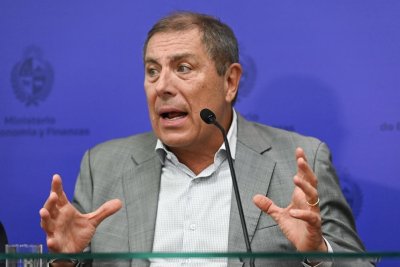
Uruguay’s Minister of Economy and Finance Gabriel Oddone said the pressure by the United States to break trade ties with China is applied daily and channeled through different areas of the bilateral relationship. File Photo by Federico Gutierrez/EPA
March 27 (UPI) — Uruguayan Minister of Economy and Finance Gabriel Oddone said the United States is exerting “unimaginable” and “unsustainable” pressure on his South American country to break its trade relationship with China, according to remarks made at a private meeting.
The comments during a session with business leaders were reported by the local weekly Búsqueda.
With about 3.5 million inhabitants and a territory comparable to the state of Florida, Uruguay has had China as its main trading partner for more than 14 years, accounting for about 26% of its exports.
Oddone said the pressure is applied daily and channeled through different areas of the bilateral relationship.
According to attendees at the meeting with the Confederation of Business Chambers, the minister said that if Uruguay does not comply with Washington’s demands, its trade relationship with the administration of President Donald Trump “will not improve and could get worse.”
The remarks came Tuesday during a meeting at the Technological Laboratory of Uruguay, attended by more than 20 business representatives, along with the director of the Office of Planning and Budget, Rodrigo Arim.
The meeting lasted more than two hours and addressed economic and trade issues in a context described as “very complex.”
China is the main destination for key exports, such as beef, soybeans and cellulose. The pressure from the United States comes amid growing geopolitical rivalry between Washington and Beijing, which is affecting countries with trade ties to both powers.
According to attendees cited by Búsqueda, Oddone acknowledged that the government has “little room for maneuver” due to the fiscal situation inherited from the previous administration and internal differences within the ruling coalition over advancing economic reforms.
On the domestic front, the minister defended the country’s economic performance despite lower-than-expected growth.
Uruguay’s gross domestic product grew 1.8% in 2025, below the official projection of 2.6%, while analysts have already cut expectations for 2026 to around 1.6%.
Facing criticism from the private sector over the size and slow pace of the state, Oddone urged business leaders to also consider positive aspects.
“We should not only see the glass as half-empty,” he said, noting that the economy continues to grow despite an adverse international environment in which Uruguay is “swimming in dulce de leche,” a colloquial phrase interpreted as meaning it is difficult to move quickly.
The minister also ruled out improving competitiveness through a depreciation of the exchange rate.
“Uruguay is not going to become a cheap country,” he said, adding that improvements will come from microeconomic changes to reduce costs and streamline foreign trade.
Asked by Búsqueda, the minister declined to comment publicly on the meeting, as it was a private event. Some participants described it as useful, but with “mixed” feelings, while others said they valued explanations from the economic team.
At the close, Oddone adopted an optimistic tone.
“Believe me, we will do well,” he said, highlighting the country’s institutional and economic strengths to face an international scenario marked by trade tensions and regional slowdown.